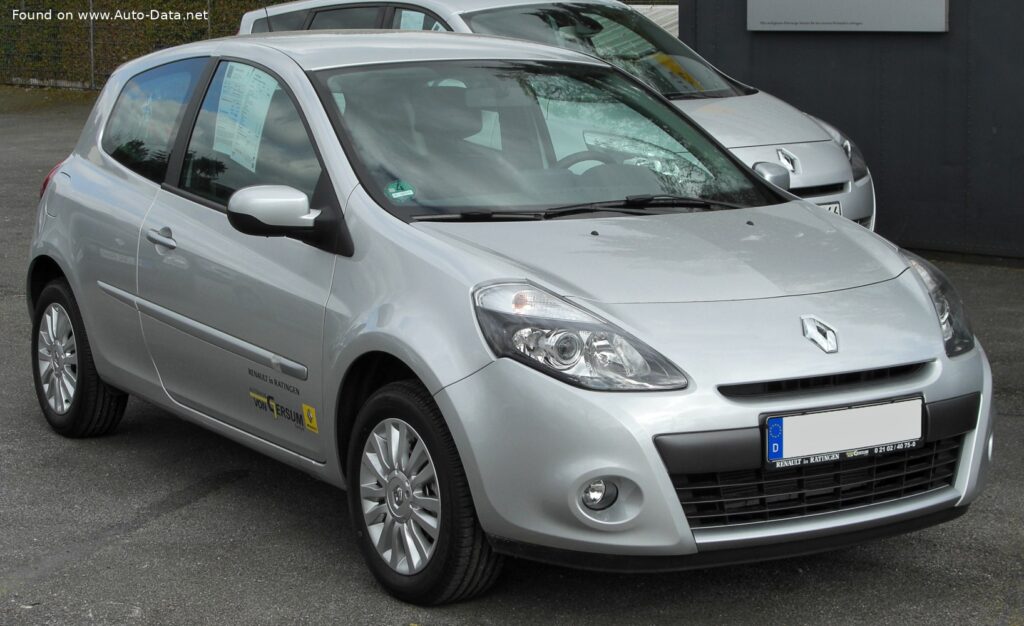
Introduction to the Renault Clio III (Phase II, 2009) 3-door 1.5 dCi (68 Hp)
The Renault Clio, a nameplate synonymous with the European supermini segment, entered its third generation in 2005, quickly establishing itself as a formidable contender. The model under scrutiny, the Renault Clio III (Phase II, 2009) 3-door, represents a mid-cycle refresh that introduced subtle yet significant updates to design, technology, and powertrain options. Launched in May 2009, this particular variant, equipped with the 1.5 dCi (68 Hp) diesel engine, was positioned as an economical and practical choice for urban dwellers and those prioritizing fuel efficiency across Europe.
While never officially sold in the United States market, the Renault Clio has consistently been a top-seller in its primary European strongholds, praised for its blend of style, comfort, and dynamic handling. The Phase II update aimed to keep the Clio competitive against a rapidly evolving field of rivals, solidifying its reputation for offering a sophisticated driving experience in a compact package. This specific 3-door hatchback configuration, powered by a modest but highly efficient diesel engine, exemplified the pragmatic automotive choices prevalent in Europe during the late 2000s, where fuel costs and emissions standards played a crucial role in purchasing decisions.
Engine & Performance: The Efficient 1.5 dCi Powertrain
At the heart of the Renault Clio III (Phase II, 2009) 3-door lies Renault’s ubiquitous 1.5-liter dCi (diesel Commonrail injection) engine, specifically the 68 horsepower variant (K9K 714 or K9K 768 code). This inline four-cylinder unit, with an engine displacement of 1461 cm³ (89.16 cu. in.), was engineered for impressive fuel economy and low emissions, rather than outright speed. It delivered a modest 68 Hp at 4000 rpm, translating to a power-per-liter figure of 46.5 Hp/l.
Despite the lower horsepower, the engine’s real strength lay in its torque delivery. It produced 160 Nm (118.01 lb.-ft.) of torque at a low 1700 rpm, a characteristic that made it feel surprisingly spry in city traffic and provided adequate pulling power for its size. This low-end torque, coupled with a standard 5-speed manual transmission, allowed for relaxed cruising and reduced the need for frequent gear changes. The engine utilized a turbocharger with an intercooler and a Diesel Commonrail fuel injection system, contributing to its efficiency and responsiveness.
Performance figures reflected its economical focus: acceleration from 0 to 60 mph was achieved in a calculated 14.4 seconds, with 0-100 km/h taking 15.2 seconds. The maximum speed was 162 km/h (100.66 mph). However, its fuel efficiency was truly remarkable for its time, with a combined NEDC rating of 4.5 l/100 km, equivalent to an outstanding 52.3 US mpg. This efficiency was further highlighted by its low CO2 emissions of 120 g/km, meeting the Euro 4 emission standard, making it a highly attractive option for environmentally conscious European drivers facing strict regulations and high fuel prices. The powertrain architecture featured a front, transverse engine layout driving the front wheels, a typical and effective setup for a compact hatchback.
Design & Features: Practicality and Refinement in a Compact Form
The Clio III (Phase II) retained the core design language of its pre-facelift predecessor but introduced several refinements to enhance its appeal. The 3-door hatchback body type offered a sporty silhouette, appealing to younger buyers or those who didn’t require the added practicality of rear doors. With a length of 4032 mm (158.74 in.) and a width of 1720 mm (67.72 in.), the Clio III was a relatively substantial supermini for its generation, contributing to a more planted road presence and improved interior space compared to earlier models.
Inside, the Clio III provided seating for five occupants, though the rear bench in the 3-door model was naturally less accessible. The cabin was designed with user-friendliness in mind, featuring clear instrumentation and ergonomic controls. Trunk space was practical for its class, offering 288 liters (10.17 cu. ft.) with the rear seats up, expanding significantly to 1038 liters (36.66 cu. ft.) when the rear seats were folded down, demonstrating its versatility for cargo.
Suspension-wise, the Clio III utilized an independent McPherson strut setup with coil springs and an anti-roll bar at the front, providing a comfortable and predictable ride. The rear featured a coil spring torsion beam, a cost-effective and space-efficient solution common in this segment. Braking was handled by ventilated discs (260×22 mm) at the front and solid discs (240×8 mm) at the rear, complemented by an Anti-lock Braking System (ABS) for enhanced safety. The car featured electric power steering with a rack and pinion system, offering light and precise control, particularly beneficial for urban maneuvering. Standard tire sizes ranged from 185/60 R15 to 195/50 R16, mounted on 6J x 15 or 6.5J x 16 wheel rims, respectively.
Technical Specifications
| Category | Specification | US Equivalent |
|---|---|---|
| Brand | Renault | |
| Model | Clio | |
| Generation | Clio III (Phase II, 2009) 3-door | |
| Type (Engine) | 1.5 dCi (68 Hp) | |
| Start of Production | May, 2009 | |
| End of Production | October, 2010 | |
| Powertrain Architecture | Internal Combustion engine | |
| Body type | Hatchback | |
| Seats | 5 | |
| Doors | 3 | |
| Performance Specs | ||
| Fuel consumption (economy) – urban (NEDC) | 5.3 l/100 km | 44.4 US mpg |
| Fuel consumption (economy) – extra urban (NEDC) | 4.1 l/100 km | 57.4 US mpg |
| Fuel consumption (economy) – combined (NEDC) | 4.5 l/100 km | 52.3 US mpg |
| CO2 emissions (NEDC) | 120 g/km | |
| Fuel Type | Diesel | |
| Acceleration 0 – 60 mph (Calculated) | 14.4 sec | |
| Acceleration 0 – 100 km/h | 15.2 sec | |
| Maximum speed | 162 km/h | 100.66 mph |
| Emission standard | Euro 4 | |
| Weight-to-power ratio | 17 kg/Hp | 58.9 Hp/tonne |
| Weight-to-torque ratio | 7.2 kg/Nm | 138.5 Nm/tonne |
| Engine Specs | ||
| Power | 68 Hp @ 4000 rpm | |
| Power per litre | 46.5 Hp/l | |
| Torque | 160 Nm @ 1700 rpm | 118.01 lb.-ft. @ 1700 rpm |
| Engine layout | Front, Transverse | |
| Engine Model/Code | K9K 714, K9K 768 | |
| Engine displacement | 1461 cm³ | 89.16 cu. in. |
| Number of cylinders | 4 | |
| Engine configuration | Inline | |
| Cylinder Bore | 76 mm | 2.99 in. |
| Piston Stroke | 80.5 mm | 3.17 in. |
| Compression ratio | 17.9:1 | |
| Number of valves per cylinder | 2 | |
| Fuel injection system | Diesel Commonrail | |
| Engine aspiration | Turbocharger, Intercooler | |
| Valvetrain | SOHC | |
| Engine oil capacity | 4.5 l | 4.76 US qt |
| Coolant | 6.5 l | 6.87 US qt |
| Space, Volume and Weights | ||
| Kerb Weight | 1155 kg | 2546.34 lbs. |
| Max. weight | 1645 kg | 3626.6 lbs. |
| Max load | 490 kg | 1080.27 lbs. |
| Trunk (boot) space – minimum | 288 l | 10.17 cu. ft. |
| Trunk (boot) space – maximum | 1038 l | 36.66 cu. ft. |
| Fuel tank capacity | 55 l | 14.53 US gal |
| Max. roof load | 80 kg | 176.37 lbs. |
| Permitted trailer load with brakes (12%) | 1200 kg | 2645.55 lbs. |
| Permitted trailer load without brakes | 535 kg | 1179.47 lbs. |
| Permitted towbar download | 75 kg | 165.35 lbs. |
| Dimensions | ||
| Length | 4032 mm | 158.74 in. |
| Width | 1720 mm | 67.72 in. |
| Width including mirrors | 2025 mm | 79.72 in. |
| Height | 1497 mm | 58.94 in. |
| Wheelbase | 2575 mm | 101.38 in. |
| Front track | 1458-1472 mm | 57.4 – 57.95 in. |
| Rear (Back) track | 1450-1471 mm | 57.09 – 57.91 in. |
| Front overhang | 830 mm | 32.68 in. |
| Rear overhang | 626 mm | 24.65 in. |
| Ride height (ground clearance) | 120 mm | 4.72 in. |
| Minimum turning circle (turning diameter) | 10.7-11.3 m | 35.1 – 37.07 ft. |
| Drivetrain, Brakes and Suspension Specs | ||
| Drivetrain Architecture | The Internal combustion engine (ICE) drives the front wheels of the vehicle. | |
| Drive wheel | Front wheel drive | |
| Number of gears and type of gearbox | 5 gears, manual transmission | |
| Front suspension | Independent, type McPherson with coil spring and anti-roll bar | |
| Rear suspension | Coil spring, Torsion | |
| Front brakes | Ventilated discs, 260×22 mm | |
| Rear brakes | Disc, 240×8 mm | |
| Assisting systems | ABS (Anti-lock braking system) | |
| Steering type | Steering rack and pinion | |
| Power steering | Electric Steering | |
| Tires size | 185/60 R15; 195/50 R16 | |
| Wheel rims size | 6J x 15; 6.5J x 16 | |
Legacy & Market Impact of the Renault Clio III (Phase II, 2009) 3-door
The Renault Clio III (Phase II, 2009) 3-door, particularly with its 1.5 dCi engine, played a crucial role in maintaining Renault’s strong presence in the highly competitive European supermini market. In a segment dominated by stalwarts like the Volkswagen Polo, Ford Fiesta, and Peugeot 207, the Clio distinguished itself through a combination of stylish design, comfortable ride quality, and excellent fuel economy. Its 2009 facelift ensured it remained visually fresh and technologically relevant against newer rivals.
The 1.5 dCi engine, in its various power outputs, was a cornerstone of Renault’s strategy to meet European demand for efficient, low-emission vehicles. The 68 Hp variant, while not a performance king, was perfectly suited for the urban and extra-urban commuting typical of its target audience. It offered a compelling package for buyers prioritizing running costs and environmental responsibility, at a time when diesel engines were still widely embraced in Europe for their efficiency advantages. The Clio III’s strong sales figures across markets like France, Italy, and the UK cemented its status as a popular and trusted choice.
Beyond its immediate market performance, the Clio III contributed significantly to the evolution of the supermini class. It brought a level of refinement, safety, and available features often associated with larger cars, pushing the boundaries of what consumers expected from a compact vehicle. The platform it rode on, shared with the Nissan Micra and Modus, underscored the benefits of alliance engineering, allowing for robust chassis dynamics and a comfortable cabin environment. Its legacy is one of a well-rounded, dependable, and highly efficient vehicle that successfully navigated the demands of the European automotive landscape during a period of increasing focus on fuel efficiency and emissions. The Renault Clio III (Phase II, 2009) 3-door continues to be remembered as a practical and well-engineered example of a successful European compact car.