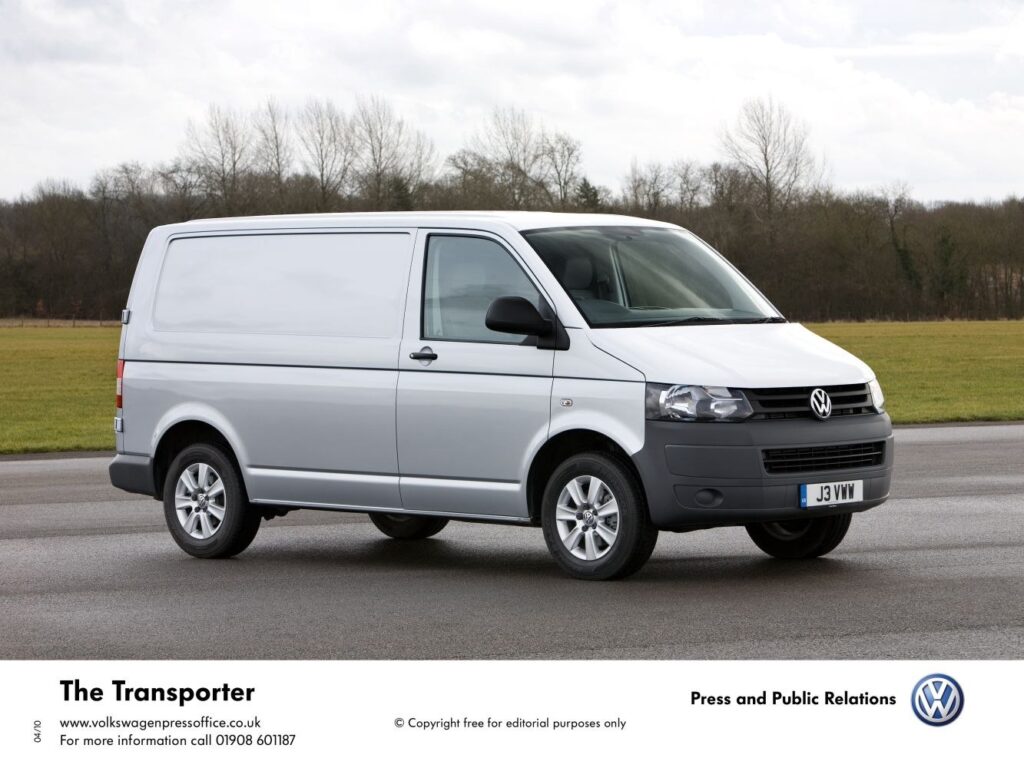
Volkswagen Transporter (T5, facelift 2009) Panel Van 2.0 TDI (84 Hp) L1H2
The Volkswagen Transporter, a name synonymous with versatility and reliability in the light commercial vehicle (LCV) segment, has been a cornerstone of Volkswagen’s global product lineup for decades. The T5 generation, introduced in 2003, represented a significant evolution in design, technology, and capability. The subject of this article is the facelifted T5, specifically the Volkswagen Transporter (T5, facelift 2009) Panel Van 2.0 TDI (84 Hp) L1H2, produced from 2009 to 2015. This particular variant, a panel van with the 2.0-liter TDI engine producing 84 horsepower, and designated as L1H2 (indicating a standard length and medium roof height), played a crucial role as an economical and practical workhorse primarily in European and other international markets where the Transporter has a strong legacy. While the Transporter series, including its passenger van derivatives like the Multivan and Caravelle, is globally recognized, this commercial panel van was not typically offered in the United States, where Volkswagen’s commercial vehicle strategy differs significantly, focusing instead on larger vans like the Crafter or rebadged models.
Engine and Performance of the Volkswagen Transporter (T5, facelift 2009) Panel Van
At the heart of this specific Transporter T5 facelift model is Volkswagen’s venerable 2.0-liter (1968 cm3 or 120.09 cu. in.) TDI diesel engine, identified by the EA189 / CAAA code. This inline four-cylinder unit, featuring a DOHC valvetrain, common-rail fuel injection, and aided by a turbocharger and intercooler, was engineered for efficiency and durability rather than outright speed. It delivered a modest but effective 84 horsepower at 3500 rpm, paired with a robust 220 Nm (162.26 lb.-ft.) of torque available across a broad range from 1250 to 2500 rpm. This low-end torque was crucial for a commercial vehicle designed to haul goods, providing ample pulling power even when fully loaded.
Power was sent to the front wheels via a 5-speed manual transmission, a setup chosen for its reliability and cost-effectiveness. While not a speed demon, the Transporter 2.0 TDI (84 Hp) L1H2 was more than capable of its intended tasks. Acceleration from 0 to 60 mph was achieved in approximately 18.8 seconds, with a top speed of 88.23 mph (142 km/h). These figures underscore its role as a functional utility vehicle, optimized for urban and regional deliveries where efficiency and payload capacity take precedence over high-performance metrics.
Fuel economy was a key selling point for this diesel powertrain, meeting the Euro 5 emission standard. The combined fuel consumption (NEDC) was rated at 7.2-7.5 liters per 100 km, translating to an impressive 32.7 – 31.4 US mpg. Urban driving saw figures of 25 – 24.2 US mpg, while extra-urban cruising improved to 39.2 – 37.3 US mpg. CO2 emissions ranged from 190-198 g/km, reflecting Volkswagen’s commitment to producing relatively clean diesel engines for its time, further enhanced by the inclusion of a particulate filter.
Design and Features
The Volkswagen Transporter (T5, facelift 2009) Panel Van is a study in functional design. As a panel van, its primary purpose is cargo transport, and the L1H2 designation is critical here. L1 denotes the shortest wheelbase and overall length variant available for the T5, while H2 signifies the medium roof height. This configuration offered a practical balance between maneuverability in urban environments and substantial cargo volume. The body type features 4-5 doors, typically including a sliding side door for easy access to the cargo area, and 2-3 seats in the cabin, allowing for a driver and one or two passengers.
The exterior design of the facelifted T5 introduced updated headlights, a revised grille, and a more modern bumper, aligning its aesthetics with Volkswagen’s passenger car lineup of the era. However, the core identity remained robust and utilitarian. Inside, the cabin was designed for durability and ergonomics, with hard-wearing materials and a straightforward dashboard layout. Storage compartments were strategically placed to accommodate the needs of commercial users.
With a maximum trunk (boot) space of an impressive 6700 liters (236.61 cu. ft.), the L1H2 variant provided considerable capacity for goods. Its kerb weight ranged from 3719.2 to 4636.32 lbs (1687-2103 kg), and it boasted a maximum payload capacity of 1977.55 – 2453.74 lbs (897-1113 kg), making it suitable for a wide array of commercial applications. Safety features for the period included an Anti-lock Braking System (ABS), and the vehicle was equipped with ventilated disc brakes both front and rear (308×29.5 mm front, 294×22 mm rear) for reliable stopping power. The independent McPherson strut front suspension and independent coil spring trailing arm rear suspension, coupled with hydraulic power steering, provided a stable and manageable driving experience, even under load.
Technical Specifications
| General Information | |
|---|---|
| Brand | Volkswagen |
| Model | Transporter |
| Generation | Transporter (T5, facelift 2009) Panel Van |
| Type (Engine) | 2.0 TDI (84 Hp) L1H2 |
| Start of Production | 2009 year |
| End of Production | 2015 year |
| Powertrain Architecture | Internal Combustion Engine |
| Body Type | Van |
| Seats | 2-3 |
| Doors | 4-5 |
| Performance Specs | |
| Fuel Consumption (Economy) – Urban (NEDC) | 9.4-9.7 l/100 km (25 – 24.2 US mpg) |
| Fuel Consumption (Economy) – Extra Urban (NEDC) | 6-6.3 l/100 km (39.2 – 37.3 US mpg) |
| Fuel Consumption (Economy) – Combined (NEDC) | 7.2-7.5 l/100 km (32.7 – 31.4 US mpg) |
| CO2 Emissions (NEDC) | 190-198 g/km |
| Fuel Type | Diesel |
| Acceleration 0 – 60 mph | 18.8 sec |
| Maximum Speed | 142 km/h (88.23 mph) |
| Emission Standard | Euro 5 |
| Weight-to-Power Ratio | 20.1 kg/Hp (49.8 Hp/tonne) |
| Weight-to-Torque Ratio | 7.7 kg/Nm (130.4 Nm/tonne) |
| Engine Specs | |
| Power | 84 Hp @ 3500 rpm |
| Power per Liter | 42.7 Hp/l |
| Torque | 220 Nm (162.26 lb.-ft.) @ 1250-2500 rpm |
| Engine Layout | Front, Transverse |
| Engine Model/Code | EA189 / CAAA |
| Engine Displacement | 1968 cm3 (120.09 cu. in.) |
| Number of Cylinders | 4 |
| Engine Configuration | Inline |
| Cylinder Bore | 81 mm (3.19 in.) |
| Piston Stroke | 95.5 mm (3.76 in.) |
| Compression Ratio | 16.5:1 |
| Number of Valves per Cylinder | 4 |
| Fuel Injection System | Diesel Commonrail |
| Engine Aspiration | Turbocharger, Intercooler |
| Valvetrain | DOHC |
| Engine Oil Capacity | 7 l (7.4 US qt) |
| Coolant | 11 l (11.62 US qt) |
| Engine Systems | Particulate filter |
| Space, Volume and Weights | |
| Kerb Weight | 1687-2103 kg (3719.2 – 4636.32 lbs.) |
| Max. Weight | 2800-3000 kg (6172.94 – 6613.87 lbs.) |
| Max Load | 897-1113 kg (1977.55 – 2453.74 lbs.) |
| Trunk (Boot) Space – Maximum | 6700 l (236.61 cu. ft.) |
| Fuel Tank Capacity | 80 l (21.13 US gal) |
| Permitted Trailer Load with Brakes (12%) | 2200 kg (4850.17 lbs.) |
| Permitted Trailer Load without Brakes | 750 kg (1653.47 lbs.) |
| Permitted Towbar Download | 100 kg (220.46 lbs.) |
| Dimensions | |
| Length | 4892 mm (192.6 in.) |
| Width | 1904 mm (74.96 in.) |
| Width Including Mirrors | 2283 mm (89.88 in.) |
| Height | 2176 mm (85.67 in.) |
| Wheelbase | 3000 mm (118.11 in.) |
| Front Overhang | 896 mm (35.28 in.) |
| Rear Overhang | 996 mm (39.21 in.) |
| Ride Height (Ground Clearance) | 201 mm (7.91 in.) |
| Minimum Turning Circle (Turning Diameter) | 11.9 m (39.04 ft.) |
| Approach Angle | 21° |
| Departure Angle | 17° |
| Ramp-over (Brakeover) Angle | 14° |
| Wading Depth | 300 mm (11.81 in.) |
| Drivetrain, Brakes and Suspension Specs | |
| Drivetrain Architecture | Front-wheel drive (ICE drives front wheels) |
| Drive Wheel | Front wheel drive |
| Number of Gears and Type of Gearbox | 5 gears, manual transmission |
| Front Suspension | Independent, McPherson with coil spring and anti-roll bar |
| Rear Suspension | Independent coil spring, Transverse stabilizer, Trailing arm |
| Front Brakes | Ventilated discs, 308×29.5 mm |
| Rear Brakes | Ventilated discs, 294×22 mm |
| Assisting Systems | ABS (Anti-lock braking system) |
| Steering Type | Steering rack and pinion |
| Power Steering | Hydraulic Steering |
| Tires Size | 215/65 R16 |
| Wheel Rims Size | 6.5J x 16 |
Legacy and Market Impact
The Volkswagen Transporter series, often affectionately known as the “Bus” or “Microbus” in its passenger variants, has a storied history dating back to the T1 in the 1950s. The T5 generation, and particularly its facelifted version from 2009, continued this legacy of robust, versatile, and dependable commercial vehicles. While the Transporter has never been a mainstream offering in the United States in its panel van configuration, its impact across Europe, the UK, Australia, and various Asian markets has been profound.
In these regions, the Transporter T5 facelift, especially in its 2.0 TDI (84 Hp) L1H2 panel van guise, was a cornerstone for small businesses, tradespeople, and logistics companies. Its reputation for reliability, relatively low running costs, and strong residual values made it a highly attractive proposition. The modest 84 horsepower engine, while not designed for speed, was perfectly suited for the demands of urban deliveries and regional transport, offering excellent fuel economy and sufficient torque for heavy loads. Its compact L1 length combined with the H2 medium roof provided a sweet spot for cargo capacity without sacrificing too much maneuverability in congested city environments.
The Transporter T5 faced stiff competition in its segment from rivals such as the Ford Transit Custom, Mercedes-Benz Vito, Renault Trafic, and Opel/Vauxhall Vivaro. However, Volkswagen’s strong brand identity, extensive dealer network, and the Transporter’s proven track record allowed it to maintain a significant market share. Its adaptability was also a key factor; the T5 platform served as a base for a multitude of configurations, from basic panel vans to luxury passenger shuttles, campers, and specialized utility vehicles, showcasing its engineering versatility.
The 2009 facelift ensured the T5 remained competitive in terms of design and technology through the mid-2010s, bridging the gap until the introduction of the T6 generation. Its enduring appeal lies in its no-nonsense approach to commercial transport: a durable chassis, an efficient powertrain, and a practical, spacious cargo area. The Volkswagen Transporter T5 facelift Panel Van 2.0 TDI (84 Hp) L1H2 stands as a testament to Volkswagen’s expertise in creating work vehicles that seamlessly blend utility, economy, and everyday usability, cementing its place as an icon in the global LCV landscape.