Peugeot 207 CC (facelift 2009) 1.6 HDi (112 Hp): A European Open-Top Diesel Compact
The Peugeot 207 CC (facelift 2009) 1.6 HDi (112 Hp) represents a significant iteration of Peugeot’s popular compact coupe-cabriolet, a segment where the French automaker pioneered with its predecessor, the 206 CC. Introduced as part of the 207 CC’s mid-cycle refresh in 2009, this particular variant combined the allure of open-top motoring with the exceptional fuel efficiency and torque of a modern diesel engine. Primarily targeted at the European market, where diesel powertrains and compact dimensions are highly valued, the 207 CC (facelift 2009) offered a blend of style, practicality, and economical performance in a 2-door, 4-seat package. Its retractable hardtop roof, a hallmark of Peugeot’s “CC” (Coupe-Cabriolet) philosophy, allowed drivers to transform the car from a secure coupe into an exhilarating convertible at the touch of a button, making it a versatile choice for a wide range of climates and preferences.
Engine & Performance of the Peugeot 207 CC (facelift 2009) 1.6 HDi (112 Hp)
At the heart of this particular Peugeot 207 CC (facelift 2009) 1.6 HDi (112 Hp) variant lies Peugeot’s renowned 1.6-liter HDi (High-Pressure Direct Injection) diesel engine, an inline-four configuration designed for both efficiency and robust performance. This powerplant, identified by the engine code 9HR DV6C, delivers a respectable 112 horsepower at 3600 rpm, translating to a power-per-liter ratio of 71.8 Hp/l. More importantly for a diesel, it produces a substantial 199.14 lb.-ft. (270 Nm) of torque, available from a low 1750 rpm. This characteristic low-end torque is crucial for responsive acceleration and relaxed cruising, especially considering the vehicle’s curb weight of 3086.47 lbs. (1400 kg).
The engine’s advanced fuel injection system, featuring common-rail technology, coupled with a turbocharger and intercooler, ensures optimal combustion and power delivery. This setup not only contributes to its lively performance but also to its impressive fuel economy. The 207 CC 1.6 HDi achieves an estimated 49 US mpg (4.8 l/100 km) in combined driving, reaching up to 57.4 US mpg (4.1 l/100 km) on the extra-urban cycle. Such figures were highly competitive and appealing to European buyers facing higher fuel costs. Performance-wise, the car can accelerate from 0 to 60 mph in a reasonable 11 seconds, with a top speed of 119.3 mph (192 km/h). Adhering to the Euro 5 emission standard, the vehicle also boasts relatively low CO2 emissions of 124 g/km, reflecting its commitment to environmental responsibility for its era. Power is sent to the front wheels through a precise 6-speed manual transmission, offering engaging control for the driver.
Design & Features
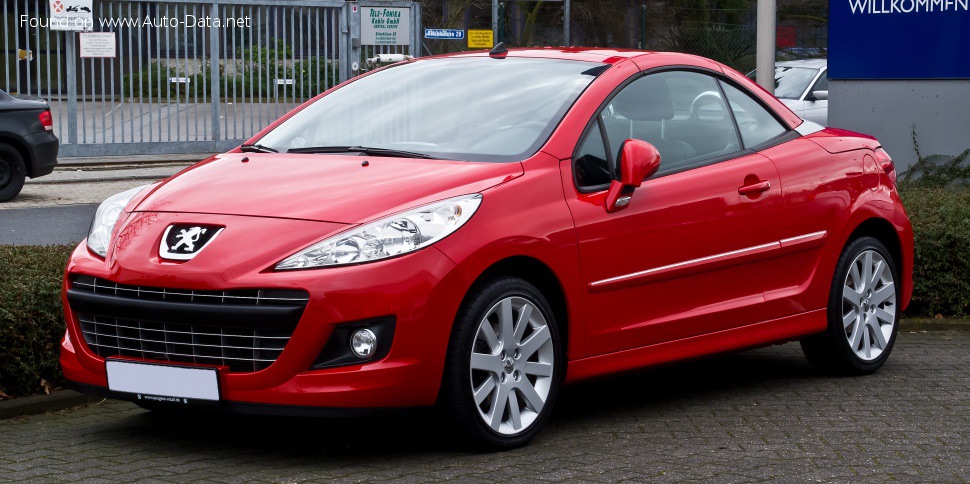
The design of the Peugeot 207 CC (facelift 2009) is a direct evolution of the 207 hatchback’s styling, adapted for its unique coupe-cabriolet form. The facelift introduced subtle refinements to the front fascia, including redesigned headlights and a more prominent grille, aligning it with Peugeot’s contemporary design language. Its defining feature remains the fully automatic, electrically operated retractable hardtop, which seamlessly tucks away into the trunk, transforming the car from a sleek coupe into an open-air convertible. This hardtop design offered superior security, noise insulation, and weather protection compared to traditional soft-top convertibles.
Measuring 159.21 inches (4044 mm) in length, 68.82 inches (1748 mm) in width, and 54.84 inches (1393 mm) in height, the 207 CC maintained compact dimensions, making it well-suited for urban environments and narrow European streets. Despite its compact footprint, it offered seating for four, though the rear seats were more suitable for children or short trips. The trunk space varied significantly depending on the roof’s position: 13.07 cu. ft. (370 liters) with the roof up, shrinking to 5.12 cu. ft. (145 liters) when the roof was stowed. Practical features included a 13.21 US gallon (50-liter) fuel tank and the option to tow up to 2358.95 lbs. (1070 kg) with brakes.
Underneath, the 207 CC utilized an independent McPherson strut front suspension and a semi-independent, coil spring rear suspension, providing a comfortable yet composed ride. Braking duties were handled by ventilated discs at the front and solid discs at the rear, augmented by an Anti-lock Braking System (ABS) for enhanced safety. The steering system was a rack and pinion type, offering direct feedback to the driver. Standard tire size was 195/55 R16, mounted on 16-inch wheel rims, balancing grip with ride comfort. The vehicle also featured a particulate filter as part of its engine systems, further reducing emissions.
Technical Specifications
| General Information | |
| Brand | Peugeot |
| Model | 207 |
| Generation | 207 CC (facelift 2009) |
| Type (Engine) | 1.6 HDi (112 Hp) |
| Start of production | 2009 year |
| End of production | 2015 year |
| Powertrain Architecture | Internal Combustion engine |
| Body type | Coupe – Cabriolet |
| Seats | 4 |
| Doors | 2 |
| Performance Specs | |
| Fuel consumption (economy) – urban | 39.2 US mpg (6 l/100 km) |
| Fuel consumption (economy) – extra urban | 57.4 US mpg (4.1 l/100 km) |
| Fuel consumption (economy) – combined | 49 US mpg (4.8 l/100 km) |
| CO2 emissions | 124 g/km |
| Fuel Type | Diesel |
| Acceleration 0 – 60 mph | 11 sec |
| Maximum speed | 119.3 mph (192 km/h) |
| Emission standard | Euro 5 |
| Weight-to-power ratio | 12.5 kg/Hp, 80 Hp/tonne |
| Weight-to-torque ratio | 5.2 kg/Nm, 192.9 Nm/tonne |
| Engine Specs | |
| Power | 112 Hp @ 3600 rpm. |
| Power per liter | 71.8 Hp/l |
| Torque | 199.14 lb.-ft. (270 Nm) @ 1750 rpm. |
| Engine layout | Front, Transverse |
| Engine Model/Code | 9HR DV6C |
| Engine displacement | 1.6 liters (1560 cm3 / 95.2 cu. in.) |
| Number of cylinders | 4 |
| Engine configuration | Inline |
| Cylinder Bore | 2.95 in. (75 mm) |
| Piston Stroke | 3.48 in. (88.3 mm) |
| Compression ratio | 17.6:1 |
| Number of valves per cylinder | 2 |
| Fuel injection system | Diesel Commonrail |
| Engine aspiration | Turbocharger, Intercooler |
| Valvetrain | SOHC |
| Engine oil capacity | 3.96 US qt (3.75 l) |
| Engine oil specification | Not specified |
| Coolant | 5.92 US qt (5.6 l) |
| Engine systems | Particulate filter |
| Space, Volume and Weights | |
| Kerb Weight | 3086.47 lbs. (1400 kg) |
| Max. weight | 3930.84 lbs. (1783 kg) |
| Max load | 844.37 lbs. (383 kg) |
| Trunk (boot) space – minimum | 5.12 cu. ft. (145 l) |
| Trunk (boot) space – maximum | 13.07 cu. ft. (370 l) |
| Fuel tank capacity | 13.21 US gal (50 l) |
| Permitted trailer load with brakes (12%) | 2358.95 lbs. (1070 kg) |
| Permitted trailer load without brakes | 1322.77 lbs. (600 kg) |
| Dimensions | |
| Length | 159.21 in. (4044 mm) |
| Width | 68.82 in. (1748 mm) |
| Width with mirrors folded | 71.57 in. (1818 mm) |
| Width including mirrors | 77.64 in. (1972 mm) |
| Height | 54.84 in. (1393 mm) |
| Wheelbase | 100 in. (2540 mm) |
| Front track | 57.83 in. (1469 mm) |
| Rear (Back) track | 57.87 in. (1470 mm) |
| Drag coefficient (Cd) | 0.31 |
| Minimum turning circle (turning diameter) | 36.09 ft. (11.0 m) |
| Drivetrain, Brakes and Suspension Specs | |
| Drivetrain Architecture | The Internal combustion engine (ICE) drives the front wheels of the vehicle. |
| Drive wheel | Front wheel drive |
| Number of gears and type of gearbox | 6 gears, manual transmission |
| Front suspension | Independent type McPherson |
| Rear suspension | Semi-independent, coil spring |
| Front brakes | Ventilated discs |
| Rear brakes | Disc |
| Assisting systems | ABS (Anti-lock braking system) |
| Steering type | Steering rack and pinion |
| Tires size | 195/55 R16 |
| Wheel rims size | 16 |
Legacy & Market Impact of the Peugeot 207 CC
The Peugeot 207 CC, and particularly its facelifted 2009 iteration with the efficient 1.6 HDi engine, carved out a distinct niche in the European automotive landscape. Peugeot had a strong history with the coupe-cabriolet concept, having popularized it with the highly successful 206 CC. The 207 CC continued this legacy, offering an attractive and relatively affordable entry into the convertible market. Its primary competitors in Europe included other compact coupe-cabriolets like the Opel/Vauxhall Tigra TwinTop, Mitsubishi Colt CZC, and later, the Nissan Micra C+C, though few offered the combination of a diesel engine with a retractable hardtop in this size class.
The diesel variant, such as the 1.6 HDi (112 Hp), was particularly significant for its market. In Europe, where diesel fuel was often cheaper and consumption taxes favored efficient engines, the ability to combine the joy of open-air driving with excellent fuel economy and lower running costs was a major selling point. This made the 207 CC 1.6 HDi an appealing choice for buyers who desired style and leisure but also demanded practicality for daily commuting or longer journeys. Its blend of French flair, compact dimensions, and advanced diesel technology cemented its reputation as a smart choice for the segment.
While never officially sold in the United States, the 207 CC’s impact was profound in its home markets. It showcased Peugeot’s engineering capability in creating a robust and stylish retractable hardtop mechanism in a smaller vehicle. The car’s popularity contributed to the broader trend of coupe-cabriolets in the late 2000s and early 2010s, a segment that has since largely diminished in favor of SUVs and crossovers. Nevertheless, the 207 CC remains a testament to a period when automakers explored innovative body styles and powertrain combinations to cater to diverse consumer demands, leaving a legacy as a stylish, efficient, and versatile convertible that offered a taste of the good life without breaking the bank for European drivers.