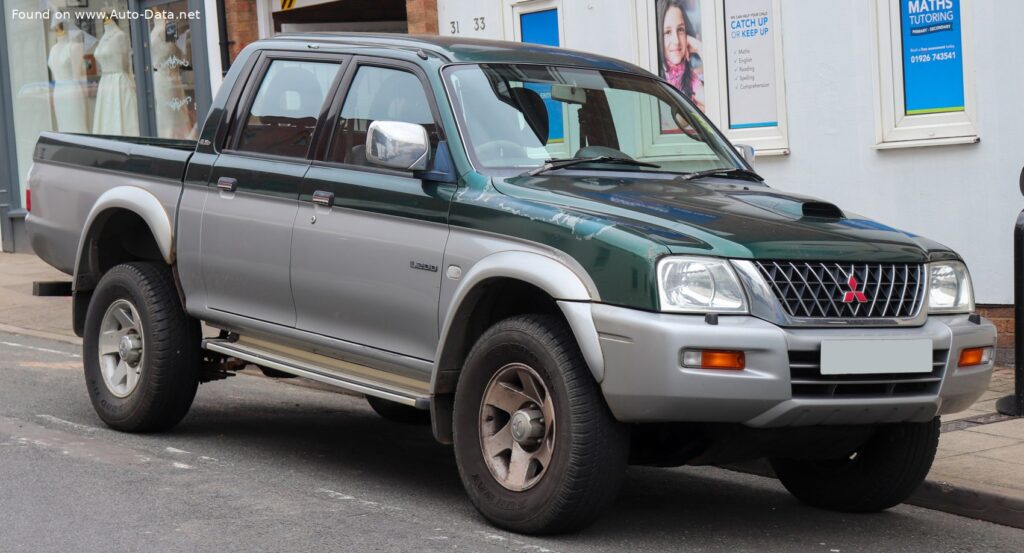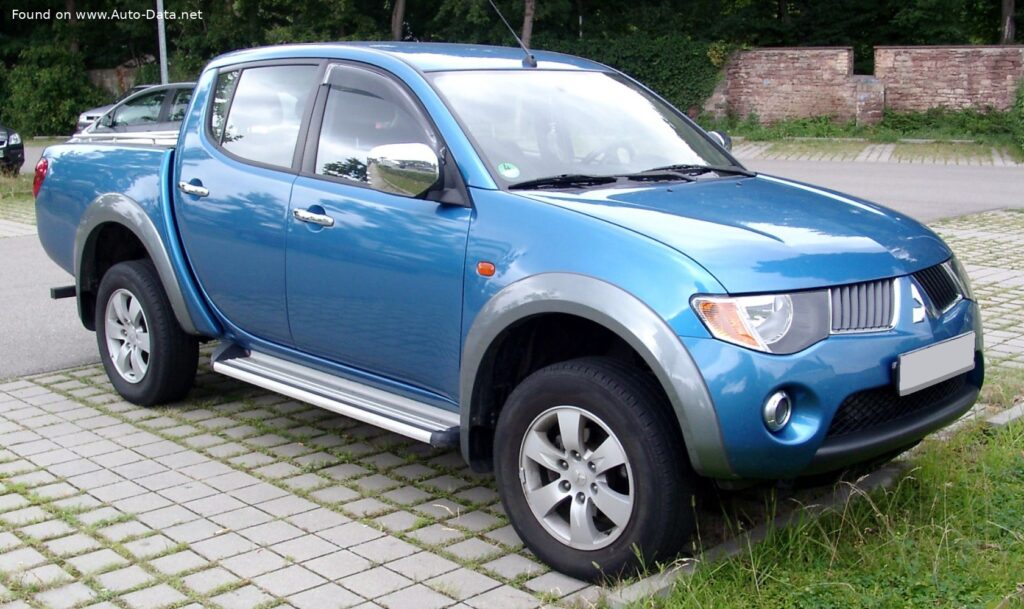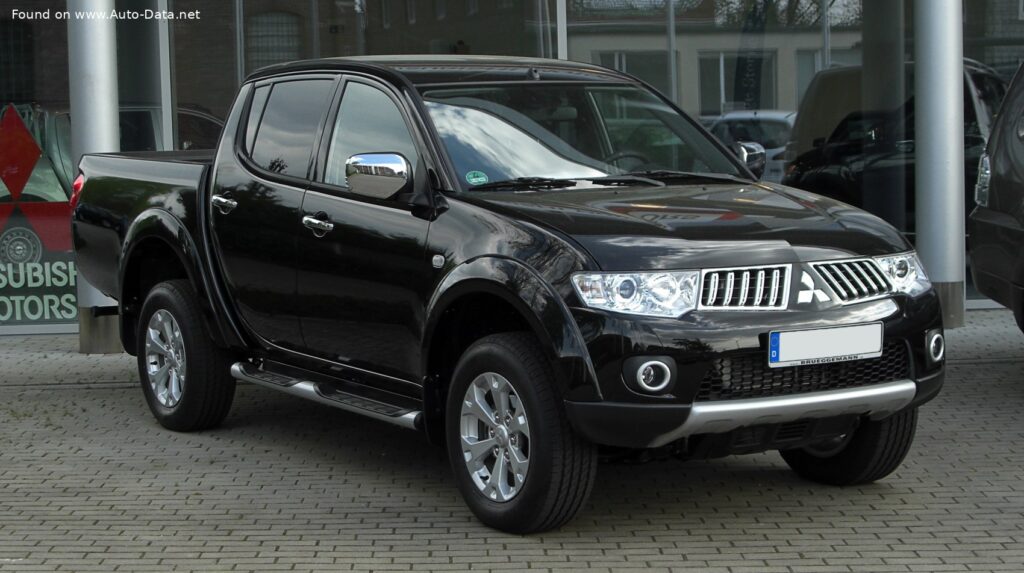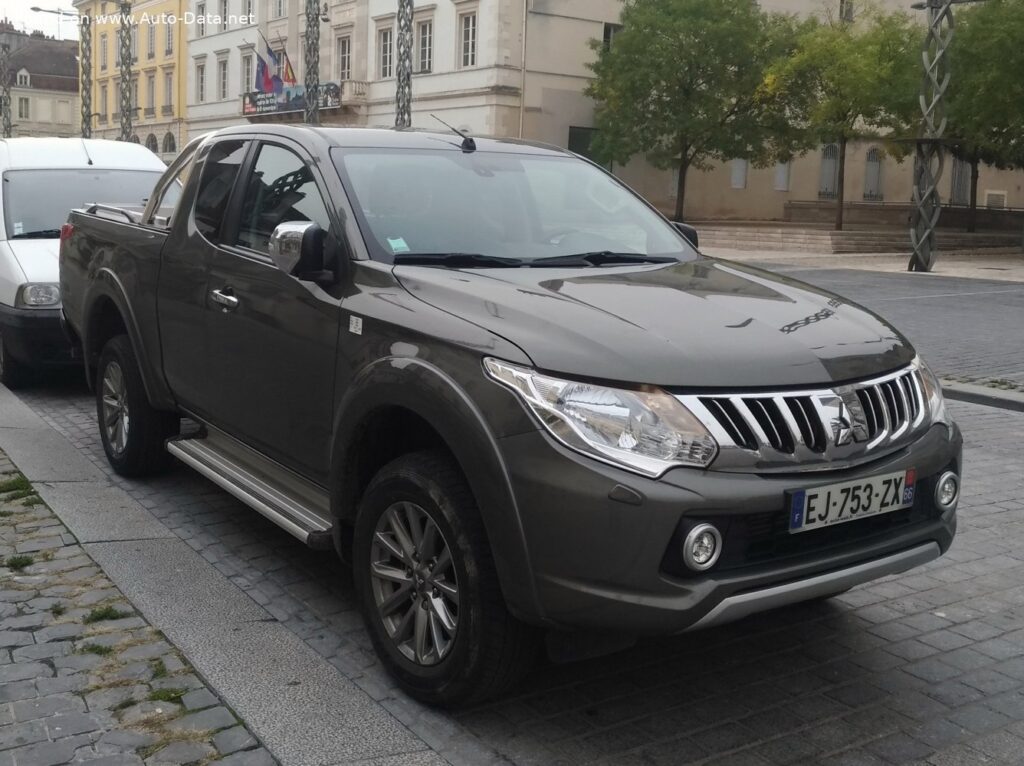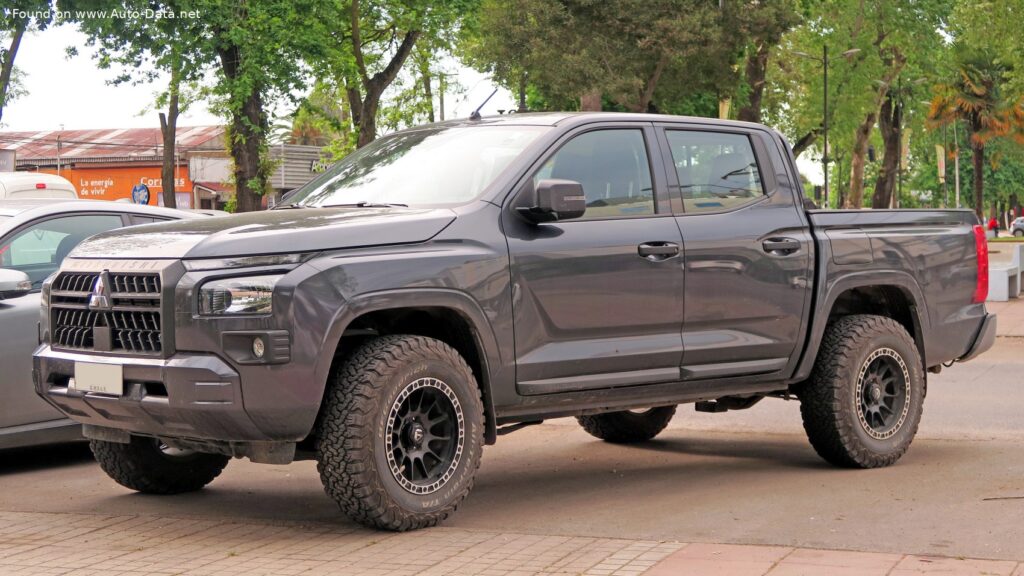
The Mitsubishi L200 VI Double Cab 2.4 MIVEC (201 Hp): A Modern Workhorse for Global Markets
The Mitsubishi L200 VI Double Cab 2.4 MIVEC (201 Hp) represents the sixth generation of Mitsubishi’s highly successful mid-size pickup truck, a vehicle renowned globally for its rugged durability, versatility, and robust performance. Introduced in 2023, this iteration of the L200 (also known as the Triton in various markets such as Australia and Thailand) continues Mitsubishi’s legacy in the competitive pickup segment. While not officially sold in the United States, the L200 VI Double Cab plays a crucial role in numerous international markets, including Europe, Asia, Oceania, and Africa, where it serves as both a dependable work vehicle and a capable lifestyle truck. This specific variant, featuring the 2.4-liter MIVEC diesel engine producing 201 horsepower, targets customers who demand a blend of power, efficiency, and modern amenities in a practical four-door, five-seat pickup configuration.
Designed to meet the rigorous demands of diverse environments, from urban streets to challenging off-road terrains, the L200 VI Double Cab builds upon a foundation of five previous generations, each contributing to its reputation for reliability and strength. This latest model incorporates contemporary design language, advanced powertrain technology, and enhanced safety features, positioning it as a strong contender against rivals in its primary markets. Its development reflects Mitsubishi’s commitment to innovation, particularly in engine efficiency and occupant comfort, while retaining the core attributes that have made the L200 a global favorite.
Engine and Performance: Powering the Mitsubishi L200 VI Double Cab
At the heart of the Mitsubishi L200 VI Double Cab 2.4 MIVEC (201 Hp) lies a sophisticated 2.4-liter (2442 cm3 or 149.02 cu. in.) 4N16 inline-four diesel engine. This powerplant utilizes Mitsubishi’s Innovative Valve timing Electronic Control (MIVEC) system, a technology traditionally associated with gasoline engines but adapted here for diesel applications to optimize valve timing for improved fuel efficiency and power delivery across the RPM range. Further boosting its output and efficiency, the engine is equipped with a BiTurbocharger and an intercooler, ensuring a robust and responsive driving experience.
This refined diesel engine generates a substantial 201 horsepower at 3500 rpm, providing ample power for hauling, towing, and navigating various driving conditions. More impressively for a utility vehicle, it delivers a peak torque of 470 Nm (346.65 lb.-ft.) available across a broad rev band, from 1500 to 2750 rpm. This wide torque plateau is critical for strong acceleration from a standstill and effortless pulling power, whether carrying a heavy payload or towing a substantial trailer. The common rail direct fuel injection system and DOHC (Double Overhead Camshaft) valvetrain further contribute to the engine’s efficiency and clean combustion, helping it meet the stringent Euro 6 emission standards.
Power is channeled to the rear wheels via a durable 6-speed manual transmission, a choice that emphasizes driver engagement and control, particularly favored in markets where manual transmissions remain popular for their robustness and perceived efficiency. The powertrain architecture for this specific variant is rear-wheel drive, indicating its focus on payload capacity and on-road efficiency, though L200 models are widely available with advanced four-wheel-drive systems in other configurations. Fuel economy figures underscore the engine’s efficiency, with a combined rating of 30.9 – 29 US mpg (7.6-8.1 l/100 km), making it an economical choice for daily operations and long-distance travel. The vehicle also features a Start & Stop System and a Particulate Filter to further reduce emissions and fuel consumption.
Design and Features: Form Meets Function
The Mitsubishi L200 VI Double Cab features a contemporary and assertive design that balances its utilitarian purpose with a modern aesthetic. As a double cab pickup, it offers the practicality of a four-door configuration with seating for five occupants, making it suitable for both commercial and family use. Its dimensions are substantial, with a length of 209.45 inches (5320 mm), a width of 73.43 inches (1865 mm), and a height of 70.67 inches (1795 mm), riding on a wheelbase of 123.23 inches (3130 mm). These proportions contribute to a commanding road presence and a spacious interior for its class.
Designed for robustness, the L200 VI Double Cab incorporates a traditional but highly effective suspension setup. The front features an independent double wishbone system with coil springs and a transverse stabilizer, providing a comfortable ride and precise handling. The rear utilizes a rigid axle with leaf springs, a proven design choice for pickup trucks known for its durability and ability to handle heavy loads without compromise. This configuration ensures that the L200 can confidently tackle challenging terrains and substantial payloads, with a maximum load capacity ranging from 2118.64 to 2204.62 lbs (961-1000 kg).
Off-road capability is inherent in the L200’s DNA, even in this rear-wheel-drive configuration. With a generous ground clearance of 8.98 inches (228 mm), an approach angle of 30.4°, a departure angle of 22.8°, and a ramp-over angle of 23.4°, the vehicle is well-equipped to navigate uneven surfaces and obstacles. Braking is handled by ventilated discs at the front (290 mm) and drum brakes at the rear (295 mm), complemented by an Anti-lock Braking System (ABS) for enhanced safety during aggressive braking. The steering system is a rack and pinion setup with electric power steering, offering light and responsive handling, especially at lower speeds. The vehicle rides on 265/70 R16 tires mounted on 7.5J x 16 wheel rims, providing a good balance of on-road comfort and off-road grip. The inclusion of an AdBlue tank (4.49 US gal / 17 l) highlights its commitment to modern diesel emission standards.
Technical Specifications
| Category | Specification |
|---|---|
| General Information | |
| Brand | Mitsubishi |
| Model | L200 VI Double Cab |
| Type (Engine) | 2.4 MIVEC (201 Hp) |
| Start of Production | 2023 year |
| Powertrain Architecture | Internal Combustion engine |
| Body Type | Pick-up |
| Seats | 5 |
| Doors | 4 |
| Performance Specs | |
| Fuel Consumption (Urban) | 9.6-10.2 l/100 km (24.5 – 23.1 US mpg) |
| Fuel Consumption (Extra Urban) | 6.5-6.6 l/100 km (36.2 – 35.6 US mpg) |
| Fuel Consumption (Combined) | 7.6-8.1 l/100 km (30.9 – 29 US mpg) |
| Fuel Type | Diesel |
| Emission Standard | Euro 6 |
| Weight-to-Power Ratio | 10 kg/Hp (100.5 Hp/tonne) |
| Weight-to-Torque Ratio | 4.3 kg/Nm (235 Nm/tonne) |
| Engine Specs | |
| Power | 201 Hp @ 3500 rpm |
| Power per Liter | 82.3 Hp/l |
| Torque | 470 Nm (346.65 lb.-ft.) @ 1500-2750 rpm |
| Engine Layout | Front, Longitudinal |
| Engine Model/Code | 4N16 |
| Engine Displacement | 2442 cm3 (149.02 cu. in.) |
| Number of Cylinders | 4 |
| Engine Configuration | Inline |
| Cylinder Bore | 86 mm (3.39 in.) |
| Piston Stroke | 105.1 mm (4.14 in.) |
| Compression Ratio | 15.2:1 |
| Number of Valves per Cylinder | 4 |
| Fuel Injection System | Diesel Commonrail |
| Engine Aspiration | BiTurbo, Intercooler |
| Valvetrain | DOHC |
| Engine Oil Capacity | 6.7 l (7.08 US qt) |
| Engine Oil Specification | Not specified |
| Coolant Capacity | 7.7 l (8.14 US qt) |
| Engine Systems | Start & Stop System, Particulate filter |
| Space, Volume and Weights | |
| Kerb Weight | 2000-2039 kg (4409.25 – 4495.23 lbs.) |
| Max. Weight (GVWR) | 3000 kg (6613.87 lbs.) |
| Max Load | 961-1000 kg (2118.64 – 2204.62 lbs.) |
| Fuel Tank Capacity | 75 l (19.81 US gal) |
| AdBlue Tank Capacity | 17 l (4.49 US gal) |
| Permitted Trailer Load with Brakes (12%) | 3500 kg (7716.18 lbs.) |
| Permitted Trailer Load without Brakes | 750 kg (1653.47 lbs.) |
| Dimensions | |
| Length | 5320 mm (209.45 in.) |
| Width | 1865 mm (73.43 in.) |
| Height | 1795 mm (70.67 in.) |
| Wheelbase | 3130 mm (123.23 in.) |
| Front Track | 1570 mm (61.81 in.) |
| Rear (Back) Track | 1565 mm (61.61 in.) |
| Front Overhang | 890 mm (35.04 in.) |
| Rear Overhang | 1300 mm (51.18 in.) |
| Ride Height (Ground Clearance) | 228 mm (8.98 in.) |
| Minimum Turning Circle (Turning Diameter) | 12.6 m (41.34 ft.) |
| Approach Angle | 30.4° |
| Departure Angle | 22.8° |
| Ramp-over (Brakeover) Angle | 23.4° |
| Drivetrain, Brakes and Suspension Specs | |
| Drivetrain Architecture | Internal Combustion engine (ICE) drives the rear wheels. |
| Drive Wheel | Rear wheel drive |
| Number of Gears and Type of Gearbox | 6 gears, manual transmission |
| Front Suspension | Double wishbone, Independent coil spring, Transverse stabilizer |
| Rear Suspension | Rigid axle suspension, Leaf spring |
| Front Brakes | Ventilated discs, 290 mm |
| Rear Brakes | Drum, 295 mm |
| Assisting Systems | ABS (Anti-lock braking system) |
| Steering Type | Steering rack and pinion |
| Power Steering | Electric Steering |
| Tires Size | 265/70 R16 |
| Wheel Rims Size | 7.5J x 16 |
Legacy and Market Impact of the Mitsubishi L200 VI Double Cab
The Mitsubishi L200, known as the Triton in many markets, has an enduring legacy as one of the most trusted and capable pickup trucks globally. The sixth-generation L200 VI Double Cab 2.4 MIVEC (201 Hp) continues this tradition, strengthening Mitsubishi’s position in the highly competitive mid-size pickup segment outside of North America. Its primary markets, encompassing Europe, Asia, Australia, South America, and Africa, value the L200 for its reputation for reliability, exceptional durability, and robust utility in challenging environments.
In these regions, the L200 VI Double Cab competes directly with formidable rivals such as the Toyota Hilux, Ford Ranger, Nissan Navara, Isuzu D-Max, and Volkswagen Amarok. What sets the L200 apart is its balanced approach, offering a blend of strong towing and payload capacities, respectable fuel efficiency for a diesel pickup, and a comfortable cabin that has evolved to meet modern consumer expectations. Its ability to serve as both a rugged workhorse for tradesmen and farmers, and a versatile family vehicle for adventure-seekers, contributes significantly to its widespread appeal.
The historical significance of the L200 line traces back decades, with each generation progressively refining its capabilities while maintaining core Mitsubishi characteristics of strength and engineering integrity. This latest iteration, with its advanced MIVEC diesel engine and contemporary features, signifies Mitsubishi’s ongoing commitment to innovation in the pickup truck sector. While the 2.4 MIVEC (201 Hp) variant with rear-wheel drive emphasizes efficiency and payload for specific market needs, the broader L200 lineup, often featuring advanced 4WD systems, continues to uphold its reputation for exceptional off-road prowess. The L200 VI Double Cab’s market impact is profound, solidifying Mitsubishi’s role as a key player in providing reliable, capable, and economically sensible pickup solutions to a global audience.