Introduction to the Peugeot 207 CC (facelift 2009)
The Peugeot 207 CC (facelift 2009) represents a significant offering in the European compact coupe-cabriolet segment, a niche Peugeot had effectively pioneered and dominated for years. Unveiled as an update to the already popular 207 CC, this facelifted model solidified its position as an accessible and stylish open-top vehicle. While never officially sold in the United States, the 207 CC was a familiar sight on European roads, embodying the French automaker’s flair for design and its commitment to offering a retractable hardtop experience in a relatively small package. This particular variant, equipped with the 1.6 THP (Turbo High Pressure) engine generating 150 horsepower, was positioned as a spirited and efficient choice for consumers seeking a blend of performance and the versatility of a coupe and a convertible in one car.
The 207 CC, succeeding the immensely successful 206 CC, continued Peugeot’s tradition of offering a hardtop convertible in the supermini segment. The “CC” designation, standing for “Coupe-Cabriolet,” highlighted its dual nature: a secure and quiet coupe when the roof was up, and an exhilarating open-air convertible at the touch of a button. The 2009 facelift brought subtle yet effective enhancements, refining its aesthetics, improving interior materials, and updating mechanical components to maintain its competitive edge in a segment that saw increasing competition from other European manufacturers.
Engine and Performance: The Heart of the Peugeot 207 CC (facelift 2009)
At the core of this particular Peugeot 207 CC (facelift 2009) model lies the sophisticated 1.6 THP engine, a testament to modern engineering and a product of a collaborative effort between PSA Peugeot Citroën and BMW. This turbocharged, direct-injection gasoline (petrol) engine, internally coded as 5FX EP6DT, was engineered to deliver a compelling combination of power, torque, and fuel efficiency. It features a compact inline four-cylinder configuration with a displacement of 1598 cm³ (97.52 cubic inches), utilizing a DOHC (Double Overhead Camshaft) valvetrain with VVT (Variable Valve Timing) to optimize combustion and efficiency across the rev range.
The 1.6 THP unit produces a robust 150 horsepower at 6000 rpm, translating to a healthy power-per-liter output of 93.9 horsepower. More impressively, it generates a substantial 177.01 lb.-ft. of torque available from a low 1400 rpm, peaking through 3500 rpm. This broad torque band is crucial for real-world drivability, providing strong acceleration from low speeds and making the car feel responsive in various driving conditions. Power is delivered to the front wheels via a precise 5-speed manual transmission, offering an engaging driving experience.
In terms of outright performance, the 207 CC 1.6 THP is capable of accelerating from 0 to 60 mph in a brisk 8.2 seconds (0-100 km/h in 8.6 seconds), with a top speed reaching 130.49 mph (210 km/h). These figures are commendable for a compact convertible weighing in at 3108.52 lbs. (1410 kg) and reflect the engine’s ability to move the vehicle with authority. The car’s weight-to-power ratio stands at 9.4 kg/Hp (106.4 Hp/tonne), further underscoring its energetic character.
Fuel economy, a critical factor for European buyers, was also a strong suit for this engine. The combined fuel consumption is rated at 7.2 liters per 100 kilometers, which translates to an impressive 32.7 US mpg. Urban driving yields 24.5 US mpg, while extra-urban conditions can see figures as high as 40.6 US mpg. With CO2 emissions of 171 g/km, the vehicle met the Euro 4 emission standard, demonstrating Peugeot’s commitment to environmental responsibility for its time.
Design and Features
Body and Styling of the 207 CC (facelift 2009)
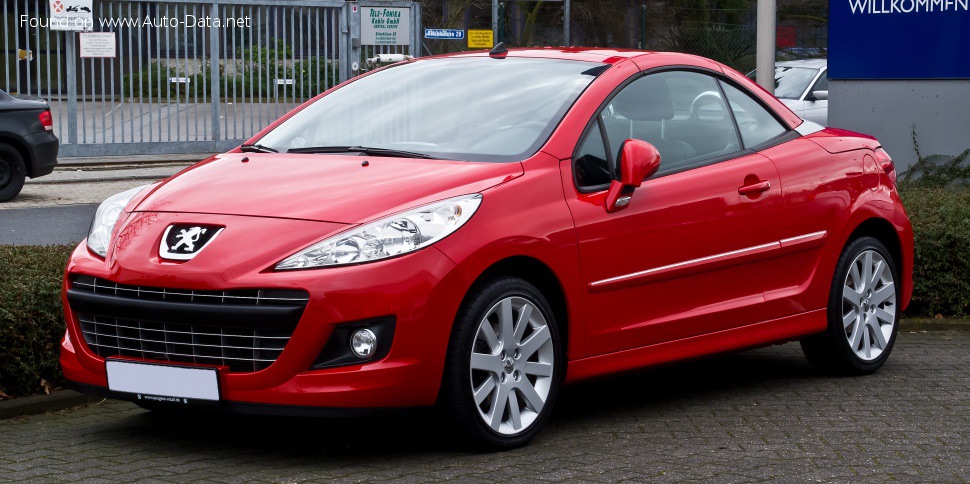
The Peugeot 207 CC (facelift 2009) maintains the distinctive coupe-cabriolet body style, a hallmark of Peugeot’s open-top offerings. Measuring 159.21 inches (4044 mm) in length, 68.82 inches (1748 mm) in width (77.64 inches or 1972 mm including mirrors), and 54.84 inches (1393 mm) in height, the 207 CC is a compact vehicle designed for urban maneuverability and stylish cruising. Its wheelbase of 100 inches (2540 mm) contributes to a stable ride quality, while the minimum turning circle of 36.09 feet (11.0 m) ensures agility in tight spaces. The facelift introduced subtle refinements, including revised front and rear bumpers, updated lighting signatures, and new wheel designs, enhancing its contemporary appeal without altering its fundamental character.
The most defining feature, of course, is its electrically operated retractable hardtop. This sophisticated mechanism allows the car to transform from a secure, insulated coupe to an open-air convertible in a matter of seconds. When the roof is stowed, it neatly folds into the trunk, a clever piece of engineering that, while reducing luggage capacity, provides the security and all-weather usability that fabric roofs cannot match.
Interior and Practicality
Inside, the 207 CC offers seating for four, arranged in a 2+2 configuration. While the front seats provide ample comfort and support, the rear seats are typically more suited for occasional use or for children, a common characteristic of compact convertibles. The facelift brought improvements to interior materials and trim, enhancing the perceived quality and tactile experience.
Practicality is balanced by the convertible mechanism. With the roof up, the trunk space is a respectable 13.07 cubic feet (370 liters). However, when the roof is down and stowed, the available luggage space shrinks to 5.12 cubic feet (145 liters). This trade-off is inherent to hardtop convertibles in this segment but still offers enough room for small bags or groceries. The fuel tank capacity of 13.21 US gallons (50 liters) provides a decent range for extended drives.
Chassis, Suspension, and Safety
The 207 CC features a robust chassis designed to handle the demands of open-top motoring, with additional structural bracing to compensate for the absence of a fixed roof. The suspension system comprises an independent McPherson strut setup at the front and a semi-independent, coil spring arrangement at the rear, tuned to provide a comfortable yet engaging ride. Stopping power is ensured by ventilated disc brakes at the front and disc brakes at the rear, complemented by an Anti-lock Braking System (ABS) for enhanced safety during emergency braking. The car rides on 205/45 R17 tires, mounted on 17-inch wheel rims, providing a good balance of grip and ride comfort. Steering is managed by a rack and pinion system, offering precise control.
Technical Specifications
| General Information | |
| Brand | Peugeot |
| Model | 207 |
| Generation | 207 CC (facelift 2009) |
| Type (Engine) | 1.6 THP (150 Hp) |
| Start of Production | 2009 year |
| End of Production | 2009 year |
| Powertrain Architecture | Internal Combustion engine |
| Body type | Coupe – Cabriolet |
| Seats | 4 |
| Doors | 2 |
| Performance Specs | |
| Fuel Consumption (Economy) – urban | 9.6 l/100 km (24.5 US mpg) |
| Fuel Consumption (Economy) – extra urban | 5.8 l/100 km (40.6 US mpg) |
| Fuel Consumption (Economy) – combined | 7.2 l/100 km (32.7 US mpg) |
| CO2 Emissions | 171 g/km |
| Fuel Type | Petrol (Gasoline) |
| Acceleration 0 – 60 mph | 8.2 sec |
| Acceleration 0 – 100 km/h | 8.6 sec |
| Maximum Speed | 210 km/h (130.49 mph) |
| Emission Standard | Euro 4 |
| Weight-to-power ratio | 9.4 kg/Hp (106.4 Hp/tonne) |
| Weight-to-torque ratio | 5.9 kg/Nm (170.2 Nm/tonne) |
| Engine Specs | |
| Power | 150 Hp @ 6000 rpm |
| Power per liter | 93.9 Hp/l |
| Torque | 240 Nm @ 1400-3500 rpm (177.01 lb.-ft.) |
| Engine Layout | Front, Transverse |
| Engine Model/Code | 5FX EP6DT |
| Engine Displacement | 1598 cm³ (97.52 cu. in.) |
| Number of Cylinders | 4 |
| Engine Configuration | Inline |
| Cylinder Bore | 77 mm (3.03 in.) |
| Piston Stroke | 85.8 mm (3.38 in.) |
| Compression Ratio | 10.5:1 |
| Number of Valves per Cylinder | 4 |
| Fuel Injection System | Direct injection |
| Engine Aspiration | Turbocharger, Intercooler |
| Valvetrain | DOHC-VVT |
| Engine Oil Capacity | 4.25 l (4.49 US qt) |
| Coolant Capacity | 5.3 l (5.6 US qt) |
| Dimensions, Volume, and Weights | |
| Kerb Weight | 1410 kg (3108.52 lbs.) |
| Max. Weight | 1760 kg (3880.14 lbs.) |
| Max Load | 350 kg (771.62 lbs.) |
| Trunk (boot) Space – minimum | 145 l (5.12 cu. ft.) |
| Trunk (boot) Space – maximum | 370 l (13.07 cu. ft.) |
| Fuel Tank Capacity | 50 l (13.21 US gal) |
| Permitted Trailer Load with Brakes (12%) | 1060 kg (2336.9 lbs.) |
| Permitted Trailer Load without Brakes | 600 kg (1322.77 lbs.) |
| Length | 4044 mm (159.21 in.) |
| Width | 1748 mm (68.82 in.) |
| Width with Mirrors Folded | 1818 mm (71.57 in.) |
| Width Including Mirrors | 1972 mm (77.64 in.) |
| Height | 1393 mm (54.84 in.) |
| Wheelbase | 2540 mm (100 in.) |
| Front Track | 1469 mm (57.83 in.) |
| Rear (Back) Track | 1470 mm (57.87 in.) |
| Drag Coefficient (Cd) | 0.31 |
| Minimum Turning Circle (Turning Diameter) | 11.0 m (36.09 ft.) |
| Drivetrain, Brakes, and Suspension Specs | |
| Drivetrain Architecture | Front-wheel drive. Internal Combustion engine. |
| Drive Wheel | Front wheel drive |
| Number of Gears and Type of Gearbox | 5 gears, manual transmission |
| Front Suspension | Independent type McPherson |
| Rear Suspension | Semi-independent, coil spring |
| Front Brakes | Ventilated discs |
| Rear Brakes | Disc |
| Assisting Systems | ABS (Anti-lock braking system) |
| Steering Type | Steering rack and pinion |
| Tires Size | 205/45 R17 |
| Wheel Rims Size | 17 |
Legacy and Market Impact of the Peugeot 207 CC (facelift 2009)
The Peugeot 207 CC (facelift 2009) played a crucial role in maintaining Peugeot’s dominance in the compact coupe-cabriolet segment in Europe. Building on the immense success of its predecessor, the 206 CC, the 207 CC continued to offer a compelling package for buyers seeking the versatility and style of a retractable hardtop convertible without the premium price tag typically associated with such vehicles. Its blend of French design flair, respectable performance from the THP engine, and the practicality of a hardtop made it a highly attractive option.
In its primary European markets, the 207 CC faced competition from a growing number of rivals. Key competitors included the Renault Megane CC, Opel Astra TwinTop, Volkswagen Eos, and the Ford Focus CC. Each offered its own interpretation of the hardtop convertible, but Peugeot’s long-standing reputation in this segment, dating back to the 402 Éclipse of the 1930s, gave it a significant advantage. The 207 CC was often praised for its engaging design, particularly its sleek profile with the roof up, and the ease of its roof operation.
The 1.6 THP engine, in particular, enhanced the 207 CC’s reputation. This engine, shared with various BMW and Mini models, brought a level of refinement, power, and efficiency that elevated the driving experience beyond what many expected from a car in this class. Its strong torque delivery made it enjoyable for both city driving and highway cruising, while its fuel economy was competitive for a turbocharged gasoline engine of its era.
Historically, the 207 CC, and its 2009 facelift, represent the peak of Peugeot’s small convertible strategy. It democratized the hardtop convertible, making open-top motoring accessible to a broader audience. While the segment itself began to wane in popularity in the subsequent years, with manufacturers increasingly focusing on SUVs and crossovers, the 207 CC stands as a testament to an era when stylish, compact convertibles were a vibrant part of the automotive landscape. Its legacy is one of combining practicality, style, and a touch of driving excitement in a package that remained uniquely Peugeot. For many, it represented an affordable slice of European chic, capable of transforming from a practical coupe to a sun-worshipping convertible at will.