The Seat Ibiza IV (facelift 2012) 2.0 TDI (143 Hp): A European Hot Hatch Diesel
The Seat Ibiza IV (facelift 2012), specifically the 2.0 TDI (143 Hp) variant, represents a compelling chapter in the history of the Spanish automaker’s popular subcompact car. Unveiled in 2012 as a refreshed iteration of the fourth-generation Ibiza, this model cemented its role as a key player in Europe’s fiercely competitive B-segment, offering a blend of sporty aesthetics, agile handling, and remarkable diesel efficiency. While the Seat brand is not officially sold in the United States, the Ibiza is a highly recognized and successful nameplate across Europe, Asia, and other international markets, celebrated for its youthful appeal and dynamic driving characteristics, often borrowing heavily from its Volkswagen Group siblings like the VW Polo and Audi A1.
Produced from 2012 to 2015, this particular iteration of the Ibiza IV brought subtle yet effective updates to its exterior styling, interior refinement, and technological offerings, keeping it fresh against a wave of new competitors. The 2.0 TDI (143 Hp) version stood out as a performance-oriented diesel option, providing a unique proposition for buyers seeking both exhilarating acceleration and impressive fuel economy—a combination particularly valued in markets with high fuel prices and emissions regulations. This article delves into the technical prowess, design philosophy, and market impact of this distinctive European hatchback.
Engine and Performance: The Heart of the Seat Ibiza IV (facelift 2012) 2.0 TDI
At the core of the Seat Ibiza IV (facelift 2012) 2.0 TDI (143 Hp) lies a robust and efficient 2.0-liter inline-four diesel engine, designated by the code CFHD. This powertrain, a testament to Volkswagen Group’s diesel engineering expertise, delivers a peak power output of 143 horsepower at 4200 revolutions per minute. More significantly for real-world driving, it produces a substantial 236.02 lb.-ft. of torque, available across a broad and usable range from 1750 to 2500 rpm. This ample torque ensures strong pulling power and effortless acceleration, characteristic of a well-tuned diesel engine.
The engine’s design incorporates a common rail fuel injection system, which allows for precise fuel delivery and contributes to both its power output and its commendable fuel efficiency. Furthermore, it features a turbocharger and intercooler setup, optimizing air intake for enhanced performance, especially at lower engine speeds where turbo lag is minimized. To comply with the stringent Euro 5 emission standards prevalent during its production years, the engine was equipped with a particulate filter, reducing harmful emissions.
Performance figures for the 2.0 TDI (143 Hp) are impressive for a subcompact hatchback. It sprints from 0 to 60 mph in a brisk 7.8 seconds, making it one of the quicker options in its class. The top speed is rated at 130.49 mph, affirming its capabilities for highway cruising. Power is delivered to the front wheels via a slick-shifting 6-speed manual transmission, offering engaging driver control and allowing the driver to fully exploit the engine’s torque band.
Fuel economy was a major selling point for this diesel variant. The combined cycle consumption is an outstanding 51.1 US mpg (4.6 l/100 km), with extra-urban driving pushing that figure to an even more remarkable 60.3 US mpg (3.9 l/100 km). Even in urban environments, it achieves a respectable 39.9 US mpg (5.9 l/100 km). These figures, coupled with CO2 emissions of just 119 g/km, underscore the Ibiza 2.0 TDI’s commitment to efficiency and environmental responsibility, especially pertinent in the European market. The engine’s displacement is 1968 cm³ (120.09 cu. in.), with a bore of 3.19 inches and a stroke of 3.76 inches, and a compression ratio of 16:1.
Design and Features: Sporty Aesthetics and Practicality
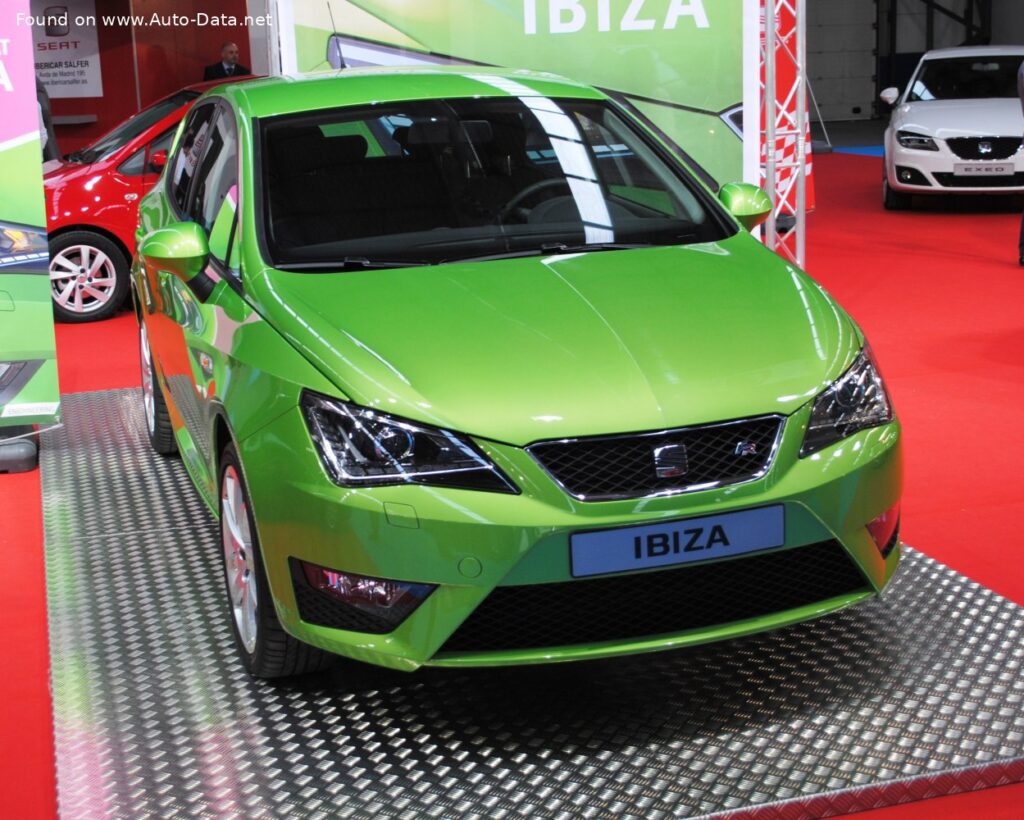
The Seat Ibiza IV (facelift 2012) retained the sharp, angular design language that had become a hallmark of the Seat brand, embodying its “auto emoción” philosophy. As a 5-door hatchback, it offered a practical body style that balanced sporty looks with everyday usability. The facelift introduced subtle refinements, including revised headlights and taillights, updated grille designs, and new wheel options, giving it a more modern and aggressive stance. The model came equipped with 215/40 R17 tires mounted on 7J x 17-inch wheel rims, contributing to its sporty appearance and handling prowess.
Measuring 160.71 inches in length, 66.65 inches in width, and 56.73 inches in height, with a wheelbase of 97.2 inches, the Ibiza IV was compact enough for urban maneuverability yet offered sufficient interior space for five occupants. The design prioritized a dynamic profile, with crisp lines and sculpted surfaces creating a sense of movement even when stationary.
Inside, the facelift brought improvements to material quality and ergonomics. While specific luxury features are not detailed in the provided data, a typical subcompact of this era in Europe would feature comfortable seating, air conditioning, a basic infotainment system, and power windows. The focus was on a driver-centric cockpit, with clear instrumentation and intuitive controls. Practicality was addressed with a minimum trunk (boot) space of 8.83 cubic feet (250 liters), expandable by folding the rear seats, making it suitable for city errands or weekend trips.
Safety features included an Anti-lock Braking System (ABS) as standard, enhancing control during emergency braking. The braking system comprised ventilated discs at the front and solid discs at the rear, ensuring confident stopping power. The suspension setup featured an independent McPherson strut system with coil springs and an anti-roll bar at the front, paired with a rear suspension utilizing hydraulic elements, designed to provide a balance of comfortable ride quality and responsive handling. Electric power steering, with a rack and pinion system, offered light effort at low speeds for easy parking and more feedback at higher speeds.
Technical Specifications
| General Information | |
|---|---|
| Brand | Seat |
| Model | Ibiza |
| Generation | Ibiza IV (facelift 2012) |
| Type (Engine) | 2.0 TDI (143 Hp) |
| Start of Production | 2012 year |
| End of Production | 2015 year |
| Powertrain Architecture | Internal Combustion engine |
| Body type | Hatchback |
| Seats | 5 |
| Doors | 5 |
| Performance Specifications | |
| Fuel consumption (economy) – urban | 39.9 US mpg (5.9 l/100 km) |
| Fuel consumption (economy) – extra urban | 60.3 US mpg (3.9 l/100 km) |
| Fuel consumption (economy) – combined | 51.1 US mpg (4.6 l/100 km) |
| CO2 emissions | 119 g/km |
| Fuel Type | Diesel |
| Acceleration 0 – 60 mph | 7.8 sec |
| Maximum speed | 130.49 mph (210 km/h) |
| Emission standard | Euro 5 |
| Weight-to-power ratio | 8.7 kg/Hp, 114.9 Hp/tonne |
| Weight-to-torque ratio | 3.9 kg/Nm, 257 Nm/tonne |
| Engine Specifications | |
| Power | 143 Hp @ 4200 rpm |
| Power per liter | 72.7 Hp/l |
| Torque | 236.02 lb.-ft. @ 1750-2500 rpm (320 Nm) |
| Engine layout | Front, Transverse |
| Engine Model/Code | CFHD |
| Engine displacement | 120.09 cu. in. (1968 cm³) |
| Number of cylinders | 4 |
| Engine configuration | Inline |
| Cylinder Bore | 3.19 in. (81 mm) |
| Piston Stroke | 3.76 in. (95.5 mm) |
| Compression ratio | 16:1 |
| Number of valves per cylinder | 4 |
| Fuel injection system | Diesel Commonrail |
| Engine aspiration | Turbocharger, Intercooler |
| Engine oil capacity | 4.54 US qt (4.3 l) |
| Engine oil specification | Not specified in data |
| Coolant | 8.45 US qt (8 l) |
| Engine systems | Particulate filter |
| Space, Volume and Weights | |
| Kerb Weight | 2744.76 lbs (1245 kg) |
| Max. weight | 3725.81 lbs (1690 kg) |
| Max load | 981.06 lbs (445 kg) |
| Trunk (boot) space – minimum | 8.83 cu. ft. (250 l) |
| Fuel tank capacity | 11.89 US gal (45 l) |
| Dimensions | |
| Length | 160.71 in. (4082 mm) |
| Width | 66.65 in. (1693 mm) |
| Height | 56.73 in. (1441 mm) |
| Wheelbase | 97.2 in. (2469 mm) |
| Front track | 57.05 in. (1449 mm) |
| Rear (Back) track | 56.73 in. (1441 mm) |
| Minimum turning circle (turning diameter) | 34.38 ft. (10.48 m) |
| Drivetrain, Brakes and Suspension Specifications | |
| Drivetrain Architecture | The Internal combustion engine (ICE) drives the front wheels of the vehicle. |
| Drive wheel | Front wheel drive |
| Number of gears and type of gearbox | 6 gears, manual transmission |
| Front suspension | Independent, type McPherson with coil spring and anti-roll bar |
| Rear suspension | Hydraulic elements |
| Front brakes | Ventilated discs |
| Rear brakes | Disc |
| Assisting systems | ABS (Anti-lock braking system) |
| Steering type | Steering rack and pinion |
| Power steering | Electric Steering |
| Tires size | 215/40 R17 |
| Wheel rims size | 7J x 17 |
Legacy and Market Impact of the Seat Ibiza IV (facelift 2012)
The Seat Ibiza has consistently been a cornerstone of the Spanish brand’s lineup since its inception in 1984, and the fourth generation, particularly after its 2012 facelift, continued this legacy with significant impact in its primary European market. The Ibiza IV (facelift 2012) 2.0 TDI (143 Hp) carved out a distinct niche for itself by offering a rare combination of sporty performance, dynamic handling, and exceptional diesel fuel economy, a highly desirable trait in regions where diesel powertrains were still very popular and fuel costs were a major consideration for consumers.
In the highly competitive European subcompact segment, the Ibiza faced formidable rivals such as the Volkswagen Polo (its platform mate), Ford Fiesta, Renault Clio, Peugeot 208, and Opel Corsa. What set the Ibiza apart was its youthful and energetic brand image, often perceived as the sportier and more design-forward alternative within the Volkswagen Group’s small car portfolio. The 2.0 TDI (143 Hp) variant, in particular, offered a “warm hatch” experience with diesel efficiency, appealing to buyers who wanted more than just basic transportation but also appreciated lower running costs and robust torque delivery.
The Ibiza’s reputation was built on its engaging driving dynamics, thanks to its well-tuned chassis and responsive electric power steering. The facelifted model further enhanced its appeal through refined interior materials and updated technology, ensuring it remained relevant against newer competitors. Its strong performance figures, especially the rapid 0-60 mph acceleration for a diesel subcompact, contributed to its image as a fun-to-drive vehicle.
Historically, the Ibiza has been Seat’s best-selling model for many years, symbolizing the brand’s commitment to producing stylish, practical, and enjoyable cars. The 2012 facelift of the fourth generation helped sustain its market relevance during its production run, bridging the gap to the eventual fifth generation. While not a global powerhouse in the same vein as some Japanese or Korean competitors, the Ibiza remains a cultural icon in Spain and a consistently strong performer across Europe, showcasing Seat’s ability to inject passion and flair into an otherwise utilitarian segment. The 2.0 TDI (143 Hp) variant, with its blend of power and parsimony, stands as a prime example of how Seat successfully catered to specific market demands with a distinct personality. Its presence helped solidify Seat’s position as a vibrant, sporty brand within the larger Volkswagen Group.