The Peugeot 207 CC (facelift 2009): A European Compact Convertible
The Peugeot 207 CC (facelift 2009) represents a significant iteration of the compact coupe-cabriolet from the French automaker, Peugeot. Introduced in 2009 as a refreshed version of the original 207 CC, which first appeared in 2007, this model continued Peugeot’s successful lineage of affordable hardtop convertibles. While never officially sold in the United States market, the 207 CC played a crucial role in Europe, offering consumers the versatility of a fixed-roof coupe combined with the open-air exhilaration of a convertible, all within a compact and stylish package. This particular variant, equipped with the 1.6 THP (Turbo High Pressure) engine producing 156 horsepower, stood out as one of the more potent and refined options in its segment, blending spirited performance with respectable fuel efficiency.
The 207 CC, like its predecessor the 206 CC, capitalized on the burgeoning popularity of the coupe-cabriolet body style in Europe during the early 21st century. Its appeal lay in the enhanced security and year-round usability offered by a retractable hardtop, a distinct advantage over traditional soft-top convertibles. The 2009 facelift brought subtle but effective styling updates, improved interior materials, and technical refinements, ensuring the 207 CC remained competitive and visually appealing throughout its production run until 2015.
Engine and Performance of the Peugeot 207 CC (facelift 2009)
At the heart of this particular Peugeot 207 CC (facelift 2009) model is the highly regarded 1.6-liter THP gasoline engine, a product of collaboration between PSA Peugeot Citroën and BMW Group. This inline four-cylinder engine, designated internally as 5FR EP6DT, is a technological marvel for its time, featuring direct fuel injection, a twin-scroll turbocharger, and an intercooler. These advanced features allowed it to produce a robust 156 horsepower at 6000 rpm, delivering a power-per-liter figure of 97.6 horsepower per liter, an impressive output for a non-performance-oriented compact car.
Perhaps even more significant than its peak horsepower is the engine’s torque delivery. The 1.6 THP generates a substantial 240 Nm (177.01 lb.-ft.) of torque available across a broad rev range, from a low 1400 rpm up to 4000 rpm. This wide torque band ensures responsive acceleration and flexible driving characteristics, making the 207 CC feel lively both in urban environments and on the open road. Power is sent to the front wheels via a precise 6-speed manual transmission, offering engaging control for the driver.
Performance figures for the 1.6 THP variant are commendable. The car can accelerate from 0 to 60 mph in a brisk 8.1 seconds (0-100 km/h in 8.5 seconds) and reach a maximum speed of 130.49 mph (210 km/h). Despite its spirited performance, the engine also demonstrated reasonable fuel efficiency for its class. The combined fuel consumption is rated at 7.4 liters per 100 km, which translates to approximately 31.8 US mpg. Urban driving yields about 22.8 US mpg, while extra-urban cruising can achieve an impressive 41.3 US mpg. Emissions were kept in check, with CO2 output at 170 g/km, meeting the Euro 5 emission standard.
Design and Features
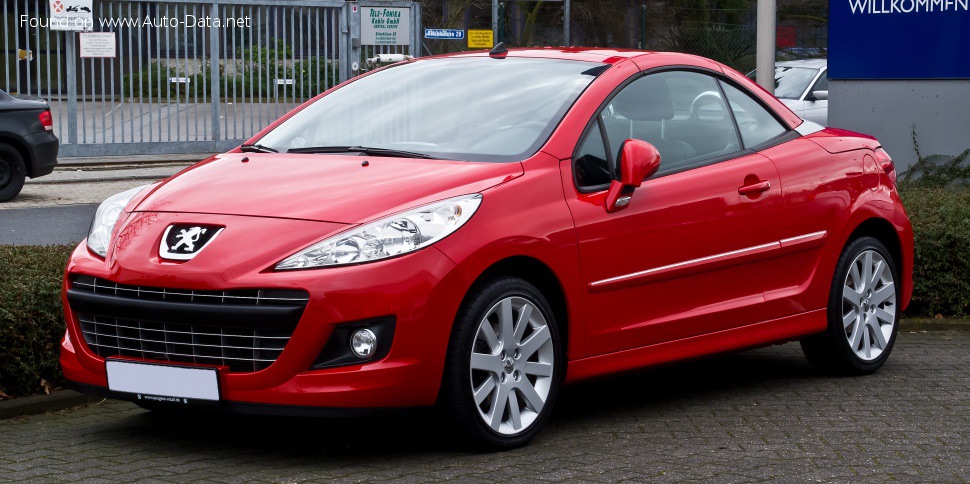
The Peugeot 207 CC (facelift 2009) retains the distinctive coupe-cabriolet body style, characterized by its sleek, two-door silhouette and a fully automatic retractable hardtop. This design offered the best of both worlds: the refined aesthetics and security of a fixed-roof coupe with the simple push of a button, and the liberating experience of a convertible. The facelift brought subtle enhancements to the front fascia, including updated headlights, a revised grille, and new bumper designs, which gave the car a more contemporary and sophisticated look.
Measuring 159.21 inches in length, 68.82 inches in width (77.64 inches including mirrors), and 54.84 inches in height, the 207 CC is a compact vehicle, making it highly maneuverable in crowded European cities. Its wheelbase spans 100 inches, contributing to a stable ride. The car typically accommodates four occupants, though the rear seats are more suited for occasional use or smaller passengers, typical of a 2+2 convertible configuration. The trunk space is notably versatile: with the roof up, it offers a respectable 13.07 cubic feet (370 liters) of cargo volume, which shrinks to 5.12 cubic feet (145 liters) when the hardtop is stowed, a common trade-off for retractable hardtop designs.
Underneath its stylish exterior, the 207 CC features a robust chassis designed for a balance of comfort and dynamic handling. It employs an independent McPherson-type front suspension and a semi-independent, coil spring rear suspension. Braking is handled by ventilated discs at the front and solid discs at the rear, complemented by an Anti-lock Braking System (ABS) for enhanced safety. The car rides on 17-inch wheels shod with 205/45 R17 tires, providing ample grip. Steering is managed by a precise rack and pinion system, offering good feedback to the driver. The vehicle’s drag coefficient (Cd) of 0.31 indicates a reasonably aerodynamic profile for a convertible.
Technical Specifications
| General Information | |
|---|---|
| Brand | Peugeot |
| Model | 207 |
| Generation | 207 CC (facelift 2009) |
| Engine Type | 1.6 THP (156 Hp) |
| Production Start | 2009 |
| Production End | 2015 |
| Powertrain Architecture | Internal Combustion Engine |
| Body Type | Coupe – Cabriolet |
| Seats | 4 |
| Doors | 2 |
| Performance Specifications | |
| Fuel Consumption (Urban) | 10.3 l/100 km (22.8 US mpg) |
| Fuel Consumption (Extra Urban) | 5.7 l/100 km (41.3 US mpg) |
| Fuel Consumption (Combined) | 7.4 l/100 km (31.8 US mpg) |
| CO2 Emissions | 170 g/km |
| Fuel Type | Petrol (Gasoline) |
| Acceleration 0 – 60 mph | 8.1 sec |
| Acceleration 0 – 100 km/h | 8.5 sec |
| Maximum Speed | 210 km/h (130.49 mph) |
| Emission Standard | Euro 5 |
| Weight-to-Power Ratio | 9 kg/Hp (110.7 Hp/tonne) |
| Weight-to-Torque Ratio | 5.9 kg/Nm (170.3 Nm/tonne) |
| Engine Specifications | |
| Power | 156 Hp @ 6000 rpm |
| Power per Liter | 97.6 Hp/l |
| Torque | 240 Nm @ 1400-4000 rpm (177.01 lb.-ft.) |
| Engine Layout | Front, Transverse |
| Engine Model/Code | 5FR EP6DT |
| Engine Displacement | 1598 cm3 (97.52 cu. in.) |
| Number of Cylinders | 4 |
| Engine Configuration | Inline |
| Cylinder Bore | 77 mm (3.03 in.) |
| Piston Stroke | 85.8 mm (3.38 in.) |
| Compression Ratio | 10.5:1 |
| Valves per Cylinder | 4 |
| Fuel Injection System | Direct injection |
| Engine Aspiration | Turbocharger, Intercooler |
| Valvetrain | DOHC-VVT |
| Engine Oil Capacity | 4.25 l (4.49 US qt) |
| Coolant Capacity | 5.5 l (5.81 US qt) |
| Space, Volume, and Weights | |
| Curb Weight | 1409 kg (3106.31 lbs.) |
| Maximum Weight | 1774 kg (3911 lbs.) |
| Maximum Load | 365 kg (804.69 lbs.) |
| Trunk Space (Minimum) | 145 l (5.12 cu. ft.) |
| Trunk Space (Maximum) | 370 l (13.07 cu. ft.) |
| Fuel Tank Capacity | 50 l (13.21 US gal) |
| Permitted Trailer Load with Brakes (12%) | 1060 kg (2336.9 lbs.) |
| Permitted Trailer Load without Brakes | 600 kg (1322.77 lbs.) |
| Dimensions | |
| Length | 4044 mm (159.21 in.) |
| Width | 1748 mm (68.82 in.) |
| Width with mirrors folded | 1818 mm (71.57 in.) |
| Width including mirrors | 1972 mm (77.64 in.) |
| Height | 1393 mm (54.84 in.) |
| Wheelbase | 2540 mm (100 in.) |
| Front Track | 1469 mm (57.83 in.) |
| Rear Track | 1470 mm (57.87 in.) |
| Drag Coefficient (Cd) | 0.31 |
| Minimum Turning Circle | 11.0 m (36.09 ft.) |
| Drivetrain, Brakes, and Suspension | |
| Drivetrain Architecture | Front-wheel drive, Internal Combustion Engine |
| Drive Wheel | Front-wheel drive |
| Number of Gears | 6 |
| Gearbox Type | Manual transmission |
| Front Suspension | Independent type McPherson |
| Rear Suspension | Semi-independent, coil spring |
| Front Brakes | Ventilated discs |
| Rear Brakes | Disc |
| Assisting Systems | ABS (Anti-lock braking system) |
| Steering Type | Steering rack and pinion |
| Tires Size | 205/45 R17 |
| Wheel Rims Size | 17 inches |
Legacy and Market Impact
The Peugeot 207 CC (facelift 2009) built upon a successful formula established by its predecessors, contributing significantly to Peugeot’s reputation as a pioneer in the affordable hardtop convertible segment. In the European market, the 207 CC faced competition from a growing number of rivals, including the Renault Megane CC, Volkswagen Eos, and Ford Focus CC. However, Peugeot’s early entry into this niche, starting with the 206 CC, gave it a strong foothold and brand recognition.
The 207 CC was particularly well-regarded for its stylish design, which managed to integrate the complex retractable hardtop mechanism without overly compromising its aesthetic appeal. Its compact dimensions made it practical for European urban environments, while the powerful and efficient 1.6 THP engine offered a compelling blend of performance and economy, appealing to a wide range of drivers looking for both fun and practicality. The hardtop provided superior refinement and weather protection compared to traditional soft-tops, making it a viable year-round vehicle, a crucial factor in many European climates.
Although it never reached American shores, the 207 CC’s success in Europe demonstrated the global appeal of well-executed niche vehicles. It showcased Peugeot’s engineering capabilities, particularly with the sophisticated THP engine developed in partnership with BMW, which found its way into various models across both brands. The 207 CC’s production run from 2009 to 2015 solidified its place as a popular and influential model in the compact convertible landscape, embodying the French automaker’s commitment to innovation and distinctive style in the mainstream market.