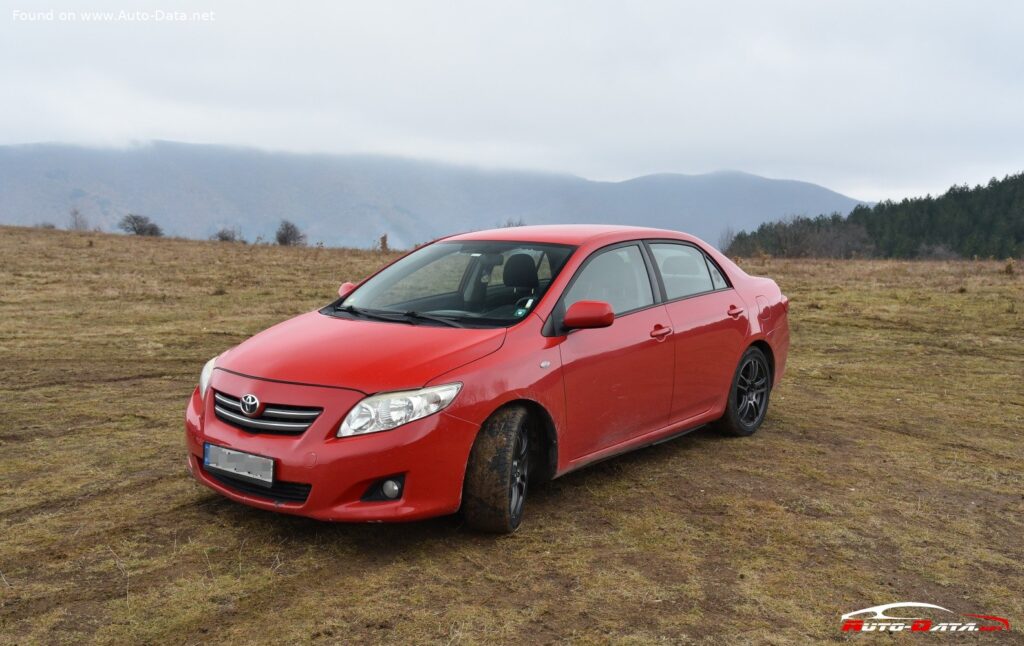
Toyota Corolla X (E140, E150) 1.6 i 16V VVT-i (124 Hp) MMT
The Toyota Corolla X, representing the tenth generation of Toyota’s globally renowned compact car, spanned production from 2006 to 2012. Known internally by its chassis codes E140 and E150, this iteration continued the Corolla’s legacy as a reliable, economical, and practical vehicle. While the Corolla nameplate is universally recognized, the specific variant under discussion, the Toyota Corolla X (E140, E150) 1.6 i 16V VVT-i (124 Hp) MMT sedan, was primarily targeted at European and Asian markets, differing significantly from the models offered in North America during the same period. This particular model featured a 1.6-liter naturally aspirated engine paired with Toyota’s Multi-mode Manual Transmission (MMT), offering a balance of efficiency and everyday performance in a four-door sedan package.
The E140/E150 generation was designed to appeal to a broad demographic, from young families to commuters, by offering a comfortable ride, a spacious interior for its class, and Toyota’s hallmark reputation for durability. Its design represented an evolution rather than a revolution, maintaining the Corolla’s understated yet functional aesthetic. For markets outside North America, particularly in Europe, the 1.6-liter engine was a popular choice, providing adequate power while adhering to stricter emissions standards like Euro 4, making it a competitive offering in the C-segment.
Engine and Performance of the Toyota Corolla X (E140, E150)
At the heart of the Toyota Corolla X (E140, E150) 1.6 i 16V VVT-i (124 Hp) MMT is the 1ZR-FE engine, a 1.6-liter (1,598 cm³ or 97.52 cu. in.) inline-four gasoline unit. This powerplant features Toyota’s VVT-i (Variable Valve Timing intelligent) technology, which optimizes valve overlap for improved fuel efficiency and power delivery across the RPM range. The engine is naturally aspirated and utilizes a multi-port manifold injection system, coupled with a DOHC (Dual Overhead Camshaft) valvetrain with four valves per cylinder, contributing to its respectable output.
This 1.6-liter engine produces 124 horsepower at 6000 rpm, delivering a power-per-liter ratio of 77.6 hp/l. Peak torque stands at 157 Nm (115.8 lb.-ft.) at 5200 rpm. These figures provide the 1300 kg (2866.01 lbs.) sedan with a weight-to-power ratio of 10.5 kg/Hp (95.4 Hp/tonne). In terms of acceleration, the vehicle can go from 0 to 60 mph in 11.5 seconds (0-100 km/h in 12.1 seconds), reaching a maximum speed of 121.79 mph (196 km/h). While not a performance-oriented variant, these metrics position it as a competent and practical choice for daily driving.
A distinctive feature of this particular model is its transmission: a 5-speed Multi-mode Manual Transmission (MMT). The MMT is an automated manual gearbox, designed to offer the fuel efficiency benefits of a manual transmission with the convenience of an automatic. It operates without a clutch pedal, using electronic actuators to engage the clutch and shift gears. While innovative for its time, the MMT often received mixed reviews, with some drivers noting its distinct shift characteristics that could feel less smooth than a conventional automatic or a well-executed manual shift. Despite this, it contributed to the vehicle’s overall fuel economy, with a combined rating of 35.1 US mpg (6.7 l/100 km), and it met the Euro 4 emission standard, demonstrating Toyota’s commitment to environmental considerations.
Design and Features
The Toyota Corolla X (E140, E150) sedan’s design is characterized by its clean lines and practical aesthetic, reflecting Toyota’s global design language for the Corolla during this era. Measuring 178.74 inches (4540 mm) in length, 69.29 inches (1760 mm) in width, and 57.87 inches (1470 mm) in height, with a wheelbase of 102.36 inches (2600 mm), the Corolla X provides a comfortable and spacious cabin for five occupants. The four-door sedan body type emphasized accessibility and utility, fitting perfectly into its role as a versatile family car or reliable commuter.
Inside, the Corolla X offered a functional and ergonomic layout. While specific trim levels and features varied by market, common elements included durable upholstery, clear instrumentation, and intuitive controls. Safety features for the era typically included ABS (Anti-lock Braking System) as standard, with airbags and other passive safety systems designed to protect occupants. The car’s 450-liter (15.89 cu. ft.) trunk space provided ample room for luggage or groceries, further enhancing its practicality. The steering system utilized a rack and pinion setup, offering a minimum turning circle of 34.12 feet (10.4 m), making it maneuverable in urban environments. The vehicle rode on 205/55 R16 tires, offering a balance of comfort and grip.
The suspension system comprised spring struts at the front and a torsion beam at the rear, a common and cost-effective setup for compact cars that provides a comfortable ride and predictable handling. Braking duties were handled by ventilated discs at the front and disc brakes at the rear, ensuring adequate stopping power for the vehicle’s performance capabilities.
Technical Specifications
| Category | Specification | US Equivalent / Notes |
|---|---|---|
| Brand | Toyota | |
| Model | Corolla | |
| Generation | Corolla X (E140, E150) | |
| Type (Engine) | 1.6 i 16V VVT-i (124 Hp) MMT | |
| Start of Production | 2006 year | |
| End of Production | 2012 year | |
| Powertrain Architecture | Internal Combustion engine | |
| Body Type | Sedan | |
| Seats | 5 | |
| Doors | 4 | |
| Performance Specs | ||
| Fuel Consumption (Urban) | 8.4 l/100 km | 28 US mpg |
| Fuel Consumption (Extra Urban) | 5.7 l/100 km | 41.3 US mpg |
| Fuel Consumption (Combined) | 6.7 l/100 km | 35.1 US mpg |
| Fuel Type | Petrol (Gasoline) | |
| Acceleration 0 – 60 mph | 11.5 sec | |
| Acceleration 0 – 100 km/h | 12.1 sec | |
| Maximum Speed | 196 km/h | 121.79 mph |
| Emission Standard | Euro 4 | |
| Weight-to-Power Ratio | 10.5 kg/Hp | 95.4 Hp/tonne |
| Weight-to-Torque Ratio | 8.3 kg/Nm | 120.8 Nm/tonne |
| Engine Specs | ||
| Power | 124 Hp @ 6000 rpm | |
| Power per Liter | 77.6 Hp/l | |
| Torque | 157 Nm @ 5200 rpm | 115.8 lb.-ft. @ 5200 rpm |
| Engine Layout | Front, Transverse | |
| Engine Model/Code | 1ZR-FE | |
| Engine Displacement | 1598 cm³ | 1.6 Liters (97.52 cu. in.) |
| Number of Cylinders | 4 | |
| Engine Configuration | Inline | |
| Cylinder Bore | 80.5 mm | 3.17 in. |
| Piston Stroke | 78.5 mm | 3.09 in. |
| Compression Ratio | 10.2:1 | |
| Number of Valves per Cylinder | 4 | |
| Fuel Injection System | Multi-port manifold injection | |
| Engine Aspiration | Naturally aspirated engine | |
| Valvetrain | DOHC | |
| Engine Oil Capacity | 4.2 l | 4.44 US qt |
| Coolant Capacity | 5.5 l | 5.81 US qt |
| Space, Volume and Weights | ||
| Kerb Weight | 1300 kg | 2866.01 lbs. |
| Max. Weight | 1785 kg | 3935.25 lbs. |
| Max Load | 485 kg | 1069.24 lbs. |
| Trunk (Boot) Space – Minimum | 450 l | 15.89 cu. ft. |
| Fuel Tank Capacity | 55 l | 14.53 US gal |
| Dimensions | ||
| Length | 4540 mm | 178.74 in. |
| Width | 1760 mm | 69.29 in. |
| Height | 1470 mm | 57.87 in. |
| Wheelbase | 2600 mm | 102.36 in. |
| Front Track | 1525 mm | 60.04 in. |
| Rear (Back) Track | 1520 mm | 59.84 in. |
| Minimum Turning Circle | 10.4 m | 34.12 ft. |
| Drivetrain, Brakes and Suspension Specs | ||
| Drivetrain Architecture | Front wheel drive, Internal Combustion engine | |
| Drive Wheel | Front wheel drive | |
| Number of Gears and Type of Gearbox | 5 gears, automatic transmission (MMT) | |
| Front Suspension | Spring Strut | |
| Rear Suspension | Torsion | |
| Front Brakes | Ventilated discs | |
| Rear Brakes | Disc | |
| Assisting Systems | ABS (Anti-lock braking system) | |
| Steering Type | Steering rack and pinion | |
| Tires Size | 205/55 R16 | |
Legacy and Market Impact
The Toyota Corolla, in its tenth generation (E140, E150), continued to be a cornerstone of Toyota’s global sales strategy. While the specific 1.6-liter MMT variant was not a primary offering in the North American market, it played a crucial role in Europe, Asia, and other regions where smaller-displacement engines and efficiency were paramount. In these markets, the Corolla competed fiercely with popular compact sedans such as the Honda Civic, Volkswagen Jetta (known as Bora or Vento in some markets), Ford Focus, and Opel Astra (Vauxhall Astra in the UK).
The Toyota Corolla X (E140, E150) 1.6 i 16V VVT-i (124 Hp) MMT maintained the Corolla’s legendary reputation for reliability and low running costs. This was a significant draw for consumers who prioritized long-term dependability and value. Its 1ZR-FE engine, with VVT-i technology, proved to be robust and efficient, contributing to the car’s appeal in markets sensitive to fuel prices and emissions regulations. The Euro 4 compliance was a key factor in its market acceptance in Europe.
The Multi-mode Manual Transmission (MMT), however, often stood out as a point of contention. While it aimed to blend the best of manual and automatic transmissions, its operational characteristics, which included noticeable pauses during gear changes and a learning curve for smooth driving, sometimes deterred drivers accustomed to conventional automatics. Despite this, for many, the MMT offered a cost-effective automatic-like experience with improved fuel economy compared to a traditional torque-converter automatic, making it an acceptable compromise in certain markets.
Overall, the Corolla X generation solidified the model’s position as one of the best-selling nameplates in automotive history. Its impact was characterized by its consistent delivery of practical transportation, unwavering reliability, and adaptability to diverse global market demands. Even today, these tenth-generation Corollas remain a common sight on roads worldwide, a testament to their enduring quality and the robust engineering that Toyota instilled in every iteration of this iconic compact car.