
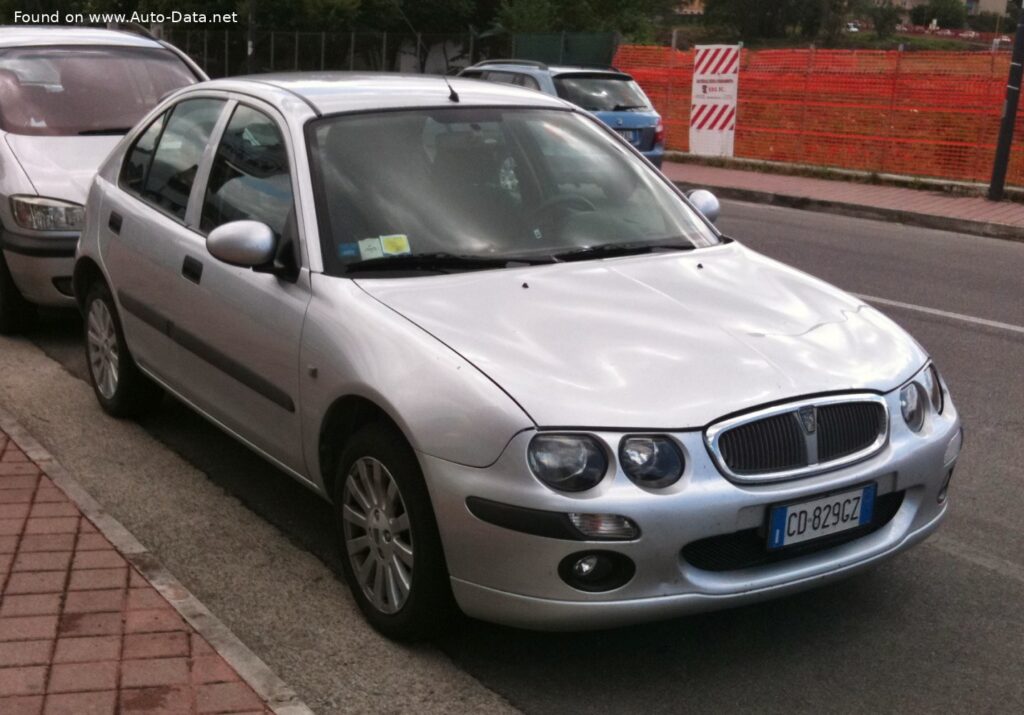
The Rover 25 (RF) 1.4 i 16V (103 Hp): A British Compact Car Perspective
The Rover 25 (RF) 1.4 i 16V (103 Hp) represents a significant chapter in the history of the British automotive industry, serving as a compact hatchback (often referred to as a supermini in its primary European market) during a transitional period for the Rover brand. Introduced in 1999 as a facelifted and rebadged version of the popular Rover 200 (R3) series, the Rover 25 aimed to revitalize the marque’s presence in the fiercely competitive small car segment. Produced until 2005, this generation of the Rover 25 was designed to offer a blend of traditional British styling cues, practicality, and a spirited driving experience, particularly in the 1.4-liter 16-valve variant. While never officially sold in the United States, the Rover 25 played a crucial role in its home market, embodying Rover’s final efforts to appeal to a broad customer base with an accessible and somewhat upscale compact vehicle. Its design and engineering reflected the trends of late 20th and early 21st-century European compacts, emphasizing efficiency, maneuverability, and a degree of comfort for its class.
Engine and Performance
At the heart of the Rover 25 (RF) 1.4 i 16V (103 Hp) lies Rover’s venerable K-Series engine, a 1.4-liter (1396 cm3 or 85.19 cu. in.) inline-four gasoline unit. This particular iteration of the K-Series was notable for its multi-port manifold injection and a sophisticated 16-valve DOHC (Double Overhead Camshaft) valvetrain, a configuration that allowed for efficient breathing and a commendable power output for its displacement. The engine, designated with the K code, was mounted transversely at the front and drove the front wheels, a standard layout for compact cars of its era, optimizing both interior space and manufacturing efficiency.
This naturally aspirated powerplant delivered a respectable 103 horsepower at a relatively high 6000 rpm, showcasing its free-revving nature. Torque output stood at 90.72 lb.-ft. (123 Nm) arriving at 4500 rpm, providing adequate pulling power for city driving and highway cruising. Mated to a precise 5-speed manual transmission, the 1.4 i 16V variant offered a lively performance for its class. Acceleration from 0 to 60 mph was achieved in a brisk 9.7 seconds (0-100 km/h in 10.2 seconds), and the vehicle could reach a maximum speed of 111.85 mph (180 km/h). These figures positioned the Rover 25 as a competitive option against its European rivals in terms of dynamic capability.
Fuel economy was also a strong suit for the 1.4-liter engine. The combined fuel consumption was rated at 35.6 US mpg (6.6 L/100 km), with urban consumption at 26.7 US mpg (8.8 L/100 km) and extra-urban figures reaching an impressive 44.4 US mpg (5.3 L/100 km). With a fuel tank capacity of 13.21 US gallons (50 liters), the Rover 25 offered a decent cruising range. The engine’s lightweight design contributed to a favorable weight-to-power ratio of 10.7 kg/Hp (93.2 Hp/tonne), aiding both performance and efficiency. Despite its positive attributes, the K-Series engine was also known for potential head gasket issues in some applications, a factor that sometimes overshadowed its otherwise innovative design and strong performance.
Design and Features
The Rover 25 (RF) adopted the popular hatchback body style, available in both 3-door and 5-door configurations, offering seating for five occupants. Its design language was an evolution of the Rover 200, incorporating a more contemporary and slightly more aggressive front fascia characterized by a distinctive “quad lamp” headlight arrangement and a revised grille. This update aimed to give the car a sportier and more modern appearance, distancing it from the more conservative styling of its predecessor.
In terms of dimensions, the Rover 25 was a compact vehicle, measuring 157.09 inches (3990 mm) in length, 66.46 inches (1688 mm) in width, and 55.79 inches (1417 mm) in height. Its wheelbase of 98.43 inches (2500 mm) provided a stable ride for its size, while front and rear tracks of 57.99 inches (1473 mm) and 57.72 inches (1466 mm), respectively, contributed to its handling characteristics. The car’s curb weight of 2436.11 lbs (1105 kg) made it relatively light, further enhancing its agility and fuel efficiency.
The interior of the Rover 25, while functional, often featured a more traditional British aesthetic compared to some of its continental rivals. Depending on the trim level, it could include touches like wood trim or higher-quality fabric upholstery, aiming for a slightly more premium feel within the compact segment. Practicality was a key consideration, with a minimum trunk space of 10.74 cu. ft. (304 liters), which could expand to a generous 38.35 cu. ft. (1086 liters) with the rear seats folded down, making it versatile for carrying luggage or larger items.
For its time, the Rover 25 included essential features for comfort and safety. The suspension system comprised a wishbone setup at the front and a spring strut arrangement at the rear, providing a balance between ride comfort and handling. Braking was handled by ventilated discs at the front and drum brakes at the rear, augmented by an Anti-lock Braking System (ABS) for improved stopping performance and control under emergency conditions. Steering was a hydraulic rack and pinion system, offering direct feedback to the driver. The car rode on 175/65 R14 T tires, standard for a compact vehicle of its era.
Technical Specifications
| Feature | Specification |
|---|---|
| Brand | Rover |
| Model | 25 |
| Generation | 25 (RF) |
| Type (Engine) | 1.4 i 16V (103 Hp) |
| Start of Production | 1999 year |
| End of Production | 2005 year |
| Powertrain Architecture | Internal Combustion engine |
| Body Type | Hatchback |
| Seats | 5 |
| Doors | 3-5 |
| Fuel Consumption (Economy) – Urban | 8.8 l/100 km (26.7 US mpg) |
| Fuel Consumption (Economy) – Extra Urban | 5.3 l/100 km (44.4 US mpg) |
| Fuel Consumption (Economy) – Combined | 6.6 l/100 km (35.6 US mpg) |
| Fuel Type | Petrol (Gasoline) |
| Acceleration 0 – 60 mph | 9.7 sec |
| Acceleration 0 – 100 km/h | 10.2 sec |
| Maximum Speed | 180 km/h (111.85 mph) |
| Weight-to-Power Ratio | 10.7 kg/Hp, 93.2 Hp/tonne |
| Weight-to-Torque Ratio | 9 kg/Nm, 111.3 Nm/tonne |
| Power | 103 Hp @ 6000 rpm. |
| Power per Liter | 73.8 Hp/l |
| Torque | 123 Nm @ 4500 rpm (90.72 lb.-ft. @ 4500 rpm) |
| Engine Layout | Front, Transverse |
| Engine Model/Code | K |
| Engine Displacement | 1396 cm3 (85.19 cu. in.) |
| Number of Cylinders | 4 |
| Engine Configuration | Inline |
| Cylinder Bore | 75 mm (2.95 in.) |
| Piston Stroke | 79 mm (3.11 in.) |
| Compression Ratio | 10.5:1 |
| Number of Valves per Cylinder | 4 |
| Fuel Injection System | Multi-port manifold injection |
| Engine Aspiration | Naturally aspirated engine |
| Valvetrain | DOHC |
| Engine Oil Capacity | 4.5 l (4.76 US qt) |
| Coolant Capacity | 4.6 l (4.86 US qt) |
| Kerb Weight | 1105 kg (2436.11 lbs) |
| Maximum Weight | 1500 kg (3306.93 lbs) |
| Maximum Load | 395 kg (870.83 lbs) |
| Trunk (Boot) Space – Minimum | 304 l (10.74 cu. ft.) |
| Trunk (Boot) Space – Maximum | 1086 l (38.35 cu. ft.) |
| Fuel Tank Capacity | 50 l (13.21 US gal) |
| Length | 3990 mm (157.09 in.) |
| Width | 1688 mm (66.46 in.) |
| Height | 1417 mm (55.79 in.) |
| Wheelbase | 2500 mm (98.43 in.) |
| Front Track | 1473 mm (57.99 in.) |
| Rear (Back) Track | 1466 mm (57.72 in.) |
| Drivetrain Architecture | The Internal combustion engine (ICE) drives the front wheels of the vehicle. |
| Drive Wheel | Front wheel drive |
| Number of Gears and Type of Gearbox | 5 gears, manual transmission |
| Front Suspension | Wishbone |
| Rear Suspension | Spring Strut |
| Front Brakes | Ventilated discs |
| Rear Brakes | Drum |
| Assisting Systems | ABS (Anti-lock braking system) |
| Steering Type | Steering rack and pinion |
| Power Steering | Hydraulic Steering |
| Tires Size | 175/65 R14 T |
Legacy and Market Impact
The Rover 25 (RF) emerged at a precarious time for the Rover Group, serving as a critical volume seller in the fiercely competitive European compact car market. It was an evolution rather than a revolution, essentially a heavily revised Rover 200, which meant it carried forward an aging platform that dated back to the mid-1990s. Despite this, Rover positioned the 25 as a more dynamic and youthful offering, aiming to capture a broader demographic with its refreshed styling and a slightly sportier demeanor.
In its primary market, the Rover 25 faced stiff competition from well-established and highly regarded rivals such as the Ford Fiesta, Vauxhall Corsa (Opel Corsa in mainland Europe), Volkswagen Polo, Peugeot 206, and Renault Clio. These competitors often boasted more modern platforms, innovative features, and, in some cases, better perceived reliability. The Rover 25 attempted to differentiate itself with its distinctively British character, a comfortable ride, and a relatively upscale interior for its class, often featuring traditional design elements that appealed to a segment of buyers.
The 1.4 i 16V (103 Hp) variant was particularly important, offering a compelling balance of performance and economy that resonated with many buyers seeking a practical yet engaging daily driver. Its relatively sprightly acceleration and good fuel efficiency made it a popular choice among private buyers and fleet operators alike. However, persistent concerns over the reliability of the K-Series engine’s head gasket, though often exaggerated or due to poor maintenance, did impact the car’s long-term reputation.
As Rover’s fortunes declined in the early 2000s, the 25, along with its larger sibling the 45, became a symbol of the company’s struggle to modernize and compete effectively against global automotive giants. Attempts were made to broaden its appeal with niche variants like the rugged-looking Streetwise and the ill-fated CityRover, a rebadged Tata Indica. Ultimately, the Rover 25 ceased production in 2005 with the collapse of MG Rover Group, marking the end of an era for a storied British brand.
Despite its eventual fate, the Rover 25 remains an interesting footnote in automotive history. It showcased Rover’s capabilities in engine design with the K-Series and its efforts to maintain a distinct brand identity. Today, it is remembered as one of the last true Rovers, a practical and characterful compact car that, for a time, offered a unique British alternative in a market dominated by continental European and Asian manufacturers. Its legacy is intertwined with the broader narrative of the British automotive industry’s challenges and transformations at the turn of the millennium.
