The Nissan Silvia (S15) 2.0 i 16V (165 Hp) Automatic: A JDM Icon’s Refined Side
The Nissan Silvia (S15) represents the seventh and final generation of Nissan’s revered Silvia line, a series of compact sports cars that captured the hearts of enthusiasts worldwide. Produced from 1999 to 2002, the S15 was primarily sold in Japan, Australia, and New Zealand, never officially reaching North American shores. Nevertheless, its aggressive styling, potent performance, and rear-wheel-drive architecture cemented its status as a highly sought-after import, particularly within the drifting and tuning communities. While the turbocharged Spec-R variant often garners the most attention, the Nissan Silvia (S15) 2.0 i 16V (165 Hp) Automatic offered a more accessible and refined entry into the S15 lineage, providing a blend of sporty aesthetics with a comfortable, automatic driving experience for its primary markets.
Engine and Performance: The Naturally Aspirated Heart
At the core of this particular Nissan Silvia (S15) variant is the SR20DE engine, a naturally aspirated (NA) version of Nissan’s renowned SR20 series. This 2.0-liter (1998 cm³ or 121.93 cu. in.) inline-four engine features a Double Overhead Camshaft (DOHC) valvetrain with 16 valves, providing efficient breathing and a respectable power output for its segment. The engine’s layout is front-mounted and longitudinal, a classic configuration for a rear-wheel-drive sports coupe, contributing to its balanced weight distribution and engaging driving dynamics.
The SR20DE in this specification produces 165 horsepower at 6400 rpm, delivering a power-per-liter ratio of 82.6 Hp/l. Torque peaks at 141.61 lb.-ft. (192 Nm) at 4800 rpm, providing a strong mid-range pull. While not as explosively powerful as its turbocharged SR20DET sibling, the NA SR20DE is known for its smooth power delivery, reliability, and surprisingly good response, especially in the upper rev range. Paired exclusively with a 4-speed automatic transmission, this version of the S15 was geared towards a driver seeking a more relaxed yet still sporty experience, suitable for daily commuting or cruising rather than outright track performance.
Performance figures include a top speed of 130.49 mph (210 km/h), making it a capable performer on highways. The vehicle’s curb weight of 2645.55 lbs (1200 kg) contributes to a favorable weight-to-power ratio of 7.3 kg/Hp, or 137.5 Hp per tonne, allowing for sprightly acceleration despite the automatic gearbox. Fuel economy for urban driving is rated at approximately 19.6 US mpg (12 l/100 km), which was competitive for a compact sports coupe of its era.
Design and Features: Sharper Edges, Classic Coupe Appeal
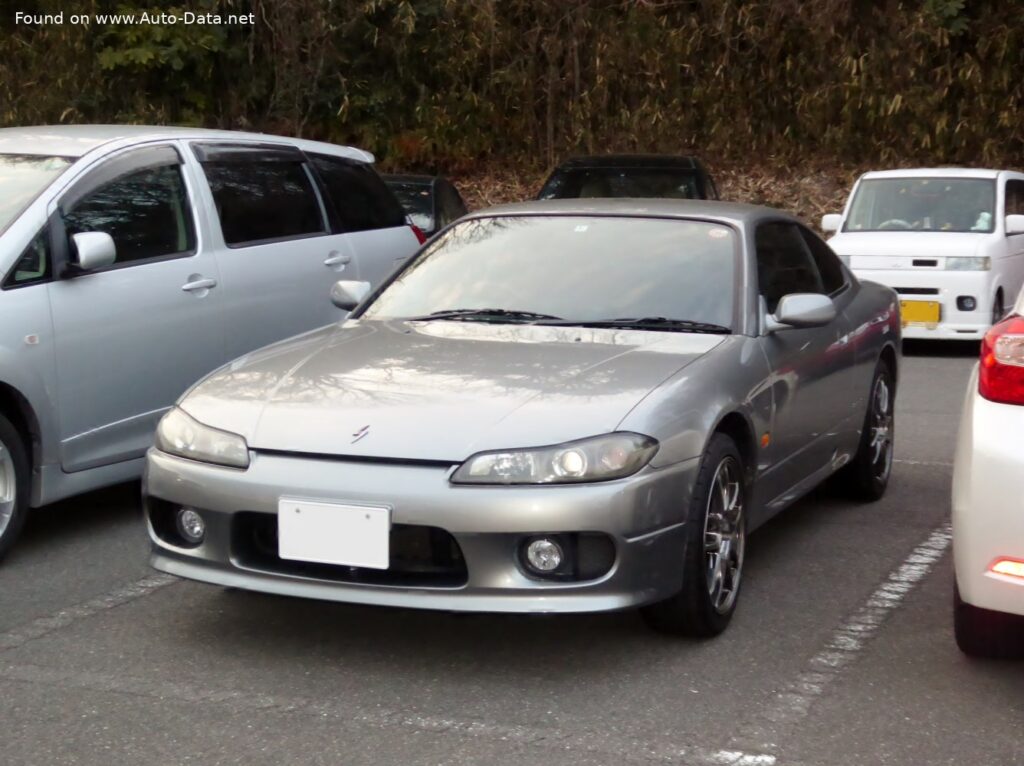
The Nissan Silvia (S15) marked a significant evolution in design from its predecessor, the S14. It adopted a sharper, more aggressive aesthetic that resonated strongly with the automotive trends of the late 1990s and early 2000s. The coupe body style, with its sleek two-door silhouette and four-seat configuration (though the rear seats were primarily for occasional use), exuded a strong sense of sportiness. Its dimensions—175 inches in length, 66.73 inches in width, and 50.59 inches in height—gave it a compact yet purposeful stance on the road, further accentuated by a wheelbase of 99.41 inches.
Key design elements include its distinctive headlights, bold front grille, and a sculpted rear end that gave it a more modern and aerodynamic appearance. The standard 205/55 R16 tires on 16-inch wheels provided a good balance of grip and ride comfort. Inside, the S15 maintained a driver-focused cockpit, with clear instrumentation and ergonomically placed controls, typical of Japanese sports cars of the period.
In terms of features, this Silvia variant came equipped with essential systems for its time. Safety was addressed with an Anti-lock Braking System (ABS), providing enhanced control during emergency braking. The braking system itself comprised ventilated discs at the front and solid discs at the rear, ensuring adequate stopping power. A hydraulic power steering system offered direct and responsive feedback, a hallmark of sports cars designed for driver engagement. The suspension setup, featuring coil springs at both the front and rear, was tuned to provide a firm yet compliant ride, balancing everyday usability with spirited driving capabilities.
Technical Specifications
| Category | Specification |
|---|---|
| General Information | |
| Brand | Nissan |
| Model | Silvia |
| Generation | Silvia (S15) |
| Type (Engine) | 2.0 i 16V (165 Hp) Automatic |
| Start of Production | 1999 year |
| End of Production | 2002 year |
| Powertrain Architecture | Internal Combustion engine |
| Body type | Coupe |
| Seats | 4 |
| Doors | 2 |
| Performance Specs | |
| Fuel Consumption (economy) – urban | 12 l/100 km (19.6 US mpg) |
| Fuel Type | Petrol (Gasoline) |
| Maximum Speed | 210 km/h (130.49 mph) |
| Weight-to-Power Ratio | 7.3 kg/Hp (137.5 Hp/tonne) |
| Weight-to-Torque Ratio | 6.3 kg/Nm (160 Nm/tonne) |
| Engine Specs | |
| Power | 165 Hp @ 6400 rpm |
| Power per liter | 82.6 Hp/l |
| Torque | 192 Nm @ 4800 rpm (141.61 lb.-ft. @ 4800 rpm) |
| Engine Layout | Front, Longitudinal |
| Engine Model/Code | SR20DE |
| Engine Displacement | 1998 cm³ (2.0 l / 121.93 cu. in.) |
| Number of Cylinders | 4 |
| Engine Configuration | Inline |
| Cylinder Bore | 86 mm (3.39 in.) |
| Piston Stroke | 86 mm (3.39 in.) |
| Compression Ratio | 9.5:1 |
| Number of Valves per Cylinder | 4 |
| Fuel Injection System | Multi-port manifold injection |
| Engine Aspiration | Naturally aspirated engine |
| Valvetrain | DOHC |
| Engine Oil Capacity | 3.4 l (3.59 US qt) |
| Space, Volume and Weights | |
| Kerb Weight | 1200 kg (2645.55 lbs) |
| Max. Weight | 1650 kg (3637.63 lbs) |
| Max Load | 450 kg (992.08 lbs) |
| Trunk (boot) Space – minimum | 240 l (8.48 cu. ft.) |
| Fuel Tank Capacity | 65 l (17.17 US gal) |
| Dimensions | |
| Length | 4445 mm (175 in.) |
| Width | 1695 mm (66.73 in.) |
| Height | 1285 mm (50.59 in.) |
| Wheelbase | 2525 mm (99.41 in.) |
| Front Track | 1480 mm (58.27 in.) |
| Rear (Back) Track | 1470 mm (57.87 in.) |
| Minimum Turning Circle (turning diameter) | 9.8 m (32.15 ft.) |
| Drivetrain, Brakes and Suspension Specs | |
| Drivetrain Architecture | Internal combustion engine (ICE) drives the rear wheels of the vehicle. |
| Drive Wheel | Rear wheel drive |
| Number of Gears and Type of Gearbox | 4 gears, automatic transmission |
| Front Suspension | Coil spring |
| Rear Suspension | Coil spring |
| Front Brakes | Ventilated discs |
| Rear Brakes | Disc |
| Assisting Systems | ABS (Anti-lock braking system) |
| Power Steering | Hydraulic Steering |
| Tires Size | 205/55 R16 |
| Wheel Rims Size | 16 |
Legacy and Market Impact: The End of an Era
The Nissan Silvia (S15) holds a significant place in automotive history, particularly as the swan song of a legendary nameplate. Its production run from 1999 to 2002 marked the culmination of decades of Nissan’s commitment to delivering accessible, fun-to-drive, rear-wheel-drive sports coupes. While the 2.0 i 16V (165 Hp) Automatic variant might not boast the raw power of its turbocharged counterparts, it contributed to the S15’s broader appeal by offering a more comfortable and fuel-efficient option for the Japanese domestic market (JDM) and other Asian and Oceanic regions.
In its primary markets, the S15 competed with a range of Japanese sports cars. While direct competitors for the NA automatic model might include more comfort-oriented coupes like certain trims of the Toyota Celica (though primarily front-wheel drive), its true spirit and lineage placed it alongside vehicles such as the Honda Integra Type R (front-wheel drive, but performance-focused) or even smaller, lighter sports cars like the Mazda MX-5 Miata, albeit with a different focus on practicality and power. The S15’s rear-wheel-drive platform and strong aftermarket support, even for the NA models, also made it an attractive base for enthusiasts looking to build a custom project or participate in grassroots motorsport.
The S15’s reputation has only grown since its discontinuation. Its distinct styling, robust chassis, and the legacy of the SR20 engine family have ensured its status as a modern classic. It is widely celebrated in popular culture, appearing in numerous video games, movies, and anime, which has further fueled its desirability globally. Even the naturally aspirated, automatic versions are increasingly valued as examples of the model’s lineage, often serving as entry points for enthusiasts who later upgrade or simply appreciate the S15’s inherent balance and aesthetic appeal. The Silvia S15 remains a testament to Nissan’s engineering prowess and its ability to create vehicles that resonate deeply with driving enthusiasts, solidifying its place as a revered icon in the pantheon of Japanese sports cars.