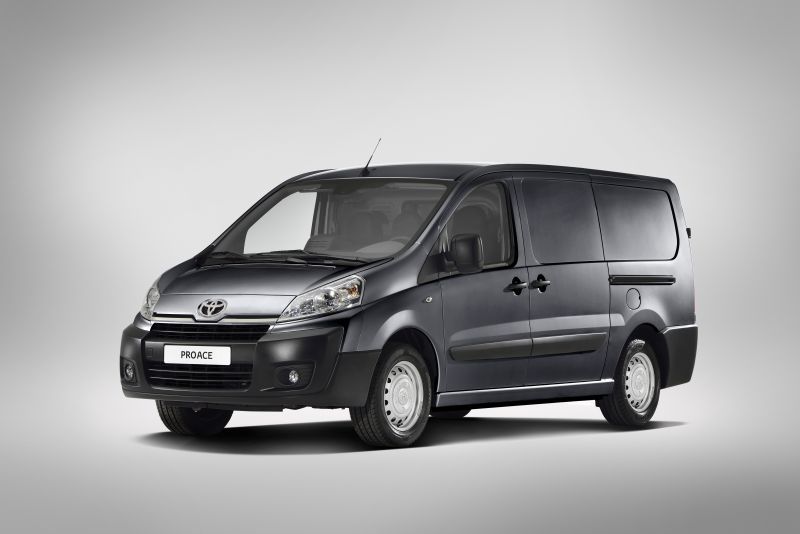
The Toyota Proace City LWB 1.5 D-4D (102 Hp): A Versatile European Workhorse
The
Toyota Proace City LWB 1.5 D-4D (102 Hp)
represents a compelling entry in the compact light commercial vehicle (LCV) segment, primarily serving the European and other international markets. Launched in April 2020, this specific iteration, part of the Proace City’s first generation, is a long-wheelbase minivan designed to offer a blend of practicality, efficiency, and maneuverability for businesses and private users alike. It’s a testament to Toyota’s strategic collaboration with Stellantis (formerly PSA Group), sharing its platform and core components with models like the Citroën Berlingo, Peugeot Partner, and Opel Combo. While not sold in the United States, the Proace City is a critical component of Toyota’s commercial vehicle strategy abroad, providing a robust and economical solution for urban logistics and passenger transport.
This particular model, equipped with the 1.5-liter D-4D diesel engine producing 102 horsepower, emphasizes fuel economy and low emissions, aligning with stringent European environmental standards. Its long-wheelbase configuration maximizes cargo volume, making it an ideal choice for tradespeople, delivery services, and families requiring substantial space. The Proace City LWB blends Toyota’s renowned reliability with European design and engineering, offering a practical and cost-effective solution in a highly competitive market segment.
Engine and Performance of the Toyota Proace City LWB
At the heart of the
Toyota Proace City LWB 1.5 D-4D (102 Hp)
is a highly efficient and robust 1.5-liter (1499 cm³ or 91.47 cu. in.) D-4D inline four-cylinder diesel engine. This unit, codenamed YH01, is positioned transversely at the front and features a modern common rail direct fuel injection system, augmented by a turbocharger and intercooler for optimal power delivery and efficiency. With a power output of 102 horsepower (Hp) at 3500 rpm and a substantial 250 Nm (184.39 lb.-ft.) of torque available from a low 1750 rpm, the engine is well-suited for hauling loads and navigating both urban environments and open highways. The peak torque at low RPMs ensures excellent responsiveness and pulling power, a crucial attribute for a commercial vehicle.
Power is sent to the front wheels via a smooth-shifting 5-speed manual transmission, a choice that prioritizes driver engagement and cost-effectiveness. The powertrain architecture, driving the front wheels, contributes to better traction and interior packaging. The engine is also equipped with modern features such as a Start & Stop System, which conserves fuel during idle, and a particulate filter, crucial for meeting the stringent Euro 6d-ISC-FCM emission standard.
Fuel economy is a standout feature, particularly important for commercial operators. According to the WLTP cycle, the combined fuel consumption ranges from 5.2 to 5.7 liters per 100 kilometers, which translates to an impressive 45.2 to 41.3 US miles per gallon. CO2 emissions are kept within 137-150 g/km, reflecting its environmentally conscious design. The vehicle’s weight-to-power ratio stands at 13.3 kg/Hp (75.3 Hp/tonne), while the weight-to-torque ratio is 5.4 kg/Nm (184.5 Nm/tonne), indicating a well-balanced performance profile for its intended utility. The 50-liter (13.21 US gallon) fuel tank, complemented by a 17-liter (4.49 US gallon) AdBlue tank, ensures a practical range for daily operations.
Design and Features
The Toyota Proace City LWB is characterized by its functional and practical minivan body type, featuring five doors and seating for 2-3 occupants, catering specifically to commercial applications where cargo space is paramount. Its long-wheelbase designation is reflected in its generous dimensions: a length of 4753 mm (187.13 inches), a width of 1848 mm (72.76 inches) (2107 mm or 82.95 inches including mirrors), and a height ranging from 1812-1860 mm (71.34-73.23 inches). The substantial wheelbase of 2975 mm (117.13 inches) directly contributes to its impressive cargo capacity and stable ride.
The design prioritizes utility, with a focus on ease of loading and unloading. The large rear and side doors provide excellent access to the cargo area. The minimum trunk (boot) space is an expansive 3900 liters (137.73 cu. ft.), which can be expanded to 4300 liters (151.85 cu. ft.), making it exceptionally versatile for various cargo requirements. The maximum payload capacity is a robust 1045 kg (2303.83 lbs.), further underscoring its commercial credentials. It also boasts a permitted trailer load with brakes of 1350 kg (2976.24 lbs.) and without brakes of 750 kg (1653.47 lbs.), enhancing its utility for businesses that need to tow equipment.
Underneath, the Proace City LWB employs a tried-and-tested suspension setup: an independent McPherson type at the front and a torsion beam at the rear, designed to handle varying loads while maintaining ride comfort. Braking is managed by ventilated discs at the front and disc brakes at the rear, complemented by an Anti-lock Braking System (ABS) for enhanced safety. The electric power steering, with a rack and pinion system, provides light and precise handling, particularly beneficial in urban environments where the minimum turning circle is a respectable 11.5 meters (37.73 feet). The vehicle rides on 215/65 R16 98H or 205/60 R16 96H tires, mounted on 6.5J x 16 wheel rims, offering a good balance of durability and ride comfort.
Technical Specifications
| Category | Specification | US Equivalent |
|---|---|---|
General Information
|
||
| Brand | Toyota | Toyota |
| Model | Proace City | Proace City |
| Generation | Proace City LWB | Proace City LWB |
| Engine Type | 1.5 D-4D (102 Hp) | 1.5 D-4D (102 Hp) |
| Production Start | April, 2020 | April, 2020 |
| Body Type | Minivan | Minivan |
| Seats | 2-3 | 2-3 |
| Doors | 5 | 5 |
Performance Specifications
|
||
| Combined Fuel Consumption (WLTP) | 5.2-5.7 l/100 km | 45.2 – 41.3 US mpg |
| CO2 Emissions (WLTP) | 137-150 g/km | 137-150 g/km |
| Fuel Type | Diesel | Diesel |
| Emission Standard | Euro 6d-ISC-FCM | Euro 6d-ISC-FCM |
Engine Specifications
|
||
| Power | 102 Hp @ 3500 rpm | 102 Hp @ 3500 rpm |
| Torque | 250 Nm @ 1750 rpm | 184.39 lb.-ft. @ 1750 rpm |
| Engine Layout | Front, Transverse | Front, Transverse |
| Engine Displacement | 1499 cm³ | 1.5 liters (91.47 cu. in.) |
| Number of Cylinders | 4, Inline | 4, Inline |
| Valves per Cylinder | 4 | 4 |
| Fuel Injection System | Diesel Commonrail | Diesel Commonrail |
| Engine Aspiration | Turbocharger, Intercooler | Turbocharger, Intercooler |
| Valvetrain | OHC | OHC |
| Engine Oil Capacity | 4 liters | 4.23 US quarts |
Space, Volume, and Weights
|
||
| Kerb Weight | 1355 kg | 2987.26 lbs. |
| Max. Weight (GVWR) | 2400 kg | 5291.09 lbs. |
| Max Load | 1045 kg | 2303.83 lbs. |
| Trunk Space (Min-Max) | 3900 – 4300 liters | 137.73 – 151.85 cu. ft. |
| Fuel Tank Capacity | 50 liters | 13.21 US gallons |
| AdBlue Tank Capacity | 17 liters | 4.49 US gallons |
| Max. Roof Load | 150 kg | 330.69 lbs. |
| Permitted Trailer Load (with brakes) | 1350 kg | 2976.24 lbs. |
| Permitted Trailer Load (without brakes) | 750 kg | 1653.47 lbs. |
Dimensions
|
||
| Length | 4753 mm | 187.13 inches |
| Width | 1848 mm | 72.76 inches |
| Width including mirrors | 2107 mm | 82.95 inches |
| Height | 1812-1860 mm | 71.34 – 73.23 inches |
| Wheelbase | 2975 mm | 117.13 inches |
| Front Track | 1553 mm | 61.14 inches |
| Rear Track | 1549-1568 mm | 60.98 – 61.73 inches |
| Front Overhang | 892 mm | 35.12 inches |
| Rear Overhang | 886 mm | 34.88 inches |
| Ride Height (Ground Clearance) | 160-175 mm | 6.3 – 6.89 inches |
| Minimum Turning Circle | 11.5 m | 37.73 ft. |
Drivetrain, Brakes, and Suspension
|
||
| Drivetrain Architecture | Front wheel drive | Front wheel drive |
| Gearbox | 5 gears, manual transmission | 5 gears, manual transmission |
| Front Suspension | Independent type McPherson | Independent type McPherson |
| Rear Suspension | Torsion beam | Torsion beam |
| Front Brakes | Ventilated discs | Ventilated discs |
| Rear Brakes | Disc | Disc |
| Assisting Systems | ABS (Anti-lock braking system) | ABS (Anti-lock braking system) |
| Steering Type | Steering rack and pinion | Steering rack and pinion |
| Power Steering | Electric Steering | Electric Steering |
| Tire Size | 215/65 R16 98H; 205/60 R16 96H | 215/65 R16 98H; 205/60 R16 96H |
| Wheel Rims Size | 6.5J x 16 | 6.5J x 16 |
Legacy and Market Impact
The Toyota Proace City LWB, including the 1.5 D-4D (102 Hp) variant, has carved out a significant niche in the highly competitive European and international light commercial vehicle market. Its introduction marked Toyota’s strengthened presence in the compact van segment, a move facilitated by its strategic partnership with Stellantis. This collaboration allows Toyota to offer a well-engineered and proven platform, benefiting from economies of scale and shared development costs, while still leveraging the Toyota brand’s reputation for reliability and customer service.
In its primary markets, the Proace City LWB competes directly with established players such as the Ford Transit Connect, Renault Kangoo, Volkswagen Caddy, and its platform siblings from Citroën, Peugeot, and Opel. Its long-wheelbase configuration and impressive cargo volume, combined with an efficient diesel powertrain, make it a strong contender for businesses requiring maximum utility without sacrificing maneuverability in urban areas. The 102 Hp diesel engine strikes an excellent balance between performance for carrying heavy loads and exceptional fuel economy, which is a major cost factor for commercial fleets.
The vehicle’s adherence to Euro 6d-ISC-FCM emission standards, coupled with its Start & Stop system and particulate filter, highlights its commitment to environmental responsibility, a growing concern for businesses and regulatory bodies in Europe. This focus on efficiency and lower emissions contributes to reduced operating costs and a smaller carbon footprint, enhancing its appeal to fleet managers.
For Toyota, the Proace City LWB complements its larger Proace van lineup, providing a comprehensive range of commercial vehicles to meet diverse business needs. Its impact is primarily seen in its ability to offer a robust, reliable, and economical solution for last-mile delivery, trade services, and even as a versatile family hauler in some configurations. While it may not be a familiar sight on American roads, the Proace City LWB 1.5 D-4D (102 Hp) stands as a testament to efficient, practical automotive engineering tailored for global commercial demands, embodying the spirit of a modern, adaptable workhorse. Its success reinforces the trend of platform sharing in the automotive industry, delivering specialized vehicles to specific regional markets effectively.