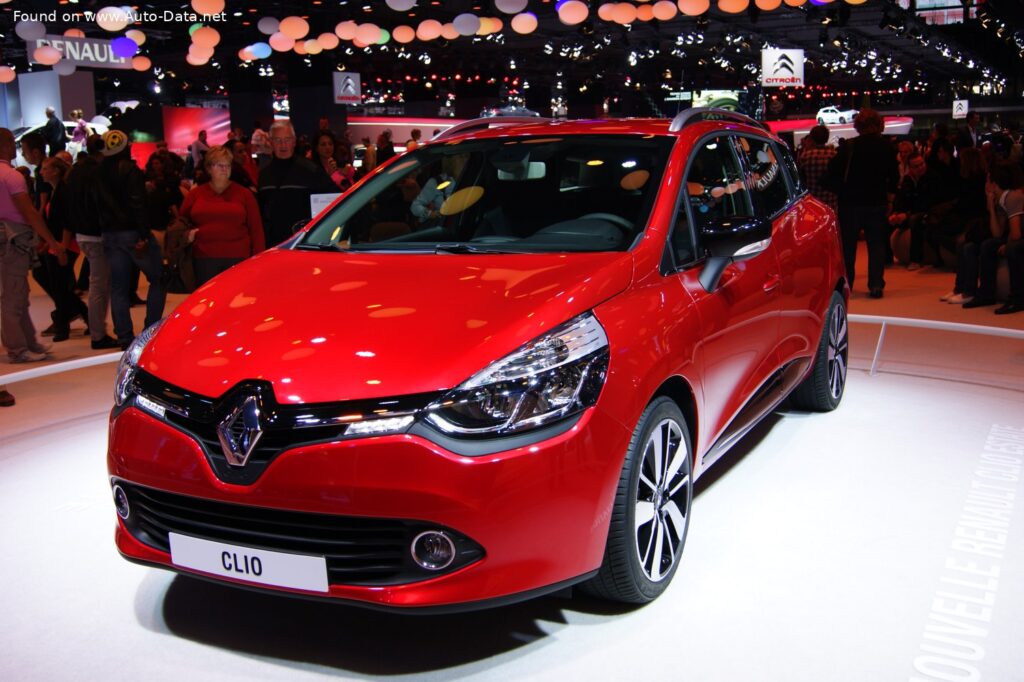
Introduction to the Renault Clio IV Grandtour (Phase I) 0.9 Energy Tce (90 Hp) Start&Stop
The Renault Clio, a cornerstone of the French automaker’s lineup, has long been a dominant force in the European B-segment, known affectionately in the United States as the subcompact class. The fourth generation, introduced in 2012, brought a significant refresh in design and technology. Among its various configurations, the Renault Clio IV Grandtour (Phase I) 0.9 Energy Tce (90 Hp) Start&Stop represents a compelling blend of practicality, efficiency, and modern engineering tailored specifically for the European market. Produced from 2013 to 2016, this particular model combined the versatile station wagon body style with an innovative small-displacement turbocharged gasoline engine, making it a popular choice for families and individuals seeking a compact yet spacious vehicle with low running costs.
While never officially sold in the North American market, the Clio IV Grandtour exemplifies Renault’s strategic focus on fuel economy and intelligent packaging for its primary European customer base. Its design language, overseen by Laurens van den Acker, marked a bold departure from previous generations, injecting a dose of style and dynamism into the segment. The Grandtour variant, or estate as it’s known across the Atlantic, further enhanced its appeal by offering significantly more cargo capacity than its hatchback sibling, without compromising the Clio’s nimble driving dynamics. This article delves into the specifics of this intriguing European offering, highlighting its powertrain, design, features, and overall impact.
Engine and Performance of the Renault Clio IV Grandtour (Phase I) 0.9 Energy Tce (90 Hp) Start&Stop
At the heart of the Renault Clio IV Grandtour (Phase I) 0.9 Energy Tce (90 Hp) Start&Stop lies a remarkably compact yet potent 0.9-liter (899 cm³) three-cylinder gasoline engine, designated by the H4B 408 code. This powerplant is a prime example of the automotive industry’s trend towards “downsizing,” where smaller, turbocharged engines deliver performance comparable to larger, naturally aspirated units while significantly improving fuel efficiency and reducing emissions. With a power output of 90 horsepower at 5250 rpm, the engine demonstrates a respectable power-per-liter figure of 100.1 HP/liter.
Torque delivery is equally impressive for such a small engine, producing 135 Nm (99.57 lb.-ft.) at a relatively low 2500 rpm. This low-end torque is crucial for urban driving and contributes to the car’s responsive feel despite its modest horsepower. The engine incorporates a turbocharger and an intercooler, ensuring efficient air intake and combustion. Fuel is delivered via a direct injection system, further optimizing efficiency and performance.
Power is channeled to the front wheels through a precise 5-speed manual transmission, offering engaging control for the driver. This setup allows the Clio Grandtour to accelerate from 0 to 60 mph in a calculated 11.6 seconds, reaching a top speed of 113.09 mph (182 km/h). While not a performance powerhouse, these figures are more than adequate for daily commuting and highway cruising in its intended market.
A key feature enhancing the Clio’s efficiency is the integrated Start&Stop system. This technology automatically shuts off the engine when the vehicle is stationary, such as at a traffic light, and restarts it seamlessly when the driver depresses the clutch. This significantly reduces fuel consumption and CO2 emissions in stop-and-go traffic. The combined fuel economy is rated at an impressive 4.5 liters per 100 kilometers, translating to approximately 52.3 US mpg, with CO2 emissions of just 104 g/km, underscoring its environmentally conscious design