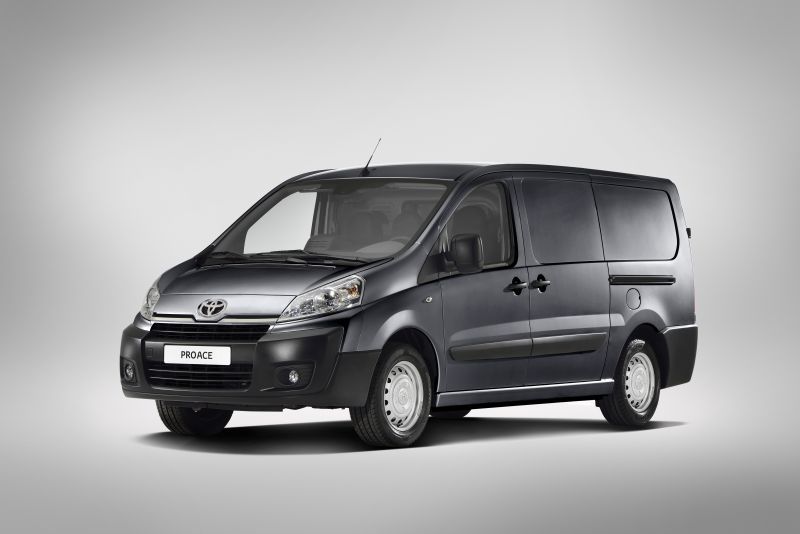
Toyota Proace City LWB 1.5 D-4D (130 Hp): A Versatile European Compact Van
The Toyota Proace City LWB 1.5 D-4D (130 Hp) represents Toyota’s strategic entry into the highly competitive compact light commercial vehicle (LCV) segment, primarily targeting European and select Asian markets. Launched in April 2020, this model is part of the first generation of the Proace City, a product of a collaborative venture between Toyota and the former PSA Group (now Stellantis). This partnership allowed Toyota to quickly offer a robust and efficient solution for businesses and individuals requiring a practical, economical, and spacious vehicle for urban and regional use. While not offered in the United States, where the commercial van market is dominated by larger vehicles, the Proace City LWB plays a crucial role in its primary markets, providing a compact yet highly capable alternative to traditional passenger minivans and larger cargo vans. The Long Wheelbase (LWB) variant, in particular, maximizes cargo volume and versatility, making it a compelling option for a wide array of professional applications.
Powertrain and Performance of the Toyota Proace City LWB
At the heart of the Toyota Proace City LWB 1.5 D-4D (130 Hp) is a modern 1.5-liter D-4D turbocharged diesel engine, meticulously engineered for a balance of power, efficiency, and durability. This inline four-cylinder engine, designated YH01, features a common rail direct injection system and an overhead camshaft (OHC) valvetrain with four valves per cylinder, ensuring optimal fuel atomization and combustion efficiency. It produces a robust 130 horsepower at 3750 revolutions per minute (rpm), making it one of the more potent options in its class. More significantly for a commercial vehicle, the engine delivers an impressive 221.27 lb-ft of torque, available from a low 1750 rpm. This substantial torque output is critical for hauling heavy loads and navigating challenging urban environments without constant gear changes, providing excellent low-end grunt.
The powertrain architecture is a front, transverse engine layout, driving the front wheels through a precise 6-speed manual transmission. This setup contributes to the vehicle’s nimble handling and efficient power delivery. The focus on efficiency is evident in its fuel consumption figures: a combined (NEDC) economy rating of 51.1 to 53.5 US miles per gallon (4.4-4.6 l/100 km). This makes the Proace City LWB an exceptionally economical choice for businesses concerned with operational costs. Furthermore, it complies with the stringent Euro 6d-ISC-FCM emission standard, reflecting Toyota’s commitment to environmental responsibility, aided by a Start & Stop system and a particulate filter. The vehicle’s weight-to-power ratio stands at 11 kg/Hp (approximately 90.5 Hp per tonne), indicating a responsive feel for its segment, while its weight-to-torque ratio of 4.8 kg/Nm (208.9 Nm per tonne) underscores its strong pulling capabilities.
Design, Features, and Utility
The design of the Toyota Proace City LWB prioritizes functionality and practicality, consistent with its role as a versatile compact van. Its minivan body type, characterized by five doors and a flexible 2-3 seat configuration, is optimized for both cargo transport and occasional passenger duty. The LWB designation is particularly important, extending the vehicle’s length to 187.13 inches (4753 mm) and its wheelbase to 117.13 inches (2975 mm), which translates directly into superior cargo capacity. The rear cargo area offers a minimum of 137.73 cubic feet (3900 liters) and a maximum of 151.85 cubic feet (4300 liters) when configured for maximum load, making it highly competitive for its footprint.
From a utility perspective, the Proace City LWB is engineered to handle substantial loads. It boasts a maximum payload capacity of 2125.26 lbs (964 kg) and a maximum roof load of 330.69 lbs (150 kg). For those needing to tow, the vehicle is rated for a permitted trailer load with brakes of 3306.93 lbs (1500 kg) and 1653.47 lbs (750 kg) without brakes, further enhancing its versatility for various commercial tasks. The suspension system, featuring an independent McPherson type at the front and a robust torsion beam at the rear, is designed to provide a comfortable ride while effectively managing heavy loads. Stopping power is assured by ventilated disc brakes at the front and disc brakes at the rear, complemented by an Anti-lock Braking System (ABS) for enhanced safety. The electric power steering system, with a steering rack and pinion, ensures ease of maneuverability, particularly beneficial in congested urban settings, with a minimum turning circle of 37.73 feet (11.5 meters). The vehicle rides on 16-inch wheels, typically shod with tires sized 215/65 R16 or 205/60 R16, providing a good balance of grip and ride comfort.
Technical Specifications: Toyota Proace City LWB 1.5 D-4D (130 Hp)
| General Information | |
| Brand | Toyota |
| Model | Proace City LWB |
| Type (Engine) | 1.5 D-4D (130 Hp) |
| Start of Production | April, 2020 |
| Powertrain Architecture | Internal Combustion Engine |
| Body Type | Minivan |
| Seats | 2-3 |
| Doors | 5 |
| Performance Specifications | |
| Fuel Consumption (Urban, NEDC) | 46.1 US mpg (5.1 l/100 km) |
| Fuel Consumption (Extra Urban, NEDC) | 54.7 – 58.8 US mpg (4-4.3 l/100 km) |
| Fuel Consumption (Combined, NEDC) | 51.1 – 53.5 US mpg (4.4-4.6 l/100 km) |
| CO2 Emissions (NEDC) | 117-121 g/km |
| Fuel Type | Diesel |
| Emission Standard | Euro 6d-ISC-FCM |
| Weight-to-Power Ratio | 11 kg/Hp (90.5 Hp/tonne) |
| Weight-to-Torque Ratio | 4.8 kg/Nm (208.9 Nm/tonne) |
| Engine Specifications | |
| Power | 130 Hp @ 3750 rpm |
| Power per liter | 86.7 Hp/l |
| Torque | 221.27 lb-ft (300 Nm) @ 1750 rpm |
| Engine Layout | Front, Transverse |
| Engine Model/Code | YH01 |
| Engine Displacement | 1.5 liters (1499 cm3, 91.47 cu. in.) |
| Number of Cylinders | 4 |
| Engine Configuration | Inline |
| Number of Valves per Cylinder | 4 |
| Fuel Injection System | Diesel Commonrail |
| Engine Aspiration | Turbocharger, Intercooler |
| Valvetrain | OHC |
| Engine Oil Capacity | 4.23 US qt (4 l) |
| Engine Oil Specification | Unavailable |
| Engine Systems | Start & Stop System, Particulate filter |
| Space, Volume, and Weights | |
| Kerb Weight | 3165.84 lbs (1436 kg) |
| Max. Weight | 5291.09 lbs (2400 kg) |
| Max Load | 2125.26 lbs (964 kg) |
| Trunk (Boot) Space – Minimum | 137.73 cu. ft. (3900 l) |
| Trunk (Boot) Space – Maximum | 151.85 cu. ft. (4300 l) |
| Fuel Tank Capacity | 13.21 US gal (50 l) |
| AdBlue Tank | 4.49 US gal (17 l) |
| Max. Roof Load | 330.69 lbs (150 kg) |
| Permitted Trailer Load with Brakes (12%) | 3306.93 lbs (1500 kg) |
| Permitted Trailer Load without Brakes | 1653.47 lbs (750 kg) |
| Permitted Towbar Download | 163.14 lbs (74 kg) |
| Dimensions | |
| Length | 187.13 in. (4753 mm) |
| Width | 72.76 in. (1848 mm) |
| Width with Mirrors Folded | 75.63 in. (1921 mm) |
| Width Including Mirrors | 82.95 in. (2107 mm) |
| Height | 71.34 – 73.23 in. (1812-1860 mm) |
| Wheelbase | 117.13 in. (2975 mm) |
| Front Track | 61.14 in. (1553 mm) |
| Rear Track | 60.98 – 61.73 in. (1549-1568 mm) |
| Front Overhang | 35.12 in. (892 mm) |
| Rear Overhang | 34.88 in. (886 mm) |
| Ride Height (Ground Clearance) | 6.3 – 6.89 in. (160-175 mm) |
| Minimum Turning Circle (Diameter) | 37.73 ft. (11.5 m) |
| Drivetrain, Brakes, and Suspension | |
| Drivetrain Architecture | Front-wheel drive, Internal Combustion Engine |
| Drive Wheel | Front-wheel drive |
| Number of Gears and Type of Gearbox | 6 gears, Manual Transmission |
| Front Suspension | Independent type McPherson |
| Rear Suspension | Torsion |
| Front Brakes | Ventilated discs |
| Rear Brakes | Disc |
| Assisting Systems | ABS (Anti-lock braking system) |
| Steering Type | Steering rack and pinion |
| Power Steering | Electric Steering |
| Tires Size | 215/65 R16 98H; 205/60 R16 96H |
| Wheel Rims Size | 6.5J x 16 |
Legacy and Market Impact of the Toyota Proace City LWB
The Toyota Proace City LWB, particularly with the efficient 1.5 D-4D (130 Hp) engine, has quickly carved out a significant niche in the European and Asian compact LCV markets. Its reputation is built on a foundation of reliability, cost-effectiveness, and impressive versatility, characteristics that align perfectly with Toyota’s global brand image. By leveraging the proven platform and engineering expertise of Stellantis, Toyota was able to offer a compelling product that meets the specific demands of businesses requiring compact yet capable transportation solutions.
In its primary markets, the Proace City LWB competes fiercely with its platform siblings, including the Citroën Berlingo, Peugeot Partner/Rifter, Opel/Vauxhall Combo, and Fiat Doblò. Beyond these, it faces rivals such as the Ford Transit Connect, Renault Kangoo, and Volkswagen Caddy. What sets the Toyota offering apart is often its strong dealer network, reputation for long-term durability, and competitive pricing strategies. For small businesses, delivery services, and tradespeople, the Proace City LWB provides an ideal blend of compact dimensions for urban maneuverability, substantial cargo capacity for tools and goods, and excellent fuel economy to keep operating costs low.
The historical significance of the Proace City LWB lies in Toyota’s strategic expansion into a segment where it previously had limited presence. This partnership model allows Toyota to rapidly adapt to market trends and regulatory requirements in different regions without the massive R&D investment of an entirely new platform. The vehicle stands as a testament to the evolving nature of the automotive industry, where collaborations are key to addressing diverse global market needs efficiently. Its impact is seen in its consistent sales performance, proving that a well-engineered, practical, and economical compact van fills a vital role in modern commerce, offering a flexible and reliable solution for the demands of contemporary logistics and business operations. The Toyota Proace City LWB 1.5 D-4D (130 Hp) embodies the modern utility vehicle: smart, efficient, and built for purpose.