The Toyota Corolla XI (E170) 1.6 Valvematic (132 Hp): A Global Standard of Reliability and Efficiency
The Toyota Corolla, a name synonymous with automotive dependability and widespread global appeal, entered its eleventh generation with the E170 series, produced from 2012 to 2015. Among its diverse powertrain offerings across various international markets, the Toyota Corolla XI (E170) 1.6 Valvematic (132 Hp) variant stood out as a particularly well-balanced option, especially prevalent in European and Asian markets where its combination of efficiency and adequate performance met local demands. This iteration of the Corolla sedan continued the model’s legacy of providing practical, no-nonsense transportation wrapped in an increasingly refined package, cementing its status as a benchmark in the compact sedan segment. While not a primary engine choice for the North American market, this 1.6-liter Valvematic engine showcased Toyota’s commitment to advanced valvetrain technology for optimizing fuel economy and power delivery in key international regions.
Engine and Performance: The 1.6 Valvematic Heartbeat of the Toyota Corolla XI (E170)
At the core of the Toyota Corolla XI (E170) 1.6 Valvematic (132 Hp) lies a naturally aspirated 1.6-liter (1598 cm³ or 97.52 cu. in.) inline-four gasoline engine, designated 1ZR-FAE. This powerplant is a testament to Toyota’s engineering philosophy of combining robust reliability with innovative efficiency. The “Valvematic” designation refers to Toyota’s advanced variable valve lift system, which works in conjunction with variable valve timing (VVT-i) to continuously adjust the amount of valve lift for optimal air intake. This sophisticated valvetrain technology allows for precise control over the engine’s breathing, leading to improved fuel efficiency and a broader, flatter torque curve compared to conventional engines.
The 1ZR-FAE engine delivers a respectable 132 horsepower at 6400 rpm, providing ample motivation for the compact sedan. Torque output peaks at 118.01 lb.-ft. (160 Nm) at 4400 rpm, ensuring responsive acceleration in everyday driving scenarios. Mated to a precise 6-speed manual transmission, this powertrain enables the Corolla XI (E170) to accelerate from 0 to 60 mph in a brisk 9.5 seconds, while its top speed reaches 124.27 mph (200 km/h). These figures underscore the car’s capability as a competent performer within its class, offering a blend of spirited driving and economical operation.
Fuel efficiency was a key selling point for this variant. The 1.6 Valvematic engine achieved a combined fuel economy of 39.2 US mpg (6 liters per 100 km), with even more impressive figures on the highway at 48 US mpg (4.9 liters per 100 km). Urban driving returned a still-respectable 29.4 US mpg (8 liters per 100 km). These numbers, coupled with CO2 emissions of 139 g/km, allowed the vehicle to meet Euro 5 J emission standards, making it an environmentally conscious choice for consumers in its target markets. The engine’s front, transverse layout and front-wheel-drive architecture are standard for the segment, contributing to efficient packaging and predictable handling characteristics.
Design and Features: Practicality Meets Modern Aesthetics
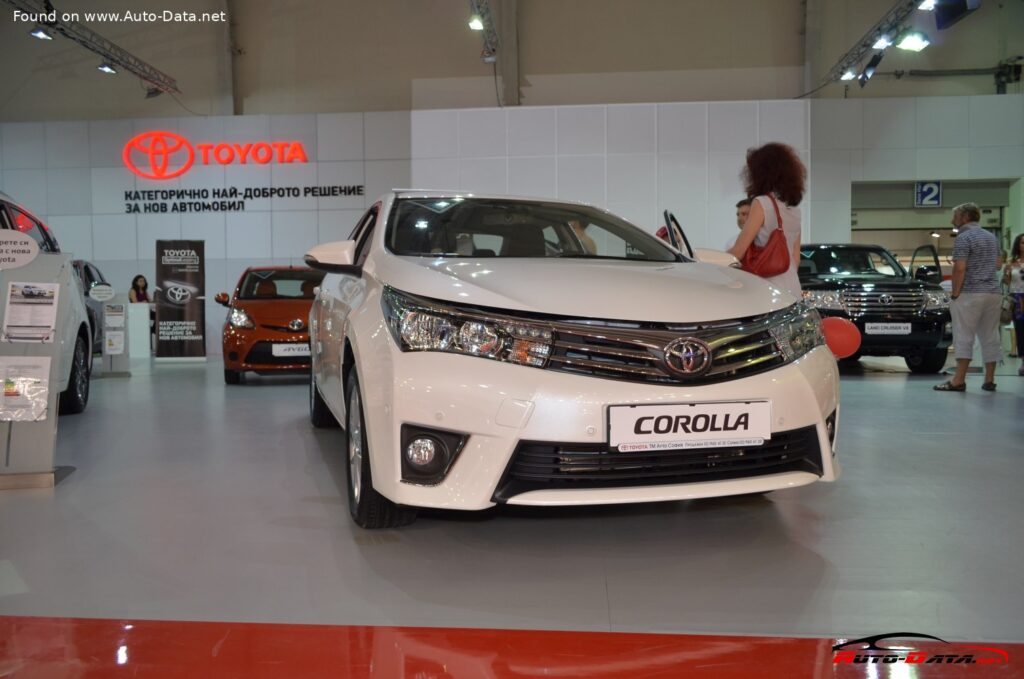
The eleventh-generation Toyota Corolla, particularly the E170 sedan, presented a more dynamic and contemporary design compared to its predecessors. While maintaining the Corolla’s signature understated elegance, the E170 adopted sharper lines, a more pronounced grille, and sleeker headlights, giving it a more upscale and assertive presence on the road. The body type remained a classic 4-door sedan, accommodating five occupants comfortably, a hallmark of the Corolla’s family-friendly appeal.
Measuring 181.89 inches (4620 mm) in length, 69.88 inches (1775 mm) in width, and 57.68 inches (1465 mm) in height, the E170 offered a spacious interior for its class. A generous wheelbase of 106.3 inches (2700 mm) contributed significantly to passenger comfort, particularly for rear-seat occupants, and enhanced ride stability. The trunk space was practical, offering 15.96 cu. ft. (452 liters) of cargo volume, sufficient for daily errands, family trips, or luggage.
In terms of features, the Toyota Corolla XI (E170) 1.6 Valvematic (132 Hp) focused on providing essential comforts and safety. Standard safety equipment included an Anti-lock Braking System (ABS), a crucial feature for maintaining control during emergency braking. The vehicle’s suspension system comprised an independent McPherson strut setup with coil springs and an anti-roll bar at the front, paired with a torsion beam rear suspension, a common and cost-effective arrangement that delivered a compliant ride and predictable handling. Ventilated disc brakes at the front and disc brakes at the rear provided confident stopping power. Steering was handled by a rack and pinion system, offering direct and responsive feedback to the driver. Depending on the trim level, tire sizes ranged from 195/65 R15 to 205/55 R16, mounted on 15 or 16-inch wheels, respectively. The car’s drag coefficient (Cd) of 0.27 was commendable for its segment, contributing to its aerodynamic efficiency and fuel economy.
Technical Specifications: Toyota Corolla XI (E170) 1.6 Valvematic (132 Hp)
| Category | Specification |
|---|---|
| Brand | Toyota |
| Model | Corolla |
| Generation | Corolla XI (E170) |
| Type (Engine) | 1.6 Valvematic (132 Hp) |
| Start of Production | 2012 year |
| End of Production | 2015 year |
| Powertrain Architecture | Internal Combustion engine |
| Body type | Sedan |
| Seats | 5 |
| Doors | 4 |
| Fuel consumption (economy) – urban | 8 l/100 km (29.4 US mpg) |
| Fuel consumption (economy) – extra urban | 4.9 l/100 km (48 US mpg) |
| Fuel consumption (economy) – combined | 6 l/100 km (39.2 US mpg) |
| CO2 emissions | 139 g/km |
| Fuel Type | Petrol (Gasoline) |
| Acceleration 0 – 62 mph (0-100 km/h) | 10 sec |
| Acceleration 0 – 60 mph (Calculated) | 9.5 sec |
| Maximum speed | 124.27 mph (200 km/h) |
| Emission standard | Euro 5 J |
| Weight-to-power ratio | 9.7 kg/Hp, 103.1 Hp/tonne |
| Weight-to-torque ratio | 8 kg/Nm, 125 Nm/tonne |
| Power | 132 Hp @ 6400 rpm |
| Power per liter | 82.6 Hp/l |
| Torque | 118.01 lb.-ft. (160 Nm) @ 4400 rpm |
| Engine layout | Front, Transverse |
| Engine Model/Code | 1ZR-FAE |
| Engine displacement | 1598 cm³ (97.52 cu. in.) |
| Number of cylinders | 4 |
| Engine configuration | Inline |
| Cylinder Bore | 3.17 in. (80.5 mm) |
| Piston Stroke | 3.09 in. (78.5 mm) |
| Compression ratio | 10.7:1 |
| Number of valves per cylinder | 4 |
| Fuel injection system | Multi-port manifold injection |
| Engine aspiration | Naturally aspirated engine |
| Valvetrain | DOHC – Valvematic |
| Engine oil capacity | 4.44 US qt (4.2 l) |
| Coolant capacity | 5.92 US qt (5.6 l) |
| Kerb Weight | 2821.92 lbs. (1280 kg) |
| Max. weight | 3902.18 lbs. (1770 kg) |
| Max load | 1080.27 lbs. (490 kg) |
| Trunk (boot) space – minimum | 15.96 cu. ft. (452 l) |
| Fuel tank capacity | 14.53 US gal (55 l) |
| Length | 181.89 in. (4620 mm) |
| Width | 69.88 in. (1775 mm) |
| Height | 57.68 in. (1465 mm) |
| Wheelbase | 106.3 in. (2700 mm) |
| Front track | 60.43 in. (1535 mm) |
| Rear (Back) track | 60.43 in. (1535 mm) |
| Ride height (ground clearance) | 4.92 in. (125 mm) |
| Drag coefficient (Cd) | 0.27 |
| Minimum turning circle (turning diameter) | 35.43 ft. (10.8 m) |
| Drivetrain Architecture | The Internal combustion engine (ICE) drives the front wheels of the vehicle. |
| Drive wheel | Front wheel drive |
| Number of gears and type of gearbox | 6 gears, manual transmission |
| Front suspension | Independent, type McPherson with coil spring and anti-roll bar |
| Rear suspension | Torsion |
| Front brakes | Ventilated discs |
| Rear brakes | Disc |
| Assisting systems | ABS (Anti-lock braking system) |
| Steering type | Steering rack and pinion |
| Tires size | 195/65 R15; 205/55 R16 |
| Wheel rims size | 15; 16 |
Legacy and Market Impact of the Toyota Corolla XI (E170)
The Toyota Corolla, in its eleventh generation, continued to build upon a legacy of unparalleled global sales success and a reputation for bulletproof reliability. The Toyota Corolla XI (E170) 1.6 Valvematic (132 Hp), while a specific variant geared towards certain international markets, played a significant role in maintaining this esteemed reputation. In regions like Europe and parts of Asia, where smaller displacement engines are often favored for tax reasons and fuel economy, this 1.6-liter option provided a compelling blend of performance and operational cost efficiency. It allowed the Corolla to effectively compete against a strong field of rivals such as the Honda Civic, Volkswagen Jetta (known as Vento or Bora in some markets), Hyundai Elantra, and Kia Forte.
The E170 generation was praised for its improved interior quality, quieter cabin, and more refined driving dynamics compared to earlier models. While not designed to be a sporty car, its comfortable ride, intuitive controls, and predictable handling made it an excellent daily driver. The Valvematic technology in the 1.6-liter engine underscored Toyota’s commitment to continuous improvement, offering a tangible benefit in terms of fuel consumption and emissions without resorting to forced induction, which can sometimes add complexity and cost. This approach resonated with a broad customer base prioritizing longevity and low maintenance.
The Corolla’s historical significance lies in its consistent ability to meet the needs of a diverse global market. It has consistently been one of the best-selling nameplates worldwide, a testament to its universal appeal. The E170 generation, with variants like the 1.6 Valvematic, contributed to this ongoing success by offering a well-rounded package that delivered on the core promises of the Corolla brand: affordability, reliability, efficiency, and practicality. Even after production ended in 2015, these vehicles continue to be a common sight on roads globally, valued by owners for their enduring quality and minimal fuss, solidifying the Corolla’s status as a true automotive icon. Its impact is not just in sales figures, but in setting a benchmark for what a compact sedan can and should be – a dependable workhorse that seamlessly integrates into the lives of millions.