Skoda Octavia III Combi 1.2 TSI (86 Hp): A Practical European Workhorse
The Skoda Octavia III Combi 1.2 TSI (86 Hp) represents a significant iteration of Skoda Auto’s highly successful compact family car, produced between 2013 and 2017. As a key model for the Czech automaker, a subsidiary of the Volkswagen Group, the Octavia has consistently been a top seller in its primary European markets, lauded for its blend of practicality, value, and robust engineering. The third-generation Octavia, often referred to by its internal designation A7, built upon the strengths of its predecessors, offering enhanced space, improved efficiency, and a more refined driving experience. The “Combi” designation signifies its station wagon (estate) body style, a particularly popular choice in Europe for families and businesses requiring ample cargo capacity without sacrificing the maneuverability of a compact vehicle. The 1.2 TSI variant, with its 86 horsepower, was positioned as an entry-level option, emphasizing fuel economy and accessible performance for daily driving.
Engine & Performance of the Skoda Octavia III Combi 1.2 TSI (86 Hp)
At the heart of the Skoda Octavia III Combi 1.2 TSI (86 Hp) lies a modern, turbocharged gasoline engine designed for efficiency and smooth power delivery. This particular variant features the EA211 series 1.2-liter (1197 cm3 or 73.05 cu. in.) inline-four engine, a compact yet potent powertrain configuration. Equipped with direct fuel injection and a turbocharger with an intercooler, this engine generates a respectable 86 horsepower at a broad range of 4300-5300 rpm. More impressively, it delivers a healthy 118.01 lb.-ft. (160 Nm) of torque, available from a low 1400 rpm and sustained up to 3500 rpm. This broad torque band is crucial for real-world drivability, providing ample pulling power for city traffic and comfortable cruising on highways, despite the modest peak horsepower figure.
Power is channeled to the front wheels via a five-speed manual transmission, a setup chosen for its reliability and efficiency. This combination allows the Octavia Combi 1.2 TSI to accelerate from 0 to 60 mph in a calculated 11.6 seconds, with a top speed of 110.6 mph (178 km/h). While not a performance leader, these figures are perfectly adequate for its intended use as a family hauler.
Fuel efficiency was a key selling point for this engine. The NEDC (New European Driving Cycle) combined fuel economy figure stands at an impressive 44.4 US mpg (5.3 l/100 km), with urban consumption rated at 35.6 US mpg (6.6 l/100 km) and extra-urban at 52.3 US mpg (4.5 l/100 km). These figures highlight the effectiveness of the TSI technology in balancing power and economy. With CO2 emissions of 122 g/km, the vehicle met Euro 5 emission standards, reflecting its commitment to environmental performance for its time. The engine’s DOHC valvetrain and 4 valves per cylinder further contribute to its efficiency and responsiveness.
Design & Features of the Skoda Octavia III Combi
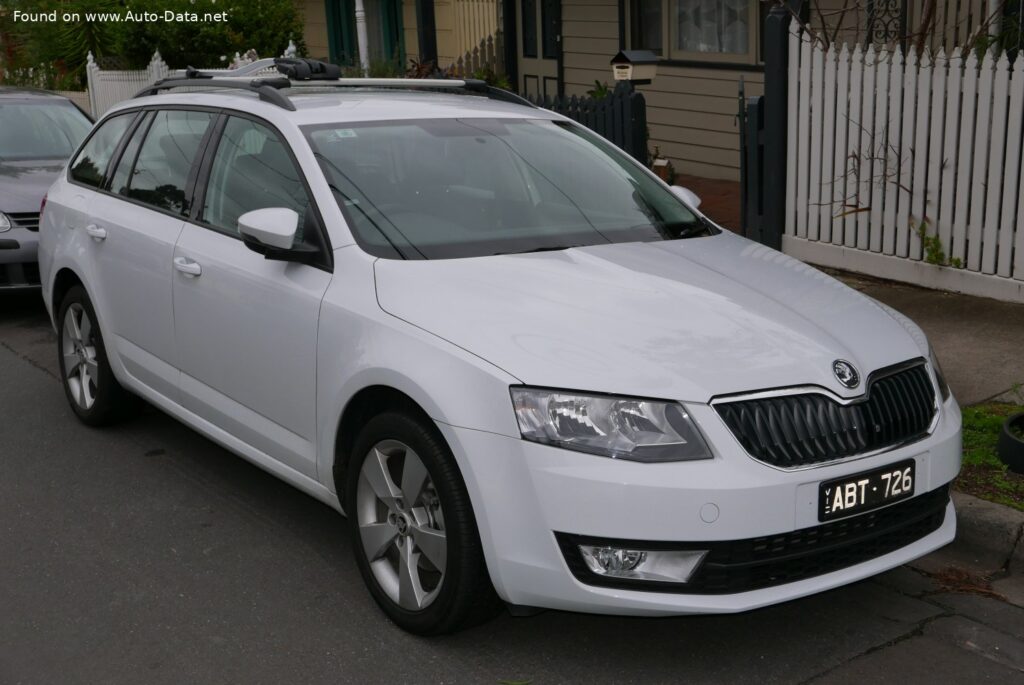
The third-generation Skoda Octavia Combi, launched in 2013, showcased a more assertive and modern design language compared to its predecessors, while retaining Skoda’s characteristic understated elegance. Built on the Volkswagen Group’s MQB platform, it benefited from improved proportions and a lighter, stiffer body structure. The exterior design features sharp, precise lines, a prominent grille, and distinctive C-shaped taillights, aligning it visually with other contemporary VW Group products.
Measuring 183.43 inches (4659 mm) in length, 71.42 inches (1814 mm) in width (79.41 inches or 2017 mm including mirrors), and 57.68 inches (1465 mm) in height, the Octavia Combi offered substantial interior volume. Its generous 105.75-inch (2686 mm) wheelbase was particularly beneficial for rear passenger legroom, making it a comfortable five-seater vehicle. The station wagon body style is where the Octavia truly shined in terms of practicality. It boasted an enormous minimum trunk (boot) space of 21.54 cu. ft. (610 liters), which could expand to a cavernous 61.45 cu. ft. (1740 liters) with the rear seats folded down. This class-leading cargo capacity was a major draw for families, small businesses, and anyone needing versatile load-lugging abilities.
Inside, the Octavia presented a functional and well-appointed cabin, characterized by high-quality materials and intuitive ergonomics. While the 1.2 TSI (86 Hp) variant typically came with more basic trim levels, it still offered essential comfort and convenience features. Standard equipment for the era included power steering, anti-lock braking system (ABS), and a suite of airbags, underscoring a commitment to safety. The front suspension utilized an independent McPherson strut setup with coil springs and an anti-roll bar, while the rear featured a torsion beam axle with coil springs, a cost-effective and space-efficient solution for this entry-level variant, providing a comfortable and predictable ride.
Technical Specifications for the Skoda Octavia III Combi 1.2 TSI (86 Hp)
| Category | Specification | Metric Units | U.S. / Imperial Units |
|---|---|---|---|
| General Information | |||
| Brand | Skoda | ||
| Model | Octavia | ||
| Generation | Octavia III Combi | ||
| Type (Engine) | 1.2 TSI (86 Hp) | ||
| Start of Production | 2013 year | ||
| End of Production | 2017 year | ||
| Powertrain Architecture | Internal Combustion engine | ||
| Body type | Station wagon (estate) | ||
| Seats | 5 | ||
| Doors | 5 | ||
| Performance Specs | |||
| Fuel consumption (economy) – urban (NEDC) | 6.6 l/100 km | 35.6 US mpg | |
| Fuel consumption (economy) – extra urban (NEDC) | 4.5 l/100 km | 52.3 US mpg | |
| Fuel consumption (economy) – combined (NEDC) | 5.3 l/100 km | 44.4 US mpg | |
| CO2 emissions (NEDC) | 122 g/km | ||
| Fuel Type | Petrol (Gasoline) | ||
| Acceleration 0 – 100 km/h | 12.2 sec | ||
| Acceleration 0 – 62 mph | 12.2 sec | ||
| Acceleration 0 – 60 mph (Calculated) | 11.6 sec | ||
| Maximum speed | 178 km/h | 110.6 mph | |
| Emission standard | Euro 5 | ||
| Weight-to-power ratio | 13.6 kg/Hp | 73.4 Hp/tonne | |
| Weight-to-torque ratio | 7.3 kg/Nm | 136.5 Nm/tonne | |
| Engine Specs | |||
| Power | 86 Hp @ 4300-5300 rpm | ||
| Power per liter | 71.8 Hp/l | ||
| Torque | 160 Nm @ 1400-3500 rpm | 118.01 lb.-ft. @ 1400-3500 rpm | |
| Engine layout | Front, Transverse | ||
| Engine Model/Code | EA211 / CJZB, CYVA | ||
| Engine displacement | 1197 cm3 | 73.05 cu. in. | |
| Number of cylinders | 4 | ||
| Engine configuration | Inline | ||
| Cylinder Bore | 71 mm | 2.8 in. | |
| Piston Stroke | 75.6 mm | 2.98 in. | |
| Compression ratio | 10.5:1 | ||
| Number of valves per cylinder | 4 | ||
| Fuel injection system | Direct injection | ||
| Engine aspiration | Turbocharger, Intercooler | ||
| Valvetrain | DOHC | ||
| Engine oil capacity | 4 l | 4.23 US qt | 3.52 UK qt | |
| Coolant | 8.9 l | 9.4 US qt | 7.83 UK qt | |
| Space, Volume and Weights | |||
| Kerb Weight | 1172 kg | 2583.82 lbs. | |
| Max. weight | 1817 kg | 4005.8 lbs. | |
| Max load | 645 kg | 1421.98 lbs. | |
| Trunk (boot) space – minimum | 610 l | 21.54 cu. ft. | |
| Trunk (boot) space – maximum | 1740 l | 61.45 cu. ft. | |
| Fuel tank capacity | 50 l | 13.21 US gal | 11 UK gal | |
| Max. roof load | 75 kg | 165.35 lbs. | |
| Permitted trailer load with brakes (12%) | 1100 kg | 2425.08 lbs. | |
| Permitted trailer load without brakes | 620 kg | 1366.87 lbs. | |
| Permitted towbar download | 75 kg | 165.35 lbs. | |
| Dimensions | |||
| Length | 4659 mm | 183.43 in. | |
| Width | 1814 mm | 71.42 in. | |
| Width including mirrors | 2017 mm | 79.41 in. | |
| Height | 1465 mm | 57.68 in. | |
| Wheelbase | 2686 mm | 105.75 in. | |
| Front track | 1549 mm | 60.98 in. | |
| Rear (Back) track | 1520 mm | 59.84 in. | |
| Front overhang | 886 mm | 34.88 in. | |
| Rear overhang | 1087 mm | 42.8 in. | |
| Ride height (ground clearance) | 140 mm | 5.51 in. | |
| Drag coefficient (Cd) | 0.305 | ||
| Minimum turning circle (turning diameter) | 11.05 m | 36.25 ft. | |
| Approach angle | 13.9° | ||
| Departure angle | 12.2° | ||
| Drivetrain, Brakes and Suspension Specs | |||
| Drivetrain Architecture | The Internal combustion engine (ICE) drives the front wheels of the vehicle. | ||
| Drive wheel | Front wheel drive | ||
| Number of gears and type of gearbox | 5 gears, manual transmission | ||
| Front suspension | Independent, type McPherson with coil spring and anti-roll bar | ||
| Rear suspension | Coil spring, Torsion | ||
| Front brakes | Ventilated discs | ||
| Rear brakes | Disc | ||
| Assisting systems | ABS (Anti-lock braking system) | ||
| Steering type | Steering rack and pinion | ||
| Power steering | Electric Steering | ||
| Tires size | 195/65 R15; 205/55 R16 | ||
| Wheel rims size | 6J x 15; 6.5J x 16 | ||
Legacy & Market Impact of the Skoda Octavia III Combi
The Skoda Octavia, particularly in its Combi (station wagon) form, has carved out a formidable legacy in the European automotive landscape. The third generation, including the Skoda Octavia III Combi 1.2 TSI (86 Hp), played a crucial role in solidifying Skoda’s reputation as a purveyor of practical, well-built, and value-packed vehicles. While not sold in the United States, the Octavia’s impact across Europe, the UK, and other international markets has been substantial.
Skoda, under the stewardship of the Volkswagen Group, has meticulously cultivated an image of “Simply Clever” solutions and robust, no-nonsense engineering. The Octavia perfectly embodies this philosophy, offering VW Group quality and technology at a more accessible price point and often with superior practicality. Its primary competitors in the European C-segment included established players like the Volkswagen Golf Variant, Ford Focus Estate, Opel Astra Sports Tourer, and Peugeot 308 SW. Against these rivals, the Octavia consistently stood out for its cavernous trunk space, competitive pricing, and comfortable ride quality.
The 1.2 TSI (86 Hp) engine variant, specifically, was significant for its role as an entry-level offering. It democratized the Octavia’s appeal, making it an attractive option for budget-conscious buyers, young families, and fleet operators who prioritized low running costs and reliability. Its impressive fuel economy and relatively low CO2 emissions contributed to lower ownership costs, including favorable tax rates in many European countries. This engine showcased the Volkswagen Group’s commitment to downsizing and turbocharging, proving that a small displacement engine could provide ample performance for a family car while maintaining excellent efficiency.
The Octavia III Combi’s success also underscored the enduring popularity of the station wagon body style in Europe, where its versatility is highly valued over SUVs in many segments. Its ability to swallow vast amounts of luggage, combined with its car-like driving dynamics and efficiency, made it a pragmatic choice for everyday life, long journeys, and even light commercial duties. The model’s strong residual values and reputation for reliability further cemented its position as a smart long-term investment for many European consumers.
In essence, the Skoda Octavia III Combi, and particularly efficient variants like the 1.2 TSI (86 Hp), is remembered as a