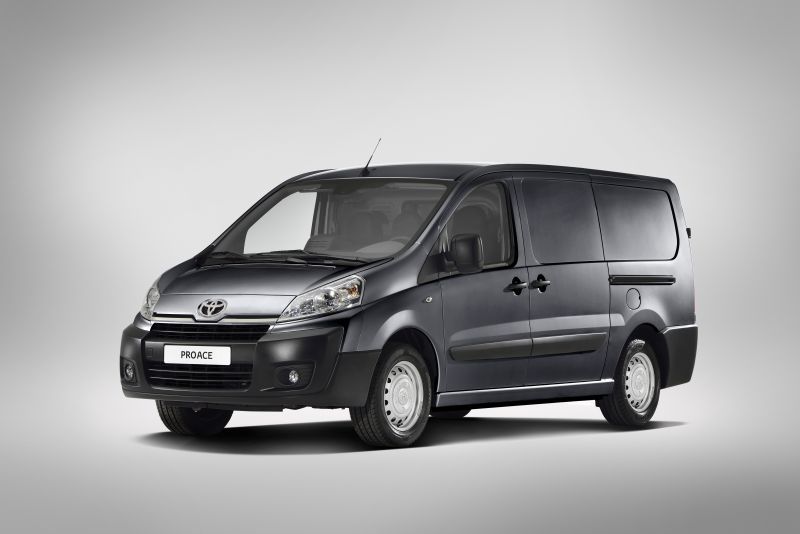
Introduction to the Toyota Proace City LWB
The Toyota Proace City LWB 1.5 D-4D (130 Hp) Automatic represents Toyota’s strategic entry into the compact light commercial vehicle (LCV) and multi-purpose vehicle (MPV) segment in European and other international markets. Launched in April 2020, this particular variant, the long-wheelbase (LWB) model equipped with a 1.5-liter D-4D diesel engine and an 8-speed automatic transmission, is a testament to the brand’s commitment to offering versatile and efficient transport solutions. While not typically available in the North American market, the Proace City plays a crucial role in Toyota’s global portfolio, competing in a fiercely contested segment dominated by European manufacturers.
Part of a collaborative venture with Stellantis (formerly PSA Group), the Proace City shares its platform and many components with popular European models like the Peugeot Partner, Citroën Berlingo, and Opel/Vauxhall Combo. This partnership allows Toyota to leverage proven designs and technologies, adapting them with its own branding and specific market tuning to deliver a vehicle that upholds Toyota’s reputation for reliability and quality. The LWB variant, as its name suggests, offers extended cargo or passenger capacity, making it an ideal choice for businesses requiring ample storage or families seeking a practical and spacious vehicle.
Engine & Performance of the Toyota Proace City LWB
At the heart of the Toyota Proace City LWB is a robust and efficient 1.5-liter D-4D diesel engine, delivering 130 horsepower (Hp) at 3750 revolutions per minute (rpm). This inline four-cylinder powerplant, with its 1499 cubic centimeters (91.47 cu. in.) displacement, is designed for a balance of power, fuel economy, and low emissions. The engine’s configuration features an overhead camshaft (OHC) valvetrain and a sophisticated Diesel Commonrail fuel injection system, ensuring precise fuel delivery for optimal combustion.
A key component of its performance is the turbocharger with an intercooler, which significantly boosts power output and torque across a broad rev range, making the 1.5 D-4D engine feel more substantial than its displacement might suggest. It generates an impressive 300 Newton-meters (221.27 lb.-ft.) of torque at a low 1750 rpm, providing excellent pulling power for hauling goods or navigating urban traffic. This strong low-end torque is particularly beneficial for a utility vehicle, enabling confident acceleration even when fully loaded.
Power is channeled to the front wheels through a smooth and responsive 8-speed automatic transmission. This modern gearbox optimizes gear selection for both efficiency and performance, contributing to the vehicle’s commendable fuel economy figures. According to NEDC standards, the combined fuel consumption ranges from 4.4-4.6 liters per 100 kilometers (53.5 – 51.1 US mpg), with extra-urban figures reaching 4.3-4.4 l/100 km (54.7 – 53.5 US mpg). These figures highlight the Proace City LWB’s cost-effectiveness for businesses and private users alike.
In terms of environmental impact, the vehicle meets the stringent Euro 6d-ISC-FCM emission standard, with CO2 emissions between 117-121 g/km. This is aided by modern engine systems such as a Start & Stop System, which conserves fuel by shutting off the engine during idle periods, and a Particulate Filter, which reduces harmful emissions. The engine’s architecture, being front and transverse, also contributes to efficient packaging and front-wheel drive dynamics, which are ideal for a vehicle of this type.
Design & Features
Body and Dimensions
The Toyota Proace City LWB is categorized as a minivan, a versatile body type that serves both commercial and passenger transport needs. With five doors, it typically features two front doors, two sliding rear doors for easy access in tight spaces, and a large tailgate for cargo loading. The long-wheelbase variant measures 4753 mm (187.13 in.) in length, providing substantial interior volume. Its width stands at 1848 mm (72.76 in.), expanding to 2107 mm (82.95 in.) including mirrors, ensuring a stable footprint on the road. The height varies between 1812-1860 mm (71.34 – 73.23 in.), offering ample headroom and cargo space.
The extended 2975 mm (117.13 in.) wheelbase is crucial for the LWB’s enhanced practicality, allowing for an impressive minimum trunk (boot) space of 3900 liters (137.73 cu. ft.), expandable to a maximum of 4300 liters (151.85 cu. ft.) with seats folded or removed (depending on configuration). This makes it highly competitive for carrying substantial loads. The vehicle’s design is focused on utility, with a kerb weight of 1450 kg (3196.7 lbs.) and a maximum permissible weight of 2380 kg (5247 lbs.), translating to a generous maximum payload of 930 kg (2050.3 lbs.). It also boasts a permitted trailer load with brakes of 1050 kg (2314.85 lbs.), further extending its hauling capabilities.
Interior and Practicality
Inside, the Proace City LWB is designed for functionality. It typically offers 2-3 seats in its commercial van configuration, providing space for the driver and one or two passengers, often with a folding passenger seat to accommodate longer items. The cabin ergonomics are straightforward, prioritizing ease of use for daily work. Storage solutions are usually abundant, catering to the needs of professionals.
Chassis and Safety
The vehicle’s chassis features an independent McPherson type front suspension, which provides a comfortable ride and responsive handling. The rear employs a torsion beam suspension, a robust and space-efficient design well-suited for load-carrying applications. Braking is handled by ventilated discs at the front and disc brakes at the rear, coupled with an Anti-lock Braking System (ABS) for enhanced safety during emergency stops. Steering is managed by a rack and pinion system with electric power steering, offering light and precise control, particularly useful in urban environments and for maneuvering at low speeds. The standard tire size is 215/65 R16 98H or 205/60 R16 96H, mounted on 6.5J x 16 wheel rims, providing a good balance of grip and ride comfort for a utility vehicle.
Technical Specifications
| General Information | |
|---|---|
| Brand | Toyota |
| Model | Proace City |
| Generation | Proace City LWB |
| Type (Engine) | 1.5 D-4D (130 Hp) Automatic |
| Start of Production | April, 2020 year |
| Powertrain Architecture | Internal Combustion engine |
| Body Type | Minivan |
| Seats | 2-3 |
| Doors | 5 |
| Performance Specs | |
| Fuel Consumption (economy) – urban (NEDC) | 4.7-4.8 l/100 km (50 – 49 US mpg) |
| Fuel Consumption (economy) – extra urban (NEDC) | 4.3-4.4 l/100 km (54.7 – 53.5 US mpg) |
| Fuel Consumption (economy) – combined (NEDC) | 4.4-4.6 l/100 km (53.5 – 51.1 US mpg) |
| CO2 emissions (NEDC) | 117-121 g/km |
| Fuel Type | Diesel |
| Emission Standard | Euro 6d-ISC-FCM |
| Weight-to-power ratio | 11.2 kg/Hp (89.7 Hp/tonne) |
| Weight-to-torque ratio | 4.8 kg/Nm (206.9 Nm/tonne) |
| Engine Specs | |
| Power | 130 Hp @ 3750 rpm |
| Power per liter | 86.7 Hp/l |
| Torque | 300 Nm @ 1750 rpm (221.27 lb.-ft. @ 1750 rpm) |
| Engine Layout | Front, Transverse |
| Engine Model/Code | YH01 |
| Engine Displacement | 1499 cm3 (91.47 cu. in.) |
| Number of Cylinders | 4 |
| Engine Configuration | Inline |
| Number of Valves per Cylinder | 4 |
| Fuel Injection System | Diesel Commonrail |
| Engine Aspiration | Turbocharger, Intercooler |
| Valvetrain | OHC |
| Engine Oil Capacity | 4 l (4.23 US qt) |
| Engine Oil Specification | Not specified |
| Engine Systems | Start & Stop System, Particulate filter |
| Space, Volume and Weights | |
| Kerb Weight | 1450 kg (3196.7 lbs.) |
| Max. Weight | 2380 kg (5247 lbs.) |
| Max Load | 930 kg (2050.3 lbs.) |
| Trunk (boot) space – minimum | 3900 l (137.73 cu. ft.) |
| Trunk (boot) space – maximum | 4300 l (151.85 cu. ft.) |
| Fuel Tank Capacity | 50 l (13.21 US gal) |
| AdBlue Tank | 17 l (4.49 US gal) |
| Max. Roof Load | 150 kg (330.69 lbs.) |
| Permitted Trailer Load with Brakes (12%) | 1050 kg (2314.85 lbs.) |
| Permitted Trailer Load without Brakes | 750 kg (1653.47 lbs.) |
| Permitted Towbar Download | 74 kg (163.14 lbs.) |
| Dimensions | |
| Length | 4753 mm (187.13 in.) |
| Width | 1848 mm (72.76 in.) |
| Width with Mirrors Folded | 1921 mm (75.63 in.) |
| Width Including Mirrors | 2107 mm (82.95 in.) |
| Height | 1812-1860 mm (71.34 – 73.23 in.) |
| Wheelbase | 2975 mm (117.13 in.) |
| Front Track | 1553 mm (61.14 in.) |
| Rear (Back) Track | 1549-1568 mm (60.98 – 61.73 in.) |
| Front Overhang | 892 mm (35.12 in.) |
| Rear Overhang | 886 mm (34.88 in.) |
| Ride Height (Ground Clearance) | 160-175 mm (6.3 – 6.89 in.) |
| Minimum Turning Circle (Turning Diameter) | 11.5 m (37.73 ft.) |
| Drivetrain, Brakes and Suspension Specs | |
| Drivetrain Architecture | The Internal combustion engine (ICE) drives the front wheels of the vehicle. |
| Drive Wheel | Front wheel drive |
| Number of Gears and Type of Gearbox | 8 gears, automatic transmission |
| Front Suspension | Independent type McPherson |
| Rear Suspension | Torsion |
| Front Brakes | Ventilated discs |
| Rear Brakes | Disc |
| Assisting Systems | ABS (Anti-lock braking system) |
| Steering Type | Steering rack and pinion |
| Power Steering | Electric Steering |
| Tires Size | 215/65 R16 98H; 205/60 R16 96H |
| Wheel Rims Size | 6.5J x 16 |
Legacy & Market Impact
The Toyota Proace City, and specifically the Toyota Proace City LWB variant, has carved out a significant niche for Toyota in the competitive European and Asian LCV markets. Its introduction in 2020 marked Toyota’s strengthened commitment to offering a comprehensive range of commercial vehicles, complementing its larger Proace and Hilux models. The strategy of collaborating with Stellantis on this platform has proven highly effective, allowing Toyota to enter the segment quickly and efficiently with a well-engineered and proven product.
In its primary markets, the Proace City LWB competes directly with established players in the compact van segment, such as the Ford Transit Connect (which has seen limited success in North America but is a strong contender globally), Renault Kangoo, Volkswagen Caddy, Mercedes-Benz Citan, and its platform siblings like the Peugeot Partner and Citroën Berlingo. Its reputation benefits from Toyota’s renowned reliability and customer service, offering a compelling alternative to traditional European brands. For businesses, the Proace City LWB is valued for its low running costs, primarily due to its excellent diesel fuel economy, generous cargo capacity, and robust construction. The 1.5 D-4D (130 Hp) Automatic variant, in particular, appeals to those seeking an easy-to-drive, comfortable, and efficient vehicle for urban deliveries or longer hauls.
The long-wheelbase configuration is especially impactful, providing a distinct advantage in versatility. It allows for greater cargo volume, making it suitable for a wider array of commercial applications, from parcel delivery to trades services, or as a spacious family vehicle in its passenger configurations. The ability to tow substantial loads further enhances its utility, positioning it as a true workhorse.
The Proace City’s legacy is defined by its role as a practical, no-nonsense utility vehicle that delivers on its promises of efficiency and dependability. While it may not possess the emotional appeal of some passenger cars, its significance lies in its capability to support countless small businesses and families, providing reliable transportation day in and day out. It exemplifies Toyota’s adaptive strategy to cater to diverse global market demands, offering tailored solutions that integrate local market needs with global engineering expertise. Its success underscores the continued demand for efficient diesel-powered utility vehicles in many parts of the world, even as electrification gains momentum.