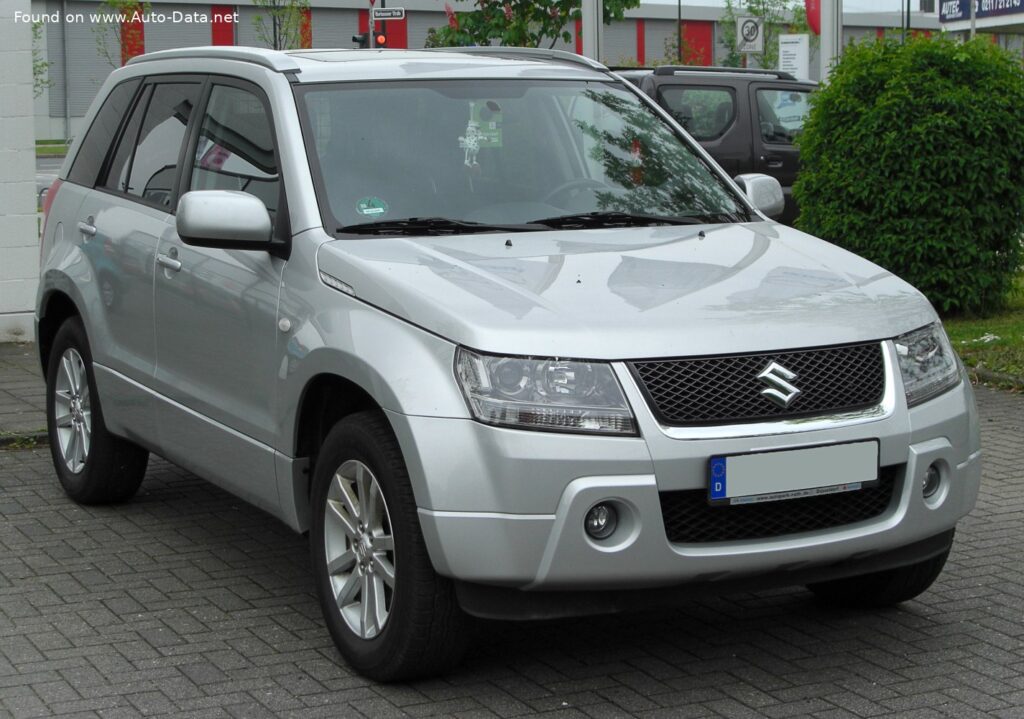
The Suzuki Grand Vitara II 5 Door: A Capable Global Compact SUV (2005-2008)
The Suzuki Grand Vitara II 5 Door, specifically the variant equipped with the 2.0-liter 16-valve engine and automatic transmission, represents a significant chapter in Suzuki’s long-standing tradition of producing robust and capable sport utility vehicles. Introduced in 2005 as the second generation of the Grand Vitara nameplate, this model marked a strategic evolution for Suzuki, blending the brand’s renowned off-road prowess with enhanced on-road refinement and modern amenities. Positioned in the highly competitive compact SUV segment, the Grand Vitara II 5 Door aimed to appeal to a broad international audience seeking a versatile vehicle capable of handling both urban commutes and adventurous excursions. While some rivals began to lean towards more car-like “crossover” designs, the Grand Vitara maintained a more traditional, rugged body-on-frame (or integrated ladder frame in this generation) construction, distinguishing it with genuine all-wheel-drive capability and a focus on durability.
Manufactured between 2005 and 2008 for this particular powertrain configuration, the Grand Vitara II 5 Door was a global product, sold across North America, Europe, Asia, and Oceania. In the United States, it offered a compelling alternative to more road-biased SUVs, catering to consumers who valued its blend of compact dimensions, practical interior, and serious off-road credentials. Its five-door configuration provided ample space for five occupants and their gear, making it a practical choice for families and adventurers alike.
Engine and Performance of the Suzuki Grand Vitara II 5 Door
At the heart of this particular Suzuki Grand Vitara II 5 Door variant lies the J20A engine, a naturally aspirated 2.0-liter (1995 cm³ or 121.74 cu. in.) inline-four gasoline engine. This powerplant was engineered to deliver a balance of usable power and reasonable efficiency for its class. Featuring a Double Overhead Camshaft (DOHC) valvetrain with four valves per cylinder and multi-port manifold fuel injection, the engine produced a respectable 140 horsepower at 6500 rpm. Torque output peaked at 137.19 lb.-ft. (186 Nm) at 4000 rpm, providing adequate pulling power for various driving conditions.
Power was delivered to all four wheels via a conventional 4-speed automatic transmission and a robust all-wheel-drive (4×4) system. This combination allowed the Grand Vitara to offer confident traction on slippery roads and respectable capability when venturing off the paved path. While the 4-speed automatic might seem modest by today’s standards, it was a common and reliable choice for SUVs of its era, known for its smooth shifts and durability. In terms of acceleration, the Grand Vitara II 5 Door 2.0 i 16V Automatic achieved 0 to 60 mph in approximately 12.9 seconds, with a top speed of 106.25 mph (171 km/h). These figures positioned it as a practical rather than overtly sporty performer, aligned with its utility-focused mission.
Fuel economy for the 2.0-liter automatic variant was rated at 25 US mpg combined (9.4 liters per 100 km). Urban driving yielded around 19.4 US mpg (12.1 l/100 km), while extra-urban driving improved to 30.9 US mpg (7.6 l/100 km). These figures were competitive for a compact SUV with a full-time or part-time 4×4 system in the mid-2000s. Furthermore, the vehicle adhered to the Euro 4 emission standard, reflecting its compliance with contemporary environmental regulations in key global markets.
Design and Features
The Suzuki Grand Vitara II 5 Door adopted a more contemporary and less overtly utilitarian design than its predecessor, yet it retained a strong, purposeful stance that hinted at its underlying capability. Its body type was a classic 5-door SUV, designed to accommodate five passengers comfortably. The exterior styling featured clean lines, prominent wheel arches, and a tailgate-mounted spare tire, a signature element that underscored its off-road readiness and distinguished it from many car-based crossovers.
Dimensionally, the Grand Vitara II 5 Door measured 175.98 inches (4470 mm) in length, 71.26 inches (1810 mm) in width, and 66.73 inches (1695 mm) in height. A wheelbase of 103.94 inches (2640 mm) contributed to a stable ride and a surprisingly spacious interior for its compact footprint. The front track measured 60.63 inches (1540 mm), and the rear track was 61.81 inches (1570 mm), providing a solid foundation for on-road stability and off-road articulation.
The chassis featured a robust suspension system, with a Spring Strut setup at the front and a Coil spring arrangement at the rear, designed to absorb bumps and provide a comfortable ride while also offering good articulation for off-road conditions. Braking performance was handled by ventilated discs at the front and reliable drum brakes at the rear, complemented by an Anti-lock Braking System (ABS) for enhanced safety. The vehicle rode on 17-inch wheel rims, typically shod with 225/65 R17 tires, balancing on-road grip with sufficient sidewall for off-pavement excursions. The steering system utilized a rack and pinion setup, offering precise control for an SUV of its class.
Inside, the Grand Vitara II 5 Door prioritized functionality and durability. While not overtly luxurious, the cabin was well-appointed for its segment, featuring logical controls and durable materials designed to withstand the rigors of an active lifestyle. Seating for five was comfortable, and the rear cargo area was practical, offering flexibility for carrying luggage or equipment. Safety features, beyond ABS, typically included multiple airbags and an integrated body structure designed to protect occupants in a collision, reflecting the evolving safety standards of the mid-2000s.
Technical Specifications: Suzuki Grand Vitara II 5 Door 2.0 i 16V (140 Hp) Automatic
| General Information | |
|---|---|
| Brand | Suzuki |
| Model | Grand Vitara |
| Generation | Grand Vitara II 5 Door |
| Type (Engine) | 2.0 i 16V (140 Hp) Automatic |
| Start of Production | 2005 year |
| End of Production | 2008 year |
| Powertrain Architecture | Internal Combustion Engine |
| Body Type | SUV |
| Seats | 5 |
| Doors | 5 |
| Performance Specifications | |
| Fuel Consumption (Urban) | 12.1 l/100 km (19.4 US mpg) |
| Fuel Consumption (Extra Urban) | 7.6 l/100 km (30.9 US mpg) |
| Fuel Consumption (Combined) | 9.4 l/100 km (25 US mpg) |
| Fuel Type | Petrol (Gasoline) |
| Acceleration 0 – 60 mph | 12.9 seconds |
| Maximum Speed | 171 km/h (106.25 mph) |
| Emission Standard | Euro 4 |
| Weight-to-Power Ratio | 11.3 kg/Hp (88.6 Hp/tonne) |
| Weight-to-Torque Ratio | 8.5 kg/Nm (117.7 Nm/tonne) |
| Engine Specifications | |
| Power | 140 Hp @ 6500 rpm |
| Power per Liter | 70.2 Hp/l |
| Torque | 186 Nm (137.19 lb.-ft.) @ 4000 rpm |
| Engine Layout | Front, Longitudinal |
| Engine Model/Code | J20A |
| Engine Displacement | 1995 cm³ (121.74 cu. in.) |
| Number of Cylinders | 4 |
| Engine Configuration | Inline |
| Cylinder Bore | 84 mm (3.31 in.) |
| Piston Stroke | 90 mm (3.54 in.) |
| Compression Ratio | 9.7:1 |
| Number of Valves per Cylinder | 4 |
| Fuel Injection System | Multi-port manifold injection |
| Engine Aspiration | Naturally aspirated engine |
| Valvetrain | DOHC |
| Engine Oil Capacity | 4.8 l (5.07 US qt) |
| Engine Oil Specification | Not specified |
| Coolant Capacity | 7.3 l (7.71 US qt) |
| Space, Volume and Weights | |
| Kerb Weight | 1580 kg (3483.3 lbs) |
| Max. Weight | 2070 kg (4563.57 lbs) |
| Max Load | 490 kg (1080.27 lbs) |
| Fuel Tank Capacity | 66 l (17.44 US gal) |
| Dimensions | |
| Length | 4470 mm (175.98 in.) |
| Width | 1810 mm (71.26 in.) |
| Height | 1695 mm (66.73 in.) |
| Wheelbase | 2640 mm (103.94 in.) |
| Front Track | 1540 mm (60.63 in.) |
| Rear (Back) Track | 1570 mm (61.81 in.) |
| Drivetrain, Brakes and Suspension Specifications | |
| Drive Wheel | All-wheel drive (4×4) |
| Number of Gears and Type of Gearbox | 4 gears, automatic transmission |
| Front Suspension | Spring Strut |
| Rear Suspension | Coil spring |
| Front Brakes | Ventilated discs |
| Rear Brakes | Drum |
| Assisting Systems | ABS (Anti-lock Braking System) |
| Steering Type | Steering rack and pinion |
| Tires Size | 225/65 R17 |
| Wheel Rims Size | 17 inches |
Legacy and Market Impact of the Suzuki Grand Vitara II 5 Door
The Suzuki Grand Vitara II 5 Door carved out a distinct niche in the global compact SUV market during its production run. While many competitors, such as the Honda CR-V, Toyota RAV4, and Nissan X-Trail (known as Rogue in North America), were increasingly embracing car-like unibody platforms and softer suspensions for improved on-road comfort, the Grand Vitara steadfastly maintained a more rugged character. Its integrated ladder frame (a unibody structure with an integrated frame) provided a stiffer, more durable platform than many rivals, offering a compelling blend of on-road civility and genuine off-road capability that was increasingly rare in its segment.
This commitment to robust engineering contributed to the Grand Vitara’s reputation for reliability and durability, qualities that Suzuki vehicles have historically been celebrated for. In markets like Europe, Australia, and parts of Asia, where driving conditions can be varied and off-road excursions more common, the Grand Vitara II 5 Door was highly regarded for its versatility. It offered a practical family vehicle during the week and a capable adventure companion on weekends, without the larger footprint or higher running costs of full-size SUVs.
In the North American market, the Grand Vitara faced stiff competition but appealed to a specific demographic. It was often chosen by buyers who desired true four-wheel-drive capability for light to moderate off-roading, or who lived in areas with challenging winter weather, but did not want the expense or size of a larger, truck-based SUV. Its relative affordability and strong value proposition also made it an attractive option. Despite Suzuki’s eventual withdrawal from the U.S. automotive market, the Grand Vitara remains a testament to the brand’s engineering philosophy and its legacy of producing capable, no-nonsense 4×4 vehicles.
The 2.0-liter automatic variant, in particular, offered a practical and easy-to-drive option for a broad range of consumers. Its balance of power, fuel economy, and all-wheel-drive capability made it a sensible choice for daily driving and occasional adventures. Even today, the Suzuki Grand Vitara II 5 Door is remembered as a well-engineered and durable compact SUV that successfully bridged the gap between traditional off-roaders and modern crossovers, leaving a lasting impact on Suzuki’s global reputation for building tough and dependable vehicles.