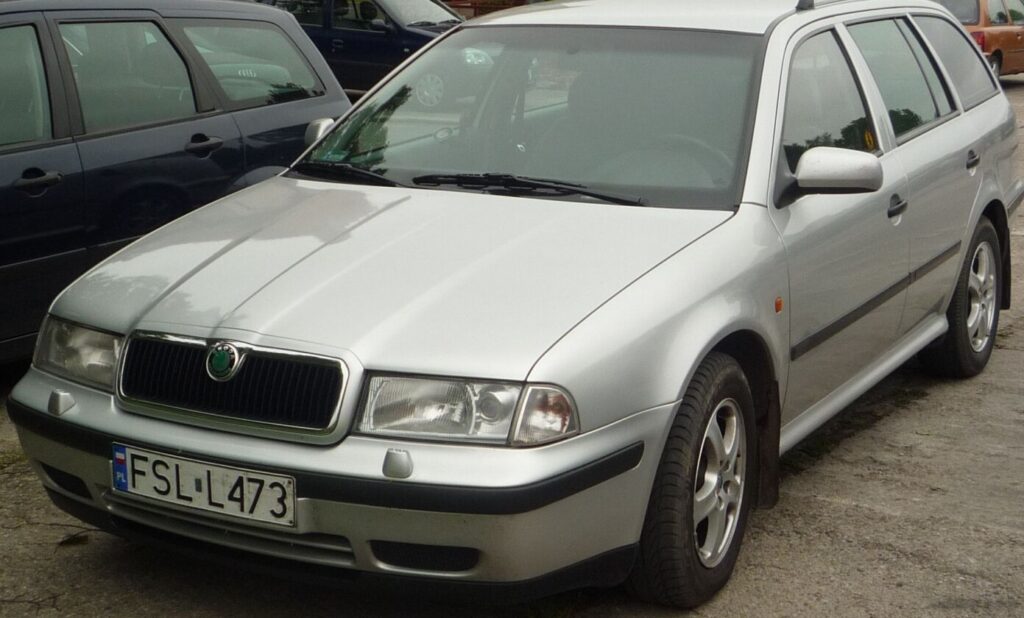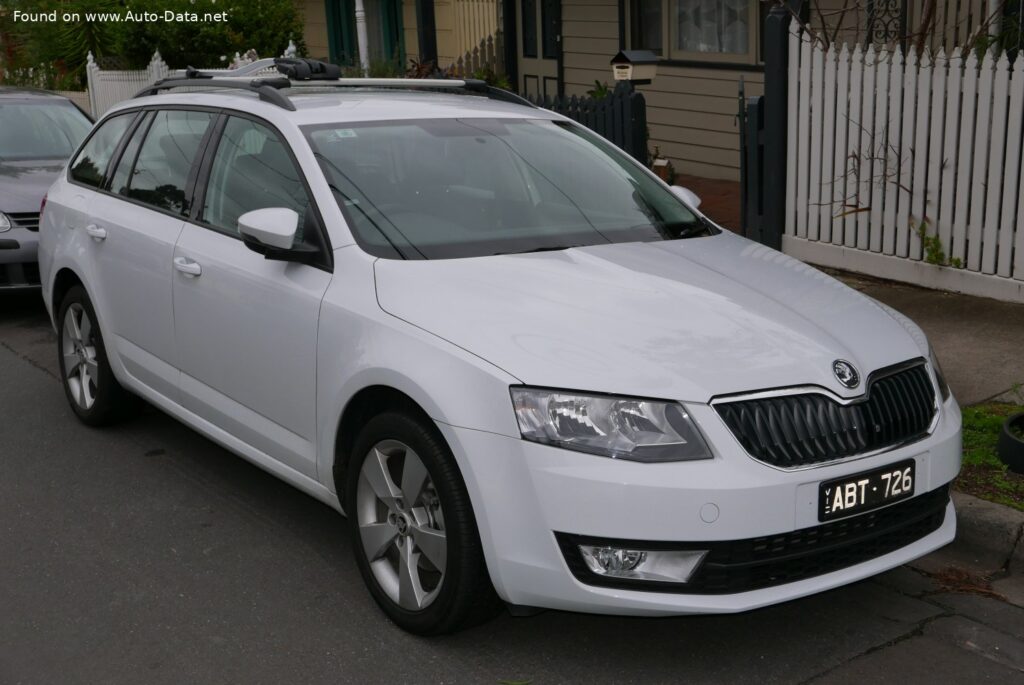
Skoda Octavia III Combi 1.4 G-TEC (110 Hp) CNG: An Overview
The Skoda Octavia III Combi 1.4 G-TEC (110 Hp) CNG represents a significant offering from the Czech automaker Skoda, a prominent member of the Volkswagen Group. Launched in November 2013 and produced until 2017, this particular variant of the third-generation Octavia Combi (Skoda’s term for station wagon) carved out a niche in the highly competitive European C-segment. It distinguished itself not only through Skoda’s hallmark practicality and value but also by its innovative bi-fuel powertrain, designed to run on both gasoline and compressed natural gas (CNG). This dual-fuel capability positioned the Octavia G-TEC as an environmentally conscious and economically viable option for families and fleet operators across the continent, offering reduced running costs and lower emissions compared to conventional gasoline or diesel engines.
During its production run, the Octavia III Combi built upon the success of its predecessors, evolving into a more refined, technologically advanced, and spacious vehicle. The G-TEC variant, in particular, highlighted Skoda’s commitment to sustainable mobility solutions without compromising on the utility and comfort that the Octavia line is renowned for. While models like this were primarily targeted at European markets where CNG infrastructure and incentives were more prevalent, its engineering principles and efficiency metrics are relevant to a global understanding of automotive development.
Engine and Performance of the Skoda Octavia III Combi 1.4 G-TEC (110 Hp) CNG
At the heart of the Skoda Octavia III Combi 1.4 G-TEC (110 Hp) CNG lies a sophisticated 1.4-liter (1395 cm³ or 85.13 cu. in.) turbocharged inline-four engine, designated as the EA211 / CPWA. This powerplant is a testament to modern engine design, featuring direct injection and a DOHC (Double Overhead Camshaft) valvetrain with four valves per cylinder, all contributing to its impressive balance of power and efficiency. The engine is also equipped with an intercooler to optimize air density, further enhancing performance.
The G-TEC engine delivers a respectable 110 horsepower (Hp) at a broad range of 4800-6000 rpm, providing ample power for daily driving and highway cruising. Torque output is particularly strong for a 1.4-liter unit, peaking at 147.51 lb.-ft. (200 Nm) between 1500 and 3500 rpm. This wide torque band ensures responsive acceleration and flexible in-gear performance, making the Octavia G-TEC feel more powerful than its horsepower figure might suggest. Power is sent to the front wheels via a smooth and precise 6-speed manual transmission, a common and well-regarded setup for its segment.
Performance figures reflect the car’s practical orientation. It accelerates from 0 to 60 mph in a calculated 10.5 seconds, and from 0 to 62 mph (0-100 km/h) in 11 seconds. The top speed reaches 119.92 mph (193 km/h), which is entirely adequate for European autobahns and general highway use. What truly sets the G-TEC apart, however, is its bi-fuel capability. It houses both a conventional 13.21 US gallon (50-liter) gasoline tank and a 33.07 lb (15 kg) CNG cylinder, allowing drivers the flexibility to switch between fuels based on availability and cost.
The efficiency metrics are impressive, especially when operating on CNG. Combined fuel consumption (NEDC) on gasoline is rated at 43.6 US mpg (5.4 l/100 km), while on CNG, it achieves an even more economical 3.5 kg/100 km. Urban consumption is 33.6 US mpg (7 l/100 km) on gasoline and 4.5 kg/100 km on CNG, with extra-urban figures of 52.3 US mpg (4.5 l/100 km) and 2.9 kg/100 km respectively. These figures, coupled with CO2 emissions of 96 g/km on CNG (compared to 126 g/km on gasoline), underscore its environmental credentials and compliance with the stringent Euro 6 emission standard. The inclusion of a Start & Stop System further aids in reducing fuel consumption and emissions in urban traffic.
Design and Features
The Skoda Octavia III Combi maintains the brand’s reputation for understated yet functional design. Its body type, a 5-door station wagon, is inherently practical, offering ample space for passengers and cargo. With an overall length of 183.43 inches (4659 mm), a width of 71.42 inches (1814 mm) (79.41 inches or 2017 mm including mirrors), and a height of 57.68 inches (1465 mm), the Octavia Combi strikes a balance between a compact footprint and generous interior volume. The wheelbase of 105.51 inches (2680 mm) contributes to a stable ride and comfortable cabin.
Practicality is a cornerstone of the Octavia Combi’s design. It comfortably seats five occupants and boasts a substantial trunk space, ranging from 16.95 cu. ft. (480 liters) with all seats in place to a cavernous 56.86 cu. ft. (1610 liters) with the rear seats folded down. This makes it an ideal vehicle for families, long trips, or carrying bulky items. The integration of the CNG tanks is seamless, located beneath the trunk floor to minimize intrusion into the cargo area, a testament to clever engineering.
From a technological standpoint, the Octavia III Combi, even in its G-TEC variant, offered a suite of modern features for its time. While specific infotainment details are not provided, it would have included standard amenities such as air conditioning, power windows, and a comprehensive audio system. Safety was also a priority, with standard features like ABS (Anti-lock Braking System) and a robust chassis design. The suspension system, featuring an independent McPherson setup with coil springs and an anti-roll bar at the front, and an independent multi-link spring suspension with a stabilizer at the rear, ensures a comfortable ride and predictable handling characteristics. Ventilated disc brakes at the front and disc brakes at the rear provide confident stopping power, further supported by the standard ABS. Electric power steering enhances maneuverability and efficiency. The vehicle rides on 205/55 R16 tires fitted to 6.5J x 16-inch wheel rims, a common and cost-effective size.
Technical Specifications
| Category | Specification |
|---|---|
| General Information | |
| Brand | Skoda |
| Model | Octavia |
| Generation | Octavia III Combi |
| Type (Engine) | 1.4 G-TEC (110 Hp) CNG |
| Production Start | November, 2013 |
| Production End | 2017 |
| Powertrain Architecture | Internal Combustion Engine |
| Body Type | Station Wagon (Estate) |
| Seats | 5 |
| Doors | 5 |
| Performance Specifications | |
| Fuel Consumption (Urban, Petrol NEDC) | 7 l/100 km (33.6 US mpg) |
| Fuel Consumption (Urban, CNG NEDC) | 4.5 kg/100 km |
| Fuel Consumption (Extra Urban, Petrol NEDC) | 4.5 l/100 km (52.3 US mpg) |
| Fuel Consumption (Extra Urban, CNG NEDC) | 2.9 kg/100 km |
| Fuel Consumption (Combined, Petrol NEDC) | 5.4 l/100 km (43.6 US mpg) |
| Fuel Consumption (Combined, CNG NEDC) | 3.5 kg/100 km |
| CO2 Emissions (Petrol NEDC) | 126 g/km |
| CO2 Emissions (CNG NEDC) | 96 g/km |
| Fuel Type | Petrol / CNG |
| Acceleration 0 – 60 mph | 10.5 seconds |
| Acceleration 0 – 62 mph (0-100 km/h) | 11 seconds |
| Maximum Speed | 119.92 mph (193 km/h) |
| Emission Standard | Euro 6 |
| Weight-to-Power Ratio | 12.2 kg/Hp (82 Hp/tonne) |
| Weight-to-Torque Ratio | 6.7 kg/Nm (149.1 Nm/tonne) |
| Engine Specifications | |
| Power | 110 Hp @ 4800-6000 rpm |
| Power per Liter | 78.9 Hp/l |
| Torque | 147.51 lb.-ft. (200 Nm) @ 1500-3500 rpm |
| Engine Layout | Front, Transverse |
| Engine Model/Code | EA211 / CPWA |
| Engine Displacement | 1395 cm³ (85.13 cu. in.) |
| Number of Cylinders | 4 |
| Engine Configuration | Inline |
| Cylinder Bore | 2.93 in. (74.5 mm) |
| Piston Stroke | 3.15 in. (80 mm) |
| Compression Ratio | 10.5:1 |
| Number of Valves per Cylinder | 4 |
| Fuel Injection System | Direct injection |
| Engine Aspiration | Turbocharger, Intercooler |
| Valvetrain | DOHC |
| Engine Oil Capacity | 4 liters (4.23 US qt) |
| Engine Oil Specification | Not specified |
| Coolant Capacity | 10.2 liters (10.78 US qt) |
| Engine Systems | Start & Stop System |
| Dimensions, Volume, and Weights | |
| Curb Weight | 2956.4 lbs. (1341 kg) |
| Max. Weight (Gross Vehicle Weight) | 4111.62 lbs. (1865 kg) |
| Max. Load Capacity | 1155.22 lbs. (524 kg) |
| Trunk Space (Minimum) | 16.95 cu. ft. (480 l) |
| Trunk Space (Maximum) | 56.86 cu. ft. (1610 l) |
| Fuel Tank Capacity (Petrol) | 13.21 US gal (50 l) |
| CNG Cylinder Capacity | 15 kg (33.07 lbs.) |
| Max. Roof Load | 165.35 lbs. (75 kg) |
| Max. Trailer Load (with brakes, 12%) | 3086.47 lbs. (1400 kg) |
| Max. Trailer Load (without brakes) | 1543.24 lbs. (700 kg) |
| Permitted Towbar Download | 165.35 lbs. (75 kg) |
| Length | 183.43 in. (4659 mm) |
| Width | 71.42 in. (1814 mm) |
| Width (including mirrors) | 79.41 in. (2017 mm) |
| Height | 57.68 in. (1465 mm) |
| Wheelbase | 105.51 in. (2680 mm) |
| Front Track | 60.75 in. (1543 mm) |
| Rear Track | 59.65 in. (1515 mm) |
| Ride Height (Ground Clearance) | 5.51 in. (140 mm) |
| Drag Coefficient (Cd) | 0.322 |
| Minimum Turning Circle | 36.25 ft. (11.05 m) |
| Approach Angle | 13.9° |
| Departure Angle | 12.2° |
| Drivetrain, Brakes, and Suspension | |
| Drivetrain Architecture | Front-wheel drive (ICE drives front wheels) |
| Drive Wheel | Front-wheel drive |
| Number of Gears & Gearbox Type | 6 gears, manual transmission |
| Front Suspension | Independent, McPherson with coil spring and anti-roll bar |
| Rear Suspension | Independent multi-link spring suspension with stabilizer |
| Front Brakes | Ventilated discs |
| Rear Brakes | Disc |
| Assisting Systems | ABS (Anti-lock braking system) |
| Steering Type | Steering rack and pinion |
| Power Steering | Electric Steering |
| Tire Size | 205/55 R16 |
| Wheel Rims Size | 6.5J x 16 |
Legacy and Market Impact
The Skoda Octavia, particularly in its Combi station wagon form, has long been a cornerstone of Skoda’s success in Europe, consistently ranking among the best-selling models in its class. The third-generation Octavia continued this tradition, offering a compelling blend of space, comfort, reliability, and value that resonated deeply with European consumers. Within this successful lineage, the Skoda Octavia III Combi 1.4 G-TEC (110 Hp) CNG carved out a specific and important niche.
Its primary market impact stemmed from its bi-fuel capability. In countries like Germany, Italy, Austria, and Sweden, where CNG refueling infrastructure was more developed and government incentives for alternative fuel vehicles were in place, the G-TEC offered a significant advantage. It addressed the growing demand for more environmentally friendly transportation solutions, providing lower CO2 and particulate emissions compared to conventional gasoline or diesel engines, while also offering substantial savings on fuel costs due to the typically lower price of CNG. This made it a particularly attractive option for economy-minded private buyers, taxi fleets, and corporate fleets looking to reduce their environmental footprint and operational expenses.
Competitors in the European C-segment station wagon market were numerous and strong, including the Volkswagen Golf Variant (with which the Octavia shared its MQB platform), Ford Focus Estate, Opel Astra Sports Tourer, Peugeot 308 SW, and Renault Megane Sport Tourer. While many of these rivals offered efficient gasoline and diesel powertrains, few provided a factory-integrated CNG option with the same level of refinement and practicality as the Octavia G-TEC. This unique selling proposition allowed Skoda to capture a segment of the market that prioritized both utility and alternative fuel efficiency.
The legacy of the Octavia III Combi G-TEC is one of quiet innovation and practical sustainability. It demonstrated that alternative fuel vehicles didn’t have to compromise on space, performance, or everyday usability. It reinforced Skoda’s image as a brand that delivers smart, well-engineered vehicles that offer excellent value. While CNG vehicles have not gained significant traction in the United States due to limited infrastructure, the Octavia G-TEC stands as an exemplar of how European automakers adapted to regional demands for cleaner, more efficient mobility, proving that a family-friendly station wagon could also be a leader in alternative fuel technology for its time. Its success