
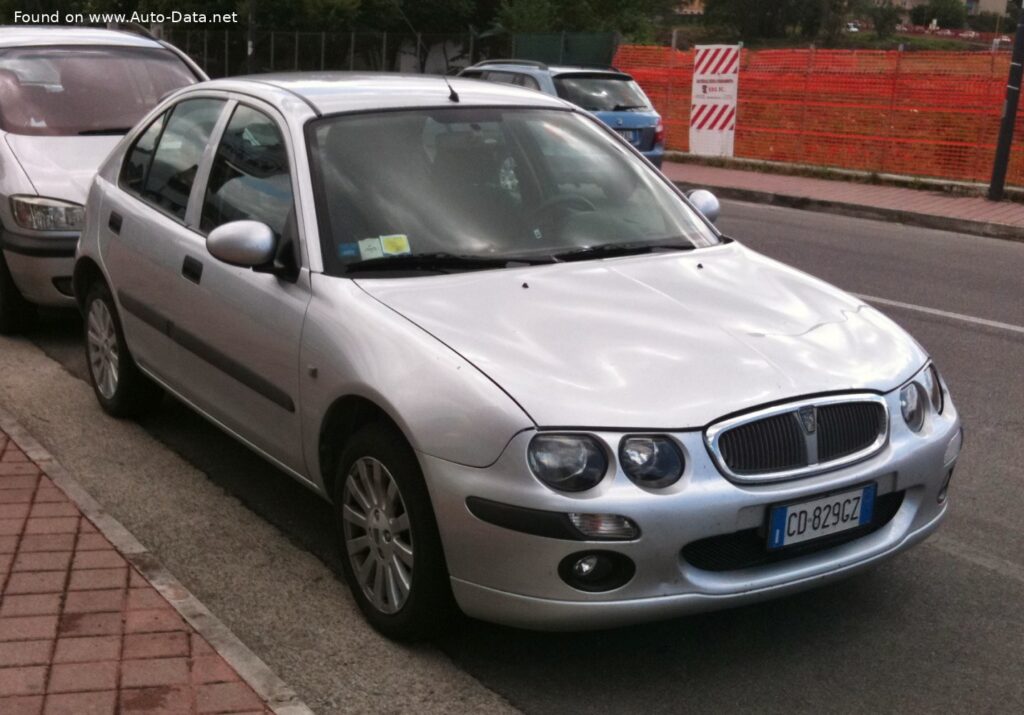
The Rover 25 (RF) 1.8 i 16V (145 Hp): A Spirited British Compact
The Rover 25, designated internally as the RF generation, emerged in 1999 as a significant evolution of the popular Rover 200 (R3) model. Positioned firmly within Europe’s highly competitive supermini and compact car segments, the 25 aimed to blend traditional British motoring charm with contemporary performance and practicality. While never officially sold in the United States, the Rover 25 played a crucial role in the European market, particularly in its home country, the United Kingdom, where it was a familiar sight on roads for over half a decade. This particular variant, the Rover 25 (RF) 1.8 i 16V (145 Hp), represented the pinnacle of the standard model line-up, offering a compelling blend of lively performance and everyday usability, eschewing the more extreme performance of the MG ZR hot hatch derivative. Its introduction marked Rover’s concerted effort to appeal to a younger, more dynamic audience while retaining its established customer base.
Produced from 1999 until Rover’s cessation of operations in 2005, the 25 series was a front-wheel-drive, internal combustion engine vehicle available in both three-door and five-door hatchback configurations. The 1.8 i 16V (145 Hp) model, in particular, stood out for its advanced K-Series engine, equipped with Variable Valve Control (VVC) technology, which was quite sophisticated for a car in its class at the turn of the millennium. This article delves into the technical prowess, design philosophy, and market impact of this engaging British compact, focusing on the high-performance 1.8-liter variant.
Engine and Performance: The Heart of the Rover 25 (RF) 1.8 i 16V (145 Hp)
At the core of the spirited Rover 25 (RF) 1.8 i 16V (145 Hp) was Rover’s renowned K18 VVC engine. This naturally aspirated, 1.8-liter (1795 cm³ or 109.54 cu. in.) inline four-cylinder engine was a marvel of its time, especially for a compact car. Utilizing a DOHC (Dual Overhead Camshaft) valvetrain with four valves per cylinder, the engine’s standout feature was its Variable Valve Control (VVC) system. This innovative technology allowed for continuous adjustment of valve timing, optimizing both power output and fuel efficiency across the rev range.
The result was an impressive 145 horsepower at a high 6750 rpm, translating to a specific output of 80.8 horsepower per liter – a commendable figure for a non-turbocharged engine. Torque delivery was equally respectable, peaking at 128.34 lb.-ft. (174 Nm) at 4000 rpm, ensuring a broad powerband suitable for both enthusiastic driving and daily commuting. Power was efficiently channeled to the front wheels via a slick-shifting 5-speed manual transmission, a common and reliable setup for European compacts.
Performance figures for the Rover 25 (RF) 1.8 i 16V (145 Hp) underscored its sporty aspirations. It could accelerate from 0 to 60 mph in a brisk 7.4 seconds, and reach 0 to 62 mph (100 km/h) in 7.8 seconds, placing it firmly in “warm hatch” territory. The top speed was rated at 124.27 mph (200 km/h), making it one of the faster cars in its class. These numbers were particularly impressive given the vehicle’s modest curb weight of just 2403.04 lbs. (1090 kg), contributing to an excellent weight-to-power ratio of 7.5 kg/Hp (133 Hp/tonne).
Despite its performance focus, the K18 VVC engine also demonstrated reasonable fuel economy for its class and era. Combined fuel consumption was rated at 31.4 US mpg (7.5 l/100 km), with highway figures reaching an impressive 40.6 US mpg (5.8 l/100 km). This balance of performance and efficiency made the 1.8 i 16V an attractive proposition for drivers seeking a lively yet practical compact car.
Design and Features
The Rover 25 (RF) adopted a distinctive hatchback body style, available with either three or five doors, providing flexibility for different customer needs. Its design was an evolution of the Rover 200, featuring a more assertive front end with “quad” headlights and a revised grille, aiming for a sportier and more contemporary aesthetic. The overall dimensions were compact, measuring 157.09 inches (3990 mm) in length, 66.46 inches (1688 mm) in width, and 55.79 inches (1417 mm) in height, with a wheelbase of 98.43 inches (2500 mm). These proportions contributed to its agility and ease of maneuverability in urban environments.
Inside, the Rover 25 (RF) 1.8 i 16V (145 Hp) offered seating for five occupants. The interior design, while functional, incorporated classic Rover touches, such as wood or metallic effect trim, aiming for a more upscale feel than many of its direct competitors. Standard features for the 1.8 i 16V model typically included power windows, central locking, and a more comprehensive stereo system. For its era, safety features included an Anti-lock Braking System (ABS) as standard, enhancing driver control during emergency braking. The car was equipped with a hydraulic power steering system, offering precise and communicative feedback.
Practicality was also a key consideration. The hatchback design provided a versatile cargo area, with a minimum trunk space of 10.74 cu. ft. (304 liters), expandable to a generous 38.35 cu. ft. (1086 liters) with the rear seats folded down. This made the Rover 25 a capable companion for grocery runs or weekend trips. The car rode on 205/45 R16 tires, providing a good balance of grip and ride comfort. Suspension was handled by a wishbone setup at the front and spring struts at the rear, a common and effective configuration for front-wheel-drive compacts, offering a dynamic yet comfortable ride quality. Braking performance was assured by ventilated discs at the front and drum brakes at the rear.
Technical Specifications: Rover 25 (RF) 1.8 i 16V (145 Hp)
| General Information | |
|---|---|
| Brand | Rover |
| Model | 25 |
| Generation | 25 (RF) |
| Type (Engine) | 1.8 i 16V (145 Hp) |
| Start of Production | 1999 year |
| End of Production | 2005 year |
| Powertrain Architecture | Internal Combustion engine |
| Body type | Hatchback |
| Seats | 5 |
| Doors | 3-5 |
| Performance Specifications | |
| Fuel Consumption (Economy) – Urban | 10.4 l/100 km (22.6 US mpg) |
| Fuel Consumption (Economy) – Extra Urban | 5.8 l/100 km (40.6 US mpg) |
| Fuel Consumption (Economy) – Combined | 7.5 l/100 km (31.4 US mpg) |
| Fuel Type | Petrol (Gasoline) |
| Acceleration 0 – 60 mph | 7.4 sec |
| Acceleration 0 – 62 mph (0 – 100 km/h) | 7.8 sec |
| Maximum Speed | 124.27 mph (200 km/h) |
| Weight-to-Power Ratio | 7.5 kg/Hp (133 Hp/tonne) |
| Weight-to-Torque Ratio | 6.3 kg/Nm (159.6 Nm/tonne) |
| Engine Specifications | |
| Power | 145 Hp @ 6750 rpm |
| Power per Litre | 80.8 Hp/l |
| Torque | 174 Nm @ 4000 rpm (128.34 lb.-ft. @ 4000 rpm) |
| Engine Layout | Front, Transverse |
| Engine Model/Code | K18 VVC |
| Engine Displacement | 1795 cm³ (109.54 cu. in.) |
| Number of Cylinders | 4 |
| Engine Configuration | Inline |
| Cylinder Bore | 80 mm (3.15 in.) |
| Piston Stroke | 89.3 mm (3.52 in.) |
| Compression Ratio | 10.5:1 |
| Number of Valves per Cylinder | 4 |
| Fuel Injection System | Multi-port manifold injection |
| Engine Aspiration | Naturally Aspirated |
| Valvetrain | DOHC |
| Engine Oil Capacity | 5 l (5.28 US qt) |
| Coolant Capacity | 4.8 l (5.07 US qt) |
| Space, Volume and Weights | |
| Kerb Weight | 1090 kg (2403.04 lbs.) |
| Max. Weight | 1520 kg (3351.03 lbs.) |
| Max Load | 430 kg (947.99 lbs.) |
| Trunk (Boot) Space – Minimum | 304 l (10.74 cu. ft.) |
| Trunk (Boot) Space – Maximum | 1086 l (38.35 cu. ft.) |
| Fuel Tank Capacity | 50 l (13.21 US gal) |
| Dimensions | |
| Length | 3990 mm (157.09 in.) |
| Width | 1688 mm (66.46 in.) |
| Height | 1417 mm (55.79 in.) |
| Wheelbase | 2500 mm (98.43 in.) |
| Front Track | 1473 mm (57.99 in.) |
| Rear (Back) Track | 1466 mm (57.72 in.) |
| Drivetrain, Brakes and Suspension | |
| Drivetrain Architecture | Front-wheel drive, Internal Combustion engine |
| Drive Wheel | Front-wheel drive |
| Number of Gears and Type of Gearbox | 5 gears, manual transmission |
| Front Suspension | Wishbone |
| Rear Suspension | Spring Strut |
| Front Brakes | Ventilated discs |
| Rear Brakes | Drum |
| Assisting Systems | ABS (Anti-lock braking system) |
| Steering Type | Steering rack and pinion |
| Power Steering | Hydraulic Steering |
| Tires Size | 205/45 R16 |
Legacy and Market Impact
The Rover 25 (RF) entered the European market at a challenging time for its parent company. As one of the last truly British-owned mass-market vehicles, it carried the weight of a storied automotive heritage. The Rover 25 (RF) 1.8 i 16V (145 Hp), in particular, carved out a niche as a surprisingly potent and refined compact. Its main competitors in Europe included established players like the Ford Fiesta, Vauxhall Corsa (Opel Corsa), Volkswagen Polo, and Peugeot 206, all of which offered a diverse range of engines and trim levels. What set the 1.8 i 16V apart was its distinctive K-Series VVC engine, which offered a blend of high revving power and efficiency that few rivals could match in a naturally aspirated form.
In its primary market, the UK, the Rover 25 was a popular choice, appreciated for its comfortable ride, relatively upmarket interior for its class, and, in the case of the 145 hp variant, its engaging driving dynamics. It was often seen as a more characterful alternative to its German and French competitors. The car’s compact dimensions made it ideal for navigating crowded European cities, while its hatchback versatility ensured it remained a practical daily driver.
Despite its merits, the Rover 25, and indeed the entire Rover brand, faced significant challenges throughout its production run. Intense competition, evolving market tastes, and the company’s precarious financial situation ultimately led to its demise. However, the 1.8 i 16V (145 Hp) variant remains a testament to Rover’s engineering capabilities, particularly with the K-Series engine, which, despite later reliability concerns in some applications, was a genuinely innovative and high-performing unit when properly maintained.
Today, the Rover 25 (RF) 1.8 i 16V (145 Hp) is remembered by enthusiasts as a “sleeper” hot hatch, offering strong performance in a relatively understated package. It represents a significant chapter in British automotive history, embodying the brand’s final efforts to compete in a rapidly globalizing industry. While its production lifespan was cut short, its contribution to the European compact car segment, especially as a performance variant, is undeniable. It stands as a reminder of Rover’s ambition and engineering prowess in its twilight years.
