The Renault Megane II Coupe 1.6 16V (113 Hp): A European Compact with Distinctive Flair
The Renault Megane II Coupe 1.6 16V (113 Hp) represents a significant chapter in the history of the French automaker’s popular compact car series. Launched in 2002, the second generation Megane quickly garnered attention for its bold, unconventional styling and a strong emphasis on safety and technological innovation for its segment. While primarily designed for and sold in European and other international markets, where it competed fiercely with established rivals, the Megane II offered a unique blend of practicality, comfort, and a distinctive aesthetic that set it apart. This particular variant, the 3-door Coupe with its 1.6-liter, 16-valve engine, provided a sporty yet economical option for buyers seeking a more dynamic driving experience within the compact class. It was produced until 2005, making way for subsequent updates within the Megane II generation.
Engineering and Performance of the Renault Megane II Coupe 1.6 16V (113 Hp)
At the heart of the Renault Megane II Coupe 1.6 16V (113 Hp) lies Renault’s venerable K4M engine, a naturally aspirated 1.6-liter (1598 cm3 or 97.52 cu. in.) inline four-cylinder unit. This powerplant, featuring a DOHC (Double Overhead Camshaft) valvetrain with four valves per cylinder, was renowned for its balance of efficiency and smooth power delivery. It produced a respectable 113 horsepower at 6000 rpm, translating to a power-per-liter output of 70.7 horsepower per liter. Peak torque stood at 152 Nm, or approximately 112.11 lb.-ft., available at 4200 rpm, providing adequate thrust for daily driving and highway cruising.
Power was exclusively sent to the front wheels via a five-speed manual transmission, a common and efficient setup for compact cars of this era. This drivetrain architecture, combined with a relatively low curb weight of 2546.34 pounds, allowed the Megane II Coupe to achieve a 0-60 mph acceleration time of 10.4 seconds. While not a performance car, this figure was competitive for its segment, offering a lively feel. The top speed was rated at 192 km/h, or approximately 119.3 mph.
Fuel economy was a key consideration for European buyers, and the Megane II Coupe 1.6 16V delivered solid numbers. On the combined cycle, it achieved an estimated 6.9 liters per 100 km, which translates to an impressive 34.1 US miles per gallon. Urban driving yielded 25.8 US mpg, while extra-urban (highway) driving saw figures as high as 41.3 US mpg. With CO2 emissions of 164 g/km and adherence to the Euro 4 emission standard, it reflected Renault’s commitment to environmental considerations within the context of early 2000s automotive technology. The substantial 15.85 US gallon fuel tank also ensured a decent cruising range.
Design and Features
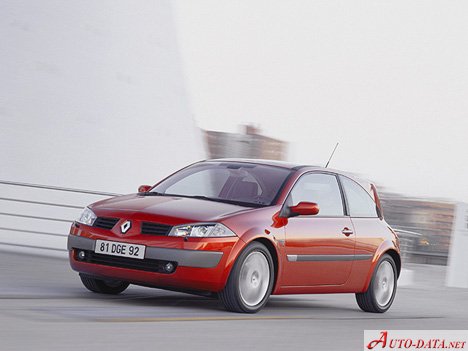
The Renault Megane II Coupe was a standout for its design, breaking away from the more conventional styling of its predecessor. Its most striking feature was arguably the distinctive “bustle-back” rear, characterized by a steeply raked rear window and a prominent, almost bulbous trunk lid. This audacious design choice, shared with the larger Megane hatchback, was a polarizing element but undeniably made the car instantly recognizable. The 3-door coupe body style further accentuated its sporty aspirations, featuring sleek lines that flowed from the front fascia to the unique rear.
Measuring 165.71 inches in length, 69.96 inches in width, and 57.4 inches in height, with a wheelbase of 103.35 inches, the Megane II Coupe offered a compact footprint that was ideal for navigating crowded European city streets. Despite its coupe designation, it was configured with five seats, making it a surprisingly practical option for small families or those needing occasional rear passenger capacity.
Inside, the Megane II continued Renault’s focus on user-friendly design and modern features. While specific interior trim levels vary, the car generally offered a comfortable cabin with good ergonomics. Key features for the era included electric power steering, which provided a light and responsive feel, and a comprehensive ABS (Anti-lock Braking System) for enhanced stopping performance. The front suspension utilized an independent McPherson strut design, while the rear featured a torsion beam setup, a common and effective combination for front-wheel-drive compacts, balancing ride comfort with competent handling. Braking was handled by ventilated discs at the front and solid discs at the rear, ensuring reliable deceleration. The car rode on 195/65 R15 tires, mounted on 6.5J x 15 wheel rims, providing a good balance of grip and ride quality.
Practicality was also considered, with a minimum trunk space of 11.65 cu. ft. that could expand significantly to 42.02 cu. ft. with the rear seats folded, demonstrating surprising versatility for a coupe.
Technical Specifications: Renault Megane II Coupe 1.6 16V (113 Hp)
| Category | Specification |
|---|---|
| General Information | |
| Brand | Renault |
| Model | Megane II Coupe |
| Engine Type | 1.6 16V (113 Hp) |
| Production Start | 2002 |
| Production End | 2005 |
| Powertrain Architecture | Internal Combustion Engine |
| Body Type | Coupe |
| Seats | 5 |
| Doors | 3 |
| Performance Specifications | |
| Fuel Consumption (Urban) | 25.8 US mpg (9.1 l/100 km) |
| Fuel Consumption (Extra Urban) | 41.3 US mpg (5.7 l/100 km) |
| Fuel Consumption (Combined) | 34.1 US mpg (6.9 l/100 km) |
| CO2 Emissions | 164 g/km |
| Fuel Type | Petrol (Gasoline) |
| Acceleration 0-60 mph | 10.4 sec |
| Maximum Speed | 119.3 mph (192 km/h) |
| Emission Standard | Euro 4 |
| Weight-to-Power Ratio | 10.2 kg/Hp (22.49 lbs/Hp) |
| Weight-to-Torque Ratio | 7.6 kg/Nm |
| Engine Specifications | |
| Power | 113 Hp @ 6000 rpm |
| Power per Liter | 70.7 Hp/l |
| Torque | 112.11 lb.-ft. @ 4200 rpm (152 Nm) |
| Engine Layout | Front, Transverse |
| Engine Model/Code | K4M |
| Engine Displacement | 97.52 cu. in. (1598 cm3) |
| Number of Cylinders | 4 |
| Engine Configuration | Inline |
| Cylinder Bore | 3.13 in. (79.5 mm) |
| Piston Stroke | 3.17 in. (80.5 mm) |
| Compression Ratio | 10:1 |
| Valves per Cylinder | 4 |
| Fuel Injection System | Multi-port manifold injection |
| Engine Aspiration | Naturally Aspirated |
| Valvetrain | DOHC |
| Engine Oil Capacity | 5.07 US qt (4.8 l) |
| Engine Oil Specification | N/A |
| Coolant Capacity | 6.34 US qt (6 l) |
| Dimensions, Volume, and Weights | |
| Kerb Weight | 2546.34 lbs (1155 kg) |
| Maximum Weight | 3758.88 lbs (1705 kg) |
| Maximum Load | 1212.54 lbs (550 kg) |
| Trunk Space (Minimum) | 11.65 cu. ft. (330 l) |
| Trunk Space (Maximum) | 42.02 cu. ft. (1190 l) |
| Fuel Tank Capacity | 15.85 US gal (60 l) |
| Max. Roof Load | 176.37 lbs (80 kg) |
| Permitted Trailer Load with Brakes (12%) | 2866.01 lbs (1300 kg) |
| Permitted Trailer Load without Brakes | 1433 lbs (650 kg) |
| Permitted Towbar Download | 165.35 lbs (75 kg) |
| Length | 165.71 in. (4209 mm) |
| Width | 69.96 in. (1777 mm) |
| Height | 57.4 in. (1458 mm) |
| Wheelbase | 103.35 in. (2625 mm) |
| Front Track | 59.76 in. (1518 mm) |
| Rear Track | 59.61 in. (1514 mm) |
| Drag Coefficient (Cd) | 0.35 |
| Minimum Turning Circle | 34.45 ft (10.5 m) |
| Drivetrain, Brakes, and Suspension | |
| Drivetrain Architecture | Front-wheel drive |
| Drive Wheel | Front wheel drive |
| Number of Gears / Gearbox Type | 5 gears, manual transmission |
| Front Suspension | Independent type McPherson |
| Rear Suspension | Torsion beam |
| Front Brakes | Ventilated discs |
| Rear Brakes | Disc |
| Assisting Systems | ABS (Anti-lock Braking System) |
| Steering Type | Steering rack and pinion |
| Power Steering | Electric Steering |
| Tires Size | 195/65 R15 |
| Wheel Rims Size | 6.5J x 15 |
Legacy and Market Impact
The Renault Megane II, including its distinctive Coupe variant, made a significant splash in the European compact car segment upon its debut. Its bold “love it or hate it” design language, particularly the controversial rear styling, ensured that it stood out in a crowded market dominated by more conventionally styled competitors like the Volkswagen Golf, Ford Focus, and Peugeot 307. This design philosophy was a hallmark of Renault’s chief designer, Patrick Le Quément, who aimed to inject a sense of avant-garde into mainstream vehicles.
Beyond aesthetics, the Megane II was a pioneer in safety. It was one of the first cars in its class to achieve a full five-star rating in Euro NCAP crash tests, a testament to Renault’s commitment to passive safety. While specific safety features like multiple airbags are not detailed in the provided data, the platform itself was engineered for high levels of occupant protection, a major selling point in Europe during the early 2000s. The inclusion of ABS as standard across the range further underscored this safety focus.
Technologically, the Megane II also introduced innovations that would become commonplace, such as the keyless card entry and start system (Renault Card), which, while not specified for this exact variant, was a defining characteristic of the generation. The electric power steering, as listed in the specifications, was another modern touch that enhanced the driving experience.
The 1.6 16V (113 Hp) Coupe specifically catered to buyers who desired a blend of style, economy, and a slightly sportier feel than the standard hatchback, without the higher running costs associated with more powerful engines. Its competitive fuel economy and practical, albeit unconventionally styled, five-seat, three-door layout made it a versatile choice.
Today, the Renault Megane II Coupe is remembered as a car that dared to be different. It solidified Renault’s reputation for innovative design and strong safety credentials within the compact segment. Its mechanical robustness, particularly with the K4M engine, ensured a long service life, and many examples can still be found on European roads, serving as a reminder of a period when mainstream automotive design was willing to take bold risks. While never officially imported to the United States, its impact on the European automotive landscape was undeniable, influencing design trends and raising the bar for safety and technology in the compact class.