Introduction to the Volkswagen Transporter (T5, facelift 2009) Panel Van
The Volkswagen Transporter, known globally as a versatile and enduring light commercial vehicle, represents a cornerstone of Volkswagen’s commercial vehicle division. The fifth generation, or T5, initially launched in 2003, received a significant facelift in 2009, introducing a host of technological and aesthetic improvements. This article focuses specifically on the Volkswagen Transporter (T5, facelift 2009) Panel Van 2.0 TDI BMT (114 Hp) L2H3 variant, produced between 2011 and 2015. While the Transporter has a storied history and iconic status in many parts of the world, particularly Europe and Asia, it is not widely sold in the United States in its commercial panel van guise, where larger, purpose-built vans from manufacturers like Ford and Mercedes-Benz dominate the market. Instead, the Transporter has carved out a niche as a highly capable and efficient workhorse for small businesses, tradespeople, and logistics operations across its primary markets.
The T5 facelift brought a refreshed exterior design, updated interior ergonomics, and, most importantly, a new range of more efficient engines, including the 2.0-liter TDI (Turbocharged Direct Injection) units. The specific L2H3 designation for this panel van indicates a long wheelbase (L2) and a high roof (H3), maximizing its cargo capacity and utility. This configuration makes it an ideal choice for professionals requiring substantial load volume and payload capability, combined with Volkswagen’s renowned build quality and reliability.
Engine and Performance: The Efficient Heart of the Volkswagen Transporter (T5, facelift 2009) Panel Van
Powering this particular variant of the Transporter T5 facelift is a 2.0-liter TDI BlueMotion Technology (BMT) inline-four cylinder diesel engine, codenamed EA189 / CAAD. This powertrain was engineered with a strong emphasis on fuel efficiency and reduced emissions, aligning with the increasingly stringent Euro 5 emission standards of its production era. The engine generates a respectable 114 horsepower at 3500 rpm, which, while not designed for outright speed, provides ample power for urban and highway driving, especially when laden.
A key characteristic of a commercial vehicle engine is torque, and the 2.0 TDI BMT delivers a robust 250 Nm (184.39 lb.-ft.) of torque across a broad and usable rev range, specifically from 1500 to 2750 rpm. This low-end torque is crucial for pulling heavy loads, facilitating smooth acceleration from a standstill, and providing flexibility in traffic without constant gear changes. The engine’s architecture features a DOHC (Dual Overhead Camshaft) valvetrain with four valves per cylinder, a common rail direct fuel injection system, and is augmented by a turbocharger and intercooler, ensuring efficient combustion and power delivery.
Performance figures for the L2H3 panel van reflect its utilitarian purpose rather than sporty aspirations. It accelerates from 0 to 60 mph in a calculated 14.3 seconds and reaches a maximum speed of 94.45 mph (152 km/h). However, its true strength lies in its fuel economy. Equipped with BlueMotion Technology, which includes a Start & Stop system and a particulate filter, the vehicle achieves impressive figures for its class. Combined fuel consumption is rated between 33.1 and 31.8 US mpg (7.1-7.4 l/100 km), with extra-urban driving yielding even better results, ranging from 36.8 to 35.1 US mpg (6.4-6.7 l/100 km). These figures highlight Volkswagen’s commitment to reducing running costs for commercial operators.
The engine is transversely mounted at the front and drives the front wheels via a robust 5-speed manual transmission. This drivetrain layout is common for light commercial vehicles, offering efficient packaging and good traction. The vehicle also features a hydraulic power steering system, ensuring manageable handling despite its size.
Design and Features: Practicality and Utility
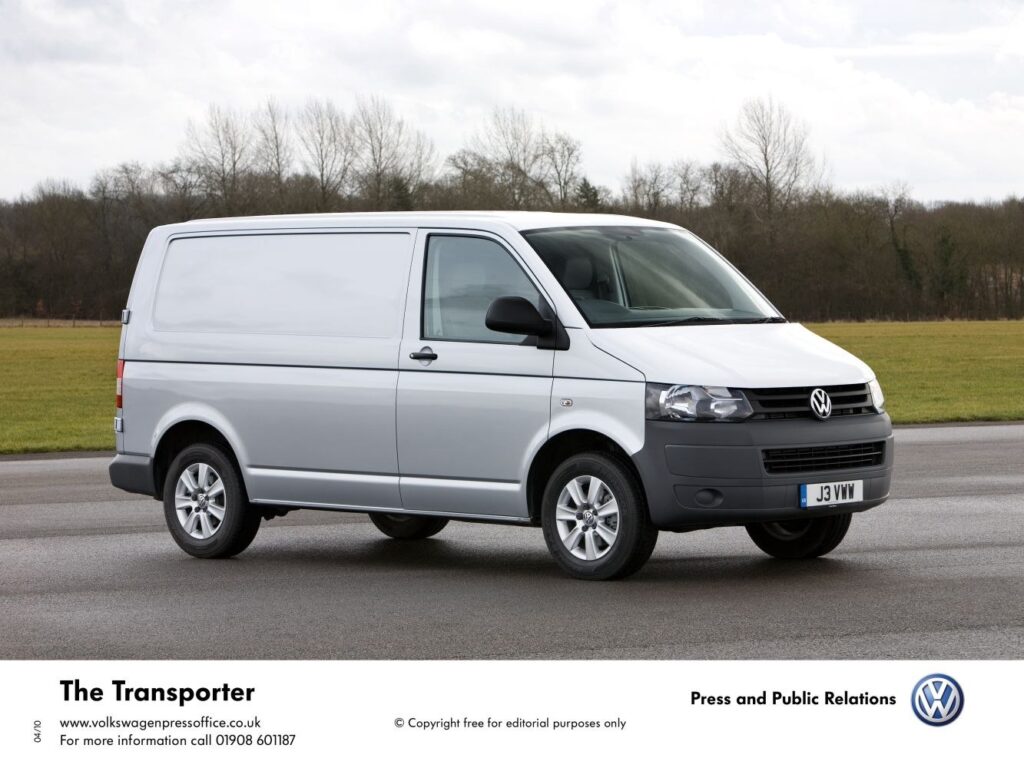
The Volkswagen Transporter (T5, facelift 2009) Panel Van is first and foremost a functional vehicle, designed to meet the rigorous demands of commercial use. Its body type is a classic panel van, characterized by solid side panels instead of windows, offering both security for cargo and a large canvas for business branding. The L2H3 designation signifies a long wheelbase of 133.86 inches (3400 mm) and a high roof, resulting in substantial internal volume. With an overall length of 208.35 inches (5292 mm) and a height of 97.48 inches (2476 mm), this Transporter variant provides an impressive maximum cargo volume of 9300 liters (328.43 cubic feet).
The exterior design of the facelifted T5 features Volkswagen’s updated corporate grille and headlight design, giving it a more modern and cohesive look compared to its pre-facelift predecessor. While subtle, these changes contributed to a fresher appearance, aligning it with other vehicles in Volkswagen’s contemporary lineup. The robust construction is evident in its ability to handle a maximum payload of 2244.31 to 2341.31 lbs. (1018-1062 kg), depending on the specific configuration. The gross vehicle weight ranges from 6172.94 to 7054.79 lbs. (2800-3200 kg).
Inside, the Transporter panel van is configured for 2 to 3 occupants, prioritizing functionality and durability. The cabin is designed to be a practical workspace, with hard-wearing materials and ergonomic layouts for controls. While specific luxury features are sparse in a commercial panel van, modern conveniences for the era would include basic infotainment, ample storage compartments, and comfortable seating for long working hours.
Safety and stability are addressed with a front independent McPherson strut suspension with a coil spring and anti-roll bar, complemented by an independent coil spring rear suspension with a transverse stabilizer and trailing arm. This setup provides a good balance between load-carrying capability and driving comfort. Braking is handled by ventilated discs on both the front (308×29.5 mm) and rear (294×22 mm) axles, aided by an Anti-lock Braking System (ABS) for enhanced control during emergency stops. The standard tire size is 215/65 R16 on 6.5J x 16 wheel rims, providing a good balance of durability and grip for commercial applications.
Technical Specifications
| Category | Specification | Value |
|---|---|---|
General Information |
||
| Brand | Volkswagen | |
| Model | Transporter | |
| Generation | Transporter (T5, facelift 2009) Panel Van | |
| Type (Engine) | 2.0 TDI BMT (114 Hp) L2H3 | |
| Production Start | 2011 year | |
| Production End | 2015 year | |
| Powertrain Architecture | Internal Combustion Engine | |
| Body type | Van | |
| Seats | 2-3 | |
| Doors | 4-5 | |
Performance Specifications |
||
| Fuel Consumption (Urban, NEDC) | 8.4-8.7 l/100 km / 28 – 27 US mpg | |
| Fuel Consumption (Extra Urban, NEDC) | 6.4-6.7 l/100 km / 36.8 – 35.1 US mpg | |
| Fuel Consumption (Combined, NEDC) | 7.1-7.4 l/100 km / 33.1 – 31.8 US mpg | |
| CO2 Emissions (NEDC) | 187-195 g/km | |
| Fuel Type | Diesel | |
| Acceleration 0 – 60 mph | 14.3 sec | |
| Maximum Speed | 94.45 mph (152 km/h) | |
| Emission Standard | Euro 5 | |
| Weight-to-Power Ratio | 15.2 kg/Hp | |
| Weight-to-Torque Ratio | 7 kg/Nm | |
Engine Specifications |
||
| Power | 114 Hp @ 3500 rpm | |
| Power per liter | 57.9 Hp/l | |
| Torque | 250 Nm @ 1500-2750 rpm / 184.39 lb.-ft. | |
| Engine Layout | Front, Transverse | |
| Engine Model/Code | EA189 / CAAD | |
| Engine Displacement | 1968 cm3 / 120.09 cu. in. | |
| Number of Cylinders | 4 | Inline |
| Cylinder Bore | 81 mm / 3.19 in. | |
| Piston Stroke | 95.5 mm / 3.76 in. | |
| Compression Ratio | 16.5:1 | |
| Valves per Cylinder | 4 | |
| Fuel Injection System | Diesel Commonrail | |
| Engine Aspiration | Turbocharger, Intercooler | |
| Valvetrain | DOHC | |
| Engine Oil Capacity | 7 l / 7.4 US qt | |
| Coolant Capacity | 11 l / 11.62 US qt | |
| Engine Systems | Start & Stop System, Particulate filter | |
Space, Volume, and Weights |
||
| Kerb Weight | 1738-2182 kg / 3831.63 – 4810.49 lbs. | |
| Max. Weight (GVWR) | 2800-3200 kg / 6172.94 – 7054.79 lbs. | |
| Max Load (Payload) | 1018-1062 kg / 2244.31 – 2341.31 lbs. | |
| Trunk (Boot) Space – maximum | 9300 l / 328.43 cu. ft. | |
| Fuel Tank Capacity | 80 l / 21.13 US gal | |
| Permitted Trailer Load with Brakes (12%) | 2200 kg / 4850.17 lbs. | |
| Permitted Trailer Load without Brakes | 750 kg / 1653.47 lbs. | |
| Permitted Towbar Download | 100 kg / 220.46 lbs. | |
Dimensions |
||
| Length | 5292 mm / 208.35 in. | |
| Width | 1904 mm / 74.96 in. | |
| Width (including mirrors) | 2283 mm / 89.88 in. | |
| Height | 2476 mm / 97.48 in. | |
| Wheelbase | 3400 mm / 133.86 in. | |
| Front Overhang | 896 mm / 35.28 in. | |
| Rear Overhang | 996 mm / 39.21 in. | |
| Ride Height (Ground Clearance) | 201 mm / 7.91 in. | |
| Minimum Turning Circle (Turning Diameter) | 13.2 m / 43.31 ft. | |
| Approach Angle | 21° | |
| Departure Angle | 17° | |
| Ramp-over (Brakeover) Angle | 12° | |
Drivetrain, Brakes, and Suspension |
||
| Drivetrain Architecture | Front-wheel drive (ICE drives front wheels) | |
| Drive Wheel | Front wheel drive | |
| Number of Gears and Type | 5 gears, manual transmission | |
| Front Suspension | Independent, McPherson with coil spring and anti-roll bar | |
| Rear Suspension | Independent coil spring, Transverse stabilizer, Trailing arm | |
| Front Brakes | Ventilated discs | 308×29.5 mm |
| Rear Brakes | Ventilated discs | 294×22 mm |
| Assisting Systems | ABS (Anti-lock braking system) | |
| Steering Type | Steering rack and pinion | |
| Power Steering | Hydraulic Steering | |
| Tires Size | 215/65 R16 | |
| Wheel Rims Size | 6.5J x 16 | |
Legacy and Market Impact of the Volkswagen Transporter (T5, facelift 2009) Panel Van
The Volkswagen Transporter series holds an almost mythical status in automotive history, dating back to the original T1 “Bus” or “Microbus.” Each subsequent generation has built upon this legacy, evolving to meet the changing demands of commercial and passenger transport. The T5, and particularly its 2009 facelift, represents a crucial stage in this evolution, solidifying its position as a modern, efficient, and highly capable light commercial vehicle.
In its primary markets, such as Europe, the Volkswagen Transporter (T5, facelift 2009) Panel Van was a formidable competitor in the bustling commercial van segment. It faced stiff competition from rivals like the Ford Transit, Mercedes-Benz Sprinter (though often positioned slightly upmarket), Renault Trafic/Opel Vivaro, and the Fiat Ducato. What set the Transporter apart was its blend of Volkswagen’s legendary build quality, refined driving dynamics for a commercial vehicle, and the introduction of advanced technologies like BlueMotion, which appealed strongly to businesses looking to reduce operational costs and environmental impact.
The L2H3 variant, with its generous cargo space and substantial payload capacity, was particularly significant for tradespeople such as carpenters, plumbers, electricians, and delivery services. Its robust chassis, reliable diesel engine, and comfortable cabin—for a commercial vehicle—made it a preferred choice for those who spent long hours on the road.