The Renault Megane II Coupe 1.6 16V (113 Hp) Automatic: A European Compact Innovator
The Renault Megane II, launched in 2002, marked a significant departure from its predecessor, showcasing Renault’s bold new design language and a strong emphasis on safety and technology. While never officially sold in the United States, the Megane II quickly became a prominent player in the highly competitive European C-segment (compact car segment). The particular variant under review, the Renault Megane II Coupe 1.6 16V (113 Hp) Automatic, represented a stylish and practical choice for consumers seeking a distinctive compact car with an automatic transmission.
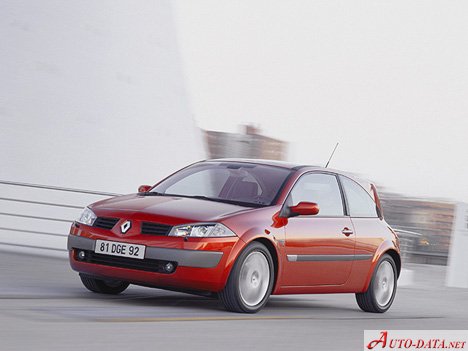
This second-generation Megane was renowned for its avant-garde styling, particularly its distinctive “bustle-back” rear end, which garnered both praise and criticism but undoubtedly made the car stand out. Beyond aesthetics, the Megane II was a technological frontrunner, pioneering features like keyless entry and start, and achieving groundbreaking safety ratings for its class. The Coupe variant, a three-door model, offered a sportier aesthetic while retaining much of the practicality expected from a compact hatchback, albeit with a more raked roofline and fewer doors.
Engine and Performance of the Renault Megane II Coupe 1.6 16V (113 Hp) Automatic
At the heart of this particular Megane II Coupe was Renault’s well-regarded K4M 1.6-liter 16-valve inline-four engine. This naturally aspirated gasoline (petrol) unit was designed for a balance of urban drivability and decent highway cruising, making it a popular choice across various Renault models. With an engine displacement of 1598 cm3 (97.52 cu. in.), it produced a respectable 113 horsepower at 6000 rpm, translating to a power-per-liter output of 70.7 Hp/l. Torque figures stood at 112.11 lb.-ft. (152 Nm) delivered at 4200 rpm, providing adequate thrust for daily commuting.
Power was sent to the front wheels via a 4-speed automatic transmission, a common setup for compact cars in this era aimed at convenience. While not a performance-oriented gearbox, it offered smooth shifts suitable for its intended market. The Megane II Coupe 1.6 16V (113 Hp) Automatic achieved a 0-60 mph acceleration in a calculated 12.2 seconds and a top speed of 113.09 mph (182 km/h). These figures positioned it as a competent, rather than exhilarating, performer within its class, prioritizing comfort and ease of use.
Fuel economy for this model was competitive for the early 2000s, with a combined rating of 31.4 US mpg (7.5 l/100 km). Urban driving saw consumption at 22.4 US mpg (10.5 l/100 km), while extra-urban (highway) driving improved significantly to 40.6 US mpg (5.8 l/100 km). With CO2 emissions of 180 g/km, it met the Euro 3 emission standard, reflecting the environmental regulations of its production period.
Design and Features
The Renault Megane II Coupe stood out with its distinctive and often polarizing design. Unlike traditional coupes, which are typically two-door variants of a sedan, the Megane II Coupe was essentially a three-door hatchback with a more steeply raked rear window and a more pronounced rear overhang, contributing to its unique “bustle-back” profile. This design element, shared with the five-door hatchback, aimed to maximize interior space and improve aerodynamics, resulting in a drag coefficient (Cd) of 0.35.
Despite its coupe designation, the Megane II Coupe offered practical seating for five, though rear headroom was somewhat compromised compared to the full hatchback due to the sloping roofline. The interior was characterized by a clean, modern design with soft-touch materials and intuitive controls. Features that were considered advanced for a compact car in 2002 included an electric power steering system, which provided light and responsive steering, particularly useful in urban environments. Safety was a paramount concern for Renault, and the Megane II was one of the first cars in its segment to receive a 5-star Euro NCAP safety rating, thanks to its robust chassis design, multiple airbags, and standard Anti-lock Braking System (ABS) with electronic brake-force distribution.
Practicality was also a strong suit, with a minimum trunk (boot) space of 11.65 cu. ft. (330 liters), expandable to a generous 42.02 cu. ft. (1190 liters) with the rear seats folded down. This flexibility made the Megane II Coupe a surprisingly versatile vehicle for its size and body style. The car rode on 195/65 R15 tires mounted on 6.5J x 15-inch wheel rims, providing a comfortable and stable ride quality.
Technical Specifications: Renault Megane II Coupe 1.6 16V (113 Hp) Automatic
| Category | Specification |
|---|---|
| General Information | |
| Brand | Renault |
| Model | Megane |
| Generation | Megane II Coupe |
| Type (Engine) | 1.6 16V (113 Hp) Automatic |
| Production Start | 2002 |
| Production End | 2005 |
| Powertrain Architecture | Internal Combustion engine |
| Body Type | Coupe |
| Seats | 5 |
| Doors | 3 |
| Performance Specs | |
| Fuel Consumption (Urban) | 22.4 US mpg (10.5 l/100 km) |
| Fuel Consumption (Extra Urban) | 40.6 US mpg (5.8 l/100 km) |
| Fuel Consumption (Combined) | 31.4 US mpg (7.5 l/100 km) |
| CO2 Emissions | 180 g/km |
| Fuel Type | Petrol (Gasoline) |
| Acceleration 0-60 mph | 12.2 sec |
| Maximum Speed | 113.09 mph (182 km/h) |
| Emission Standard | Euro 3 |
| Weight-to-Power Ratio | 10 kg/Hp |
| Weight-to-Torque Ratio | 7.4 kg/Nm |
| Engine Specs | |
| Power | 113 Hp @ 6000 rpm |
| Power per Liter | 70.7 Hp/l |
| Torque | 112.11 lb.-ft. (152 Nm) @ 4200 rpm |
| Engine Layout | Front, Transverse |
| Engine Model/Code | K4M |
| Engine Displacement | 97.52 cu. in. (1598 cm3) |
| Number of Cylinders | 4 |
| Engine Configuration | Inline |
| Cylinder Bore | 3.13 in. (79.5 mm) |
| Piston Stroke | 3.17 in. (80.5 mm) |
| Compression Ratio | 10:1 |
| Valves per Cylinder | 4 |
| Fuel Injection System | Multi-port manifold injection |
| Engine Aspiration | Naturally aspirated |
| Valvetrain | DOHC |
| Engine Oil Capacity | 5.07 US qt (4.8 l) |
| Coolant Capacity | 6.87 US qt (6.5 l) |
| Space, Volume, and Weights | |
| Kerb Weight | 2491.22 lbs. (1130 kg) |
| Max. Weight | 3869.11 lbs. (1755 kg) |
| Max Load | 1377.89 lbs. (625 kg) |
| Trunk (Boot) Space – Minimum | 11.65 cu. ft. (330 l) |
| Trunk (Boot) Space – Maximum | 42.02 cu. ft. (1190 l) |
| Fuel Tank Capacity | 15.85 US gal (60 l) |
| Max. Roof Load | 176.37 lbs. (80 kg) |
| Permitted Trailer Load with Brakes (12%) | 2866.01 lbs. (1300 kg) |
| Permitted Trailer Load without Brakes | 1433 lbs. (650 kg) |
| Permitted Towbar Download | 165.35 lbs. (75 kg) |
| Dimensions | |
| Length | 165.71 in. (4209 mm) |
| Width | 69.96 in. (1777 mm) |
| Height | 57.4 in. (1458 mm) |
| Wheelbase | 103.35 in. (2625 mm) |
| Front Track | 59.76 in. (1518 mm) |
| Rear Track | 59.61 in. (1514 mm) |
| Drag Coefficient (Cd) | 0.35 |
| Minimum Turning Circle | 34.45 ft. (10.5 m) |
| Drivetrain, Brakes, and Suspension | |
| Drivetrain Architecture | Front-wheel drive, Internal Combustion Engine |
| Drive Wheel | Front-wheel drive |
| Number of Gears & Type | 4 gears, automatic transmission |
| Front Suspension | Independent type McPherson |
| Rear Suspension | Torsion beam |
| Front Brakes | Ventilated discs |
| Rear Brakes | Disc |
| Assisting Systems | ABS (Anti-lock braking system) |
| Steering Type | Steering rack and pinion |
| Power Steering | Electric Steering |
| Tire Size | 195/65 R15 |
| Wheel Rims Size | 6.5J x 15 |
Legacy and Market Impact in Europe
The Renault Megane II, including its Coupe variant, left an indelible mark on the European automotive landscape. Its bold styling, particularly the “bustle-back” rear, was a significant departure from the conservative designs prevalent in the compact segment. This design, spearheaded by Patrick le Quément, Renault’s design director at the time, was a calculated risk that ultimately paid off, helping the Megane II achieve widespread recognition and strong sales figures across Europe.
In a segment dominated by established rivals like the Volkswagen Golf, Opel Astra, Peugeot 307, and Ford Focus, the Megane II carved out its niche by emphasizing distinctive design, innovative technology, and class-leading safety. Its achievement of the first-ever 5-star Euro NCAP rating for a compact car was a powerful selling point and significantly influenced other manufacturers to improve their safety standards. This focus on safety, combined with comfortable interiors and a smooth ride, made it a highly attractive option for European families and individuals.
The 1.6 16V Automatic variant, while not the most potent engine choice, was popular for its blend of reliability, reasonable running costs, and the convenience of an automatic transmission, which was gaining popularity in Europe. Its production run from 2002 to 2005 for this specific variant highlights its strong initial market position before subsequent facelifts and engine updates. The Megane II’s overall success solidified Renault’s reputation as an innovator in design and safety, paving the way for future generations of the Megane and influencing the broader compact car market in Europe for years to come. Even today, the Megane II remains a recognizable and often fondly remembered car on European roads, a testament to its enduring design and engineering.