Introduction to the Toyota Corolla XI (E170, facelift 2016)
The Toyota Corolla stands as an undeniable icon in the automotive world, revered globally for its unwavering reliability, practical design, and exceptional value. The eleventh generation, designated E170, continued this illustrious legacy, and its mid-cycle refresh for the 2016 model year further solidified its position in the highly competitive compact sedan segment. This article focuses on a specific iteration, the Toyota Corolla XI (E170, facelift 2016) 1.6 Valvematic (132 Hp) Automatic, a variant primarily targeted at European and Asian markets, where its blend of efficiency and adequate performance made it a compelling choice for everyday commuting and family duties. While the U.S. market typically received larger displacement engines for the Corolla, this 1.6-liter Valvematic model exemplifies Toyota’s commitment to advanced engine technology and fuel economy in other key global regions.
Launched in 2016 and produced through 2018, this facelifted E170 Corolla sedan represented a refined evolution rather than a revolutionary change. It maintained the Corolla’s core values while introducing updated styling cues, enhanced interior features, and subtle mechanical improvements to keep it fresh against a burgeoning class of rivals. The 1.6 Valvematic engine paired with an automatic transmission offered a smooth and user-friendly driving experience, perfectly aligning with the car’s role as a dependable, no-nonsense vehicle designed for a broad spectrum of drivers. Its four-door sedan body style provided ample space for five occupants and their luggage, reinforcing its appeal as a sensible and versatile daily driver.
Engine and Performance: The 1.6 Valvematic Powertrain
At the heart of the Toyota Corolla XI (E170, facelift 2016) 1.6 Valvematic variant lies the 1ZR-FAE engine, a naturally aspirated inline-four gasoline (petrol) unit boasting a displacement of 1,598 cubic centimeters (approximately 1.6 liters). This engine is notable for incorporating Toyota’s advanced Valvematic technology, a sophisticated variable valve lift system that continuously adjusts the amount of valve lift and timing. This innovation, similar in concept to BMW’s Valvetronic, allows for precise control over the intake airflow without relying solely on a traditional throttle body, thereby improving combustion efficiency, reducing pumping losses, and ultimately enhancing both fuel economy and power delivery across the rev range.
The 1.6 Valvematic engine generates a respectable 132 horsepower at 6400 rpm, providing sufficient motivation for the compact sedan. Torque output stands at 118.01 lb.-ft. (160 Nm) delivered at 4400 rpm, ensuring a responsive feel in city driving and adequate power for highway cruising. Mated to this engine is Toyota’s Multidrive S automatic transmission, a continuously variable transmission (CVT) designed for smooth, seamless acceleration and optimized fuel efficiency. While some enthusiasts might prefer a traditional geared automatic, the Multidrive S is engineered to keep the engine operating in its most efficient rpm band, contributing significantly to the car’s impressive fuel economy figures.
Performance-wise, the Corolla 1.6 Valvematic is not designed for outright speed but delivers competent acceleration for its class. It can sprint from 0 to 60 mph in a measured 10.5 seconds, and its top speed is rated at 118 mph (190 km/h). These figures underscore its role as a practical and economical vehicle rather than a performance-oriented machine. Fuel efficiency is a strong suit, with a combined rating of 42 US mpg (5.6 l/100 km). Urban consumption is quoted at 32.2 US mpg (7.3 l/100 km), while extra-urban driving yields an excellent 51.1 US mpg (4.6 l/100 km). With CO2 emissions of 139 g/km, this model meets the stringent Euro 6 emission standard, highlighting its environmental consideration for its time. The powertrain’s architecture is front-wheel drive, with the internal combustion engine positioned transversely at the front, a standard configuration for compact sedans that maximizes interior space and offers predictable handling characteristics.
Design and Features: Practicality Meets Refinement
Exterior and Aerodynamics
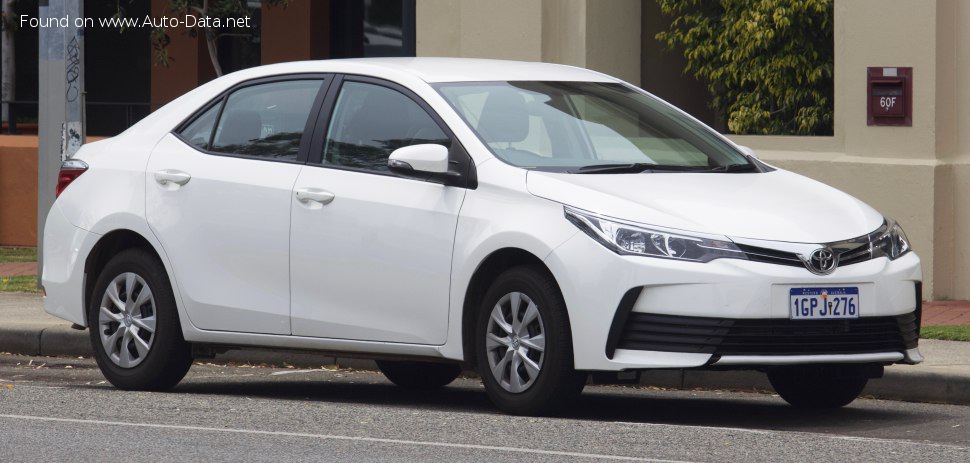
The 2016 facelift of the Toyota Corolla XI (E170) brought a sharper, more contemporary aesthetic to the sedan. Measuring 181.89 inches (4620 mm) in length, 69.88 inches (1775 mm) in width, and 57.68 inches (1465 mm) in height, the Corolla maintains a well-proportioned and appealing stance. The facelift introduced a revised front fascia with a more aggressive grille design, sleeker headlights, and updated bumper styling, giving the car a more sophisticated and modern appearance. At the rear, new LED taillights and a subtly restyled bumper completed the refreshed look. Beyond aesthetics, the design was also highly functional, achieving an impressive drag coefficient (Cd) of just 0.27, contributing to both fuel efficiency and reduced wind noise at higher speeds. The vehicle rides on 205/55 R16 tires mounted on 6.5J x16 wheel rims, a common and cost-effective size that balances grip, comfort, and tire availability.
Interior Comfort and Practicality
Inside, the Corolla XI (E170) facelift continued to prioritize user-friendliness and comfort. As a four-door, five-seat sedan, it offered ample space for occupants, particularly in the rear, thanks to its generous 106.3-inch (2700 mm) wheelbase. The interior design was ergonomic and straightforward, with durable materials chosen to withstand the rigors of daily use. Storage solutions were practical, and the trunk (boot) provided a substantial 15.96 cubic feet (452 liters) of cargo space, making it highly capable for grocery runs, luggage for road trips, or sporting equipment.
Chassis and Safety Systems
The chassis of the Corolla XI was engineered for a comfortable and composed ride. It featured an independent McPherson strut front suspension with coil springs and an anti-roll bar, a setup known for its balance of ride quality and handling precision. The rear suspension utilized a semi-independent design with coil springs, offering a good compromise between cost, packaging efficiency, and ride comfort. Braking power was provided by ventilated discs at the front and solid discs at the rear, complemented by an Anti-lock Braking System (ABS) as a standard assisting system, ensuring confident stopping in various conditions. The steering system employed a rack and pinion setup, delivering predictable and light steering for easy maneuverability, particularly in urban environments, further aided by a minimum turning circle of 35.43 feet (10.8 meters). While specific details on advanced driver-assistance systems (ADAS) are not provided, vehicles of this era typically included multiple airbags, electronic stability control, and traction control systems in most markets, bolstering overall occupant safety.
Technical Specifications
| Category | Specification | Value |
|---|---|---|
General Information |
||
| Brand | Toyota | |
| Model | Corolla | |
| Generation | Corolla XI (E170, facelift 2016) | |
| Type (Engine) | 1.6 Valvematic (132 Hp) Automatic | |
| Start of Production | 2016 year | |
| End of Production | 2018 year | |
| Powertrain Architecture | Internal Combustion engine | |
| Body Type | Sedan | |
| Seats | 5 | |
| Doors | 4 | |
Performance Specifications |
||
| Fuel Consumption (Urban) | 32.2 US mpg (7.3 l/100 km) | |
| Fuel Consumption (Extra Urban) | 51.1 US mpg (4.6 l/100 km) | |
| Fuel Consumption (Combined) | 42 US mpg (5.6 l/100 km) | |
| CO2 Emissions | 139 g/km | |
| Fuel Type | Petrol (Gasoline) | |
| Acceleration 0 – 60 mph | 10.5 sec | |
| Acceleration 0 – 62 mph (0 – 100 km/h) | 11.1 sec | |
| Maximum Speed | 118.06 mph (190 km/h) | |
| Emission Standard | Euro 6 w | |
| Weight-to-Power Ratio | 8.6 kg/Hp, 116.8 Hp/tonne | |
| Weight-to-Torque Ratio | 7.1 kg/Nm, 141.6 Nm/tonne | |
Engine Specifications |
||
| Power | 132 Hp @ 6400 rpm | |
| Power per Liter | 82.6 Hp/l | |
| Torque | 118.01 lb.-ft. (160 Nm) @ 4400 rpm | |
| Engine Layout | Front, Transverse | |
| Engine Model/Code | 1ZR-FAE | |
| Engine Displacement | 1.6 liters (1598 cm3, 97.52 cu. in.) | |
| Number of Cylinders | 4 | |
| Engine Configuration | Inline | |
| Compression Ratio | 10.7:1 | |
| Number of Valves per Cylinder | 4 | |
| Fuel Injection System | Multi-port manifold injection | |
| Engine Aspiration | Naturally aspirated engine | |
| Valvetrain | DOHC – Valvematic | |
| Engine Oil Capacity | 4.44 US qt (4.2 l) | |
| Coolant Capacity | 6.13 US qt (5.8 l) | |
Space, Volume and Weights |
||
| Kerb Weight | 2491.22 – 2755.78 lbs. (1130-1250 kg) | |
| Max. Weight (GVWR) | 3913.21 lbs. (1775 kg) | |
| Max Load | 1157.43 – 1421.98 lbs. (525-645 kg) | |
| Trunk (Boot) Space – Minimum | 15.96 cu. ft. (452 l) | |
| Fuel Tank Capacity | 14.53 US gal (55 l) | |
| Permitted Trailer Load with Brakes (12%) | 2866.01 lbs. (1300 kg) | |
| Permitted Trailer Load without Brakes | 992.08 lbs. (450 kg) | |
| Permitted Towbar Download | 121.25 lbs. (55 kg) | |
Dimensions |
||
| Length | 181.89 in. (4620 mm) | |
| Width | 69.88 in. (1775 mm) | |
| Height | 57.68 in. (1465 mm) | |
| Wheelbase | 106.3 in. (2700 mm) | |
| Front Track | 60.04 in. (1525 mm) | |
| Rear (Back) Track | 59.84 in. (1520 mm) | |
| Ride Height (Ground Clearance) | 4.92 in. (125 mm) | |
| Drag Coefficient (Cd) | 0.27 | |
| Minimum Turning Circle (Turning Diameter) | 35.43 ft. (10.8 m) | |
Drivetrain, Brakes and Suspension Specs |
||
| Drivetrain Architecture | The Internal combustion engine (ICE) drives the front wheels of the vehicle. | |
| Drive Wheel | Front wheel drive | |
| Number of Gears and Type of Gearbox | automatic transmission Multidrive S (CVT) | |
| Front Suspension | Independent, type McPherson with coil spring and anti-roll bar | |
| Rear Suspension | Semi-independent, coil spring | |
| Front Brakes | Ventilated discs | |
| Rear Brakes | Disc | |
| Assisting Systems | ABS (Anti-lock braking system) | |
| Steering Type | Steering rack and pinion | |
| Tires Size | 205/55 R16 | |
| Wheel Rims Size | 6.5J x16 | |
Legacy and Market Impact of the Toyota Corolla XI (E170, facelift 2016)
The Toyota Corolla, including the XI (E170) generation, has consistently been one of the best-selling vehicles worldwide, a testament to its enduring appeal and Toyota’s reputation for manufacturing high-quality, dependable automobiles. The 2016 facelift model, particularly the 1.6 Valvematic automatic variant, played a crucial role in maintaining this dominance in markets outside of North America, where fuel efficiency and lower taxation on smaller displacement engines are significant factors for consumers.
In its primary markets, the Toyota Corolla XI (E170, facelift 2016) competed fiercely with other established compact sedans such as the Honda Civic, Volkswagen Jetta (known as Sagitar in some Asian markets), Ford Focus Sedan, Hyundai Elantra, and Kia Forte. What set the Corolla apart was its unparalleled reputation for reliability and low running costs. Owners consistently lauded the car for its trouble-free ownership experience and excellent resale value, attributes that have become synonymous with the Corolla badge over its many decades of production. The 1.6 Valvematic engine, in particular, showcased Toyota’s engineering prowess in extracting efficiency from a naturally aspirated unit, offering a compelling alternative to turbocharged rivals while maintaining a simple, robust design.
The Multidrive S CVT, while perhaps not the most engaging transmission for driving enthusiasts, perfectly complemented the Corolla’s philosophy of smooth, economical, and effortless motoring. It contributed significantly to the car’s impressive combined fuel economy of 42 US mpg, making it an attractive option for budget-conscious buyers and those facing rising fuel prices. The car’s conservative yet modern styling, coupled with a spacious and functional interior, ensured it remained a practical choice for families and individuals alike.
The legacy of the Corolla XI (E170) facelift, and this 1.6 Valvematic variant specifically, is one of quiet competence and steadfast reliability. It didn’t aim to redefine the compact car segment with radical innovation, but rather to perfect the formula that had made the Corolla a global success: a comfortable, efficient, and utterly dependable vehicle that consistently met the needs of its owners. It reinforced Toyota’s image as a brand you can trust, contributing to the Corolla’s ongoing status as one of the most significant and historically impactful vehicles ever produced. Even after its production ended in 2018, these models continue to serve their owners faithfully, demonstrating the long-term value and durability inherent in Toyota’s engineering.