
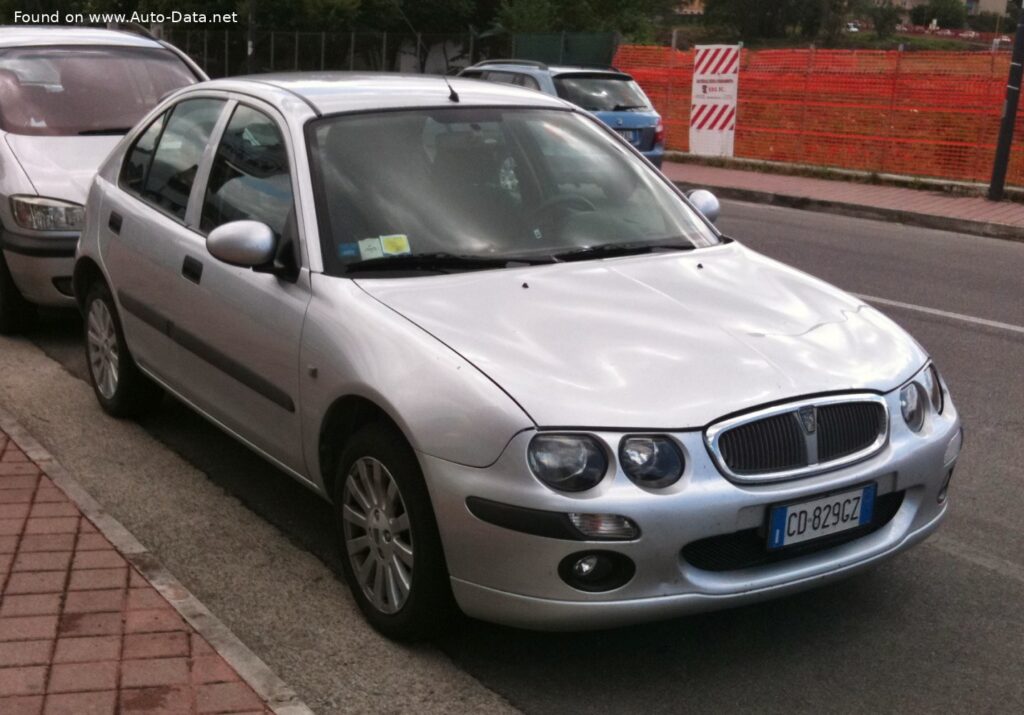
The Rover 25 (RF) 2.0 TD (113 Hp): A European Compact Hatchback Overview
The Rover 25 (RF) 2.0 TD (113 Hp) represents a significant chapter in the history of the British automotive manufacturer Rover, particularly in the European compact car segment. Produced from 2002 to 2005, this generation of the Rover 25 was an updated and rebadged version of the earlier Rover 200 (R3) series, aiming to keep Rover competitive in the fiercely contested supermini class. While never officially sold in the United States, the Rover 25 was a familiar sight on European roads, prized for its compact dimensions, relatively refined ride, and in the case of the 2.0 TD variant, its robust diesel powertrain. This particular model, with its 113 horsepower turbo-diesel engine, offered a compelling blend of performance and fuel efficiency for its time, catering to a market that increasingly valued economical yet capable daily drivers.
The Rover 25 occupied the supermini or subcompact segment, a category popular across Europe for its practicality, maneuverability in urban environments, and lower running costs. Available in both three-door and five-door hatchback configurations, it offered versatility for different buyer needs. The RF designation indicates its platform lineage, tracing back to the Honda Concerto-derived architecture that formed the basis for its predecessors. Despite its age by the early 2000s, the Rover 25 continued to serve as a cornerstone of Rover’s product lineup during the company’s tumultuous final years, offering a distinctly British take on the compact car formula.
Engine & Performance of the Rover 25 (RF) 2.0 TD (113 Hp)
At the heart of the Rover 25 (RF) 2.0 TD (113 Hp) was Rover’s acclaimed L-series turbo-diesel engine, a unit that had earned a reputation for its durability and strong torque delivery. This specific iteration, designated L / 20T2N, featured a 1,994 cubic centimeter (approximately 2.0-liter) inline four-cylinder configuration. The engine utilized an OHC (Overhead Camshaft) valvetrain with two valves per cylinder and a modern Commonrail fuel injection system, which was crucial for optimizing fuel atomization and combustion efficiency. Furthermore, the inclusion of a turbocharger and intercooler significantly boosted its power output and responsiveness across the rev range.
The engine produced a respectable 113 horsepower at 4200 revolutions per minute (rpm), making it one of the more potent diesel options in its class. More importantly for real-world driving, it delivered a substantial 191.77 lb.-ft. of torque at a low 2000 rpm. This ample low-end torque meant the Rover 25 2.0 TD felt eager and capable, particularly in urban driving and when overtaking. Power was transmitted to the front wheels via a smooth-shifting 5-speed manual transmission, a common and reliable setup for compact cars of this era.
Performance figures for the 2.0 TD variant were quite competitive. It could accelerate from 0 to 60 mph in a brisk 8.6 seconds, an impressive time for a diesel hatchback in its segment. The top speed was rated at 114.95 mph (185 km/h), demonstrating its capability for highway cruising. Fuel economy was a significant selling point for this diesel model. The combined cycle fuel consumption was an economical 36.2 US mpg, translating to even better figures on the highway at 56 US mpg. This efficiency, coupled with a 13.21 US gallon fuel tank, provided a commendable cruising range, making it an attractive option for commuters and those covering long distances.
Design & Features
The design of the Rover 25 (RF) built upon the foundations of the Rover 200, incorporating styling updates that aimed to give it a more contemporary and slightly sportier appearance. The body style was a practical hatchback, offered with either three or five doors, providing flexibility for different consumer needs. Its compact dimensions – 157.09 inches in length, 66.46 inches in width, and 55.87 inches in height – made it highly maneuverable, a crucial attribute for navigating crowded European city streets and tight parking spaces. The wheelbase measured 98.43 inches, contributing to a stable ride for its size.
Inside, the Rover 25 offered seating for five occupants, a standard configuration for the supermini class. While not overtly luxurious, the interior was designed to be functional and comfortable, with a focus on ease of use. The trunk space was practical, offering a minimum of 10.74 cubic feet, which could be expanded significantly to 38.35 cubic feet with the rear seats folded down, enhancing its utility for carrying larger items.
In terms of chassis and safety, the Rover 25 (RF) featured a conventional setup for its time. The front suspension employed a wishbone design, known for its ability to provide a good balance between ride comfort and handling precision. The rear suspension utilized a spring strut system. Braking was handled by ventilated discs at the front, offering effective stopping power, complemented by drum brakes at the rear. An important safety feature for the era, ABS (Anti-lock Braking System), was standard, aiding driver control during emergency braking. Steering was managed by a hydraulic rack and pinion system, providing direct feedback to the driver, a characteristic often appreciated by enthusiasts.
Technical Specifications
| Category | Specification |
|---|---|
| General Information | |
| Brand | Rover |
| Model | 25 |
| Generation | 25 (RF) |
| Type (Engine) | 2.0 TD (113 Hp) |
| Start of Production | 2002 year |
| End of Production | 2005 year |
| Powertrain Architecture | Internal Combustion engine |
| Body type | Hatchback |
| Seats | 5 |
| Doors | 3-5 |
| Performance Specs | |
| Fuel consumption (economy) – urban | 30.5 US mpg (7.7 l/100 km) |
| Fuel consumption (economy) – extra urban | 56 US mpg (4.2 l/100 km) |
| Fuel consumption (economy) – combined | 36.2 US mpg (6.5 l/100 km) |
| Fuel Type | Diesel |
| Acceleration 0 – 60 mph | 8.6 sec |
| Maximum speed | 114.95 mph (185 km/h) |
| Weight-to-power ratio | 10 kg/Hp, 100 Hp/tonne |
| Weight-to-torque ratio | 4.3 kg/Nm, 230.1 Nm/tonne |
| Engine Specs | |
| Power | 113 Hp @ 4200 rpm |
| Power per liter | 56.7 Hp/l |
| Torque | 191.77 lb.-ft. @ 2000 rpm (260 Nm @ 2000 rpm) |
| Engine layout | Front, Transverse |
| Engine Model/Code | L / 20T2N |
| Engine displacement | 121.68 cu. in. (1994 cm3) |
| Number of cylinders | 4 |
| Engine configuration | Inline |
| Cylinder Bore | 3.33 in. (84.5 mm) |
| Piston Stroke | 3.5 in. (88.9 mm) |
| Compression ratio | 19.5:1 |
| Number of valves per cylinder | 2 |
| Fuel injection system | Diesel Commonrail |
| Engine aspiration | Turbocharger, Intercooler |
| Valvetrain | OHC |
| Engine oil capacity | 4.76 US qt (4.5 l) |
| Engine oil specification | Not specified |
| Coolant | 7.4 US qt (7 l) |
| Space, Volume and Weights | |
| Kerb Weight | 2491.22 lbs. (1130 kg) |
| Max. weight | 3527.4 lbs. (1600 kg) |
| Max load | 1036.17 lbs. (470 kg) |
| Trunk (boot) space – minimum | 10.74 cu. ft. (304 l) |
| Trunk (boot) space – maximum | 38.35 cu. ft. (1086 l) |
| Fuel tank capacity | 13.21 US gal (50 l) |
| Dimensions | |
| Length | 157.09 in. (3990 mm) |
| Width | 66.46 in. (1688 mm) |
| Height | 55.87 in. (1419 mm) |
| Wheelbase | 98.43 in. (2500 mm) |
| Front track | 57.99 in. (1473 mm) |
| Rear (Back) track | 57.72 in. (1466 mm) |
| Drivetrain, Brakes and Suspension Specs | |
| Drivetrain Architecture | The Internal combustion engine (ICE) drives the front wheels of the vehicle. |
| Drive wheel | Front wheel drive |
| Number of gears and type of gearbox | 5 gears, manual transmission |
| Front suspension | Wishbone |
| Rear suspension | Spring Strut |
| Front brakes | Ventilated discs |
| Rear brakes | Drum |
| Assisting systems | ABS (Anti-lock braking system) |
| Steering type | Steering rack and pinion |
| Power steering | Hydraulic Steering |
| Tires size | 185/65 R14 |
Legacy & Market Impact
The Rover 25, particularly the 2.0 TD (113 Hp) variant, played a crucial role in Rover’s final years of independent production. In the highly competitive European supermini segment, it faced stiff competition from well-established rivals such as the Ford Fiesta, Vauxhall Corsa (Opel Corsa in mainland Europe), Volkswagen Polo, Peugeot 206, and Renault Clio. While perhaps not as cutting-edge as some of its competitors in terms of styling or interior technology by the early 2000s, the Rover 25 distinguished itself with a more traditional British charm, a relatively comfortable ride, and for the diesel models, impressive fuel efficiency and torque.
The 2.0 TD engine was a particular highlight, offering a blend of performance and economy that was well-regarded. It provided the Rover 25 with a degree of refinement and capability that belied its compact size, making it suitable for both urban commutes and longer journeys. Its robust nature and strong low-end torque made it a popular choice among drivers who valued practicality and low running costs.
However, the Rover 25’s legacy is inextricably linked to the broader struggles of the Rover brand. Despite its merits, the car was essentially a facelift of a design that dated back to the mid-1990s, and it struggled to keep pace with newer, more technologically advanced competitors entering the market. The company’s financial difficulties and eventual collapse in 2005 meant that the Rover 25, including its capable diesel variant, ceased production. It remains one of the last vehicles to wear the classic Rover badge, representing the culmination of a long and storied British automotive heritage.
Today, the Rover 25 2.0 TD (113 Hp) is remembered as a testament to Rover’s engineering capabilities, particularly in powertrain development, even as the company navigated troubled waters. It offered a distinctive alternative in the compact car market, embodying a certain character and driving feel that was uniquely British. While not a global phenomenon, its impact in its primary European market was significant, providing an affordable and efficient option for a generation of drivers.
