The Seat Ibiza IV (facelift 2015) 1.4 TDI (75 Hp): A European Subcompact Stalwart
The Seat Ibiza IV (facelift 2015) 1.4 TDI (75 Hp) represents a key iteration of SEAT’s highly successful supermini, a segment critically important in the European automotive landscape. Produced by the Spanish automaker SEAT, a subsidiary of the Volkswagen Group, the Ibiza has long been a cornerstone of the brand’s offerings, known for its youthful styling, dynamic driving characteristics, and practical packaging. This particular variant, part of the fourth generation (6J/6P) which first debuted in 2008, received a significant facelift in May 2015, extending its production run until 2017. As a model not officially sold in the United States, the Ibiza’s role is primarily confined to European, Latin American, and select Asian markets, where it competes fiercely in the compact hatchback segment, often referred to as the B-segment or supermini class.
The 2015 facelift brought a series of refinements, both aesthetic and technological, aiming to keep the Ibiza competitive against a perpetually evolving array of rivals. While the core architecture remained, SEAT focused on enhancing the car’s perceived quality, connectivity, and, crucially for the European market, its efficiency. The 1.4 TDI engine, a three-cylinder turbodiesel, was a prime example of this focus, offering a compelling blend of fuel economy and usable torque for urban and highway driving. This article delves into the specifics of this particular model, highlighting its engineering, design, and impact within its designated markets.
Engine and Performance: The Efficient 1.4 TDI in the Seat Ibiza IV (facelift 2015)
At the heart of the Seat Ibiza IV (facelift 2015) 1.4 TDI (75 Hp) is a compact yet robust three-cylinder diesel engine, designated with the code CUSA. This 1.4-liter (1422 cm3 or 86.78 cu. in.) inline powerplant is a testament to modern diesel engineering, featuring a turbocharger and intercooler for optimized performance and efficiency. It delivers a modest but effective 75 horsepower at 3500 rpm, which, when combined with its impressive torque output, makes for a surprisingly sprightly driving experience in its class.
The true strength of this engine lies in its torque: 210 Nm (154.89 lb.-ft.) available across a broad rev range from 1750 to 2000 rpm. This low-end torque is crucial for urban driving, allowing for brisk acceleration from a standstill and confident overtaking maneuvers without constantly needing to downshift. Power is channeled to the front wheels via a precise 5-speed manual transmission, a common setup for economy-focused vehicles in this segment.
Performance figures reflect its utilitarian purpose: the Ibiza 1.4 TDI accelerates from 0 to 60 mph in a respectable 12.4 seconds, with a top speed of 107.5 mph (173 km/h). While not designed for outright speed, these figures are more than adequate for daily commuting and longer journeys. Where this powertrain truly shines, however, is in its fuel economy. With a combined consumption rating of 3.4 liters per 100 km, equivalent to an outstanding 69.2 US mpg, the 1.4 TDI (75 Hp) was one of the most economical options in its class. Its CO2 emissions of just 88 g/km further underscore its environmental credentials, meeting stringent Euro 6 emission standards and making it a popular choice in regions with favorable tax incentives for low-emission vehicles. The inclusion of a particulate filter was standard, further reducing harmful emissions.
Design and Features: Practicality Meets Spanish Flair
Exterior and Interior Design of the Seat Ibiza IV (facelift 2015)
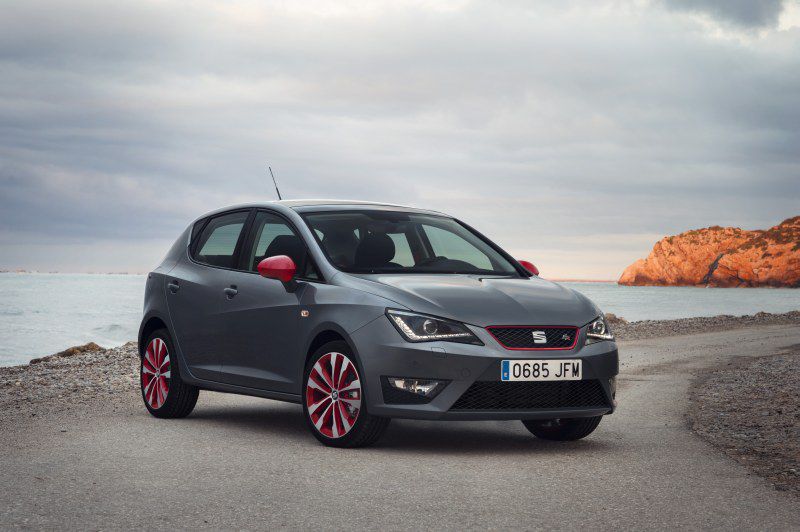
The Seat Ibiza IV (facelift 2015) maintains the sharp, angular design language that SEAT is known for, often described as “auto emoción.” The facelift brought subtle but effective changes, including redesigned headlights with optional LED daytime running lights, a refreshed grille, and updated bumper designs that gave the car a more contemporary and aggressive look. As a 5-door hatchback, it offers a practical body type popular among young families and urban dwellers, blending compact dimensions with adequate passenger and cargo space. Its overall length of 159.88 inches (4061 mm) and width of 66.65 inches (1693 mm) make it highly maneuverable in tight city streets, while the 97.2-inch (2469 mm) wheelbase ensures a stable ride.
Inside, the facelift focused on improving material quality and enhancing the technological offerings. The dashboard received new trim elements, a revised instrument cluster, and, crucially, a new infotainment system with a larger touchscreen display. Connectivity features, including Bluetooth and USB ports, became more sophisticated, reflecting the growing demand for seamless smartphone integration. Despite its compact exterior, the Ibiza offers seating for five, though the rear bench is most comfortable for two adults on longer journeys. The trunk space is a respectable 10.31 cu. ft. (292 liters), which can be expanded by folding down the rear seats, providing versatility for various cargo needs.
Safety and Chassis
Safety was a key consideration for the Ibiza, equipped with standard features like ABS (Anti-lock Braking System) and multiple airbags. The chassis was designed for a balance of comfort and agility, employing an independent McPherson strut front suspension with coil springs and an anti-roll bar, paired with a semi-independent coil spring rear suspension. This setup provides predictable handling and a comfortable ride, absorbing road imperfections effectively. Braking performance is handled by ventilated discs at the front and drum brakes at the rear, a common and cost-effective solution for vehicles in this class. The steering system, a rack and pinion type, offers precise feedback, contributing to the car’s engaging driving dynamics. Standard tire size for this variant was 185/60 R15, mounted on 15-inch wheel rims.
Technical Specifications: Seat Ibiza IV (facelift 2015) 1.4 TDI (75 Hp)
| Category | Specification |
|---|---|
| General Information | |
| Brand | Seat |
| Model | Ibiza |
| Generation | Ibiza IV (facelift 2015) |
| Type (Engine) | 1.4 TDI (75 Hp) |
| Start of Production | May, 2015 year |
| End of Production | 2017 year |
| Powertrain Architecture | Internal Combustion engine |
| Body Type | Hatchback |
| Seats | 5 |
| Doors | 5 |
| Performance Specs | |
| Fuel Consumption (combined) | 3.4 l/100 km (69.2 US mpg) |
| CO2 Emissions | 88 g/km |
| Fuel Type | Diesel |
| Acceleration 0-60 mph | 12.4 sec |
| Maximum Speed | 107.5 mph (173 km/h) |
| Emission Standard | Euro 6 |
| Weight-to-Power Ratio | 14.4 kg/Hp (69.4 Hp/tonne) |
| Weight-to-Torque Ratio | 5.1 kg/Nm (194.4 Nm/tonne) |
| Engine Specs | |
| Power | 75 Hp @ 3500 rpm |
| Power per liter | 52.7 Hp/l |
| Torque | 210 Nm (154.89 lb.-ft.) @ 1750-2000 rpm |
| Engine Layout | Front, Transverse |
| Engine Model/Code | CUSA |
| Engine Displacement | 1422 cm3 (86.78 cu. in.) |
| Number of Cylinders | 3 |
| Engine Configuration | Inline |
| Cylinder Bore | 79.5 mm (3.13 in.) |
| Piston Stroke | 95.5 mm (3.76 in.) |
| Compression Ratio | 16.2:1 |
| Number of Valves per Cylinder | 4 |
| Fuel Injection System | Diesel Commonrail |
| Engine Aspiration | Turbocharger, Intercooler |
| Engine Oil Capacity | 4.1 l (4.33 US qt) |
| Coolant Capacity | 8 l (8.45 US qt) |
| Engine Systems | Particulate filter |
| Space, Volume and Weights | |
| Kerb Weight | 1080 kg (2380.99 lbs) |
| Max. Weight | 1630 kg (3593.53 lbs) |
| Max Load | 550 kg (1212.54 lbs) |
| Trunk (boot) space – minimum | 292 l (10.31 cu. ft.) |
| Fuel Tank Capacity | 45 l (11.89 US gal) |
| Dimensions | |
| Length | 4061 mm (159.88 in.) |
| Width | 1693 mm (66.65 in.) |
| Height | 1445 mm (56.89 in.) |
| Wheelbase | 2469 mm (97.2 in.) |
| Front Track | 1465 mm (57.68 in.) |
| Rear (Back) Track | 1457 mm (57.36 in.) |
| Minimum Turning Circle (turning diameter) | 10 m (32.81 ft.) |
| Drivetrain, Brakes and Suspension Specs | |
| Drivetrain Architecture | The Internal combustion engine (ICE) drives the front wheels of the vehicle. |
| Drive Wheel | Front wheel drive |
| Number of Gears and Type of Gearbox | 5 gears, manual transmission |
| Front Suspension | Independent, type McPherson with coil spring and anti-roll bar |
| Rear Suspension | Semi-independent, coil spring |
| Front Brakes | Ventilated discs |
| Rear Brakes | Drum |
| Assisting Systems | ABS (Anti-lock braking system) |
| Steering Type | Steering rack and pinion |
| Tires Size | 185/60 R15 |
| Wheel Rims Size | 15 |
Legacy and Market Impact
The Seat Ibiza IV (facelift 2015) 1.4 TDI (75 Hp) played a crucial role in SEAT’s portfolio during its production years. The Ibiza, as a model line, has historically been the brand’s best-selling vehicle, a position it maintained through the fourth generation. In the highly competitive European supermini segment, the Ibiza found itself pitted against formidable rivals such as the Volkswagen Polo (with which it shared its platform), Ford Fiesta, Renault Clio, Peugeot 208, and Opel Corsa. What set the Ibiza apart was its distinct Spanish personality – a more emotionally charged design and a slightly sportier driving feel compared to its more conservative Volkswagen Group siblings.
This particular 1.4 TDI variant was especially significant for its contribution to SEAT’s reputation for offering economical and environmentally conscious vehicles. In markets where diesel engines were still highly favored for their fuel efficiency and lower running costs, the 75 Hp TDI was a popular choice for fleet buyers, commuters, and budget-conscious individuals. Its low CO2 emissions and excellent fuel economy made it attractive in countries with emissions-based taxation schemes, directly impacting its affordability and ownership costs.
The facelift in 2015 ensured that the Ibiza remained relevant and appealing in a rapidly advancing market. By updating its interior quality, infotainment, and safety features, SEAT addressed key consumer demands, prolonging the model’s competitive lifespan until the introduction of the all-new fifth generation in 2017. The Ibiza IV, particularly in its facelifted diesel configurations, cemented SEAT’s position as a purveyor of stylish, practical, and efficient vehicles, reinforcing its brand identity within the Volkswagen Group and helping to expand its market share in key European territories. While never reaching American shores, the Ibiza’s legacy is one of consistent performance and adaptability in a segment that continuously demands innovation and value.