
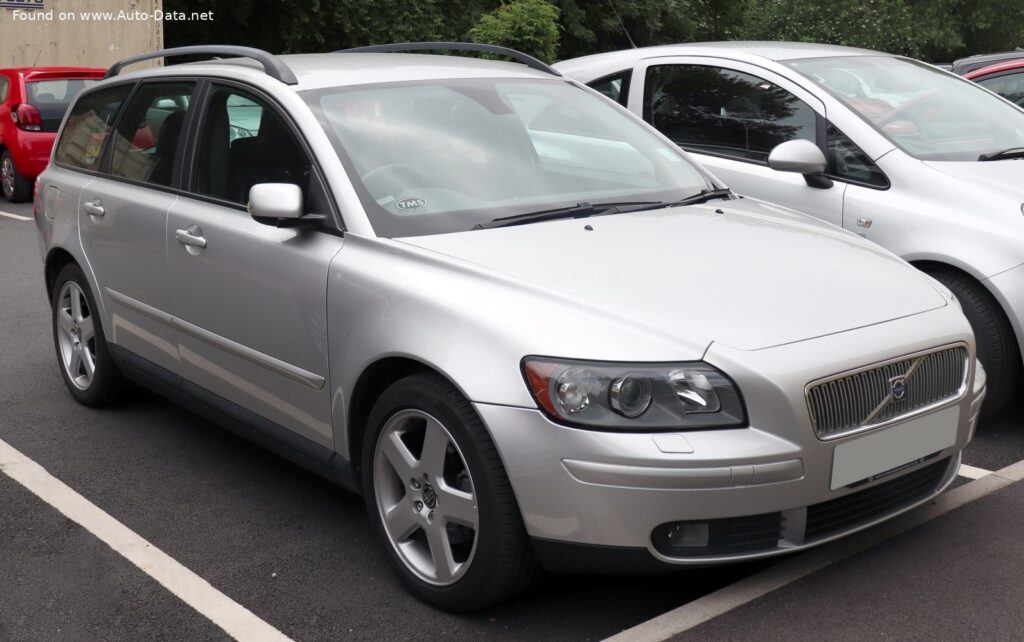
The Volvo V50 1.6 i 16V (101 Hp): A Premium Compact Wagon for the European Market
The Volvo V50, introduced in 2004, represented Volvo’s foray into the highly competitive premium compact segment, succeeding the popular V40 model. Designed as a stylish and practical compact executive car, the V50 shared its platform, known as the Ford C1 platform, with the second-generation Ford Focus and the Mazda 3. This strategic platform sharing allowed Volvo to leverage engineering efficiencies while still imbuing the V50 with its distinctive Scandinavian design philosophy and renowned safety credentials. The particular variant under review, the Volvo V50 1.6 i 16V (101 Hp), was produced between 2005 and 2007. It served as an entry-level gasoline option, primarily targeting European buyers seeking a blend of Volvo’s traditional virtues—safety, understated elegance, and practicality—in a more accessible and fuel-efficient package. Positioned as a five-door station wagon (often referred to as an estate car in Europe), the V50 offered a versatile alternative to traditional sedans, catering to families and individuals who valued cargo space without compromising on a premium driving experience.
Engine and Performance of the Volvo V50
Under the hood of the Volvo V50 1.6 i 16V (101 Hp) lies a naturally aspirated 1.6-liter (1596 cm³ or 97.39 cu. in.) inline four-cylinder gasoline engine, designated with the internal code B4164S3. This powertrain architecture is characterized by its front, transverse engine layout, driving the front wheels. The engine features a Double Overhead Camshaft (DOHC) valvetrain with 4 valves per cylinder, totaling 16 valves, which contributes to its efficiency and smooth operation. Fuel delivery is managed by a multi-port manifold injection system, a common and reliable method for its time.
The engine produces a modest but adequate 101 horsepower (Hp) at 6000 revolutions per minute (rpm), with a power per liter rating of 63.3 Hp/l. Torque output stands at 150 Nm (110.63 lb.-ft.) at 4000 rpm. While these figures do not suggest a performance-oriented vehicle, they are entirely appropriate for the V50’s intended role as an economical and practical family wagon in the European market. The engine’s compression ratio is 11:1, with a cylinder bore of 3.11 inches (79 mm) and a piston stroke of 3.2 inches (81.4 mm).
Power is transmitted to the front wheels via a standard 5-speed manual transmission, offering a direct and engaging driving experience. In terms of acceleration, the V50 1.6 i 16V takes approximately 12 seconds to reach 100 km/h (62 mph) from a standstill, with a calculated 0-60 mph time of 11.4 seconds. Its maximum speed is rated at 185 km/h (114.95 mph). Fuel economy, a crucial factor for European buyers, is respectable for its class: a combined cycle rating of 7.2 liters per 100 km, translating to approximately 32.7 US mpg. CO2 emissions are listed at 171 g/km, reflecting its compliance with European environmental standards of the era. The vehicle’s weight-to-power ratio is 12.5 kg/Hp (80.2 Hp/tonne), indicating its focus on balanced performance rather than raw power.
Design and Features
The Volvo V50’s design is a testament to Volvo’s modern aesthetic, blending clean lines with functional elegance. As a five-door station wagon, it offered significant practicality. Its exterior dimensions—177.72 inches (4514 mm) in length, 69.69 inches (1770 mm) in width, and 57.17 inches (1452 mm) in height—made it maneuverable in urban environments while providing a substantial presence on the road. The design, characterized by Volvo’s signature vertical taillights and a distinctive shoulder line, clearly linked it to its larger S60 and V70 siblings, reinforcing its premium positioning.
Inside, the V50 offered seating for five occupants, with a focus on ergonomic design and high-quality materials, typical of Volvo. The interior was praised for its floating center console, a design element that debuted in the S40/V50 generation, providing a minimalist yet sophisticated cabin experience. As a station wagon, cargo versatility was a key selling point. The trunk (boot) space ranged from 14.73 cu. ft. (417 liters) with all seats in place, expanding significantly to 46.16 cu. ft. (1307 liters) with the rear seats folded down, making it highly adaptable for various hauling needs, from groceries to sports equipment.
Safety, a cornerstone of the Volvo brand, was paramount in the V50’s design. While specific advanced driver-assistance systems found in modern Volvos were not yet prevalent, the V50 came standard with a robust suite of passive and active safety features for its time. These included a comprehensive airbag system, a rigid safety cage, and an Anti-lock Braking System (ABS) as a crucial assisting system. The braking system utilized ventilated discs at the front and solid discs at the rear, ensuring confident stopping power. The suspension setup, featuring transverse stabilizers at both the front and rear, aimed to provide a comfortable ride quality balanced with stable handling. The vehicle rode on 195/65 R15 tires, mounted on 15-inch wheel rims, a common specification for an entry-level model of its class.
Technical Specifications
| General Information | |
|---|---|
| Brand | Volvo |
| Model | V50 |
| Generation | V50 |
| Type (Engine) | 1.6 i 16V (101 Hp) |
| Start of Production | 2005 year |
| End of Production | 2007 year |
| Powertrain Architecture | Internal Combustion engine |
| Body type | Station wagon (estate) |
| Seats | 5 |
| Doors | 5 |
| Performance Specifications | |
| Fuel Consumption (Urban) | 9.5 l/100 km (24.8 US mpg) |
| Fuel Consumption (Extra Urban) | 5.8 l/100 km (40.6 US mpg) |
| Fuel Consumption (Combined) | 7.2 l/100 km (32.7 US mpg) |
| CO2 Emissions | 171 g/km |
| Fuel Type | Petrol (Gasoline) |
| Acceleration 0 – 60 mph | 11.4 sec |
| Acceleration 0 – 100 km/h | 12 sec |
| Maximum Speed | 185 km/h (114.95 mph) |
| Weight-to-Power Ratio | 12.5 kg/Hp (80.2 Hp/tonne) |
| Weight-to-Torque Ratio | 8.4 kg/Nm (119 Nm/tonne) |
| Engine Specifications | |
| Power | 101 Hp @ 6000 rpm |
| Power per Liter | 63.3 Hp/l |
| Torque | 150 Nm @ 4000 rpm (110.63 lb.-ft. @ 4000 rpm) |
| Engine Layout | Front, Transverse |
| Engine Model/Code | B4164S3 |
| Engine Displacement | 1596 cm³ (97.39 cu. in.) |
| Number of Cylinders | 4 |
| Engine Configuration | Inline |
| Cylinder Bore | 79 mm (3.11 in.) |
| Piston Stroke | 81.4 mm (3.2 in.) |
| Compression Ratio | 11:1 |
| Number of Valves per Cylinder | 4 |
| Fuel Injection System | Multi-port manifold injection |
| Engine Aspiration | Naturally aspirated engine |
| Valvetrain | DOHC |
| Engine Oil Capacity | 4 l (4.23 US qt) |
| Coolant Capacity | 6.2 l (6.55 US qt) |
| Space, Volume and Weights | |
| Kerb Weight | 1260 kg (2777.82 lbs.) |
| Maximum Weight | 1850 kg (4078.55 lbs.) |
| Maximum Load | 590 kg (1300.73 lbs.) |
| Trunk (boot) Space – Minimum | 417 l (14.73 cu. ft.) |
| Trunk (boot) Space – Maximum | 1307 l (46.16 cu. ft.) |
| Fuel Tank Capacity | 62 l (16.38 US gal) |
| Dimensions | |
| Length | 4514 mm (177.72 in.) |
| Width | 1770 mm (69.69 in.) |
| Height | 1452 mm (57.17 in.) |
| Wheelbase | 2640 mm (103.94 in.) |
| Front Track | 1535 mm (60.43 in.) |
| Rear Track | 1531 mm (60.28 in.) |
| Drivetrain, Brakes and Suspension Specifications | |
| Drivetrain Architecture | The Internal combustion engine (ICE) drives the front wheels of the vehicle. |
| Drive Wheel | Front wheel drive |
| Number of Gears and Type of Gearbox | 5 gears, manual transmission |
| Front Suspension | Transverse stabilizer |
| Rear Suspension | Transverse stabilizer |
| Front Brakes | Ventilated discs |
| Rear Brakes | Ventilated discs |
| Assisting Systems | ABS (Anti-lock braking system) |
| Steering Type | Steering rack and pinion |
| Tires Size | 195/65 R15 |
| Wheel Rims Size | 15 |
Legacy and Market Impact
The Volvo V50, including the 1.6 i 16V variant, played a significant role in Volvo’s strategy to broaden its appeal beyond its traditional larger sedan and wagon offerings. Launched into a fiercely competitive European compact executive segment, it faced formidable rivals such as the BMW 3 Series Touring, Audi A4 Avant, Mercedes-Benz C-Class Estate, and more mainstream but well-equipped options like the Volkswagen Passat Variant and Ford Mondeo Estate. Despite its smaller engine in this particular configuration, the V50 1.6 i 16V carved out a niche for buyers prioritizing brand prestige, safety, and practicality in a more compact and economical package.
The V50’s platform sharing with the Ford Focus was a calculated move, allowing Volvo to offer a refined driving experience and dynamic handling that might not have been traditionally associated with the brand’s older, softer models. While the 1.6-liter engine was not a powerhouse, its efficiency and lower running costs made it an attractive option in markets where fuel prices and taxation on engine displacement were significant considerations. Its reputation for solid build quality and excellent long-term durability further enhanced its appeal.
Volvo’s unwavering commitment to safety was a major selling point for the V50. The car consistently performed well in crash tests and was equipped with comprehensive safety features for its generation, reinforcing Volvo’s image as a leader in automotive safety. This, combined with its elegant design and practical station wagon body, made the V50 a popular choice among young families and professionals in Europe who sought a premium, versatile, and secure vehicle.
Though the 1.6 i 16V model was not sold in the United States, where larger engines and automatic transmissions dominated the market, its impact was profound in its primary European markets. It helped cement Volvo’s presence in the compact segment, demonstrating the brand’s ability to combine its core values with contemporary design and engineering. The V50’s legacy endures as a testament to Volvo’s successful adaptation to evolving market demands, offering a blend of luxury, utility, and safety in a more accessible and efficient package that resonated strongly with its target audience. It paved the way for future compact Volvo models, reinforcing the brand’s position as a premium automotive manufacturer with a conscience.
