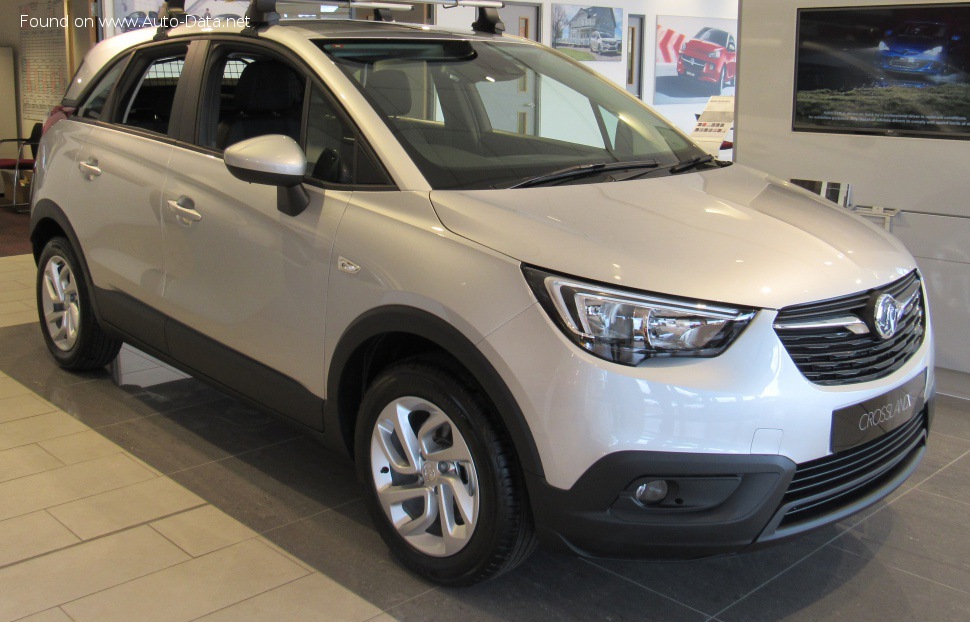
Vauxhall Crossland (facelift 2020) 1.2 Turbo (130 Hp)
The Vauxhall Crossland (facelift 2020) 1.2 Turbo (130 Hp) represents a significant update to Vauxhall’s entry into the burgeoning B-segment (subcompact) SUV market. Launched in October 2020, this refreshed model, known simply as the Crossland (dropping the ‘X’ from its predecessor, the Crossland X), aimed to solidify its position as a practical, family-friendly crossover within the highly competitive European automotive landscape. Produced by the British marque Vauxhall, a subsidiary of Stellantis (formerly Groupe PSA), the Crossland shares its platform and many mechanical components with its Opel sibling, the Crossland, and other vehicles like the Citroën C3 Aircross and Peugeot 2008. While not sold in the United States, the Crossland is a staple in the United Kingdom and continental Europe, catering to buyers seeking a versatile, elevated driving position, and efficient urban vehicle without the larger footprint or fuel consumption of a full-size SUV. This particular variant, powered by a spirited 1.2-liter turbocharged engine delivering 130 horsepower, offers a compelling balance of performance and economy, making it a popular choice for daily commutes and family adventures across its primary markets.
Engine and Performance of the Vauxhall Crossland
At the heart of the Vauxhall Crossland (facelift 2020) 1.2 Turbo (130 Hp) lies a sophisticated 1.2-liter (1199 cm3 or 73.17 cu. in.) inline three-cylinder gasoline engine, designated with the F12XHT code. This powertrain benefits from a turbocharger and intercooler, ensuring robust performance for its class. Generating a respectable 130 horsepower at 5500 rpm, the engine demonstrates a strong power-to-liter ratio of 108.4 Hp/l. More crucially for everyday drivability, it delivers a healthy 169.64 lb.-ft. (230 Nm) of torque from a low 1750 rpm, providing excellent responsiveness and reduced need for frequent gear changes in city driving.
Power is channeled to the front wheels via a precise 6-speed manual transmission, offering engaging control for the driver. This setup allows the Crossland to accelerate from 0 to 60 mph in a brisk 9.5 seconds, with a maximum speed of 124.9 mph (201 km/h). Despite its lively performance, the Crossland maintains impressive fuel efficiency, with a combined WLTP rating of 41.3 – 40.6 US mpg (5.7-5.8 l/100 km). Its CO2 emissions are rated at 130-132 g/km, adhering to the stringent Euro 6d emission standard, underscoring its commitment to environmental responsibility. The engine also features a Start & Stop System and a particulate filter, further enhancing its efficiency and reducing emissions in urban environments. The DOHC valvetrain and multi-port manifold injection system contribute to its refined operation and reliability.
Design and Features of the Vauxhall Crossland
The 2020 facelift brought a refreshed aesthetic and enhanced practicality to the Vauxhall Crossland. Adopting Vauxhall’s new ‘Vizor’ front fascia, which integrates the grille and headlights into a single, sleek module, the Crossland presented a bolder and more modern appearance. This design language aligns it with newer Vauxhall models, giving it a distinctive road presence. As a 5-door SUV with seating for five, the Crossland maintains a compact footprint suitable for urban environments while offering the elevated driving position and practical interior space characteristic of a crossover.
Dimensionally, the Crossland measures 165.83 inches (4212 mm) in length, 69.49 inches (1765 mm) in width (77.8 inches or 1976 mm including mirrors), and 63.19 inches (1605 mm) in height, with a wheelbase of 102.52 inches (2604 mm). These dimensions contribute to its nimble turning circle of 36.78 feet (11.21 m), making it highly maneuverable in tight spaces. The vehicle’s drag coefficient (Cd) of 0.31 is commendable for an SUV, aiding both fuel efficiency and reducing wind noise.
Inside, the Crossland prioritizes comfort and versatility. It offers a generous minimum trunk (boot) space of 14.48 cu. ft. (410 liters), which can expand significantly to 44.32 cu. ft. (1255 liters) with the rear seats folded, catering to varying cargo needs. Key features include an independent McPherson front suspension with a coil spring and anti-roll bar, providing a comfortable and stable ride, complemented by a dependent spring rear suspension. Braking is handled by ventilated discs measuring 283 mm at the front and solid discs of 249 mm at the rear, supported by an Anti-lock Braking System (ABS) for enhanced safety. Electric power steering and a rack and pinion steering type ensure light and responsive handling. Standard tire sizes range from 195/60 R16 to 215/50 R17, mounted on 16 or 17-inch wheel rims, offering a balance of ride comfort and grip.
Technical Specifications: Vauxhall Crossland (facelift 2020) 1.2 Turbo (130 Hp)
| Category | Specification |
|---|---|
| General Information | |
| Brand | Vauxhall |
| Model | Crossland |
| Generation | Crossland (facelift 2020) |
| Type (Engine) | 1.2 Turbo (130 Hp) |
| Start of production | October, 2020 |
| Powertrain Architecture | Internal Combustion engine |
| Body type | SUV |
| Seats | 5 |
| Doors | 5 |
| Performance Specs | |
| Combined fuel consumption (WLTP) | 5.7-5.8 l/100 km (41.3 – 40.6 US mpg) |
| CO2 emissions (WLTP) | 130-132 g/km |
| Fuel Type | Petrol (Gasoline) |
| Acceleration 0 – 60 mph | 9.5 sec |
| Maximum speed | 201 km/h (124.9 mph) |
| Emission standard | Euro 6d |
| Engine Specs | |
| Power | 130 Hp @ 5500 rpm |
| Power per liter | 108.4 Hp/l |
| Torque | 230 Nm @ 1750 rpm (169.64 lb.-ft. @ 1750 rpm) |
| Engine layout | Front, Transverse |
| Engine Model/Code | F12XHT |
| Engine displacement | 1199 cm3 (1.2 liters, 73.17 cu. in.) |
| Number of cylinders | 3 |
| Engine configuration | Inline |
| Number of valves per cylinder | 4 |
| Fuel injection system | Multi-port manifold injection |
| Engine aspiration | Turbocharger, Intercooler |
| Valvetrain | DOHC |
| Engine oil capacity | 3.5 l (3.7 US qt) |
| Coolant | 5.7 l (6.02 US qt) |
| Engine systems | Start & Stop System, Particulate filter |
| Space, Volume and Weights | |
| Max. weight (Gross Vehicle Weight Rating) | 1790 kg (3946.27 lbs.) |
| Trunk (boot) space – minimum | 410 l (14.48 cu. ft.) |
| Trunk (boot) space – maximum | 1255 l (44.32 cu. ft.) |
| Fuel tank capacity | 45 l (11.89 US gal) |
| Permitted trailer load with brakes (12%) | 840 kg (1851.88 lbs.) |
| Permitted trailer load without brakes | 600 kg (1322.77 lbs.) |
| Dimensions | |
| Length | 4212 mm (165.83 in.) |
| Width | 1765 mm (69.49 in.) |
| Width including mirrors | 1976 mm (77.8 in.) |
| Height | 1605 mm (63.19 in.) |
| Wheelbase | 2604 mm (102.52 in.) |
| Front overhang | 896 mm (35.28 in.) |
| Rear overhang | 712 mm (28.03 in.) |
| Drag coefficient (Cd) | 0.31 |
| Minimum turning circle (turning diameter) | 11.21 m (36.78 ft.) |
| Drivetrain, Brakes and Suspension Specs | |
| Drivetrain Architecture | The Internal combustion engine (ICE) drives the front wheels of the vehicle. |
| Drive wheel | Front wheel drive |
| Number of gears and type of gearbox | 6 gears, manual transmission |
| Front suspension | Independent, type McPherson with coil spring and anti-roll bar |
| Rear suspension | Dependent spring suspension |
| Front brakes | Ventilated discs, 283 mm |
| Rear brakes | Disc, 249 mm |
| Assisting systems | ABS (Anti-lock braking system) |
| Steering type | Steering rack and pinion |
| Power steering | Electric Steering |
| Tires size | 195/60 R16; 215/50 R17 |
| Wheel rims size | 16; 17 |
Legacy and Market Impact of the Vauxhall Crossland
The Vauxhall Crossland, particularly after its 2020 facelift, continued to play a crucial role in Vauxhall’s product lineup, serving as a practical and accessible option in the highly competitive subcompact crossover segment. In markets like the UK, where Vauxhall has a long-standing history, the Crossland appeals to a broad demographic, from young families to empty nesters, who value its combination of elevated driving position, generous interior space for its size, and economical running costs.
The Crossland’s market impact is primarily felt in Europe, where it competes against a formidable array of rivals. Key competitors include the Ford Puma, Nissan Juke, Renault Captur, Peugeot 2008 (its platform sibling), Citroën C3 Aircross, Skoda Kamiq, and Volkswagen T-Cross. What sets the Crossland apart in this crowded field is its emphasis on practicality, comfort, and ease of use, rather than outright sporty driving dynamics. Its upright stance and large windows contribute to excellent visibility, a boon in busy urban environments.
The 2020 facelift, with its updated styling, improved interior materials, and refined engine options like the 1.2 Turbo (130 Hp), helped maintain the Crossland’s relevance and appeal. Its mechanical ties to the broader Stellantis (formerly PSA Group) architecture ensured access to proven powertrains and technologies, benefiting from economies of scale and robust engineering. The 1.2-liter turbocharged engine, in particular, has been lauded for its balance of power and efficiency, making it a popular choice for buyers navigating rising fuel prices and stricter emission regulations.
Historically, the Crossland signifies Vauxhall’s commitment to adapting to changing consumer preferences, moving away from traditional hatchbacks and sedans towards the more popular SUV and crossover body styles. It represents a pragmatic choice for consumers seeking a versatile, no-nonsense vehicle that delivers on its promises of space, efficiency, and modern features, without breaking the bank. While it may not possess the same emotional appeal or performance credentials as some rivals, its honest approach to family-friendly transportation has cemented its place as a dependable workhorse in the European automotive landscape. Its legacy is one of quiet competence and widespread utility, a testament to Vauxhall’s enduring appeal to the everyday motorist.