The Peugeot 207 (facelift 2009): A European B-Segment Contender
The Peugeot 207 (facelift 2009) represents a significant iteration of the French automaker’s popular B-segment (subcompact) hatchback, a cornerstone of its European lineup. Introduced in 2009 as a mid-cycle refresh for the second-generation 207, this particular model, equipped with the 1.6 VTi engine delivering 120 horsepower, was a key offering designed to maintain competitiveness in a fiercely contested market. Produced from 2009 to 2012, this facelifted 207 aimed to refine the original model’s strengths, offering a blend of stylish design, engaging driving dynamics, and improved efficiency. While never officially sold in the United States, the 207 played a crucial role in Peugeot’s global strategy, especially across Europe and other international markets, serving as a direct successor to the immensely successful Peugeot 206 and a precursor to the modern 208.
Engine and Performance: The 1.6 VTi Heartbeat
At the core of this particular Peugeot 207 (facelift 2009) variant lies the 1.6-liter VTi (Variable Valve Lift and Timing Injection) gasoline engine, a naturally aspirated inline-four-cylinder unit designated internally as the EP6C (or 5FS). This powertrain was a product of collaboration between PSA Peugeot Citroën and BMW, renowned for its balance of performance and fuel efficiency. With a displacement of 1598 cm3 (97.52 cubic inches), the engine produces a healthy 120 horsepower at 6000 rpm, translating to a power-per-liter output of 75.1 horsepower per liter, which was competitive for its class at the time.
Torque output stands at 160 Nm (118.01 lb.-ft.) delivered at 4250 rpm, providing a responsive feel for daily driving. The engine’s architecture features a front, transverse layout, a compression ratio of 11:1, and a DOHC-VVT (Double Overhead Camshaft with Variable Valve Timing) valvetrain with four valves per cylinder. Fuel is delivered via a multi-port manifold injection system. This setup enabled the 207 1.6 VTi to accelerate from 0 to 60 mph in a respectable 9.1 seconds (9.6 seconds for 0-100 km/h) and reach a maximum speed of 119.3 mph (192 km/h).
Power is channeled to the front wheels through a precise 5-speed manual transmission, a common and reliable choice for this segment. In terms of efficiency, the 1.6 VTi model boasted a combined fuel economy of 39.2 US mpg (6 liters per 100 km), with urban consumption at 29.4 US mpg (8 l/100 km) and extra-urban at an impressive 48 US mpg (4.9 l/100 km). With CO2 emissions of 139 g/km, it met the Euro 5 emission standard, reflecting Peugeot’s commitment to environmental considerations within the European regulatory framework. The car’s kerb weight of 2601.45 lbs (1180 kg) contributed to a favorable weight-to-power ratio of 9.8 kg/Hp, ensuring agile performance for its class.
Design and Features: Refined Aesthetics and Practicality
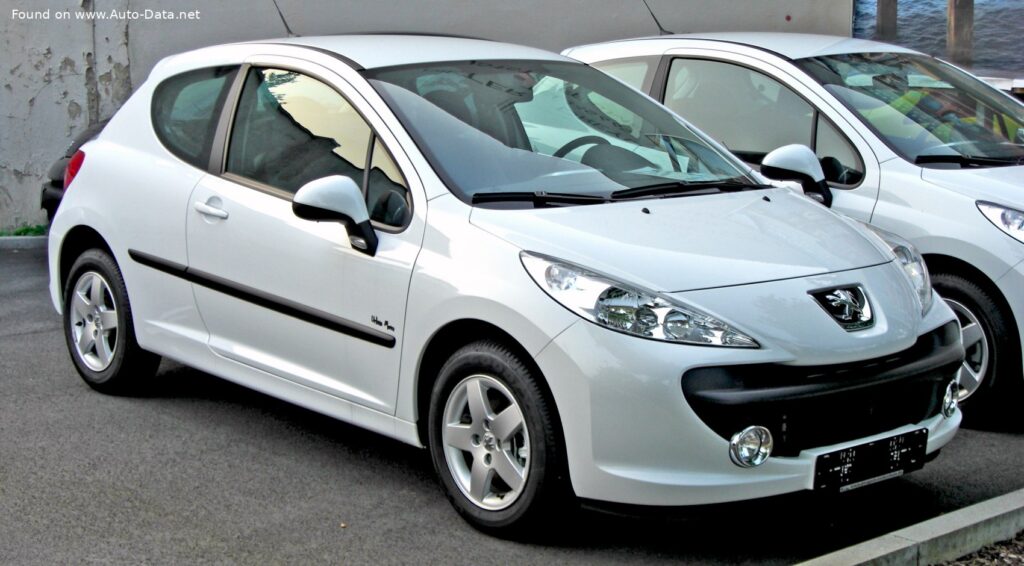
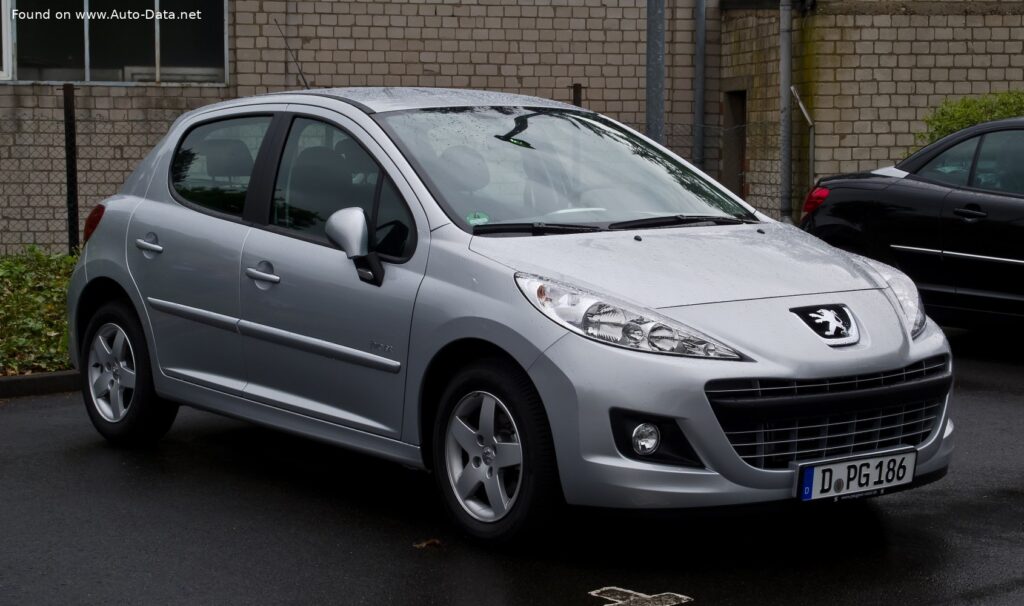
The Peugeot 207 (facelift 2009) maintained the core design language of the pre-facelift model but introduced subtle yet impactful revisions to keep its aesthetic appeal fresh. Available in both 3-door and 5-door hatchback body styles, it retained its characteristic “cat’s eye” headlights and prominent front grille, though the latter received minor updates for a more contemporary look. The overall length of the vehicle measures 159.25 inches (4045 mm), with a width of 68.82 inches (1748 mm) and a height of 57.95 inches (1472 mm). The wheelbase of 100 inches (2540 mm) provided a stable platform and contributed to a relatively spacious cabin for its class. Its drag coefficient (Cd) of 0.30 indicated a focus on aerodynamic efficiency.
Inside, the 207 offered seating for five occupants, with a focus on ergonomic design and functional layouts. The trunk (boot) space was practical, offering a minimum of 9.53 cubic feet (270 liters) which could expand significantly to 32.6 cubic feet (923 liters) with the rear seats folded down, making it versatile for city living and occasional longer trips. The fuel tank capacity of 13.21 US gallons (50 liters) provided a decent cruising range.
In terms of chassis and handling, the 207 featured an independent McPherson strut front suspension with coil springs and an anti-roll bar, while the rear utilized a semi-independent setup with coil springs and an elastic beam. This configuration aimed to strike a balance between ride comfort and dynamic handling, a hallmark of Peugeot’s engineering. Braking performance was handled by ventilated discs at the front and solid discs at the rear, complemented by an Anti-lock Braking System (ABS) for enhanced safety. The car rode on 195/55 R16 tires mounted on 16-inch wheel rims, providing good grip and a comfortable ride. The steering system was a responsive rack and pinion type, contributing to the car’s agile feel, with a minimum turning circle of 36.09 feet (11.0 meters).
Technical Specifications
| Category | Specification |
|---|---|
| Brand | Peugeot |
| Model | 207 |
| Generation | 207 (facelift 2009) |
| Type (Engine) | 1.6 VTi (120 Hp) |
| Production Start | 2009 |
| Production End | 2012 |
| Powertrain Architecture | Internal Combustion Engine (ICE) |
| Body Type | Hatchback |
| Seats | 5 |
| Doors | 3-5 |
| Performance Specs | |
| Fuel Consumption (Urban) | 29.4 US mpg (8 l/100 km) |
| Fuel Consumption (Extra Urban) | 48 US mpg (4.9 l/100 km) |
| Fuel Consumption (Combined) | 39.2 US mpg (6 l/100 km) |
| CO2 Emissions | 139 g/km |
| Fuel Type | Petrol (Gasoline) |
| Acceleration 0 – 60 mph | 9.1 sec |
| Acceleration 0 – 100 km/h | 9.6 sec |
| Maximum Speed | 119.3 mph (192 km/h) |
| Emission Standard | Euro 5 |
| Weight-to-Power Ratio | 9.8 kg/Hp (101.7 Hp/tonne) |
| Weight-to-Torque Ratio | 7.4 kg/Nm (135.6 Nm/tonne) |
| Engine Specs | |
| Power | 120 Hp @ 6000 rpm |
| Power per Liter | 75.1 Hp/l |
| Torque | 118.01 lb.-ft. (160 Nm) @ 4250 rpm |
| Engine Layout | Front, Transverse |
| Engine Model/Code | 5FS EP6C |
| Engine Displacement | 1.6 liters (1598 cm3, 97.52 cu. in.) |
| Number of Cylinders | 4 |
| Engine Configuration | Inline |
| Cylinder Bore | 3.03 in. (77 mm) |
| Piston Stroke | 3.38 in. (85.8 mm) |
| Compression Ratio | 11:1 |
| Valves per Cylinder | 4 |
| Fuel Injection System | Multi-port manifold injection |
| Engine Aspiration | Naturally aspirated engine |
| Valvetrain | DOHC-VVT |
| Engine Oil Capacity | 4.49 US qt (4.25 l) |
| Coolant Capacity | 6.02 US qt (5.7 l) |
| Space, Volume and Weights | |
| Kerb Weight | 2601.45 lbs (1180 kg) |
| Maximum Weight | 3648.65 lbs (1655 kg) |
| Maximum Load | 1047.2 lbs (475 kg) |
| Trunk Space (Minimum) | 9.53 cu. ft. (270 l) |
| Trunk Space (Maximum) | 32.6 cu. ft. (923 l) |
| Fuel Tank Capacity | 13.21 US gal (50 l) |
| Permitted Trailer Load (with brakes) | 2535.32 lbs (1150 kg) |
| Permitted Trailer Load (without brakes) | 1322.77 lbs (600 kg) |
| Dimensions | |
| Length | 159.25 in. (4045 mm) |
| Width | 68.82 in. (1748 mm) |
| Width with Mirrors Folded | 71.57 in. (1818 mm) |
| Width Including Mirrors | 77.64 in. (1972 mm) |
| Height | 57.95 in. (1472 mm) |
| Wheelbase | 100 in. (2540 mm) |
| Front Track | 58.07 in. (1475 mm) |
| Rear Track | 57.8 in. (1468 mm) |
| Drag Coefficient (Cd) | 0.30 |
| Minimum Turning Circle | 36.09 ft. (11.0 m) |
| Drivetrain, Brakes and Suspension | |
| Drivetrain Architecture | Front-wheel drive, Internal Combustion Engine (ICE) |
| Drive Wheel | Front Wheel Drive |
| Gearbox Type | 5-speed, Manual Transmission |
| Front Suspension | Independent, McPherson with coil spring and anti-roll bar |
| Rear Suspension | Semi-independent, coil spring, Elastic beam |
| Front Brakes | Ventilated discs |
| Rear Brakes | Disc |
| Assisting Systems | ABS (Anti-lock Braking System) |
| Steering Type | Steering rack and pinion |
| Tire Size | 195/55 R16 |
| Wheel Rims Size | 16 inches |
Legacy and Market Impact in Europe
The Peugeot 207 (facelift 2009), particularly with the 1.6 VTi engine, played a crucial role in Peugeot’s strategy in the highly competitive European B-segment. This segment is characterized by strong demand for compact, efficient, and stylish vehicles that can handle both urban commutes and occasional longer journeys. The 207 inherited the challenging task of following in the footsteps of the phenomenally successful Peugeot 206, a car that sold over 8 million units globally. While the 207 didn’t quite match the 206’s sales volume, it solidified Peugeot’s presence and reputation for producing attractive and enjoyable small cars.
In its primary markets, the 207 faced stiff competition from segment leaders such as the Renault Clio, Ford Fiesta, Volkswagen Polo, and Opel Corsa. The 2009 facelift helped the 207 maintain its visual freshness against these rapidly evolving rivals, offering subtle styling tweaks that enhanced its appeal without radical changes. The 1.6 VTi engine was a significant asset, providing a good balance of performance for a car of its size, making it a popular choice for buyers seeking a more spirited driving experience than the smaller engine options, without incurring the higher running costs of a diesel or larger gasoline unit. Its fuel efficiency and compliance with Euro 5 emissions standards were important selling points in environmentally conscious European markets.
The 207 was generally praised for its comfortable ride, refined interior (for its class), and respectable handling characteristics, often considered a strong performer on winding roads. Its robust build quality and comprehensive safety features, including standard ABS, contributed to its reputation as a reliable and secure choice for families and individual drivers alike. The flexibility offered by its 3-door and 5-door configurations, coupled with a practical trunk space, underscored its versatility.
Ultimately, the 207’s production run concluded in 2012, making way for its successor, the Peugeot 208. The 208 built upon the 207’s foundation, introducing further advancements in design, technology, and efficiency. However, the 207 (facelift 2009) remains an important chapter in Peugeot’s history, representing a mature and well-rounded offering in the European subcompact market. It demonstrated Peugeot’s ability to evolve its core product line, providing a blend of French flair, practical utility, and enjoyable driving dynamics that resonated with a broad customer base, even if it never made its way to American showrooms. Its legacy is one of consistent performance and a solid contribution to the brand’s enduring appeal in the global automotive landscape.