Toyota Corolla XII (E210) 1.6i (132 Hp)
The Toyota Corolla XII (E210), specifically the 1.6i (132 Hp) variant, represents the twelfth generation of Toyota’s globally renowned compact car, a lineage celebrated for its unwavering reliability, practicality, and widespread appeal. Launched in 2019, this iteration of the Corolla sedan brought a fresh design language, an advanced platform, and a renewed focus on driving dynamics to a segment traditionally dominated by efficiency and value. While the Corolla is a ubiquitous nameplate worldwide, this particular 1.6-liter naturally aspirated engine configuration, paired with a manual transmission, was a common offering in various international markets, particularly in Europe and parts of Asia, where it catered to consumers prioritizing fuel economy and lower running costs over outright power, distinguishing it somewhat from the larger-displacement or hybrid options often emphasized in the North American market during the same period. The E210 generation aimed to shed its predecessor’s somewhat conservative image, introducing a more dynamic exterior and a refined interior, all built upon the flexible Toyota New Global Architecture (TNGA) platform.
Engine and Performance: The Heart of the Toyota Corolla XII (E210)
Powering this specific variant of the Toyota Corolla XII (E210) is a 1.6-liter (1598 cm3 or 97.52 cu. in.) naturally aspirated inline four-cylinder gasoline engine, designated with the code 1ZR-FAE. This powerplant delivers a respectable 132 horsepower at 6400 rpm, paired with 117.27 lb.-ft. of torque peaking at 4200 rpm. The engine’s design, featuring 4 valves per cylinder and Toyota’s Valvematic variable valve lift and timing system, emphasizes a balance of responsiveness and fuel efficiency. With a compression ratio of 10.7:1, it is optimized for standard petrol (gasoline) fuel and meets the stringent Euro 6 AG emission standards, reflecting Toyota’s commitment to environmental responsibility.
Mated exclusively to a 6-speed manual transmission, the 1.6i (132 Hp) Corolla directs its power to the front wheels, a classic and efficient drivetrain architecture for the compact sedan segment. This combination allows the vehicle to accelerate from 0 to 60 mph in a competitive 9.2 seconds, reaching a maximum speed of 124.27 mph (200 km/h). These performance figures highlight the car’s capability as a competent daily driver, offering sufficient power for urban commuting and highway cruising without being overly aggressive.
Fuel economy stands out as a key strength for this model. The combined cycle consumption is rated at an impressive 39.2 US mpg (6 l/100 km), with extra-urban driving achieving an even more remarkable 48 US mpg (4.9 l/100 km). Even in urban environments, the Corolla manages 29.4 US mpg (8 l/100 km). These figures underscore the efficiency of the 1ZR-FAE engine and the manual transmission, making it an attractive option for cost-conscious consumers. The CO2 emissions are kept in check at 138 g/km, further solidifying its eco-friendly credentials within its class.
Design and Features of the E210 Sedan
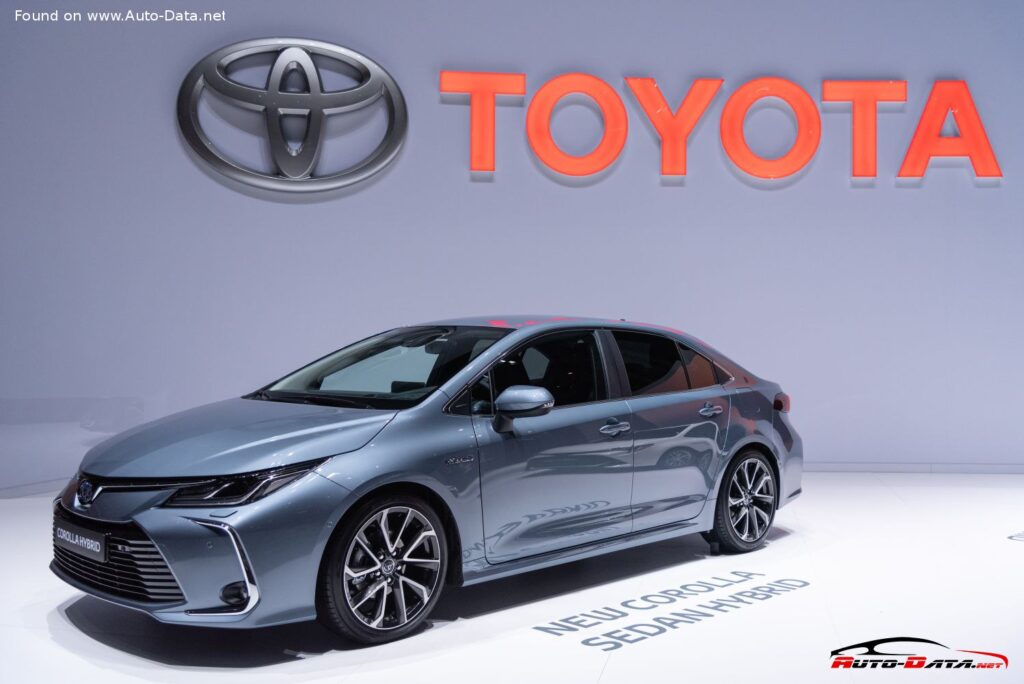
The twelfth-generation Toyota Corolla sedan, internally known as the E210, represents a significant departure from its more conservative predecessors in terms of design. Built on the GA-C platform, a derivative of the Toyota New Global Architecture (TNGA), this sedan boasts a more athletic and sculpted appearance. Its length of 182.28 inches (4630 mm), width of 70.08 inches (1780 mm), and height of 56.5 inches (1435 mm) give it a sleek, low-slung profile. The extended wheelbase of 106.3 inches (2700 mm) contributes to both improved ride comfort and a more spacious cabin, while a drag coefficient (Cd) of 0.282 speaks to its aerodynamic efficiency.
As a 4-door, 5-seat sedan, the E210 Corolla prioritizes passenger comfort and practicality. The interior, while not explicitly detailed in the provided data, typically featured a more contemporary design with improved materials and ergonomics compared to previous generations. Modern amenities, such as advanced infotainment systems and connectivity options, were standard or available, reflecting the expectations of today’s compact car buyers.
From a chassis perspective, the E210 generation made strides in driving dynamics. It features an independent McPherson strut front suspension with a coil spring and anti-roll bar, paired with a sophisticated double wishbone rear suspension. This combination significantly enhances handling agility and ride quality, providing a more engaging driving experience. Braking is handled by ventilated discs at the front and solid discs at the rear, complemented by an Anti-lock Braking System (ABS) for enhanced safety. The electric power steering system, coupled with a rack and pinion setup, offers precise control and ease of maneuverability, with a minimum turning circle of 35.43 feet (10.8 m). The vehicle can be fitted with 17 or 18-inch wheel rims, further contributing to its contemporary stance. The trunk space of 16.63 cu. ft. (471 liters) provides ample room for luggage, reinforcing its role as a practical family sedan.
Technical Specifications: Toyota Corolla XII (E210) 1.6i (132 Hp)
| Category | Specification |
|---|---|
| General Information | |
| Brand | Toyota |
| Model | Corolla |
| Generation | Corolla XII (E210) |
| Engine Type | 1.6i (132 Hp) |
| Production Start | 2019 year |
| Production End | 2022 year |
| Powertrain Architecture | Internal Combustion engine |
| Body Type | Sedan |
| Seats | 5 |
| Doors | 4 |
| Performance Specs | |
| Fuel Consumption (Urban) | 29.4 US mpg (8 l/100 km) |
| Fuel Consumption (Extra Urban) | 48 US mpg (4.9 l/100 km) |
| Fuel Consumption (Combined) | 39.2 US mpg (6 l/100 km) |
| CO2 Emissions | 138 g/km |
| Fuel Type | Petrol (Gasoline) |
| Acceleration 0 – 60 mph | 9.2 sec |
| Acceleration 0 – 62 mph (100 km/h) | 9.7 sec |
| Maximum Speed | 124.27 mph (200 km/h) |
| Emission Standard | Euro 6 AG |
| Weight-to-Power Ratio | 10.1 kg/Hp, 99.2 Hp/tonne |
| Weight-to-Torque Ratio | 8.4 kg/Nm, 119.5 Nm/tonne |
| Engine Specs | |
| Power | 132 Hp @ 6400 rpm |
| Power per liter | 82.6 Hp/l |
| Torque | 117.27 lb.-ft. (159 Nm) @ 4200 rpm |
| Engine Layout | Front, Transverse |
| Engine Model/Code | 1ZR-FAE |
| Engine Displacement | 1.6 l (1598 cm3, 97.52 cu. in.) |
| Number of Cylinders | 4 |
| Engine Configuration | Inline |
| Cylinder Bore | 3.17 in. (80.5 mm) |
| Piston Stroke | 3.09 in. (78.5 mm) |
| Compression Ratio | 10.7:1 |
| Valves per Cylinder | 4 |
| Engine Aspiration | Naturally aspirated engine |
| Valvetrain | Valvematic |
| Engine Oil Capacity | 4.44 US qt (4.2 l) |
| Coolant Capacity | 5.92 US qt (5.6 l) |
| Engine Systems | Particulate filter |
| Space, Volume and Weights | |
| Kerb Weight | 2932.15 – 3042.38 lbs. (1330-1380 kg) |
| Trunk (Boot) Space – Minimum | 16.63 cu. ft. (471 l) |
| Fuel Tank Capacity | 13.21 US gal (50 l) |
| Permitted Trailer Load with Brakes (12%) | 2866.01 lbs. (1300 kg) |
| Permitted Trailer Load without Brakes | 992.08 lbs. (450 kg) |
| Dimensions | |
| Length | 182.28 in. (4630 mm) |
| Width | 70.08 in. (1780 mm) |
| Height | 56.5 in. (1435 mm) |
| Wheelbase | 106.3 in. (2700 mm) |
| Front Track | 60.28 in. (1531 mm) |
| Rear Track | 60.79 in. (1544 mm) |
| Front Overhang | 36.81 in. (935 mm) |
| Rear Overhang | 39.17 in. (995 mm) |
| Ride Height (Ground Clearance) | 5.12 in. (130 mm) |
| Drag Coefficient (Cd) | 0.282 |
| Minimum Turning Circle | 35.43 ft. (10.8 m) |
| Drivetrain, Brakes and Suspension Specs | |
| Drivetrain Architecture | Front-wheel drive, Internal Combustion engine |
| Drive Wheel | Front wheel drive |
| Gearbox Type | 6 gears, manual transmission |
| Front Suspension | Independent, McPherson with coil spring and anti-roll bar |
| Rear Suspension | Double wishbone |
| Front Brakes | Ventilated discs |
| Rear Brakes | Disc |
| Assisting Systems | ABS (Anti-lock braking system) |
| Steering Type | Steering rack and pinion |
| Power Steering | Electric Steering |
| Wheel Rims Size | 17; 18 |
Legacy and Market Impact of the Toyota Corolla XII (E210)
The Toyota Corolla, in its twelfth generation (E210), continued to uphold its reputation as one of the best-selling cars globally, a testament to its enduring appeal and Toyota’s commitment to continuous improvement. The 1.6i (132 Hp) variant, while not the primary offering in the North American market which often saw 1.8L, 2.0L, or hybrid powertrains, played a crucial role in other key international markets, particularly in Europe and Asia. In these regions, it directly competed with a strong field of compact sedans such as the Honda Civic, Volkswagen Jetta (known as Sagitar in China), Hyundai Elantra, and Kia Forte. Its blend of reliable Japanese engineering, competitive fuel economy, and a spacious, well-appointed interior made it a compelling choice for a wide demographic, from young families to fleet operators.
The E210 generation marked a pivotal moment for the Corolla, moving beyond its traditional “appliance” image to embrace a more emotional and dynamic character, largely thanks to the TNGA platform. This architecture provided a lower center of gravity, increased structural rigidity, and allowed for more sophisticated suspension setups, like the double wishbone rear, which significantly improved handling and ride comfort. This shift resonated well with consumers who desired a more engaging driving experience without sacrificing the legendary reliability and low running costs for which the Corolla is famous.
The 1.6-liter engine, with its Valvematic technology, demonstrated Toyota’s expertise in naturally aspirated engine design, delivering a smooth power delivery and excellent efficiency without resorting to forced induction. This appealed to markets where simplicity and proven technology were highly valued. Furthermore, its compliance with Euro 6 AG emission standards ensured its relevance in environmentally conscious markets, contributing to lower carbon footprints.
Historically, the Corolla has been a benchmark for dependability and value. The E210 generation, and particularly this 1.6i variant, reinforced this legacy while simultaneously elevating the car’s aesthetic and dynamic appeal. It solidified the Corolla’s position not just as a reliable workhorse but as a genuinely desirable compact sedan, capable of holding its own against more premium-badged rivals in terms of design and driving pleasure. Its market impact was profound, continually setting high standards for practicality, efficiency, and longevity in the fiercely competitive global compact car segment, ensuring the Toyota Corolla’s continued reign as a global automotive icon.