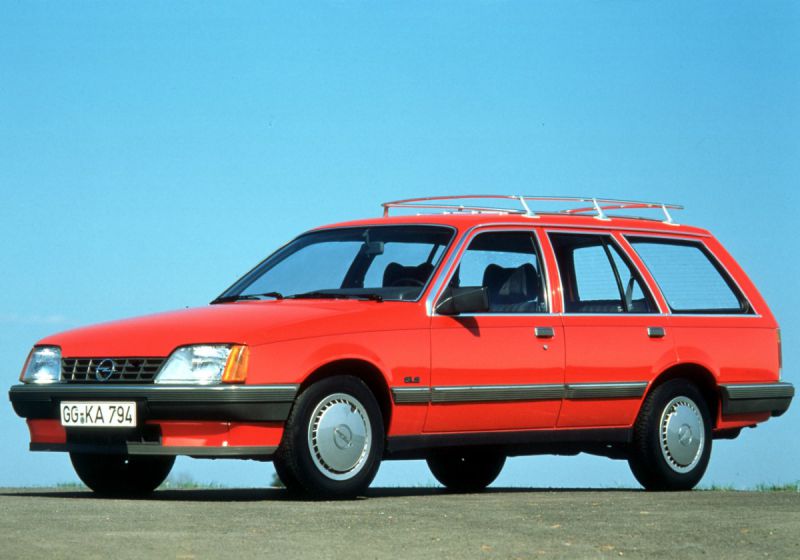
The Opel Rekord E Caravan (facelift 1982) 2.3 D: A European Workhorse
The Opel Rekord E Caravan (facelift 1982) 2.3 D represents a significant chapter in European automotive history, embodying the practical, durable, and economical ethos of a mid-size family car from the early 1980s. Produced by the German automaker Opel, a subsidiary of General Motors, the Rekord series was a ubiquitous sight on European roads for decades. The E generation, launched in 1977, received a notable facelift in 1982, which refined its aesthetics and updated its mechanical offerings. This particular variant, the 2.3 D, was a diesel-powered station wagon, known in Europe as an “estate,” designed to offer robust utility, impressive fuel economy, and ample space for families and businesses alike. While never officially sold in the United States, the Rekord E Caravan played a crucial role in Opel’s market strategy across the European continent, serving as a reliable and cost-effective alternative to more premium or performance-oriented vehicles.
Evolution and Market Positioning of the Opel Rekord E Caravan
The Opel Rekord series, spanning multiple generations, established itself as a cornerstone of Opel’s product lineup, consistently delivering a blend of practicality, comfort, and affordability. The E generation, in particular, was a direct competitor to other European mid-size vehicles such as the Ford Sierra and Volkswagen Passat. The 1982 facelift introduced subtle but effective changes, modernizing the vehicle’s appearance to align with evolving design trends while retaining its fundamental robust character. The Caravan, or station wagon, body style was especially popular, catering to the strong demand for versatile vehicles capable of hauling both passengers and cargo. The choice of a diesel engine for the 2.3 D variant was a strategic move, capitalizing on the growing preference for fuel-efficient powertrains in Europe, particularly in an era of fluctuating fuel prices.
Engine and Performance: The Opel Rekord E Caravan 2.3 D’s Powertrain
At the heart of the Opel Rekord E Caravan (facelift 1982) 2.3 D lies a naturally aspirated, inline-four diesel engine, designated with the model code 23D. This 2.3-liter (2260 cm³ or 137.91 cubic inches) powerplant was designed for durability and efficiency rather than outright speed. It produced a modest 71 horsepower at 4400 rpm, which was a respectable output for a diesel engine of its time and displacement. More significantly, it generated 135 Nm (99.57 lb.-ft.) of torque at a relatively low 2400 rpm, providing the necessary pulling power for a family station wagon, especially when laden with cargo or towing. The engine featured a SOHC (Single Overhead Camshaft) valvetrain and a precombustion chamber injection system, characteristic of diesel technology from that era, emphasizing reliable operation and reasonable fuel consumption.
Paired with a 5-speed manual transmission, the 2.3 D variant delivered its power to the rear wheels, a traditional drivetrain architecture for Opel models of this period. This setup contributed to a predictable driving experience and robust feel. While acceleration was not its forte, with a 0-60 mph time calculated at 20.4 seconds and a top speed of 95.07 mph, the Rekord E Caravan 2.3 D was perfectly adequate for the cruising speeds and traffic conditions prevalent in Europe. Its true strength lay in its fuel economy, achieving an impressive combined figure of 34.1 US mpg (6.9 l/100 km). This made it an economically sensible choice for long-distance travel and daily commuting, a crucial factor for many European consumers. The substantial 70-liter (18.49 US gallons) fuel tank further extended its range, minimizing stops at the pump.
Design and Features: Practicality Meets Mid-Eighties Style
The 1982 facelift of the Opel Rekord E Caravan brought a refreshed, yet still distinctly utilitarian, aesthetic. The station wagon body type, available with either 3 or 5 doors, was designed with practicality as the paramount concern. Its generous dimensions – 184.17 inches in length, 67.72 inches in width, and 58.07 inches in height – provided a spacious interior for up to five occupants and a substantial cargo area. The design language of the early 1980s was evident in its clean lines, large glass areas, and functional, uncluttered appearance, prioritizing visibility and ease of use. The long wheelbase of 105.04 inches contributed to a stable ride, a desirable trait for a family hauler.
Inside, the Rekord E Caravan focused on durability and straightforward ergonomics. While specific luxury features might have been limited in this base diesel model, the emphasis was on robust materials and logical control layouts. The large cargo capacity, enabled by the station wagon body, made it an ideal vehicle for family vacations, transporting goods, or as a fleet vehicle for businesses. Safety features, typical for the era, included a sturdy body structure and basic seatbelts. The vehicle’s ground clearance of 5.51 inches and a turning circle of 35.43 feet made it maneuverable enough for urban environments while still being capable on less-than-perfect rural roads. The braking system, featuring ventilated discs at the front and drums at the rear, provided reliable stopping power for a vehicle of its weight and performance.
Technical Specifications: Opel Rekord E Caravan (facelift 1982) 2.3 D (71 Hp)
| Category | Specification | US Equivalent / Notes |
|---|---|---|
| General Information | ||
| Brand | Opel | |
| Model | Rekord | |
| Generation | Rekord E Caravan (facelift 1982) | |
| Type (Engine) | 2.3 D (71 Hp) | |
| Start of production | 1982 year | |
| End of production | 1986 year | |
| Powertrain Architecture | Internal Combustion engine | |
| Body type | Station wagon (estate) | |
| Seats | 5 | |
| Doors | 3-5 | |
| Performance Specs | ||
| Fuel consumption (combined) | 6.9 l/100 km | 34.1 US mpg |
| Fuel Type | Diesel | |
| Acceleration 0 – 60 mph | 20.4 sec | |
| Maximum speed | 153 km/h | 95.07 mph |
| Weight-to-power ratio | 17.7 kg/Hp | 39.02 lbs/Hp |
| Weight-to-torque ratio | 9.3 kg/Nm | 20.5 lbs/Nm |
| Engine Specs | ||
| Power | 71 Hp @ 4400 rpm | |
| Power per liter | 31.4 Hp/l | |
| Torque | 135 Nm @ 2400 rpm | 99.57 lb.-ft. @ 2400 rpm |
| Engine Model/Code | 23D | |
| Engine displacement | 2260 cm³ | 2.3 Liters / 137.91 cu. in. |
| Number of cylinders | 4 | Inline configuration |
| Cylinder Bore | 92 mm | 3.62 in. |
| Piston Stroke | 85 mm | 3.35 in. |
| Compression ratio | 22:1 | |
| Number of valves per cylinder | 2 | |
| Fuel injection system | Precombustion chamber injection | |
| Engine aspiration | Naturally aspirated engine | |
| Valvetrain | SOHC | Single Overhead Camshaft |
| Engine oil capacity | 5.5 l | 5.81 US qt |
| Coolant | 11.5 l | 12.15 US qt |
| Space, Volume and Weights | ||
| Kerb Weight | 1260 kg | 2777.82 lbs. |
| Max. weight | 1900 kg | 4188.78 lbs. |
| Max load | 640 kg | 1410.96 lbs. |
| Fuel tank capacity | 70 l | 18.49 US gal |
| Permitted trailer load with brakes (12%) | 1000 kg | 2204.62 lbs. |
| Permitted trailer load without brakes | 535 kg | 1179.47 lbs. |
| Dimensions | ||
| Length | 4678 mm | 184.17 in. |
| Width | 1720 mm | 67.72 in. |
| Height | 1475 mm | 58.07 in. |
| Wheelbase | 2668 mm | 105.04 in. |
| Front track | 1435 mm | 56.5 in. |
| Rear (Back) track | 1432 mm | 56.38 in. |
| Ride height (ground clearance) | 140 mm | 5.51 in. |
| Minimum turning circle (turning diameter) | 10.8 m | 35.43 ft. |
| Drivetrain, Brakes and Suspension Specs | ||
| Drivetrain Architecture | The Internal combustion engine (ICE) drives the rear wheels of the vehicle. | Rear-wheel drive |
| Drive wheel | Rear wheel drive | |
| Number of gears and type of gearbox | 5 gears, manual transmission | |
| Front brakes | Ventilated discs | |
| Rear brakes | Drum | |
Legacy and Market Impact of the Opel Rekord E Caravan
The Opel Rekord E Caravan (facelift 1982) 2.3 D cemented its place in European automotive history as a quintessential family and fleet vehicle. Its legacy is one of unwavering reliability, practical design, and cost-effective operation. In a period when diesel engines were gaining significant traction in Europe due to their superior fuel economy and durability, the Rekord 2.3 D offered a compelling package. It was a no-nonsense vehicle that appealed to a broad demographic, from private families needing space and economy to businesses requiring a dependable workhorse.
Competitors in its primary European market included models like the Ford Sierra Estate, Volkswagen Passat Variant, and even some French and Italian offerings like the Renault 20/30 or Fiat 131 Panorama. However, the Rekord often stood out for its robust, almost over-engineered feel, a hallmark of German engineering from that era. Its rear-wheel-drive architecture, while becoming less common in mainstream family cars towards the end of its production run, provided a traditional driving feel that many drivers appreciated.
The Rekord E, and particularly its Caravan variant, was instrumental in maintaining Opel’s strong market share in the mid-size segment across Europe. It wasn’t a car that generated headlines for groundbreaking technology or blistering performance, but rather for its consistent, dependable service. Its significance lies in its role as a practical, accessible mode of transport that facilitated the daily lives and adventures of countless European households. Even decades later, the Rekord E is remembered fondly as a testament to functional design and enduring mechanicals, a true workhorse that embodied the spirit of its time.