
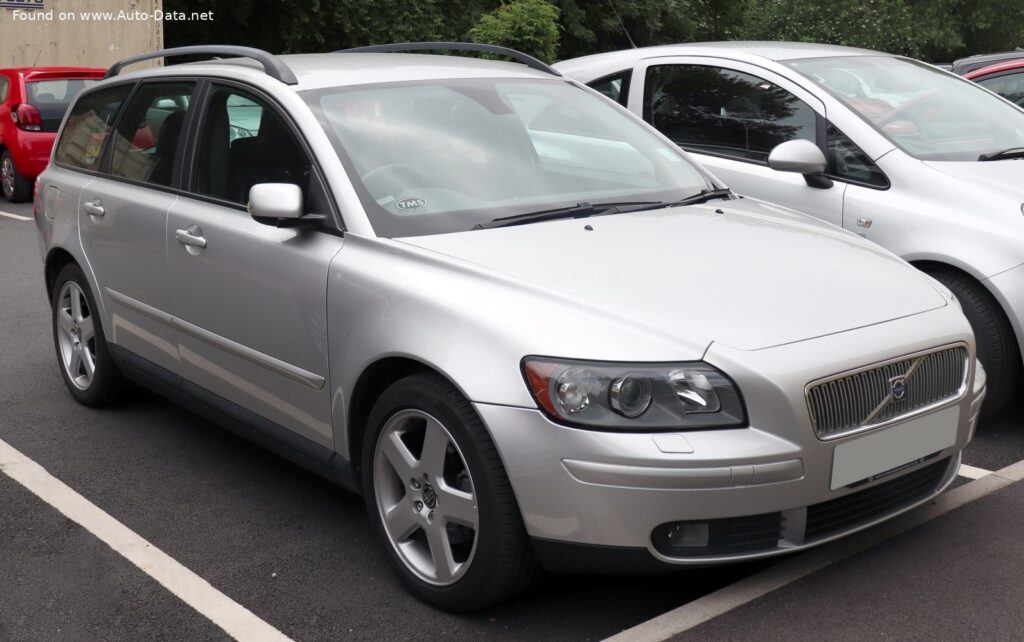
The Volvo V50 1.8 i 16V (125 Hp): A Premium Compact Wagon for the European Market
The Volvo V50, introduced in 2004, marked a significant step for the Swedish automaker in the compact executive segment. As the successor to the V40, the V50 was designed to offer a more modern, stylish, and dynamic alternative, particularly appealing to younger families and individuals seeking the practicality of a station wagon combined with premium features and Volvo’s renowned safety credentials. It was built on Volvo’s P1 platform, shared with the second-generation S40 sedan, as well as the Mazda3 and Ford Focus, showcasing a strategic collaboration within the Ford PAG (Premier Automotive Group) era.
The specific variant, the Volvo V50 1.8 i 16V (125 Hp), was produced from 2005 to 2007 and primarily targeted European markets. While the V50 itself was available in North America, this particular 1.8-liter gasoline engine was not offered there, instead serving as a popular entry-level petrol option for European consumers. It represented a sensible choice for those prioritizing fuel efficiency and lower running costs over outright performance, while still benefiting from Volvo’s distinctive design and robust build quality. This article delves into the technical specifications, design philosophy, and market impact of this specific iteration of the V50, highlighting its role within Volvo’s diverse European lineup.
Engine and Performance of the Volvo V50 1.8 i 16V (125 Hp)
At the heart of the Volvo V50 1.8 i 16V (125 Hp) lies a naturally aspirated 1.8-liter (1798 cm3 or 109.72 cu. in.) inline four-cylinder gasoline engine. This powerplant, designated B4184S11, was configured with a DOHC (Double Overhead Camshaft) valvetrain and four valves per cylinder, ensuring efficient breathing and combustion. Fuel delivery was handled by a multi-port manifold injection system, a common and reliable method for its time, contributing to a smooth power delivery characteristic.
The engine produced a respectable 125 horsepower at 6000 rpm, translating to a power-per-liter figure of 69.5 Hp/l. Torque output stood at 121.7 lb.-ft. (165 Nm) peaking at 4000 rpm. These figures positioned the 1.8i as a competent, though not overtly sporty, performer within its class. The engine was mounted transversely at the front, driving the front wheels through a precise and engaging 6-speed manual transmission. This gearbox choice allowed drivers to extract the most from the engine’s power band, offering good control and a more involved driving experience compared to automatic alternatives.
In terms of outright performance, the Volvo V50 1.8 i 16V was capable of accelerating from 0 to 60 mph in approximately 10.5 seconds, with a top speed of 124.27 mph (200 km/h). While not blisteringly fast, these numbers were perfectly adequate for daily commuting, family trips, and highway cruising in Europe. The vehicle’s weight-to-power ratio was 10.4 kg/Hp (95.8 Hp/tonne), indicating a balanced approach to performance and efficiency.
Fuel economy was a key selling point for this variant. The combined fuel consumption was rated at 32.2 US mpg (7.3 l/100 km), with extra-urban figures reaching an impressive 40.6 US mpg (5.8 l/100 km). Urban driving naturally saw higher consumption at 24 US mpg (9.8 l/100 km). These figures, coupled with CO2 emissions of 174 g/km, made it an economically sensible choice for the European market, where fuel prices and emissions regulations often play a significant role in purchasing decisions. The fuel tank capacity of 16.38 US gallons (62 liters) provided a decent range between fill-ups.
Design and Features
The V50’s design represented a more youthful and dynamic direction for Volvo, moving away from the boxier aesthetics of its predecessors without abandoning the brand’s core identity. The body type is a five-door station wagon (often referred to as an “estate” in Europe), offering seating for five occupants. Its sleek profile, characterized by Volvo’s signature shoulder line and distinctive vertical taillights, gave it a sophisticated yet practical appearance. Dimensionally, the V50 1.8 i 16V measured 177.72 inches in length, 69.69 inches in width, and 57.17 inches in height, with a wheelbase of 103.94 inches. These compact dimensions made it nimble in urban environments while still providing ample interior space.
Inside, the V50 showcased Volvo’s commitment to ergonomic design and high-quality materials. The interior was notable for its “floating” center console, a design element that became a hallmark of Volvo’s contemporary models. This slim console housed controls for audio and climate, creating a sense of spaciousness and modern minimalism. While specific trim features for the 1.8i variant would vary by market and optional packages, standard amenities typically included power windows, central locking, and a competent audio system.
Practicality was a strong suit of the V50 wagon. It offered a respectable minimum trunk space of 14.73 cu. ft. (417 liters), which could be expanded significantly to 46.16 cu. ft. (1307 liters) with the rear seats folded down. This flexibility made it ideal for hauling luggage, groceries, or sports equipment, catering to the diverse needs of its target audience.
Volvo’s unwavering dedication to safety was evident in the V50. While the data specifically mentions ABS (Anti-lock Braking System) as an assisting system, the V50 platform inherently incorporated a comprehensive suite of passive and active safety features. These would typically include multiple airbags (front, side, and curtain), stability control (ESC), traction control, and a robust body structure designed to absorb impact energy. The V50 utilized ventilated discs for the front brakes and solid discs for the rear, providing confident stopping power. The steering system was a responsive rack and pinion setup, complemented by front and rear transverse stabilizers for improved handling and ride comfort. The standard tire size was 195/65 R15 on 15-inch wheels, balancing comfort and grip.
Technical Specifications
| Category | Specification |
|---|---|
| Brand | Volvo |
| Model | V50 |
| Generation | V50 |
| Engine Type | 1.8 i 16V (125 Hp) |
| Production Start | 2005 |
| Production End | 2007 |
| Powertrain Architecture | Internal Combustion Engine |
| Body Type | Station wagon (estate) |
| Seats | 5 |
| Doors | 5 |
| Fuel Type | Petrol (Gasoline) |
| Fuel Consumption (Urban) | 24 US mpg (9.8 l/100 km) |
| Fuel Consumption (Extra Urban) | 40.6 US mpg (5.8 l/100 km) |
| Fuel Consumption (Combined) | 32.2 US mpg (7.3 l/100 km) |
| CO2 Emissions | 174 g/km |
| Acceleration 0-60 mph | 10.5 sec |
| Maximum Speed | 124.27 mph (200 km/h) |
| Power | 125 Hp @ 6000 rpm |
| Power per liter | 69.5 Hp/l |
| Torque | 121.7 lb.-ft. @ 4000 rpm (165 Nm) |
| Engine Layout | Front, Transverse |
| Engine Model/Code | B4184S11 |
| Engine Displacement | 1.8 l (1798 cm3 / 109.72 cu. in.) |
| Number of Cylinders | 4 |
| Engine Configuration | Inline |
| Cylinder Bore | 3.27 in (83 mm) |
| Piston Stroke | 3.27 in (83.1 mm) |
| Compression Ratio | 10.8:1 |
| Valves per Cylinder | 4 |
| Fuel Injection System | Multi-port manifold injection |
| Engine Aspiration | Naturally aspirated |
| Valvetrain | DOHC |
| Engine Oil Capacity | 4.54 US qt (4.3 l) |
| Coolant Capacity | 7.93 US qt (7.5 l) |
| Kerb Weight | 2877.03 lbs (1305 kg) |
| Maximum Weight | 4166.74 lbs (1890 kg) |
| Maximum Load | 1289.7 lbs (585 kg) |
| Trunk Space (Minimum) | 14.73 cu. ft. (417 l) |
| Trunk Space (Maximum) | 46.16 cu. ft. (1307 l) |
| Fuel Tank Capacity | 16.38 US gal (62 l) |
| Length | 177.72 in (4514 mm) |
| Width | 69.69 in (1770 mm) |
| Height | 57.17 in (1452 mm) |
| Wheelbase | 103.94 in (2640 mm) |
| Front Track | 60.43 in (1535 mm) |
| Rear Track | 60.28 in (1531 mm) |
| Drivetrain Architecture | Front-wheel drive (ICE drives front wheels) |
| Drive Wheel | Front-wheel drive |
| Gearbox | 6 gears, manual transmission |
| Front Suspension | Transverse stabilizer |
| Rear Suspension | Transverse stabilizer |
| Front Brakes | Ventilated discs |
| Rear Brakes | Ventilated discs |
| Assisting Systems | ABS (Anti-lock braking system) |
| Steering Type | Steering rack and pinion |
| Tires Size | 195/65 R15 |
| Wheel Rims Size | 15 inches |
Legacy and Market Impact
The Volvo V50, and particularly its European-market specific 1.8 i 16V variant, played a crucial role in Volvo’s strategy to expand its footprint in the competitive compact premium segment. Prior to the V50, Volvo’s smaller offerings, like the V40, were seen as competent but perhaps lacking the contemporary flair of German rivals. The V50, with its sharper styling, enhanced driving dynamics (thanks to the P1 platform), and modern interior, aimed squarely at a younger, more design-conscious demographic.
In Europe, the V50 1.8 i 16V competed against a formidable lineup of compact executive wagons, including the Audi A4 Avant, BMW 3 Series Touring, Mercedes-Benz C-Class Estate, and the Saab 9-3 SportCombi. While it might not have matched the outright sportiness of a BMW or the badge prestige of an Audi for some buyers, the V50 carved out its niche by offering a unique blend of Scandinavian design, exceptional safety, and practical versatility. The 1.8-liter engine provided an accessible entry point into the premium segment, appealing to buyers who appreciated Volvo’s brand values but sought a more economical powertrain option than the larger gasoline or diesel engines.
Its legacy is one of a well-rounded and dependable family vehicle that embodied Volvo’s evolving design language and commitment to safety and practicality. While not a performance powerhouse, the 1.8i variant underscored Volvo’s ability to offer efficient and reliable powertrains that met the everyday needs of European drivers. The V50, across its various engine options, helped solidify Volvo’s reputation as a strong contender in the compact premium market, paving the way for future successful models in this segment. It remains a popular choice on the used car market for those seeking a safe, practical, and stylish compact wagon with a touch of premium quality.
