The Peugeot 207 (facelift 2009) 1.6 VTi (120 Hp) Automatic: A European Subcompact Standard-Bearer
The Peugeot 207, particularly in its facelifted 2009 iteration, represented a significant chapter in the French automaker’s storied history of producing popular subcompact vehicles. Positioned in the highly competitive European B-segment, a class known for its diverse range of small yet practical cars, the 207 succeeded the incredibly successful Peugeot 206. While never officially sold in the United States, the 207 was a ubiquitous sight on European roads, embodying the continent’s preference for agile, fuel-efficient, and stylish urban commuters. This particular variant, the Peugeot 207 (facelift 2009) 1.6 VTi (120 Hp) Automatic, offered a compelling blend of accessible performance, modern design, and convenience for its primary market from its production start in 2009 until its conclusion in 2012.
As a global automotive expert, it’s crucial to understand the context of vehicles like the 207. Its design and engineering were meticulously tailored to European tastes and regulations, emphasizing compact dimensions, economical powertrains, and a comfortable ride quality often associated with French cars. The 2009 facelift brought subtle yet effective updates, ensuring the 207 remained fresh against a new wave of rivals and maintained Peugeot’s reputation for delivering charismatic small cars.
Engine and Performance of the Peugeot 207 (facelift 2009) 1.6 VTi (120 Hp) Automatic
Under the hood of the Peugeot 207 (facelift 2009) 1.6 VTi (120 Hp) Automatic lay a sophisticated 1.6-liter (1598 cm³ or 97.52 cu. in.) naturally aspirated inline-four gasoline engine, designated with the model code 5FS EP6C. This engine was a product of the collaborative efforts between PSA Peugeot Citroën and BMW, a partnership that yielded a family of engines known for their efficiency and refinement. The VTi (Variable Valve Lift and Timing Injection) technology allowed for optimized valve control, contributing to both power output and fuel economy.
The engine produced a respectable 120 horsepower (Hp) at 6000 rpm, delivering a power-per-liter ratio of 75.1 Hp/l, which was quite competitive for its segment at the time. Torque output stood at 118.01 lb.-ft. (160 Nm) peaking at 4250 rpm, providing adequate thrust for urban driving and highway cruising. Power was routed to the front wheels via a four-speed automatic transmission. While a four-speed automatic might seem rudimentary by today’s standards, which often feature 6, 8, or even 10-speed units, it was a common and reliable offering in the subcompact class during this period, prioritizing smooth shifts and ease of use over ultimate performance.
In terms of outright performance, the 207 1.6 VTi Automatic was capable of accelerating from 0 to 60 mph in a reasonable 10.9 seconds (0-100 km/h in 11.5 seconds) and achieving a maximum speed of 121.17 mph (195 km/h). These figures positioned it as a sprightly performer within its class, suitable for the varied driving conditions encountered in Europe. Fuel economy was also a strong point, with a combined rating of 34.6 US mpg (6.8 l/100 km). Urban consumption was rated at 24.5 US mpg (9.6 l/100 km), while extra-urban driving could yield an impressive 45.2 US mpg (5.2 l/100 km). The vehicle complied with the Euro 5 emission standard, emitting 159 g/km of CO2, reflecting its relatively modern powertrain and Peugeot’s commitment to environmental responsibility.
Design and Features
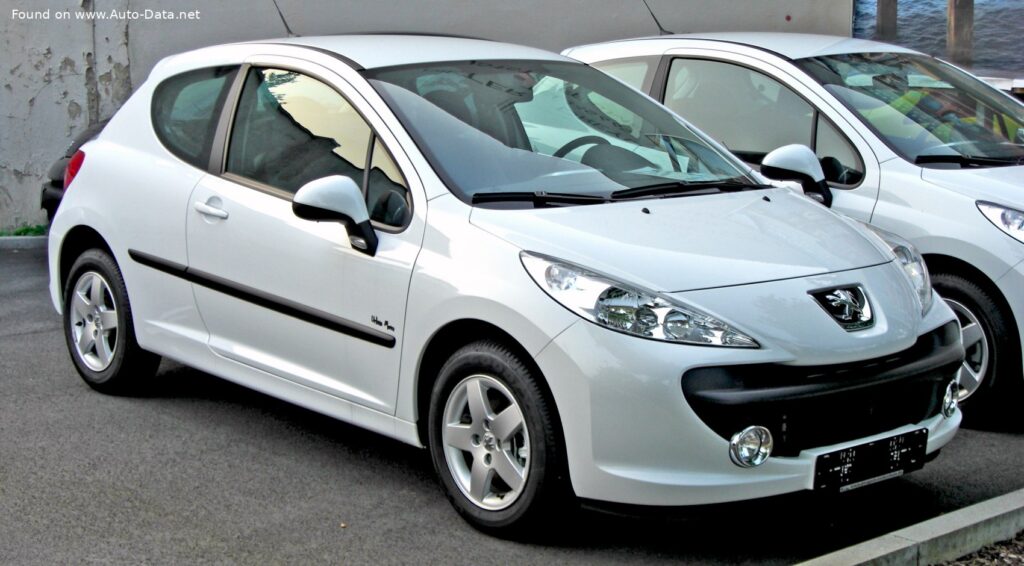
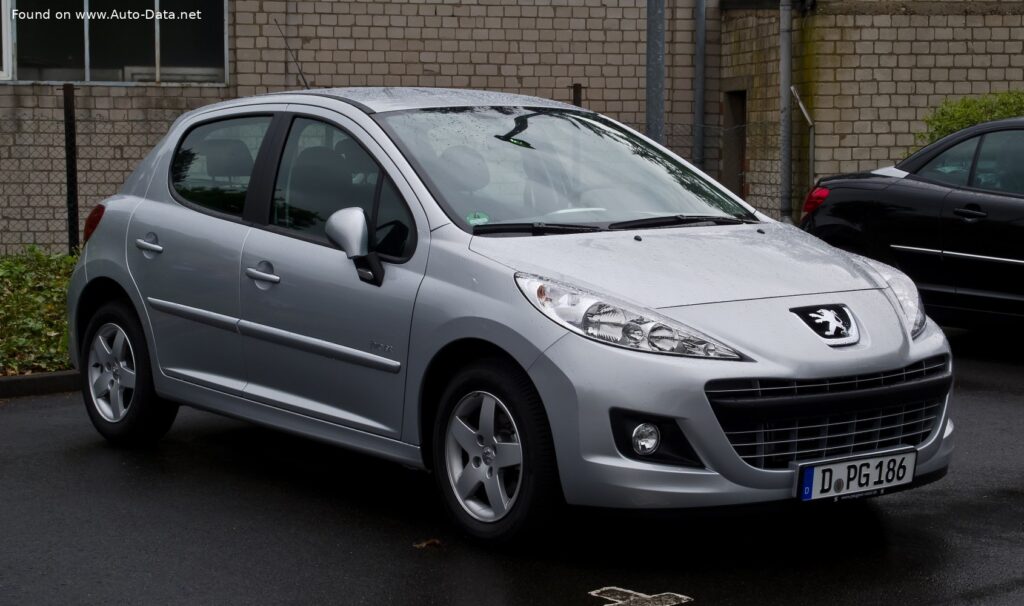
The Peugeot 207, particularly after its 2009 facelift, retained its distinctive French styling, characterized by its prominent “lion’s maw” grille and elongated, swept-back headlights. The facelift brought subtle refinements, including revised front and rear bumpers, updated taillight clusters, and new wheel designs, which collectively gave the car a more contemporary and refined appearance without drastically altering its established identity. It was available in both 3-door and 5-door hatchback configurations, offering versatility to cater to different buyer needs, whether prioritizing sporty aesthetics or enhanced practicality for passengers.
Inside, the 207 offered a comfortable and well-appointed cabin for its segment. The interior design was functional and ergonomic, with controls logically placed. Seating for five was standard, although the rear seats were best suited for two adults on longer journeys or three for shorter trips, typical of a subcompact car. Storage capacity was respectable, with a minimum trunk (boot) space of 9.53 cu. ft. (270 liters), expandable to a generous 32.6 cu. ft. (923 liters) with the rear seats folded down, making it practical for grocery runs or weekend getaways.
From a safety and chassis perspective, the 207 was equipped with a robust set of features. It utilized a front-wheel-drive architecture, a standard for the segment, ensuring predictable handling. The suspension system comprised an independent McPherson strut setup at the front with a coil spring and anti-roll bar, while the rear featured a semi-independent arrangement with coil springs and an elastic beam. This combination provided a good balance of ride comfort and handling agility, a hallmark of Peugeot’s engineering philosophy. Braking was handled by ventilated discs at the front and solid discs at the rear, complemented by an Anti-lock Braking System (ABS) for enhanced stopping power and control. The steering system was a responsive rack-and-pinion type. Standard tires were 195/55 R16, mounted on 16-inch wheel rims, contributing to both grip and ride quality. With a drag coefficient (Cd) of 0.30, the 207 was aerodynamically efficient for its class, aiding both fuel economy and reduced wind noise.
Technical Specifications
| Category | Specification |
|---|---|
| General Information | |
| Brand | Peugeot |
| Model | 207 |
| Generation | 207 (facelift 2009) |
| Type (Engine) | 1.6 VTi (120 Hp) Automatic |
| Start of Production | 2009 year |
| End of Production | 2012 year |
| Powertrain Architecture | Internal Combustion engine |
| Body type | Hatchback |
| Seats | 5 |
| Doors | 3-5 |
| Performance Specs | |
| Fuel Consumption (Economy) – Urban | 9.6 l/100 km (24.5 US mpg) |
| Fuel Consumption (Economy) – Extra Urban | 5.2 l/100 km (45.2 US mpg) |
| Fuel Consumption (Economy) – Combined | 6.8 l/100 km (34.6 US mpg) |
| CO2 Emissions | 159 g/km |
| Fuel Type | Petrol (Gasoline) |
| Acceleration 0 – 60 mph | 10.9 sec |
| Acceleration 0 – 100 km/h | 11.5 sec |
| Maximum Speed | 195 km/h (121.17 mph) |
| Emission Standard | Euro 5 |
| Weight-to-Power Ratio | 10 kg/Hp (100.4 Hp/tonne) |
| Weight-to-Torque Ratio | 7.5 kg/Nm (133.9 Nm/tonne) |
| Engine Specs | |
| Power | 120 Hp @ 6000 rpm |
| Power per Liter | 75.1 Hp/l |
| Torque | 160 Nm @ 4250 rpm (118.01 lb.-ft. @ 4250 rpm) |
| Engine Layout | Front, Transverse |
| Engine Model/Code | 5FS EP6C |
| Engine Displacement | 1598 cm³ (97.52 cu. in.) |
| Number of Cylinders | 4 |
| Engine Configuration | Inline |
| Cylinder Bore | 77 mm (3.03 in.) |
| Piston Stroke | 85.8 mm (3.38 in.) |
| Compression Ratio | 11:1 |
| Number of Valves per Cylinder | 4 |
| Fuel Injection System | Multi-port manifold injection |
| Engine Aspiration | Naturally aspirated engine |
| Valvetrain | DOHC-VVT |
| Engine Oil Capacity | 4.25 l (4.49 US qt) |
| Coolant Capacity | 5.7 l (6.02 US qt) |
| Space, Volume, and Weights | |
| Kerb Weight | 1195 kg (2634.52 lbs.) |
| Max. Weight | 1696 kg (3739.04 lbs.) |
| Max Load | 501 kg (1104.52 lbs.) |
| Trunk (Boot) Space – Minimum | 270 l (9.53 cu. ft.) |
| Trunk (Boot) Space – Maximum | 923 l (32.6 cu. ft.) |
| Fuel Tank Capacity | 50 l (13.21 US gal) |
| Permitted Trailer Load with Brakes (12%) | 1150 kg (2535.32 lbs.) |
| Permitted Trailer Load without Brakes | 600 kg (1322.77 lbs.) |
| Dimensions | |
| Length | 4045 mm (159.25 in.) |
| Width | 1748 mm (68.82 in.) |
| Width with Mirrors Folded | 1818 mm (71.57 in.) |
| Width Including Mirrors | 1972 mm (77.64 in.) |
| Height | 1472 mm (57.95 in.) |
| Wheelbase | 2540 mm (100 in.) |
| Front Track | 1475 mm (58.07 in.) |
| Rear (Back) Track | 1468 mm (57.8 in.) |
| Drag Coefficient (Cd) | 0.30 |
| Minimum Turning Circle (Turning Diameter) | 11.0 m (36.09 ft.) |
| Drivetrain, Brakes, and Suspension Specs | |
| Drivetrain Architecture | Front wheel drive (Internal combustion engine drives front wheels) |
| Drive Wheel | Front wheel drive |
| Number of Gears and Type of Gearbox | 4 gears, automatic transmission |
| Front Suspension | Independent, McPherson with coil spring and anti-roll bar |
| Rear Suspension | Semi-independent, coil spring, Elastic beam |
| Front Brakes | Ventilated discs |
| Rear Brakes | Disc |
| Assisting Systems | ABS (Anti-lock braking system) |
| Steering Type | Steering rack and pinion |
| Tires Size | 195/55 R16 |
| Wheel Rims Size | 16 inch |
Legacy and Market Impact of the Peugeot 207 (facelift 2009)
The Peugeot 207 entered a lineage of highly successful Peugeot subcompacts, following in the immense footsteps of the 205 and 206, both of which were sales juggernauts for the brand. The 207 itself was a strong performer in its segment, though it faced an increasingly crowded and competitive market. Its reputation in Europe was largely positive, praised for its comfortable ride, distinctive styling, and a driving experience that blended agility with a sense of solidity. While perhaps not as revolutionary as its predecessors, it maintained Peugeot’s image as a producer of stylish and engaging small cars.
In its primary European market, the 207 competed fiercely with a host of formidable rivals. Key competitors included the Ford Fiesta, known for its dynamic handling; the Renault Clio, a perennial French rival with its own blend of style and practicality; the Volkswagen Polo, often lauded for its robust build quality and refined driving dynamics; the Opel/Vauxhall Corsa, another strong contender offering a balance of features and value; and the Fiat Punto, a stylish Italian alternative. The 207 carved out its niche by offering a distinctively French character, emphasizing comfort, a slightly more upscale feel than some rivals, and a driving experience that prioritized ease of use in urban environments.
The historical significance of the 207 lies in its role as a transitional model. It successfully carried the torch from the hugely popular 206, updating the design language and technological offerings for a new era. It bridged the gap to its successor, the Peugeot 208, which would eventually arrive with a renewed focus on efficiency, connectivity, and a more radical design approach. The Peugeot 207 (facelift 2009) 1.6 VTi (120 Hp) Automatic specifically showcased the brand’s commitment to offering accessible automatic transmissions and efficient gasoline engines, catering to a broad demographic of European drivers seeking convenience without compromising on fuel economy or dynamic capability. Its robust sales performance during its production run solidified Peugeot’s position as a dominant force in the European small car segment, a legacy that continues to shape the brand’s identity today.