Toyota Corolla XII (E210) 1.6i (132 Hp) CVT
The Toyota Corolla XII (E210) 1.6i (132 Hp) CVT represents a significant evolution in one of the automotive world’s most iconic and best-selling nameplates. Introduced in 2019 and produced until 2022, this iteration of the Corolla sedan, part of the twelfth generation (E210), aimed to blend the model’s legendary reliability and practicality with a more engaging driving experience and modern styling. While the Corolla is a global vehicle, this specific powertrain configuration, featuring a 1.6-liter naturally aspirated engine paired with a Continuously Variable Transmission (CVT), was particularly popular in European and Asian markets, where it served as a highly efficient and well-equipped compact family sedan. It built upon decades of heritage, offering a compelling package for buyers prioritizing fuel economy, low emissions, and Toyota’s renowned build quality in a competitive segment.
Engine and Performance: The Heart of the Toyota Corolla XII (E210)
At the core of this particular Toyota Corolla XII (E210) variant is Toyota’s 1ZR-FAE engine, a 1.6-liter (1598 cm³ or 97.52 cu. in.) naturally aspirated inline-four gasoline unit. This powerplant is engineered for efficiency and smooth operation, delivering a respectable 132 horsepower at 6400 rpm. Torque output stands at 159 Nm (117.27 lb.-ft.) peaking at 4200 rpm, providing adequate pulling power for daily driving and highway cruising. The engine features Toyota’s Valvematic valvetrain technology, which offers continuous variable valve lift and timing, optimizing both power delivery and fuel efficiency across the rev range. With a compression ratio of 10.7:1 and four valves per cylinder, the engine is designed for clean combustion, meeting Euro 6 AG emission standards.
Power is delivered to the front wheels via a Continuously Variable Transmission (CVT). This automatic transmission is key to the vehicle’s smooth acceleration and impressive fuel economy. Unlike traditional geared automatics, the CVT allows the engine to operate at its most efficient RPM for any given speed, resulting in seamless power delivery without noticeable shift points. Performance figures include an acceleration time from 0 to 60 mph in 9.7 seconds, with 0 to 100 km/h achieved in 10.2 seconds. The top speed is rated at 190 km/h (118.06 mph). These figures position the 1.6i Corolla as a competent performer for its class, prioritizing refined daily usability over outright sportiness.
Fuel efficiency is a strong suit for this powertrain. The combined fuel consumption is an estimated 5.8 liters per 100 km, translating to an impressive 40.6 US miles per gallon. Urban driving yields approximately 7.6 l/100 km (30.9 US mpg), while extra-urban (highway) cruising can achieve a remarkable 4.8 l/100 km (49 US mpg). This efficiency, coupled with a 50-liter (13.21 US gallons) fuel tank, provides a substantial cruising range, making it an economical choice for commuters and long-distance travelers alike. CO2 emissions are kept in check at 133 g/km, reflecting Toyota’s commitment to environmental responsibility.
Design and Features of the Toyota Corolla XII (E210) Sedan
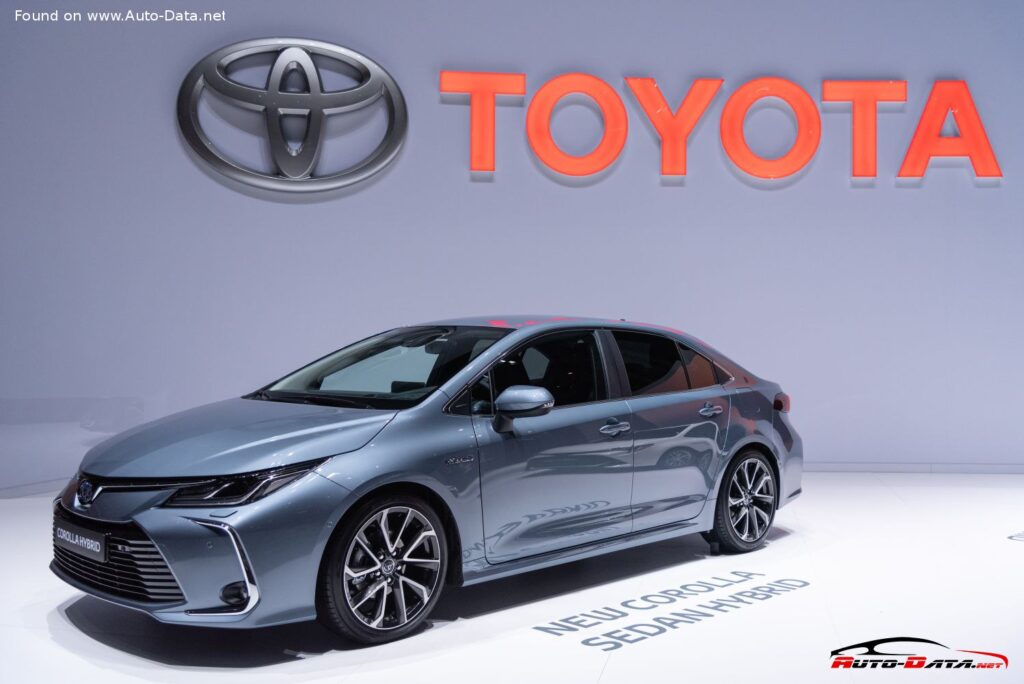
The twelfth-generation Toyota Corolla XII (E210) sedan marked a significant departure from its more conservative predecessors in terms of design. Built on the Toyota New Global Architecture (TNGA) platform (specifically the GA-C variant), it adopted a more dynamic and contemporary aesthetic. The sedan features a sleek, aerodynamic profile with a drag coefficient (Cd) of 0.282, contributing to both its visual appeal and fuel efficiency. Its dimensions are well-proportioned for the compact segment: 4630 mm (182.28 in.) in length, 1780 mm (70.08 in.) in width, and 1435 mm (56.5 in.) in height. The 2700 mm (106.3 in.) wheelbase provides a spacious cabin and contributes to stable handling.
As a four-door sedan with seating for five, the Corolla offers a practical and comfortable interior. The trunk capacity is a generous 471 liters (16.63 cu. ft.), ample for daily errands or family trips. Inside, the E210 generation introduced a more modern and driver-focused cockpit, with improved materials and infotainment options (though specific infotainment details are not provided in the technical data, it’s typical for this era). Standard features for a car of this vintage would generally include power windows, air conditioning, and a range of connectivity options, varying by market and trim level.
On the chassis front, the Corolla 1.6i CVT benefits from a sophisticated suspension setup designed to balance comfort and handling. It employs an independent McPherson strut system with coil springs and an anti-roll bar at the front, paired with a more advanced double wishbone rear suspension. This combination provides a compliant ride while maintaining composure through turns. The steering system is an electric power-assisted rack and pinion unit, offering light effort at low speeds for easy maneuvering and more feel at higher speeds. Braking is handled by ventilated discs at the front and solid discs at the rear, augmented by an Anti-lock Braking System (ABS) for enhanced safety. The vehicle typically came equipped with 17-inch or 18-inch wheel rims, further contributing to its contemporary stance.
Technical Specifications
| Category | Specification | US Equivalent |
|---|---|---|
| General Information | ||
| Brand | Toyota | |
| Model | Corolla | |
| Generation | Corolla XII (E210) | |
| Type (Engine) | 1.6i (132 Hp) CVT | |
| Start of Production | 2019 year | |
| End of Production | 2022 year | |
| Powertrain Architecture | Internal Combustion engine | |
| Body Type | Sedan | |
| Seats | 5 | |
| Doors | 4 | |
| Performance Specs | ||
| Fuel Consumption (Urban) | 7.6 l/100 km | 30.9 US mpg |
| Fuel Consumption (Extra Urban) | 4.8 l/100 km | 49 US mpg |
| Fuel Consumption (Combined) | 5.8 l/100 km | 40.6 US mpg |
| CO2 Emissions | 133 g/km | |
| Fuel Type | Petrol (Gasoline) | |
| Acceleration 0 – 60 mph | 9.7 sec | |
| Acceleration 0 – 100 km/h | 10.2 sec | |
| Maximum Speed | 190 km/h | 118.06 mph |
| Emission Standard | Euro 6 AG | |
| Weight-to-Power Ratio | 10.2 kg/Hp | 22.49 lbs/Hp |
| Weight-to-Torque Ratio | 8.4 kg/Nm | 18.52 lbs/Nm |
| Engine Specs | ||
| Power | 132 Hp @ 6400 rpm | |
| Power per liter | 82.6 Hp/l | |
| Torque | 159 Nm @ 4200 rpm | 117.27 lb.-ft. @ 4200 rpm |
| Engine Layout | Front, Transverse | |
| Engine Model/Code | 1ZR-FAE | |
| Engine Displacement | 1598 cm³ | 97.52 cu. in. |
| Number of Cylinders | 4 | |
| Engine Configuration | Inline | |
| Cylinder Bore | 80.5 mm | 3.17 in. |
| Piston Stroke | 78.5 mm | 3.09 in. |
| Compression Ratio | 10.7:1 | |
| Number of Valves per Cylinder | 4 | |
| Engine Aspiration | Naturally aspirated engine | |
| Valvetrain | Valvematic | |
| Engine Oil Capacity | 4.2 l | 4.44 US qt |
| Coolant Capacity | 5.8 l | 6.13 US qt |
| Engine Systems | Particulate filter | |
| Space, Volume and Weights | ||
| Kerb Weight | 1340-1385 kg | 2954.19 – 3053.4 lbs. |
| Trunk (Boot) Space – Minimum | 471 l | 16.63 cu. ft. |
| Fuel Tank Capacity | 50 l | 13.21 US gal |
| Permitted Trailer Load with Brakes (12%) | 1300 kg | 2866.01 lbs. |
| Permitted Trailer Load without Brakes | 450 kg | 992.08 lbs. |
| Dimensions | ||
| Length | 4630 mm | 182.28 in. |
| Width | 1780 mm | 70.08 in. |
| Height | 1435 mm | 56.5 in. |
| Wheelbase | 2700 mm | 106.3 in. |
| Front Track | 1531 mm | 60.28 in. |
| Rear (Back) Track | 1544 mm | 60.79 in. |
| Front Overhang | 935 mm | 36.81 in. |
| Rear Overhang | 995 mm | 39.17 in. |
| Ride Height (Ground Clearance) | 130 mm | 5.12 in. |
| Drag Coefficient (Cd) | 0.282 | |
| Minimum Turning Circle (Turning Diameter) | 10.8 m | 35.43 ft. |
| Drivetrain, Brakes and Suspension Specs | ||
| Drivetrain Architecture | Internal combustion engine (ICE) drives the front wheels. | |
| Drive Wheel | Front wheel drive | |
| Number of Gears and Type of Gearbox | 1 gear, automatic transmission CVT | |
| Front Suspension | Independent, McPherson with coil spring and anti-roll bar | |
| Rear Suspension | Double wishbone | |
| Front Brakes | Ventilated discs | |
| Rear Brakes | Disc | |
| Assisting Systems | ABS (Anti-lock braking system) | |
| Steering Type | Steering rack and pinion | |
| Power Steering | Electric Steering | |
| Wheel Rims Size | 17; 18 |
Legacy and Market Impact
The Toyota Corolla has long been synonymous with reliability, affordability, and practical transportation, and the twelfth-generation E210 model, including the 1.6i (132 Hp) CVT variant, continued this esteemed legacy. In its primary markets, particularly across Europe and Asia, this specific powertrain configuration was a cornerstone of its appeal. It offered an ideal balance for consumers seeking a no-fuss, economical daily driver with the peace of mind that comes from Toyota’s reputation for durability.
In the fiercely competitive compact sedan segment, the Corolla E210 faced formidable rivals such as the Honda Civic, Hyundai Elantra, Mazda3, and Volkswagen Jetta. While some competitors might have offered slightly more engaging driving dynamics or flashier interiors, the Corolla consistently won buyers over with its unwavering dependability, low running costs, and strong resale value. The E210 generation, however, made a conscious effort to inject more style and driving enjoyment into the package, thanks to the TNGA platform’s inherent benefits in rigidity and handling. The double wishbone rear suspension, in particular, was a significant upgrade that improved ride comfort and stability.
The 1.6i (132 Hp) CVT variant played a crucial role in expanding the Corolla’s reach, catering to markets where smaller, efficient gasoline engines are preferred or mandated by tax structures. Its Euro 6 AG emission compliance and excellent fuel economy underscored its relevance in an era of increasing environmental awareness. By offering a refined and efficient powertrain option in a stylish and well-built sedan, Toyota ensured that the Corolla remained a top contender, reinforcing its status as one of the world’s most successful and trusted automotive nameplates. The `Toyota Corolla XII (E210)` continues to be recognized for its blend of traditional Toyota virtues with a modern approach to design and technology, cementing its place in automotive history as a global workhorse that continually adapts to evolving consumer demands.