Mitsubishi Lancer Evolution IX 2.0 MIVEC FQ-320 (326 Hp) 4WD: A British Rally Icon
The Mitsubishi Lancer Evolution IX 2.0 MIVEC FQ-320 (326 Hp) 4WD stands as a formidable testament to Mitsubishi’s rally-bred engineering and performance prowess. Produced from 2005 to 2007, this particular variant of the ninth-generation Lancer Evolution was a specialized, high-performance model primarily developed for the United Kingdom market. The “FQ” designation, an unofficial but widely recognized acronym for “F***ing Quick,” denoted a series of factory-tuned models offered exclusively in the UK, pushing the boundaries of the already potent Evolution platform. Positioned squarely in the compact sports sedan segment, the Evo IX FQ-320 represented the pinnacle of accessible, all-wheel-drive performance, blending cutting-edge rally technology with a practical four-door sedan body.
As the penultimate iteration before the significant architectural shift to the Lancer Evolution X, the Evo IX FQ-320 retained the revered 4G63T engine, albeit with crucial enhancements. It embodied a philosophy of continuous refinement, taking an already successful formula and dialing up the intensity for discerning enthusiasts. While not sold in the United States in this specific FQ guise, the standard Lancer Evolution IX was a highly sought-after model, making the FQ-320 a legendary, almost mythical, variant for global enthusiasts. Its role in the UK market was to offer an even more aggressive, track-ready package directly from the dealership, solidifying Mitsubishi’s reputation as a leader in rally-inspired street machines.
The Heart of the Beast: Engine and Performance of the Mitsubishi Lancer Evolution IX
At the core of the Mitsubishi Lancer Evolution IX FQ-320’s electrifying performance lies the legendary 4G63T engine. This 2.0-liter (1997 cm³, or 121.86 cubic inches) inline-four power plant, positioned transversely at the front, is renowned for its robust construction and immense tuning potential. For the Evolution IX, Mitsubishi introduced its MIVEC (Mitsubishi Innovative Valve timing Electronic Control) system to the intake camshaft. This variable valve timing technology, a significant upgrade from previous generations, allowed for a broader power band and improved throttle response, enhancing both low-end torque and high-rpm power delivery.
Coupled with a potent turbocharger and a large intercooler, the 4G63T in the FQ-320 trim was factory-tuned to produce an impressive 326 horsepower at 6700 rpm. This translated to a remarkable power-per-liter output of 163.2 horsepower per liter, a figure that was exceptionally high for its era. Torque was equally compelling, peaking at 306.09 lb.-ft. (415 Nm) at 4300 rpm, ensuring brutal acceleration across a wide range of engine speeds. The engine’s cylinder bore measured 3.35 inches (85 mm) and piston stroke 3.46 inches (88 mm), with a compression ratio of 8.8:1, optimized for forced induction.
Power was channeled through a precise 6-speed manual transmission to Mitsubishi’s sophisticated All-Wheel Drive (AWD) system, which included advanced differentials like the Active Yaw Control (AYC) and Super Active Center Differential (ACD). This drivetrain architecture allowed the FQ-320 to launch with breathtaking efficiency, achieving 0 to 60 mph in an astonishing 4.3 seconds. The sprint from 0 to 62 mph (100 km/h) was completed in just 4.5 seconds. Its top speed was electronically limited to 157.21 mph (253 km/h), a testament to its raw power and aerodynamic efficiency. The car’s weight-to-power ratio of 4.3 kg/Hp (232.9 Hp/tonne) underscored its lightweight, high-performance nature, making it a formidable competitor on both street and track.
Design and Features: Form Follows Function
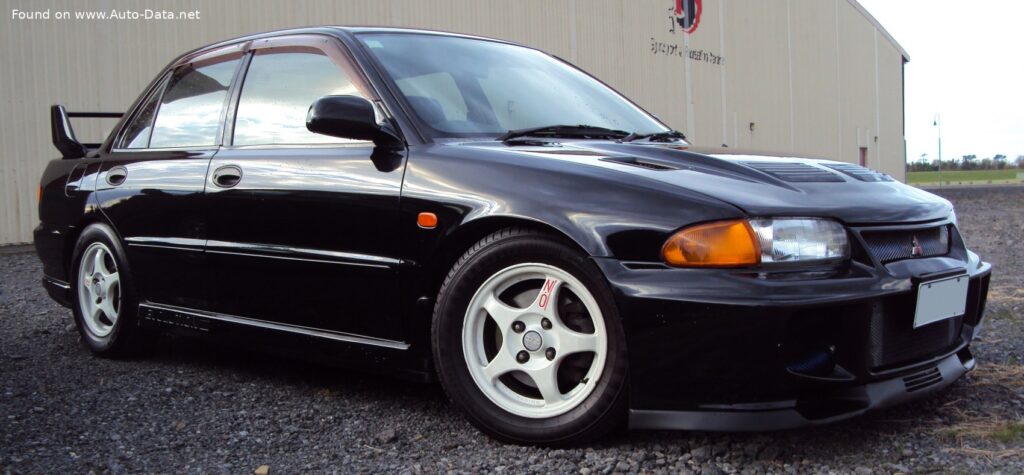
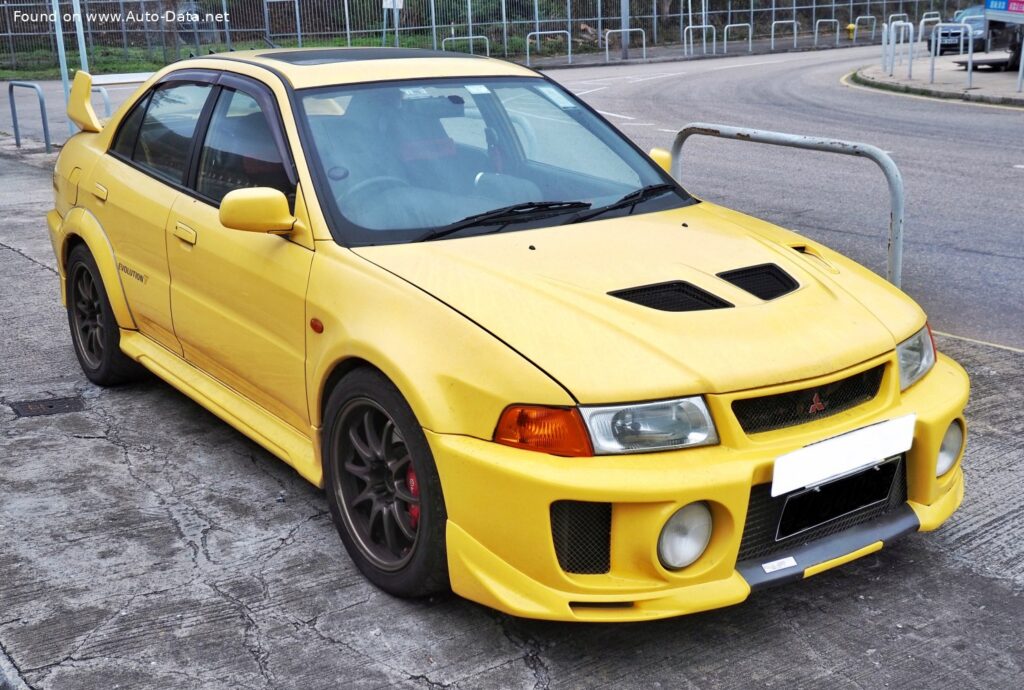
The design of the Mitsubishi Lancer Evolution IX FQ-320 is a masterclass in functional aesthetics, directly reflecting its rally heritage. The four-door sedan body, measuring 176.77 inches in length, 69.69 inches in width, and 57.09 inches in height, was aggressively styled to optimize aerodynamics and cooling. Key visual identifiers included the prominent rear wing, a redesigned front bumper with a larger air intake for improved engine cooling, and a distinctive aluminum hood with vents for heat extraction.
The car rode on 8J x 17-inch wheel rims wrapped in performance-oriented 235/45 R17 tires, providing substantial grip. The suspension system was meticulously engineered for high-performance driving. It featured an independent McPherson type setup with a transverse stabilizer at the front and an independent multi-link suspension with a transverse stabilizer at the rear, ensuring exceptional handling and minimal body roll. Stopping power was equally impressive, with large ventilated disc brakes—320 mm at the front and 300 mm at the rear—complemented by an Anti-lock Braking System (ABS) for enhanced control under hard braking. Steering was handled by a hydraulic rack and pinion system, offering direct feedback crucial for spirited driving.
Inside, the FQ-320 maintained a driver-focused cockpit. While specific interior features of the FQ-320 were tailored for the UK market, the standard Evolution IX boasted bolstered Recaro bucket seats, a Momo steering wheel, and a minimalist dashboard layout, all designed to keep the driver engaged and comfortable during high-performance maneuvers. Practicality was also considered, with five seats and a trunk capacity of 15.19 cubic feet (430 liters), making it a surprisingly versatile daily driver for enthusiasts.
Technical Specifications
| Specification | Value |
|---|---|
| Brand | Mitsubishi |
| Model | Lancer Evolution IX |
| Type (Engine) | 2.0 MIVEC FQ-320 (326 Hp) 4WD |
| Production Years | 2005 – 2007 |
| Body Type | Sedan |
| Seats | 5 |
| Doors | 4 |
| Fuel Type | Petrol (Gasoline) |
| Acceleration 0 – 60 mph | 4.3 sec |
| Maximum Speed | 157.21 mph (Electronically limited) |
| Power | 326 Hp @ 6700 rpm |
| Torque | 306.09 lb.-ft. @ 4300 rpm |
| Engine Layout | Front, Transverse |
| Engine Model/Code | 4G63T |
| Engine Displacement | 1997 cm³ (121.86 cu. in.) |
| Number of Cylinders | 4, Inline |
| Cylinder Bore | 3.35 in. (85 mm) |
| Piston Stroke | 3.46 in. (88 mm) |
| Compression Ratio | 8.8:1 |
| Valves per Cylinder | 4 |
| Fuel Injection System | Multi-port manifold injection |
| Engine Aspiration | Turbocharger, Intercooler |
| Valvetrain | DOHC (Double Overhead Camshaft) |
| Engine Oil Capacity | 5.6 US qt (5.3 l) |
| Coolant Capacity | 6.34 US qt (6 l) |
| Kerb Weight | 3086.47 lbs. (1400 kg) |
| Trunk (Boot) Space | 15.19 cu. ft. (430 l) |
| Fuel Tank Capacity | 14.53 US gal (55 l) |
| Length | 176.77 in. (4490 mm) |
| Width | 69.69 in. (1770 mm) |
| Height | 57.09 in. (1450 mm) |
| Wheelbase | 103.35 in. (2625 mm) |
| Front Track | 59.65 in. (1515 mm) |
| Rear Track | 59.65 in. (1515 mm) |
| Ground Clearance | 5.51 in. (140 mm) |
| Minimum Turning Circle | 38.71 ft. (11.8 m) |
| Drive Wheel | All-wheel drive (4×4) |
| Gearbox Type | 6 gears, Manual transmission |
| Front Suspension | Independent McPherson, Transverse stabilizer |
| Rear Suspension | Independent multi-link suspension, Transverse stabilizer |
| Front Brakes | Ventilated discs, 12.6 in. (320 mm) |
| Rear Brakes | Ventilated discs, 11.8 in. (300 mm) |
| Assisting Systems | ABS (Anti-lock braking system) |
| Steering Type | Steering rack and pinion |
| Power Steering | Hydraulic Steering |
| Tires Size | 235/45 R17 |
| Wheel Rims Size | 8J x 17 |
Legacy and Market Impact
The Mitsubishi Lancer Evolution IX, particularly its FQ variants like the FQ-320, holds a revered place in automotive history and the hearts of performance car enthusiasts. It represents the pinnacle of the classic Evo formula before the platform’s significant overhaul, making it a highly desirable modern classic. The FQ-320, with its increased power and bespoke tuning for the UK market, further cemented the Evo’s reputation as a no-compromise performance machine.
In its primary market, the UK, the FQ series became legendary. Mitsubishi Motors UK, recognizing the appetite for even more extreme performance, worked with Ralliart to offer these factory-tuned models that often outperformed their Japanese counterparts in raw power. The FQ-320 was a direct competitor to other high-performance sedans, most notably its arch-rival, the Subaru Impreza WRX STI. The rivalry between the Evo and STI was one of the most celebrated in automotive culture, driving both manufacturers to continuously innovate and push the boundaries of street-legal rally cars. The FQ-320, with its razor-sharp handling, potent engine, and sophisticated all-wheel-drive system, often had the edge in terms of outright performance and driver engagement.
Beyond its direct competition, the Evo IX FQ-320’s impact extended to the broader enthusiast community. It became a benchmark for track day performance, a darling of the tuning scene, and a symbol of raw, unadulterated driving pleasure. Its robust 4G63T engine, which had a long and successful career in rallying, proved incredibly resilient to modifications, allowing owners to extract even more power. The car’s direct lineage from the World Rally Championship (WRC) gave it unparalleled credibility, making it more than just a fast sedan; it was a piece of motorsport history adapted for the road.
Today, the Mitsubishi Lancer Evolution IX FQ-320 is highly sought after by collectors and enthusiasts worldwide. Its blend of traditional rally car mechanics, advanced electronic aids, and the final iteration of the iconic 4G63T engine make it a significant milestone in Mitsubishi’s performance heritage. Its enduring appeal lies in its ability to deliver an exhilarating, analog driving experience that few modern cars can replicate, securing its legacy as one of the greatest performance sedans of its era.