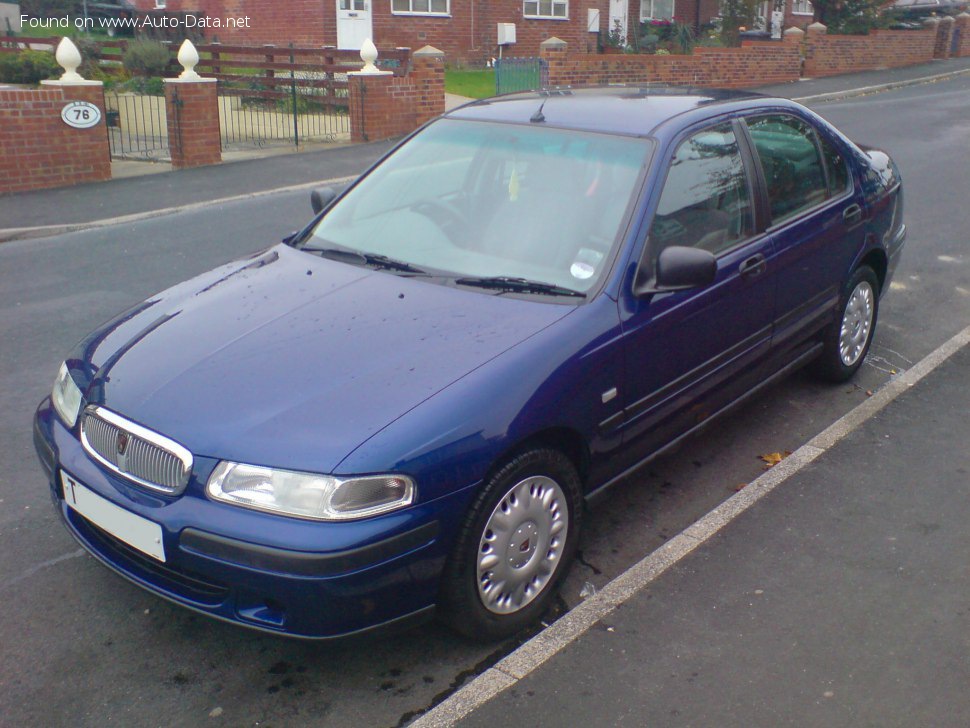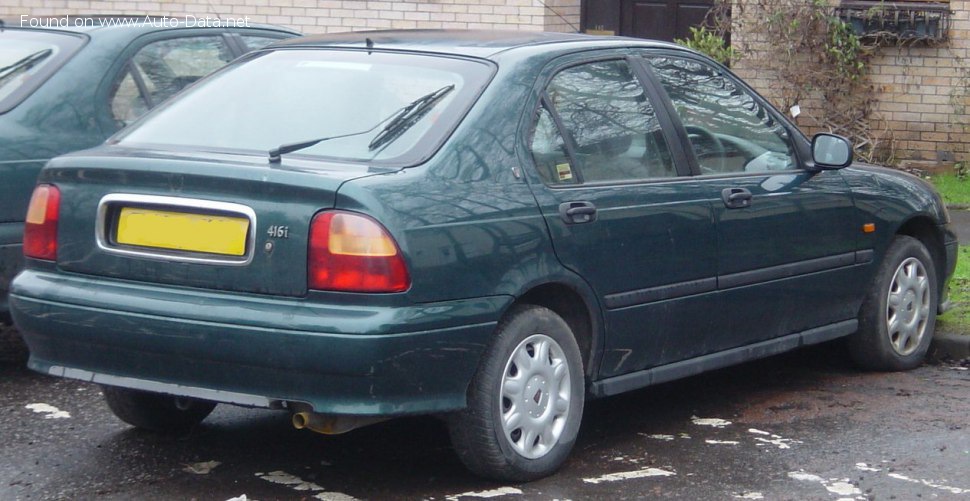
Introduction to the Rover 400 Hatchback (RT) 416 Si (111 Hp)
The Rover 400 Hatchback (RT) 416 Si, produced between 1995 and 2000, represented a significant chapter in the history of the British automotive manufacturer, Rover. Positioned firmly in the competitive compact family car segment, the RT generation of the Rover 400 was a crucial model for the brand, particularly in its primary European market. This vehicle was a testament to Rover’s efforts to blend traditional British styling and perceived comfort with modern engineering and reliability, often achieved through strategic partnerships. The 416 Si variant, specifically, offered a compelling balance of performance and fuel efficiency for the everyday consumer, becoming a popular choice for those seeking a practical yet refined five-door hatchback.
The Rover 400 (RT) succeeded the R8 generation and aimed to elevate Rover’s standing in a segment dominated by established European and Japanese rivals. While the Rover brand itself was not widely sold in the United States, its engineering and market strategy offer valuable insights into the global automotive landscape of the late 20th century. The RT generation was largely based on a platform shared with the Honda Civic and Domani, a collaboration that brought Japanese reliability and build quality to a car with distinct British character and interior design. This particular 416 Si model, with its 111 horsepower engine, was designed to appeal to buyers looking for a sprightly performer that could handle both urban commutes and longer highway journeys with ease.
Engineering and Performance: The Rover 400 Hatchback (RT) 416 Si Powertrain
At the heart of the Rover 400 Hatchback (RT) 416 Si lay Rover’s renowned K-series engine, specifically the 1.6-liter (1589 cm³) K16 unit. This inline four-cylinder, naturally aspirated petrol (gasoline) engine was celebrated for its relatively lightweight construction and advanced design for its time. Featuring a Double Overhead Camshaft (DOHC) valvetrain with four valves per cylinder, it was engineered for efficient breathing and responsive power delivery. The multi-port manifold injection system ensured precise fuel delivery, contributing to both performance and fuel economy.
The 416 Si produced a respectable 111 horsepower at 6000 rpm, translating to a power-per-liter output of approximately 69.9 HP/l. Torque figures stood at 145 Nm, or approximately 107 lb-ft, delivered at a relatively low 3000 rpm, which provided good pulling power in everyday driving scenarios. This combination of power and torque, coupled with a kerb weight of 2590.43 lbs (1175 kg), resulted in a weight-to-power ratio of 10.6 kg/Hp, or 94.5 Hp per tonne, and a weight-to-torque ratio of 8.1 kg/Nm.
Performance metrics for the 416 Si were competitive for its class in the mid-1990s. The car could accelerate from 0 to 60 mph in a calculated 10.3 seconds (0-100 km/h in 10.8 seconds), and reach a maximum speed of 118.06 mph (190 km/h). Power was sent to the front wheels via a smooth-shifting 5-speed manual transmission, offering engaging control for the driver.
Fuel efficiency was a strong suit for the 416 Si, reflecting its design as a practical family car. The combined fuel consumption was rated at 6.5 l/100 km, which translates to an impressive 36.2 US mpg. In urban driving, it achieved 25 US mpg (9.4 l/100 km), while extra-urban figures soared to 46.1 US mpg (5.1 l/100 km), demonstrating its capability for economical long-distance travel. The 14.53 US gallon (55-liter) fuel tank provided a substantial range between fill-ups.
Design and Features of the Rover 400 Hatchback (RT)
The Rover 400 Hatchback (RT) adopted a contemporary five-door hatchback body type, a highly popular configuration in the European market for its blend of practicality and compact dimensions. Measuring 170.08 inches (4320 mm) in length, 66.93 inches (1700 mm) in width, and 54.72 inches (1390 mm) in height, the 400 was designed to navigate urban environments with ease while offering a comfortable cabin for five occupants. Its 103.15-inch (2620 mm) wheelbase contributed to a stable ride and generous interior space for its class.
Aesthetically, the RT generation of the Rover 400 presented a more rounded and modern design compared to its predecessor, yet retained a distinctively British character. Its styling was less overtly angular than some of its contemporary rivals, aiming for a more understated and elegant appearance. Inside, Rover continued its tradition of offering interiors with a more upscale feel than many competitors, often incorporating wood trim and higher-quality fabrics depending on the trim level. The 416 Si, being a mid-range model, offered a good balance of comfort and convenience features.
Practicality was a key consideration, evidenced by the versatile hatchback design. The trunk (boot) space ranged from 13.07 cubic feet (370 liters) with all seats in place, expanding to a generous 25.43 cubic feet (720 liters) with the rear seats folded down, making it capable of accommodating substantial luggage or cargo.
In terms of chassis and safety, the Rover 400 (RT) featured a front-wheel-drive architecture with a well-tuned suspension system comprising spring struts at both the front and rear. This setup, combined with a hydraulic power-assisted steering rack and pinion system, provided a comfortable ride and predictable handling characteristic of its Honda underpinnings. Braking duties were handled by disc brakes at the front and drum brakes at the rear, a common configuration for cars in this segment at the time. Crucially, the 416 Si was equipped with ABS (Anti-lock Braking System), a significant safety feature that was becoming increasingly standard in the mid-90s, enhancing driver control during emergency braking. The car rode on 185/60 R14 H tires, providing a good balance of grip and ride comfort.
Technical Specifications: Rover 400 Hatchback (RT) 416 Si (111 Hp)
General Information |
|
| Brand | Rover |
| Model | 400 |
| Generation | 400 Hatchback (RT) |
| Type (Engine) | 416 Si (111 Hp) |
| Start of Production | 1995 |
| End of Production | 2000 |
| Powertrain Architecture | Internal Combustion Engine |
| Body Type | Hatchback |
| Seats | 5 |
| Doors | 5 |
Performance Specifications |
|
| Fuel Consumption (Economy) – Urban | 9.4 l/100 km (25 US mpg) |
| Fuel Consumption (Economy) – Extra Urban | 5.1 l/100 km (46.1 US mpg) |
| Fuel Consumption (Economy) – Combined | 6.5 l/100 km (36.2 US mpg) |
| Fuel Type | Petrol (Gasoline) |
| Acceleration 0 – 60 mph | 10.3 sec |
| Acceleration 0 – 62 mph (0-100 km/h) | 10.8 sec |
| Maximum Speed | 118.06 mph (190 km/h) |
| Weight-to-Power Ratio | 10.6 kg/Hp (94.5 Hp/tonne) |
| Weight-to-Torque Ratio | 8.1 kg/Nm (123.4 Nm/tonne) |
Engine Specifications |
|
| Power | 111 Hp @ 6000 rpm |
| Power per Liter | 69.9 Hp/l |
| Torque | 106.95 lb.-ft. (145 Nm) @ 3000 rpm |
| Engine Layout | Front, Transverse |
| Engine Model/Code | K16 |
| Engine Displacement | 1589 cm³ (96.97 cu. in.) |
| Number of Cylinders | 4 |
| Engine Configuration | Inline |
| Cylinder Bore | 3.15 in. (80 mm) |
| Piston Stroke | 3.11 in. (79 mm) |
| Compression Ratio | 10.5:1 |
| Number of Valves per Cylinder | 4 |
| Fuel Injection System | Multi-port manifold injection |
| Engine Aspiration | Naturally aspirated engine |
| Valvetrain | DOHC |
| Engine Oil Capacity | 3.7 US qt (3.5 l) |
| Coolant Capacity | 5.81 US qt (5.5 l) |
Space, Volume and Weights |
|
| Kerb Weight | 2590.43 lbs (1175 kg) |
| Max. Weight (GVWR) | 3615.58 lbs (1640 kg) |
| Max Load | 1025.15 lbs (465 kg) |
| Trunk (Boot) Space – Minimum | 13.07 cu. ft. (370 l) |
| Trunk (Boot) Space – Maximum | 25.43 cu. ft. (720 l) |
| Fuel Tank Capacity | 14.53 US gal (55 l) |
Dimensions |
|
| Length | 170.08 in. (4320 mm) |
| Width | 66.93 in. (1700 mm) |
| Height | 54.72 in. (1390 mm) |
| Wheelbase | 103.15 in. (2620 mm) |
| Front Track | 58.27 in. (1480 mm) |
| Rear (Back) Track | 57.87 in. (1470 mm) |
Drivetrain, Brakes and Suspension Specifications |
|
| Drivetrain Architecture | Front-wheel drive with Internal Combustion Engine (ICE) |
| Drive Wheel | Front-wheel drive |
| Number of Gears and Type of Gearbox | 5 gears, manual transmission |
| Front Suspension | Spring Strut |
| Rear Suspension | Spring Strut |
| Front Brakes | Disc |
| Rear Brakes | Drum |
| Assisting Systems | ABS (Anti-lock Braking System) |
| Steering Type | Steering rack and pinion |
| Power Steering | Hydraulic Steering |
| Tires Size | 185/60 R14 H |
Legacy and Market Impact of the Rover 400 Hatchback (RT)
The Rover 400 Hatchback (RT) played a pivotal role in Rover’s lineup during the latter half of the 1990s, particularly within the fiercely competitive European C-segment. Its introduction in 1995 marked a conscious effort by Rover to move the 400 series slightly upmarket from its predecessor, offering a more refined and comfortable alternative to the segment’s volume sellers. The 416 Si, with its capable K-series engine, was a strong contender against rivals such as the Ford Escort (later Focus), Vauxhall/Opel Astra, Volkswagen Golf, and Renault Megane.
Its primary market appeal stemmed from a combination of factors. The RT generation benefited significantly from its shared platform and components with the Honda Civic, which instilled a reputation for improved reliability and build quality compared to some earlier Rover models. This Honda connection also contributed to the car’s generally good road manners, precise steering, and comfortable ride, making it a pleasant vehicle for both daily commuting and longer journeys. Rover’s distinct interior design, which often incorporated traditional British elements like wood trim and plush seating, gave the 400 a more luxurious feel than many of its more utilitarian competitors.
Despite its merits, the Rover 400 (RT) faced an uphill battle. Rover as a brand was undergoing significant ownership changes and financial challenges during this period, which impacted its long-term viability and market perception. While the car offered a compelling package, especially in the 416 Si trim, it struggled to truly differentiate itself enough to capture a larger market share from the established segment leaders. Its design, while pleasant, was perhaps less groundbreaking than some rivals, and the brand’s image was in flux.
The Rover 400 (RT) eventually evolved into the Rover 45 in 1999, which was essentially a facelifted version of the RT, carrying over many of its core mechanical components. The legacy of the 400 (RT) is therefore intertwined with Rover’s final years as an independent British car manufacturer. It stands as an example of a car that, despite its solid engineering and thoughtful design, was ultimately overshadowed by broader corporate issues. For enthusiasts and those familiar with European automotive history, the Rover 400 Hatchback (RT) 416 Si remains a noteworthy vehicle that offered a unique blend of British character and Japanese engineering prowess in a practical and capable package, representing a significant, albeit challenging, era for the Rover marque.