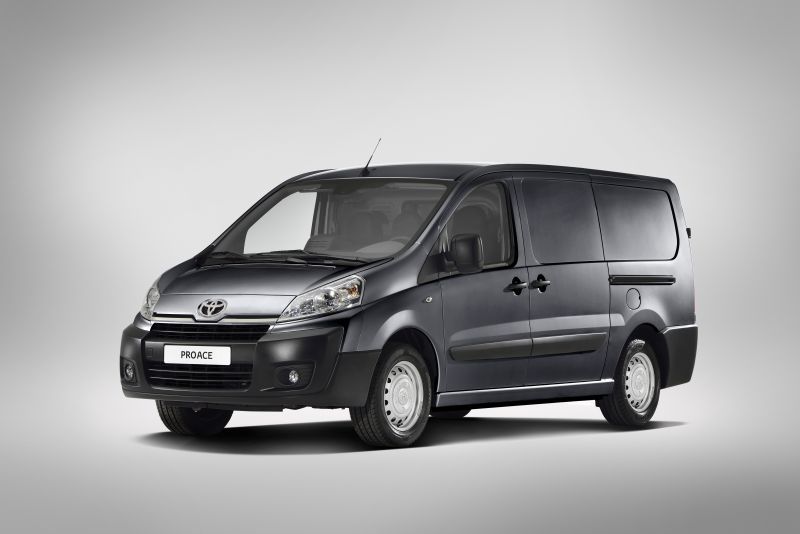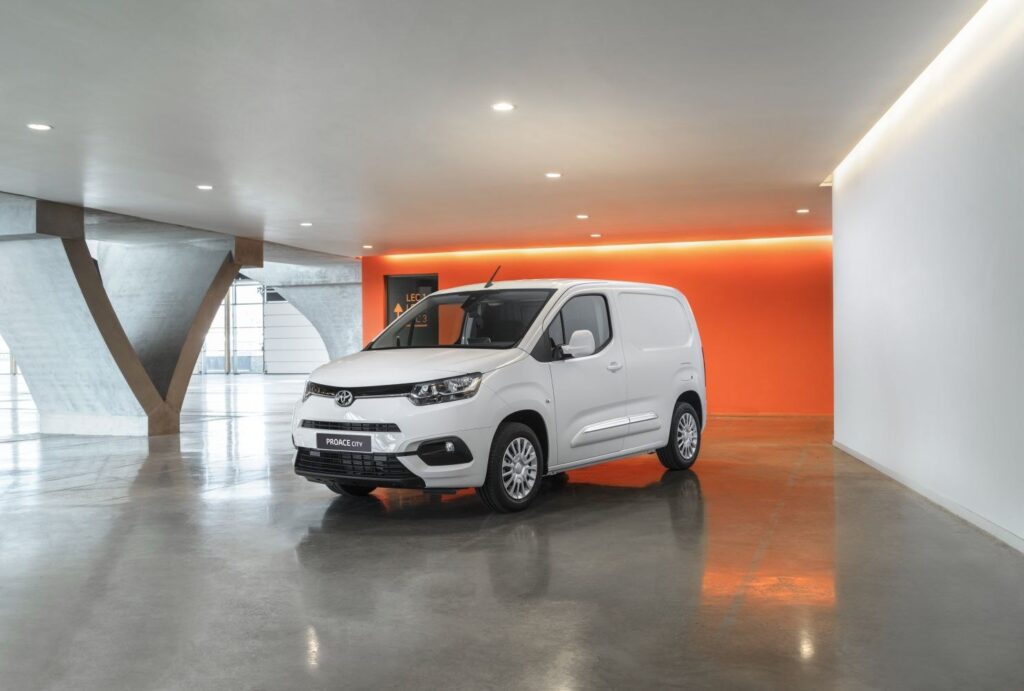
Toyota Proace City SWB 1.5 D-4D (75 Hp)
The Toyota Proace City SWB 1.5 D-4D (75 Hp) represents Toyota’s strategic entry into the compact light commercial vehicle (LCV) segment in markets primarily outside North America, such as Europe and parts of Asia. Launched in April 2020 and produced until October 2021 for this specific configuration, the Proace City is a badge-engineered variant derived from a collaboration with the then PSA Group (now Stellantis). This partnership allowed Toyota to quickly offer a competitive product in a segment dominated by European manufacturers, leveraging proven platforms and powertrains. The Short Wheelbase (SWB) version, classified as a minivan in some contexts but primarily marketed as a compact panel van or utility vehicle, is designed for urban environments and small businesses requiring a versatile, efficient, and reliable workhorse. It distinguishes itself through its practicality, compact dimensions, and a focus on operational efficiency, embodying Toyota’s commitment to diverse mobility solutions, even through strategic alliances.
The Toyota Proace City: A European Market Contender
Engine and Performance
Under the hood, the Toyota Proace City SWB 1.5 D-4D (75 Hp) is powered by a 1.5-liter (1499 cm³ or 91.47 cu. in.) inline four-cylinder diesel engine, designated with the engine code YH01. This powertrain architecture features a front, transverse layout, driving the front wheels through a 5-speed manual transmission. While its output of 75 horsepower at 3500 rpm might appear modest by American passenger car standards, it is engineered to deliver robust torque and exceptional fuel economy, critical attributes for a commercial vehicle operating in congested urban settings. The engine produces 230 Nm (169.64 lb.-ft.) of torque at a low 1750 rpm, providing ample pulling power for its intended cargo loads and ensuring responsive acceleration from a standstill.
The 1.5 D-4D engine incorporates advanced diesel technology, including a common rail fuel injection system, a turbocharger, and an intercooler, optimizing power delivery and efficiency. Furthermore, it meets the stringent Euro 6d-ISC-FCM emission standard, incorporating a Start & Stop system and a particulate filter to minimize environmental impact. In terms of performance, the Proace City SWB 1.5 D-4D accelerates from 0 to 60 mph in a calculated 15.4 seconds, with a maximum speed of 94.45 mph (152 km/h). These figures underscore its role as a practical utility vehicle rather than a speed demon, prioritizing operational economy and reliability.
Fuel efficiency is a significant highlight for this model. According to WLTP standards, combined fuel consumption ranges from 5.4-5.7 liters per 100 km, which translates to an impressive 41.3 – 43.6 US mpg. NEDC figures are even more favorable, with urban consumption at 50 – 52.3 US mpg, extra urban at 57.4 – 60.3 US mpg, and a combined average of 54.7 – 57.4 US mpg. This outstanding fuel economy, coupled with low CO2 emissions (142-149 g/km WLTP, 109-114 g/km NEDC), makes the Toyota Proace City SWB 1.5 D-4D (75 Hp) an economically sound choice for businesses mindful of running costs and environmental regulations.
Design and Features
The Toyota Proace City SWB 1.5 D-4D (75 Hp) adopts a functional and robust design, characteristic of the compact minivan/panel van segment. Its short wheelbase configuration (SWB) provides a compact footprint, with a length of 173.35 inches (4403 mm), a width of 72.76 inches (1848 mm), and a height of 74.02 inches (1880 mm). This makes it highly maneuverable in tight urban streets, further aided by a minimum turning circle of 35.43 feet (10.8 m). Despite its compact exterior, the Proace City is engineered for maximum utility, offering a flexible interior layout with 2-3 seats, typical for a commercial vehicle prioritizing cargo space.
Cargo capacity is a strong suit, with a minimum trunk (boot) space of 116.54 cu. ft. (3300 liters) and a maximum of 134.2 cu. ft. (3800 liters) when configured for optimal load. The vehicle boasts a substantial maximum load capacity of 1602.76 lbs (727 kg) and a maximum roof load of 330.69 lbs (150 kg), making it suitable for a wide range of goods and equipment. It also offers respectable towing capabilities, with a permitted trailer load of 2711.69 lbs (1230 kg) with brakes and 1631.42 lbs (740 kg) without brakes.
The chassis and suspension are designed for durability and comfort under load. It features an independent McPherson type front suspension and a torsion beam rear suspension, a common and effective setup for commercial vehicles balancing ride quality and load-bearing capability. Braking is handled by ventilated discs at the front and disc brakes at the rear, complemented by an Anti-lock Braking System (ABS) for enhanced safety. Electric power steering provides effortless maneuverability, further contributing to its ease of use in city environments. Standard tire sizes range from 195/65 R15 to 215/65 R16, mounted on 15-inch or 16-inch steel or alloy wheels.
Technical Specifications
| Category | Specification | US Equivalent |
|---|---|---|
| General Information | ||
| Brand | Toyota | Toyota |
| Model | Proace City SWB | Proace City SWB |
| Type (Engine) | 1.5 D-4D (75 Hp) | 1.5 D-4D (75 Hp) |
| Production Start | April, 2020 | April, 2020 |
| Production End | October, 2021 | October, 2021 |
| Powertrain Architecture | Internal Combustion engine | Internal Combustion engine |
| Body type | Minivan | Minivan |
| Seats | 2-3 | 2-3 |
| Doors | 4 | 4 |
| Performance Specs | ||
| Combined Fuel Consumption (WLTP) | 5.4-5.7 l/100 km | 41.3 – 43.6 US mpg |
| CO2 Emissions (WLTP) | 142-149 g/km | 142-149 g/km |
| Urban Fuel Consumption (NEDC) | 4.5-4.7 l/100 km | 50 – 52.3 US mpg |
| Extra Urban Fuel Consumption (NEDC) | 3.9-4.1 l/100 km | 57.4 – 60.3 US mpg |
| Combined Fuel Consumption (NEDC) | 4.1-4.3 l/100 km | 54.7 – 57.4 US mpg |
| CO2 Emissions (NEDC) | 109-114 g/km | 109-114 g/km |
| Fuel Type | Diesel | Diesel |
| Acceleration 0-60 mph | 15.4 sec (Calculated) | 15.4 sec |
| Maximum Speed | 152 km/h | 94.45 mph |
| Emission Standard | Euro 6d-ISC-FCM | Euro 6d-ISC-FCM |
| Weight-to-power ratio | 17.8 kg/Hp | 39.24 lbs/Hp |
| Weight-to-torque ratio | 5.8 kg/Nm | 12.79 lbs/lb-ft |
| Engine Specs | ||
| Power | 75 Hp @ 3500 rpm | 75 Hp @ 3500 rpm |
| Power per liter | 50 Hp/l | 50 Hp/l |
| Torque | 230 Nm @ 1750 rpm | 169.64 lb.-ft. @ 1750 rpm |
| Engine Layout | Front, Transverse | Front, Transverse |
| Engine Model/Code | YH01 | YH01 |
| Engine Displacement | 1499 cm³ | 91.47 cu. in. |
| Number of Cylinders | 4 | 4 |
| Engine Configuration | Inline | Inline |
| Valves per Cylinder | 4 | 4 |
| Fuel Injection System | Diesel Commonrail | Diesel Commonrail |
| Engine Aspiration | Turbocharger, Intercooler | Turbocharger, Intercooler |
| Engine Oil Capacity | 4 l | 4.23 US qt |
| Engine Systems | Start & Stop System, Particulate filter | Start & Stop System, Particulate filter |
| Space, Volume and Weights | ||
| Kerb Weight | 1333 kg | 2938.76 lbs |
| Max. Weight | 2060 kg | 4541.52 lbs |
| Max Load | 727 kg | 1602.76 lbs |
| Trunk (boot) space – minimum | 3300 l | 116.54 cu. ft. |
| Trunk (boot) space – maximum | 3800 l | 134.2 cu. ft. |
| Max. Roof Load | 150 kg | 330.69 lbs |
| Permitted Trailer Load with brakes (12%) | 1230 kg | 2711.69 lbs |
| Permitted Trailer Load without brakes | 740 kg | 1631.42 lbs |
| Permitted Towbar Download | 74 kg | 163.14 lbs |
| Dimensions | ||
| Length | 4403 mm | 173.35 in. |
| Width | 1848 mm | 72.76 in. |
| Width with mirrors folded | 1921 mm | 75.63 in. |
| Width including mirrors | 2107 mm | 82.95 in. |
| Height | 1880 mm | 74.02 in. |
| Wheelbase | 2785 mm | 109.65 in. |
| Front Track | 1548-1563 mm | 60.94 – 61.54 in. |
| Rear (Back) Track | 1568-1577 mm | 61.73 – 62.09 in. |
| Front Overhang | 892 mm | 35.12 in. |
| Rear Overhang | 726 mm | 28.58 in. |
| Ride Height (Ground Clearance) | 145-182 mm | 5.71 – 7.17 in. |
| Minimum Turning Circle (Turning Diameter) | 10.8 m | 35.43 ft. |
| Drivetrain, Brakes and Suspension Specs | ||
| Drivetrain Architecture | Front wheel drive ICE | Front wheel drive ICE |
| Drive Wheel | Front wheel drive | Front wheel drive |
| Number of gears and type of gearbox | 5 gears, manual transmission | 5 gears, manual transmission |
| Front Suspension | Independent type McPherson | Independent type McPherson |
| Rear Suspension | Torsion | Torsion |
| Front Brakes | Ventilated discs | Ventilated discs |
| Rear Brakes | Disc | Disc |
| Assisting Systems | ABS (Anti-lock braking system) | ABS (Anti-lock braking system) |
| Steering Type | Steering rack and pinion | Steering rack and pinion |
| Power Steering | Electric Steering | Electric Steering |
| Tires Size | 195/65 R15 91H; 215/65 R16 98H; 205/60 R16 96H | 195/65 R15 91H; 215/65 R16 98H; 205/60 R16 96H |
| Wheel Rims Size | 6.5J x 15; 6.5J x 16 | 6.5J x 15; 6.5J x 16 |
Legacy and Market Impact
The Toyota Proace City, particularly the SWB 1.5 D-4D (75 Hp) variant, carved out a significant niche in the European compact LCV market during its production run. Its introduction underscored Toyota’s strategy to offer a full range of commercial vehicles globally, even if it meant leveraging strategic partnerships to fill specific market gaps efficiently. In Europe, where compact vans are indispensable for small businesses, urban deliveries, and tradespeople, the Proace City faced stiff competition from established players like the Ford Transit Connect, Renault Kangoo, Volkswagen Caddy, and its platform siblings such as the Citroën Berlingo, Peugeot Partner/Rifter, and Opel/Vauxhall Combo.
Despite being a rebadged model, the Proace City benefited from Toyota’s reputation for reliability and customer service, which helped it gain traction. Its robust diesel engine, excellent fuel economy, and practical cargo solutions made it a compelling option for fleet operators and independent contractors. The vehicle’s compact dimensions and maneuverability were particularly valued in densely populated European cities, where larger vans struggle with access and parking. The inclusion of modern features like a Start & Stop system and compliance with the latest emission standards further solidified its appeal in an environmentally conscious market.
The legacy of the Toyota Proace City SWB 1.5 D-4D (75 Hp) lies in its contribution to diversifying Toyota’s commercial vehicle offerings in Europe and demonstrating the effectiveness of cross-brand collaborations in the automotive industry. It proved that a well-executed badge-engineering strategy could be successful, allowing brands to quickly adapt to market demands without extensive R&D investments in every segment. While this specific diesel variant has concluded its production, the Proace City line continues to evolve, reflecting the ongoing shift towards more efficient powertrains, including fully electric options, to meet future mobility and sustainability challenges in the global LCV market. Its impact remains as a testament to practical engineering and strategic market positioning in a highly competitive segment.