The Seat Ibiza IV FR 1.4 TSI (150 Hp) DSG: A Dynamic European Compact
The
Seat Ibiza IV FR 1.4 TSI (150 Hp) DSG
represents a pivotal moment for the Spanish automaker SEAT (Sociedad Española de Automóviles de Turismo) within the highly competitive European B-segment, often referred to as the supermini or subcompact class in the United States. Produced between 2009 and 2012, this particular variant of the fourth-generation Ibiza solidified its position as a sporty and technologically advanced offering, especially for a vehicle not officially sold in the North American market. As a product of the Volkswagen Group, the Ibiza IV shared its architecture (the PQ25 platform) with well-regarded siblings like the Volkswagen Polo V and Audi A1, benefiting from robust engineering and sophisticated powertrain options. The FR (Formula Racing) trim level, in particular, emphasized performance and a more aggressive aesthetic, appealing to drivers seeking a spirited driving experience without sacrificing everyday practicality.
The fourth-generation Ibiza, internally designated 6J, was initially unveiled at the 2008 Madrid Auto Show, with the FR variant following shortly thereafter. Its design, penned by Luc Donckerwolke, brought a sharper, more angular look to the Ibiza lineup, moving away from the softer lines of its predecessor. The integration of advanced engine technology, specifically the 1.4-liter TSI engine paired with a dual-clutch DSG transmission, set the FR model apart, offering a blend of performance and efficiency that was highly desirable in its primary European markets. This article delves into the technical prowess, design philosophy, and market impact of the
Seat Ibiza IV FR 1.4 TSI (150 Hp) DSG
, presenting a comprehensive overview for automotive enthusiasts.
Engine and Performance of the
Seat Ibiza IV FR 1.4 TSI (150 Hp) DSG
At the heart of the
Seat Ibiza IV FR 1.4 TSI (150 Hp) DSG
lies a sophisticated 1.4-liter (1390 cm3 or 84.82 cu. in.) inline four-cylinder engine, a testament to Volkswagen Group’s pioneering efforts in small-displacement, forced-induction powertrains. This engine, identified by codes such as CAVF, CNUB, CTHF, or CTJB, utilized direct injection and a turbocharger with an intercooler to achieve impressive output figures for its size. It produced a robust 150 horsepower at 5800 rpm, translating to a specific output of 107.9 Hp per liter, a figure more commonly associated with larger displacement engines.
Crucially, the engine delivered a peak torque of 220 Nm (162.26 lb.-ft.) across a broad rev range, from a low 1250 rpm all the way up to 4500 rpm. This wide torque band was instrumental in making the Ibiza FR feel responsive and eager, whether navigating urban traffic or accelerating on the highway. The combination of direct injection and turbocharging not only boosted power but also contributed to improved fuel efficiency, a key consideration in European markets.
Power was seamlessly transmitted to the front wheels via a 7-speed automatic DSG (Direct Shift Gearbox) transmission. This dual-clutch gearbox was a significant technological highlight, offering lightning-fast shifts and contributing to both performance and fuel economy. The Ibiza FR could sprint from 0 to 60 mph in a brisk 7.4 seconds (0-100 km/h in 7.8 seconds) and reach a top speed of 131.11 mph (211 km/h). These figures placed it firmly in the “warm hatch” category, offering a compelling blend of everyday usability and genuine performance.
Despite its sporty inclinations, the
Seat Ibiza IV FR 1.4 TSI (150 Hp) DSG
also demonstrated commendable fuel economy, with a combined rating of 37.3 US mpg (6.3 l/100 km). This efficiency was further highlighted by urban consumption of 29 US mpg (8.1 l/100 km) and an impressive extra-urban figure of 44.4 US mpg (5.3 l/100 km). The vehicle complied with the Euro 5 emission standard, reflecting its commitment to environmental performance for its era. With a curb weight of 2793.26 lbs (1267 kg), the power-to-weight ratio stood at 8.4 kg/Hp or 118.4 Hp/tonne, underscoring its lively acceleration capabilities.
Design and Features
The
Seat Ibiza IV FR 1.4 TSI (150 Hp) DSG
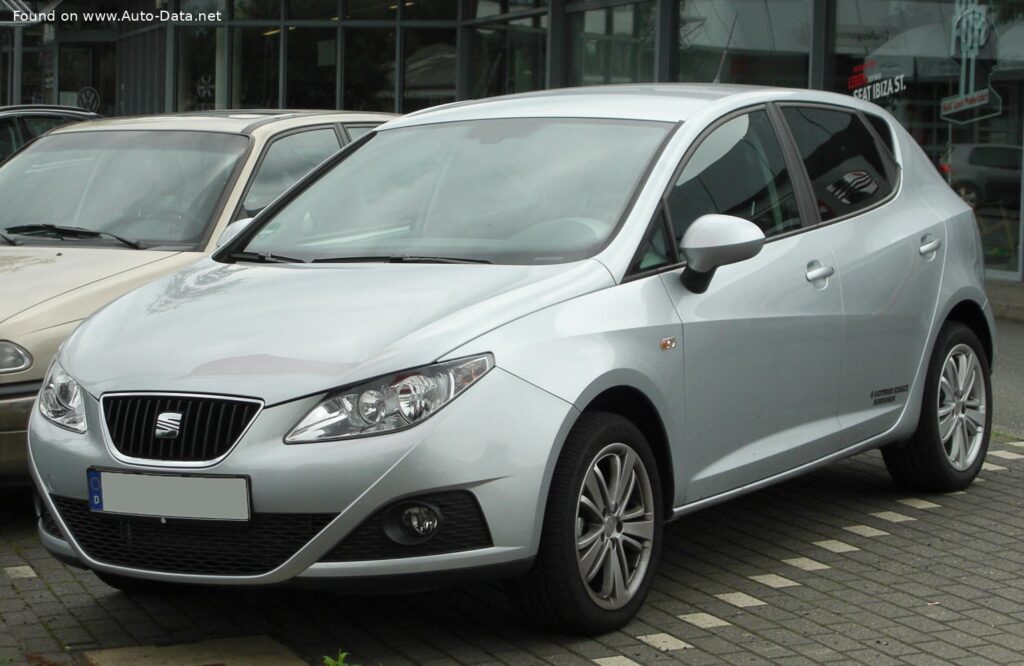
adopted a five-door hatchback body style, blending practicality with a distinctive, sporty aesthetic. Its exterior design was characterized by sharp lines, pronounced wheel arches, and a dynamic profile, reflecting SEAT’s “Auto Emoción” design philosophy. The FR trim typically featured specific styling cues such as unique front and rear bumpers, a honeycomb grille, and larger alloy wheels, giving it a more aggressive stance compared to standard Ibiza models. The vehicle measured 160.94 inches (4088 mm) in length, 66.65 inches (1693 mm) in width, and 56.73 inches (1441 mm) in height, with a wheelbase of 97.2 inches (2469 mm), providing a compact footprint ideal for European city driving.
Inside, the Ibiza IV FR offered a functional yet sporty cabin designed for five occupants. The interior featured supportive sport seats, often with unique upholstery and FR badging, a leather-wrapped steering wheel, and aluminum pedals, enhancing the driving experience. While not a luxury vehicle, the Ibiza FR provided a well-laid-out dashboard with clear instrumentation and intuitive controls, typical of Volkswagen Group vehicles. The trunk space offered 8.83 cu. ft. (250 liters) of cargo capacity, expandable by folding down the rear seats, making it versatile for daily errands or weekend trips.
In terms of features, the
Seat Ibiza IV FR 1.4 TSI (150 Hp) DSG
was equipped with a range of modern conveniences and safety systems for its time. Standard equipment would typically include power windows, central locking, air conditioning, and a quality audio system. Safety was addressed with an Anti-lock Braking System (ABS) as standard, complemented by front ventilated disc brakes and rear disc brakes for strong stopping power. The suspension setup featured an independent MacPherson strut system with coil springs and an anti-roll bar at the front, paired with hydraulic elements at the rear, tuned for a balance of agile handling and comfortable ride quality. The hydraulic power steering provided direct feedback, enhancing the sporty feel. The vehicle rode on 215/40 R17 tires mounted on 7J x 17-inch alloy wheels, contributing to both its visual appeal and handling prowess.
Technical Specifications
| Category | Specification | US Equivalent |
|---|---|---|
| General Information | ||
| Brand | Seat | |
| Model | Ibiza | |
| Generation | Ibiza IV | |
| Type (Engine) | FR 1.4 TSI (150 Hp) DSG | |
| Start of Production | 2009 year | |
| End of Production | 2012 year | |
| Powertrain Architecture | Internal Combustion engine | |
| Body type | Hatchback | |
| Seats | 5 | |
| Doors | 5 | |
| Performance Specs | ||
| Fuel consumption (economy) – urban | 8.1 l/100 km | 29 US mpg |
| Fuel consumption (economy) – extra urban | 5.3 l/100 km | 44.4 US mpg |
| Fuel consumption (economy) – combined | 6.3 l/100 km | 37.3 US mpg |
| Fuel Type | Petrol (Gasoline) | Gasoline |
| Acceleration 0 – 60 mph | 7.4 sec | 7.4 sec |
| Acceleration 0 – 100 km/h | 7.8 sec | |
| Maximum speed | 211 km/h | 131.11 mph |
| Emission standard | Euro 5 | |
| Weight-to-power ratio | 8.4 kg/Hp | |
| Weight-to-torque ratio | 5.8 kg/Nm | |
| Engine Specs | ||
| Power | 150 Hp @ 5800 rpm | 150 Hp @ 5800 rpm |
| Power per liter | 107.9 Hp/l | |
| Torque | 220 Nm @ 1250-4500 rpm | 162.26 lb.-ft. @ 1250-4500 rpm |
| Engine layout | Front, Transverse | |
| Engine Model/Code | CAVF, CNUB, CTHF, CTJB | |
| Engine displacement | 1390 cm3 | 1.4 liters (84.82 cu. in.) |
| Number of cylinders | 4 | |
| Engine configuration | Inline | |
| Cylinder Bore | 76.5 mm | 3.01 in. |
| Piston Stroke | 75.6 mm | 2.98 in. |
| Fuel injection system | Direct injection | |
| Engine aspiration | Turbocharger, Intercooler | |
| Engine oil capacity | 3.6 l | 3.8 US qt |
| Coolant capacity | 5.6 l | 5.92 US qt |
| Space, Volume and Weights | ||
| Kerb Weight | 1267 kg | 2793.26 lbs. |
| Max. weight (Gross Vehicle Weight) | 1693 kg | 3732.43 lbs. |
| Max load | 426 kg | 939.17 lbs. |
| Trunk (boot) space – minimum | 250 l | 8.83 cu. ft. |
| Fuel tank capacity | 45 l | 11.89 US gal |
| Dimensions | ||
| Length | 4088 mm | 160.94 in. |
| Width | 1693 mm | 66.65 in. |
| Height | 1441 mm | 56.73 in. |
| Wheelbase | 2469 mm | 97.2 in. |
| Front track | 1449 mm | 57.05 in. |
| Rear (Back) track | 1441 mm | 56.73 in. |
| Minimum turning circle (turning diameter) | 10.48 m | 34.38 ft. |
| Drivetrain, Brakes and Suspension Specs | ||
| Drivetrain Architecture | Front wheel drive, Internal Combustion engine | |
| Drive wheel | Front wheel drive | |
| Number of gears and type of gearbox | 7 gears, automatic transmission (DSG) | |
| Front suspension | Independent, type McPherson with coil spring and anti-roll bar | |
| Rear suspension | Hydraulic elements | |
| Front brakes | Ventilated discs | |
| Rear brakes | Disc | |
| Assisting systems | ABS (Anti-lock braking system) | |
| Steering type | Steering rack and pinion | |
| Power steering | Hydraulic Steering | |
| Tires size | 215/40 R17 | |
| Wheel rims size | 7J x 17 |
Legacy and Market Impact
The
Seat Ibiza IV FR 1.4 TSI (150 Hp) DSG
carved out a significant niche for itself in the European compact car market, particularly among younger buyers and those seeking a more engaging driving experience than typical economy cars could offer. As a member of the Volkswagen Group, SEAT benefited from shared platforms and powertrains, allowing the Ibiza to leverage sophisticated technology at a competitive price point. The FR trim, with its sporty styling and potent 1.4 TSI engine, was positioned as a ‘warm hatch’ – a step below full-blown hot hatches like the Volkswagen Polo GTI (which often used a more powerful version of the same 1.4 TSI engine, sometimes twin-charged) but significantly more engaging than standard models.
In its primary markets, the Ibiza FR competed against a formidable array of rivals. Key competitors included other European B-segment sporty variants such as the Ford Fiesta S (and later ST), Renault Clio GT (and RS), Peugeot 207 GT, and even its platform mate, the Volkswagen Polo GT/GTI. The Ibiza FR’s unique selling proposition often lay in its blend of dynamic Spanish design flair, Volkswagen Group engineering robustness, and a slightly more aggressive, youthful image compared to its German counterparts. The availability of the advanced DSG transmission further enhanced its appeal, offering a blend of performance and convenience that many rivals struggled to match with conventional automatics.
The
Seat Ibiza IV FR 1.4 TSI (150 Hp) DSG
is remembered for its lively performance, respectable fuel economy, and sharp handling. It demonstrated SEAT’s capability to produce vehicles that were not only practical and efficient but also genuinely fun to drive. Its success contributed to SEAT’s brand identity as the sportier, more passionate arm of the Volkswagen Group. While never officially imported to the United States, its mechanical underpinnings and performance characteristics reflect the global trends in compact car development, emphasizing downsizing, turbocharging, and advanced transmissions to meet evolving demands for both power and efficiency. The Ibiza FR, therefore, stands as an excellent example of a well-executed European compact performance variant from the late 2000s and early 2010s.