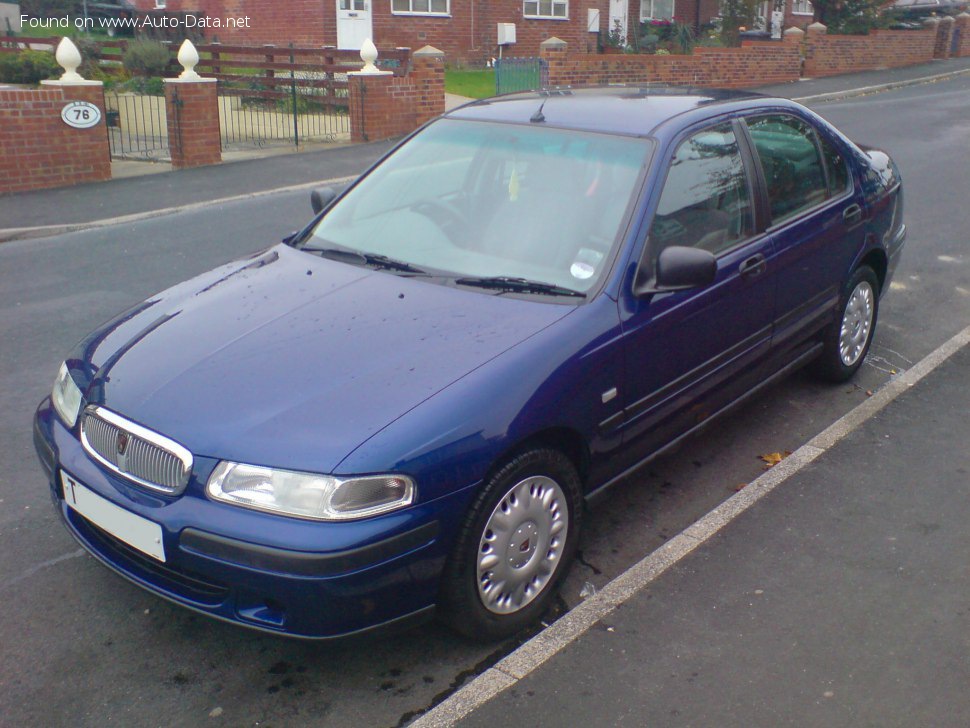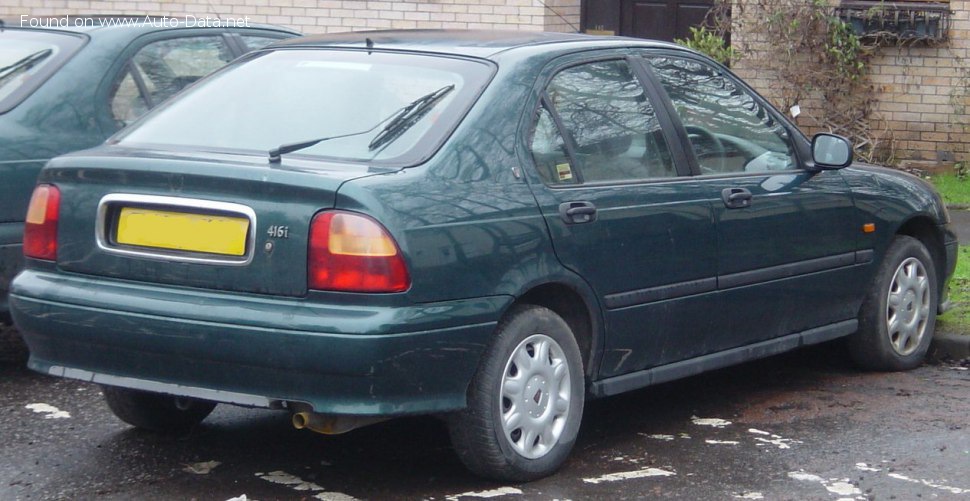
Rover 400 Hatchback (RT) 420 D (86 Hp)
The Rover 400 Hatchback, specifically the RT generation and its 420 D (86 Hp) variant, represents a significant chapter in the history of the British automotive manufacturer, Rover. Produced from 1995 to 2000, this model was a key player in the highly competitive European C-segment, or compact family car market. While never officially sold in the United States, the Rover 400 was a familiar sight on European roads, embodying Rover’s attempt to blend traditional British charm with modern practicality and efficiency. The RT generation marked a strategic evolution for Rover, moving towards a more distinct identity while still leveraging past collaborations. The 420 D variant, powered by an in-house developed diesel engine, was particularly notable for its robust performance and excellent fuel economy, catering to a European market increasingly valuing diesel powertrains for daily commuting and longer journeys.
Positioned as a more premium alternative to mainstream rivals like the Ford Escort or Opel Astra, the Rover 400 aimed to offer a refined driving experience and a touch of traditional British luxury within a compact package. The 420 D (86 Hp) model, with its five-door hatchback body style, was designed to be a versatile family vehicle, offering ample space for five occupants and a flexible cargo area. This particular iteration of the Rover 400 was crucial for the brand during a period of intense market pressure and evolving consumer demands, showcasing Rover’s engineering capabilities, especially in developing efficient diesel technology.
Engine and Performance: The Rover 400 Hatchback (RT) 420 D (86 Hp) Powertrain
At the heart of the Rover 400 Hatchback (RT) 420 D (86 Hp) was Rover’s own L-series diesel engine, a 1994 cubic centimeter (2.0-liter) inline four-cylinder unit. This engine was a testament to Rover’s internal engineering prowess, especially at a time when many manufacturers relied on external suppliers for diesel technology. Featuring a front, transverse engine layout and an Overhead Camshaft (OHC) valvetrain with two valves per cylinder, this powerplant was designed for durability and efficiency. It incorporated a turbocharger and a Diesel Commonrail fuel injection system, advanced technologies for its era, enabling precise fuel delivery and improved combustion.
The engine produced a respectable 86 horsepower at 4500 rpm and a healthy 125.39 lb.-ft. of torque at a low 2000 rpm. This torque figure was particularly beneficial for a diesel engine, providing strong pulling power and flexible acceleration in everyday driving conditions. Mated to a five-speed manual transmission, the 420 D delivered power to the front wheels, a standard setup for compact family cars of the period. While not a performance powerhouse, the vehicle was capable of accelerating from 0 to 60 mph in 13.3 seconds and reaching a top speed of 105.63 mph, perfectly adequate for its intended use as a practical family car.
One of the standout features of the 420 D was its impressive fuel economy. With a combined fuel consumption rating of 46.1 US mpg (5.1 liters per 100 km), it offered significant running cost savings, a major draw for European consumers. Its 14.53 US gallon (55-liter) fuel tank provided an excellent cruising range, making it a viable option for long-distance travel. The engine’s compression ratio of 19.5:1 highlighted its diesel nature, optimized for efficiency and torque production. The L-series engine, with its robust design and relatively advanced common rail injection, proved to be a reliable and economical choice for the Rover 400.
Design and Features
The Rover 400 Hatchback (RT) adopted a contemporary design for the mid-to-late 1990s, characterized by smooth lines and a functional aesthetic. The five-door hatchback body style offered a blend of practicality and compact dimensions, making it suitable for both urban environments and longer journeys. Measuring 170.08 inches in length, 66.93 inches in width, and 54.72 inches in height, the 400 was well-proportioned for its segment. The 103.15-inch wheelbase contributed to a stable ride and a reasonably spacious interior for its class.
Inside, the Rover 400 provided seating for five occupants. The interior design aimed for a more upscale feel than many of its direct competitors, featuring quality materials and a tasteful layout, reflecting Rover’s “premium mainstream” aspirations. Practicality was a strong point, with a minimum trunk space of 13.07 cubic feet (370 liters), expandable to a generous 25.43 cubic feet (720 liters) with the rear seats folded down, accommodating family luggage or larger cargo items.
In terms of chassis and safety, the Rover 400 (RT) featured a robust setup. Both the front and rear suspensions utilized a Spring Strut system, providing a balanced ride comfort and competent handling. Braking was handled by disc brakes on both the front and rear wheels, complemented by an Anti-lock Braking System (ABS), which was becoming an increasingly standard and crucial safety feature in the late 1990s. The steering system was a hydraulic rack and pinion setup, offering direct feedback to the driver. The vehicle rode on 185/65 R14 T size tires, providing a good balance of grip and ride comfort for a car of its class. The kerb weight of 2854.99 lbs. (1295 kg) contributed to its solid feel on the road.
Technical Specifications for the Rover 400 Hatchback (RT) 420 D (86 Hp)
| Category | Specification | US Equivalent (where applicable) |
|---|---|---|
| General Information | ||
| Brand | Rover | |
| Model | 400 | |
| Generation | 400 Hatchback (RT) | |
| Type (Engine) | 420 D (86 Hp) | |
| Start of Production | 1995 year | |
| End of Production | 2000 year | |
| Powertrain Architecture | Internal Combustion engine | |
| Body type | Hatchback | |
| Seats | 5 | |
| Doors | 5 | |
| Performance Specs | ||
| Fuel consumption (combined) | 5.1 l/100 km | 46.1 US mpg |
| Fuel Type | Diesel | |
| Acceleration 0 – 60 mph | 13.3 sec | |
| Maximum speed | 170 km/h | 105.63 mph |
| Weight-to-power ratio | 15.1 kg/Hp | |
| Weight-to-torque ratio | 7.6 kg/Nm | |
| Engine Specs | ||
| Power | 86 Hp @ 4500 rpm | |
| Power per liter | 43.1 Hp/l | |
| Torque | 170 Nm @ 2000 rpm | 125.39 lb.-ft. @ 2000 rpm |
| Engine layout | Front, Transverse | |
| Engine displacement | 1994 cm³ | 121.68 cu. in. (2.0 Liters) |
| Number of cylinders | 4 | |
| Engine configuration | Inline | |
| Cylinder Bore | 84.5 mm | 3.33 in. |
| Piston Stroke | 88.9 mm | 3.5 in. |
| Compression ratio | 19.5:1 | |
| Number of valves per cylinder | 2 | |
| Fuel injection system | Diesel Commonrail | |
| Engine aspiration | Turbocharger | |
| Valvetrain | OHC | |
| Engine oil capacity | 4.5 l | 4.76 US qt |
| Coolant capacity | 7 l | 7.4 US qt |
| Space, Volume and Weights | ||
| Kerb Weight | 1295 kg | 2854.99 lbs. |
| Max. weight | 1720 kg | 3791.95 lbs. |
| Max load | 425 kg | 936.96 lbs. |
| Trunk (boot) space – minimum | 370 l | 13.07 cu. ft. |
| Trunk (boot) space – maximum | 720 l | 25.43 cu. ft. |
| Fuel tank capacity | 55 l | 14.53 US gal |
| Dimensions | ||
| Length | 4320 mm | 170.08 in. |
| Width | 1700 mm | 66.93 in. |
| Height | 1390 mm | 54.72 in. |
| Wheelbase | 2620 mm | 103.15 in. |
| Front track | 1480 mm | 58.27 in. |
| Rear (Back) track | 1470 mm | 57.87 in. |
| Drivetrain, Brakes and Suspension Specs | ||
| Drivetrain Architecture | Front-wheel drive, Internal Combustion engine | |
| Drive wheel | Front wheel drive | |
| Number of gears and type of gearbox | 5 gears, manual transmission | |
| Front suspension | Spring Strut | |
| Rear suspension | Spring Strut | |
| Front brakes | Disc | |
| Rear brakes | Disc | |
| Assisting systems | ABS (Anti-lock braking system) | |
| Steering type | Steering rack and pinion | |
| Power steering | Hydraulic Steering | |
| Tires size | 185/65 R14 T | |
Legacy and Market Impact of the Rover 400 Hatchback (RT) 420 D (86 Hp)
The Rover 400 Hatchback (RT) 420 D (86 Hp) holds a notable place in the European automotive landscape of the late 1990s. While Rover as a brand faced significant challenges during this period, the 400 series, and particularly its diesel variants, were considered competitive offerings in their segment. The car’s reputation was built on its combination of traditional British styling cues, a comfortable ride, and, in the case of the 420 D, exceptional fuel efficiency and robust torque from its in-house L-series diesel engine. This model helped Rover maintain a presence in a segment dominated by established players.
In its primary European market, the Rover 400 competed against formidable rivals such as the Volkswagen Golf, Ford Escort (later Focus), Opel/Vauxhall Astra, Peugeot 306, and Renault Megane. While it may not have matched the sales volumes of the segment leaders, the 400 carved out a niche for itself by offering a slightly more upmarket feel and a distinct British character. The 420 D variant, in particular, was praised for its economical running costs, which were a crucial factor for many European buyers, especially fleet operators and high-mileage drivers. The L-series diesel was often regarded as one of Rover’s engineering successes, proving reliable and efficient.
The historical significance of the Rover 400 (RT) lies in its role as one of the last truly competitive models developed by Rover before the brand’s eventual decline. It represented an effort to modernize Rover’s lineup and appeal to a broader audience while retaining some of the brand’s traditional values. The diesel engine, developed internally, was a point of pride and a strategic asset, demonstrating Rover’s capability to innovate in powertrain technology. Despite the turbulent times for the Rover Group, the 400 Hatchback (RT) 420 D (86 Hp) stood as a testament to the company’s engineering talent and its commitment to offering practical, efficient, and distinctively British vehicles to the European market. Its legacy is one of a solid, economical family car that, for a time, allowed Rover to hold its own in a fiercely contested segment.