
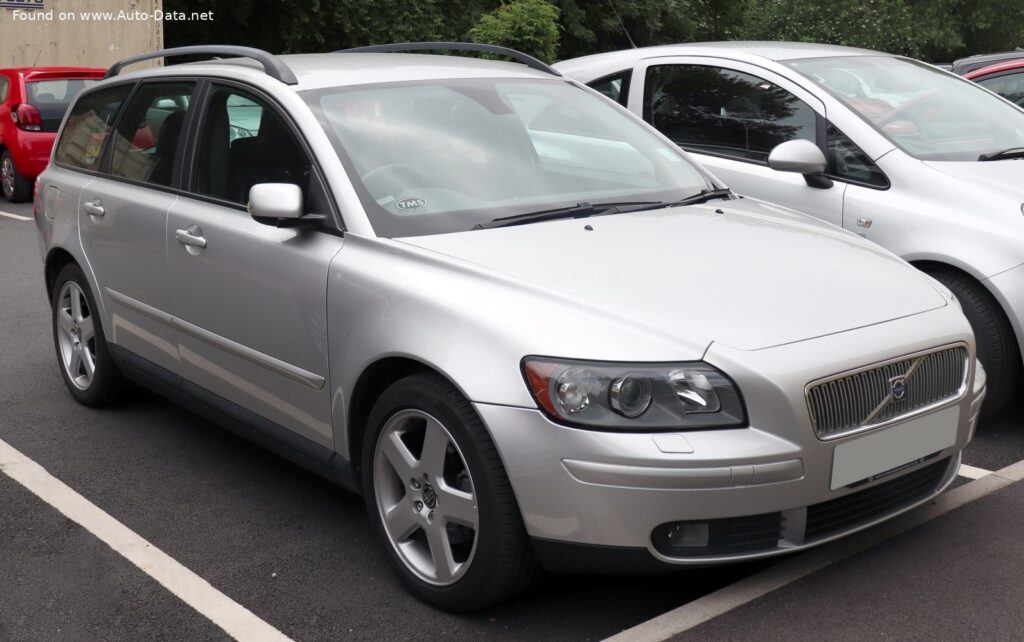
The Volvo V50 2.4 20V (140 Hp): A Scandinavian Compact Executive Wagon (2004-2007)
The Volvo V50, introduced in 2004, marked a significant chapter in Volvo’s strategy to expand its presence in the premium compact segment. Positioned as a stylish and versatile compact executive station wagon (or estate, as it’s known in many markets), the V50 was the wagon counterpart to the S40 sedan. It succeeded the V40, aiming to offer a more upscale and dynamic driving experience while retaining Volvo’s renowned commitment to safety and practicality. The V50 was built on the Ford C1 platform, shared with the Ford Focus and Mazda3, a collaboration that imbued it with more engaging handling characteristics than its predecessor. This particular variant, the Volvo V50 2.4 20V (140 Hp), was a core offering in European markets, providing a balanced blend of performance and efficiency for the discerning buyer seeking a practical yet refined family vehicle. Produced from 2004 to 2007, this generation of the V50 represented Volvo’s modern interpretation of the compact wagon, blending sleek design with robust engineering.
Engine and Performance of the Volvo V50
At the heart of the Volvo V50 2.4 20V (140 Hp) lies a naturally aspirated 2.4-liter (2435 cm3 or 148.59 cu. in.) inline-five-cylinder engine, a configuration that has long been a signature of Volvo engineering. This B5244S5 engine, with its double overhead camshaft (DOHC) and 20 valves (four per cylinder), was designed for smooth power delivery and a distinctive, pleasing engine note. It produced a respectable 140 horsepower at 4500 rpm, which, while not designed for outright blistering performance, offered ample power for everyday driving and highway cruising.
Torque figures stood at 220 Nm (162.26 lb.-ft.) at a relatively low 3750 rpm, providing good low-end grunt for responsive acceleration in urban environments. Power was channeled to the front wheels via a 5-speed manual transmission, offering the driver an engaging and direct connection to the powertrain. This setup allowed the V50 2.4 20V to accelerate from 0 to 60 mph in a credible 9.5 seconds (0-100 km/h in 10 seconds), with a maximum speed of 127.38 mph (205 km/h).
Fuel economy was a strong point for this variant, with a combined consumption rating of 8.5 liters per 100 km, translating to approximately 27.7 US mpg. This efficiency, coupled with a 16.38 US gallon (62-liter) fuel tank, provided a commendable cruising range. The engine’s naturally aspirated design, coupled with multi-port manifold injection, contributed to its reliability and relatively straightforward maintenance.
Design and Features of the Volvo V50
The design of the Volvo V50 represented a departure from Volvo’s traditionally boxier wagons, embracing a more dynamic and sculpted aesthetic. With its sleek profile, sloping roofline, and distinctive “shoulders,” the V50 was marketed as a “sportwagon.” Its overall length of 177.72 inches (4514 mm) and width of 69.69 inches (1770 mm) gave it a compact yet substantial road presence. The 5-door station wagon body style offered excellent practicality, making it a popular choice for families and individuals requiring versatile cargo space.
Inside, the V50 showcased Volvo’s commitment to minimalist Scandinavian design and ergonomic excellence. The interior featured high-quality materials and a floating center console, a design hallmark of this era’s Volvo models, which freed up space behind it for additional storage. With seating for five, the cabin was designed for comfort and long-distance travel.
As expected from Volvo, safety was paramount. The V50 came equipped with a comprehensive suite of safety features, including the brand’s pioneering Side Impact Protection System (SIPS) and Whiplash Protection System (WHIPS) for front occupants. Multiple airbags, including front, side, and curtain airbags, were standard. Anti-lock Braking System (ABS) was also a standard assisting system, ensuring controlled stopping power. The chassis featured front and rear transverse stabilizers, contributing to stable handling, while ventilated discs on both front and rear axles provided robust braking performance.
Cargo capacity was a key selling point for the V50. With the rear seats in place, it offered a respectable 14.73 cubic feet (417 liters) of trunk space. Folding down the rear seats expanded this to a generous 46.16 cubic feet (1307 liters), accommodating larger items and making the V50 a highly practical vehicle for various lifestyles.
Technical Specifications
| Category | Specification | Value (Metric) | Value (US/Imperial) |
|---|---|---|---|
| General Information | |||
| Brand | Volvo | ||
| Model | V50 | ||
| Generation | V50 | ||
| Type (Engine) | 2.4 20V (140 Hp) | ||
| Start of Production | 2004 year | ||
| End of Production | 2007 year | ||
| Powertrain Architecture | Internal Combustion engine | ||
| Body type | Station wagon (estate) | ||
| Seats | 5 | ||
| Doors | 5 | ||
| Performance Specs | |||
| Fuel consumption (combined) | 8.5 l/100 km | 27.7 US mpg | |
| CO2 emissions | 203 g/km | ||
| Fuel Type | Petrol (Gasoline) | ||
| Acceleration 0 – 60 mph | 9.5 sec | ||
| Acceleration 0 – 100 km/h | 10 sec | ||
| Maximum speed | 205 km/h | 127.38 mph | |
| Weight-to-power ratio | 10.4 kg/Hp | 96.4 Hp/tonne | |
| Weight-to-torque ratio | 6.6 kg/Nm | 151.5 Nm/tonne | |
| Engine Specs | |||
| Power | 140 Hp @ 4500 rpm | ||
| Power per liter | 57.5 Hp/l | ||
| Torque | 220 Nm @ 3750 rpm | 162.26 lb.-ft. @ 3750 rpm | |
| Engine layout | Front, Transverse | ||
| Engine Model/Code | B5244S5 | ||
| Engine displacement | 2435 cm3 | 148.59 cu. in. | |
| Number of cylinders | 5 | ||
| Engine configuration | Inline | ||
| Cylinder Bore | 83 mm | 3.27 in. | |
| Piston Stroke | 90 mm | 3.54 in. | |
| Compression ratio | 10.3:1 | ||
| Number of valves per cylinder | 4 | ||
| Fuel injection system | Multi-port manifold injection | ||
| Engine aspiration | Naturally aspirated engine | ||
| Valvetrain | DOHC | ||
| Engine oil capacity | 5.8 l | 6.13 US qt | |
| Coolant | 8 l | 8.45 US qt | |
| Space, Volume and Weights | |||
| Kerb Weight | 1452 kg | 3201.11 lbs. | |
| Trunk (boot) space – minimum | 417 l | 14.73 cu. ft. | |
| Trunk (boot) space – maximum | 1307 l | 46.16 cu. ft. | |
| Fuel tank capacity | 62 l | 16.38 US gal | |
| Dimensions | |||
| Length | 4514 mm | 177.72 in. | |
| Width | 1770 mm | 69.69 in. | |
| Height | 1452 mm | 57.17 in. | |
| Wheelbase | 2640 mm | 103.94 in. | |
| Front track | 1535 mm | 60.43 in. | |
| Rear (Back) track | 1531 mm | 60.28 in. | |
| Drivetrain, Brakes and Suspension Specs | |||
| Drivetrain Architecture | The Internal combustion engine (ICE) drives the front wheels of the vehicle. | ||
| Drive wheel | Front wheel drive | ||
| Number of gears and type of gearbox | 5 gears, manual transmission | ||
| Front suspension | Transverse stabilizer | ||
| Rear suspension | Transverse stabilizer | ||
| Front brakes | Ventilated discs | ||
| Rear brakes | Ventilated discs | ||
| Assisting systems | ABS (Anti-lock braking system) | ||
| Steering type | Steering rack and pinion | ||
Legacy and Market Impact
The Volvo V50, particularly with its 2.4 20V (140 Hp) engine, carved out a distinct niche in the highly competitive premium compact segment. While more potent T5 turbocharged variants were often highlighted in markets like the United States, this naturally aspirated 2.4-liter engine was a workhorse in European markets, appealing to a broader base of buyers who valued reliability, smooth power delivery, and fuel efficiency over outright performance. Its direct competitors included established German rivals such as the BMW 3 Series Touring, Audi A4 Avant, and the Mercedes-Benz C-Class Wagon, as well as more mainstream but upscale wagons like the Volkswagen Passat Variant.
The V50’s platform sharing with the Ford Focus and Mazda3 was a double-edged sword; while it brought improved driving dynamics and cost efficiencies, some purists questioned its “pure Volvo” credentials. However, the V50 successfully retained Volvo’s core values: an unwavering commitment to safety, robust build quality, and a practical, aesthetically pleasing design. Its reputation for being a safe, reliable, and comfortable family vehicle helped maintain Volvo’s brand image, even as it ventured into new market segments.
Historically, the V50 helped Volvo transition its design language towards a more modern, less angular aesthetic, influencing subsequent models. It demonstrated that Volvo could produce a compact vehicle that was both stylish and functional, appealing to a younger demographic while still retaining the loyalty of traditional Volvo buyers. The 2.4 20V (140 Hp) variant, in particular, solidified its legacy as a sensible and dependable choice, embodying the essence of Scandinavian engineering for everyday driving. Its blend of comfort, safety, practicality, and understated style ensured its continued presence on European roads long after its production ceased.
