
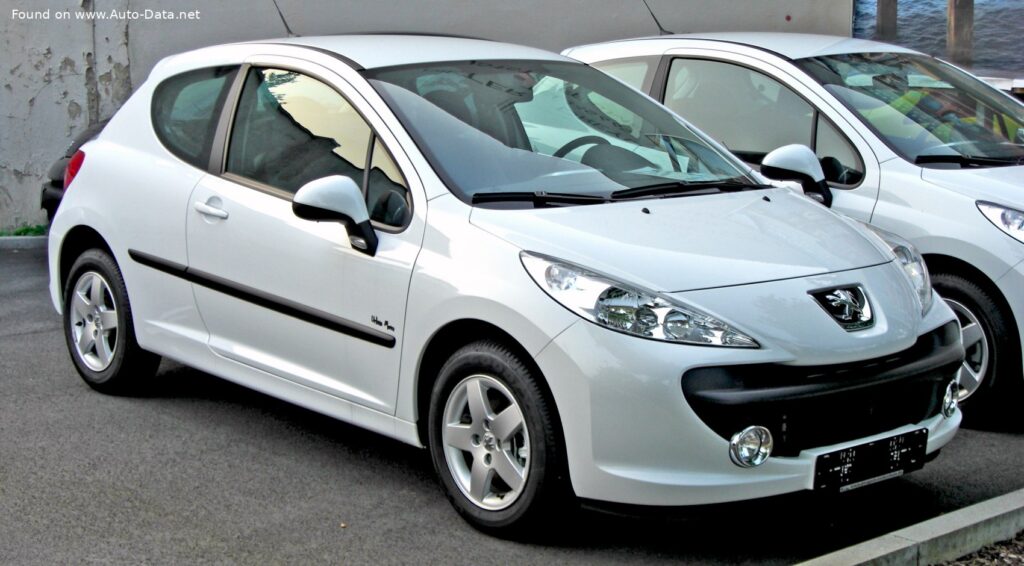
Introduction to the Peugeot 207 RC 1.6 (174 Hp)
The Peugeot 207 RC 1.6 (174 Hp), produced between 2006 and 2009, represented the pinnacle of performance within the popular Peugeot 207 supermini range. Positioned as a hot hatch, it followed in the illustrious footsteps of Peugeot’s celebrated performance models, most notably the iconic 205 GTi and its immediate predecessor, the 206 RC. While not officially sold in the United States, the 207 RC played a significant role in the highly competitive European B-segment hot hatch market, offering a compelling blend of spirited performance, sophisticated engineering, and distinctive French styling. It aimed to challenge established rivals with its potent turbocharged engine and sport-tuned chassis, embodying Peugeot’s long-standing commitment to creating engaging and accessible performance vehicles for the discerning European driver.
During its production run, the Peugeot 207 RC 1.6 (174 Hp) stood out with its aggressive aesthetics and a powertrain developed in collaboration with BMW, a testament to its technical ambition. This particular variant, known as the “RC” in Europe, was often marketed as the “GTi” in some regions, aligning it with Peugeot’s heritage of performance models. It was designed to appeal to enthusiasts seeking a practical yet exhilarating daily driver, combining compact dimensions with genuine performance capabilities.
Engine and Performance: The Heart of the Peugeot 207 RC 1.6 (174 Hp)
At the core of the Peugeot 207 RC’s appeal was its advanced 1.6-liter (1598 cm³) turbocharged inline-four engine, designated by the code 5FY EP6DTS. This powerplant was part of the “Prince” engine family, a collaborative effort between PSA Peugeot Citroën and BMW, known for its efficiency and power delivery. Generating a robust 174 horsepower at 6000 rpm, the engine showcased impressive power per liter, achieving 108.9 HP/liter. More critically for real-world driving, it produced a substantial 177.01 lb.-ft. of torque available across a broad rev range, specifically from 1600 to 3500 rpm. This low-end torque ensured brisk acceleration and flexible in-gear performance, making it highly responsive in various driving scenarios.
The engine’s sophisticated technical specifications included direct fuel injection, a twin-scroll turbocharger, and an intercooler, all contributing to its efficient power generation and reduced turbo lag. A DOHC (Dual Overhead Camshaft) valvetrain with Variable Valve Timing (VVT) further optimized combustion and efficiency. Mated to a precise 5-speed manual transmission, the front-wheel-drive architecture delivered power effectively to the road. This setup allowed the 207 RC to sprint from 0 to 60 mph in a swift 6.7 seconds, with a top speed reaching 136.7 mph. These figures placed it firmly among the top performers in its segment.
Despite its performance focus, the 207 RC also demonstrated commendable fuel economy for a hot hatch of its era. The combined fuel consumption was rated at 32.7 US mpg, while extra-urban driving could yield up to 41.3 US mpg. It complied with the Euro 4 emission standard, emitting 171 g/km of CO2, reflecting a balance between performance and environmental considerations for its time. The car’s kerb weight of 2755.78 lbs. contributed to an impressive weight-to-power ratio of 7.2 kg/Hp, underscoring its agile character.
Design and Features: Sporty Aesthetics and Practicality
The Peugeot 207 RC was offered exclusively as a 3-door hatchback, emphasizing its sporty credentials while still providing seating for five occupants. Its design cues were a clear departure from the standard 207, featuring more aggressive styling elements that visually communicated its performance intent. This included a unique front bumper with larger air intakes, pronounced wheel arches accommodating the wider 205/45 R17 tires on 17-inch alloy wheels, and a rear spoiler. The overall length of 158.66 inches, width of 67.72 inches, and height of 57.95 inches gave it a compact footprint, ideal for navigating European city streets while maintaining a planted stance.
Inside, the 207 RC continued the sporty theme with dedicated RC-specific trim. While not explicitly detailed in the provided data, typical enhancements for such a model would include bolstered sport seats for better lateral support, aluminum pedals, and unique instrument cluster graphics. The interior offered a practical balance, with a minimum trunk space of 9.53 cubic feet, expanding to a generous 32.6 cubic feet with the rear seats folded, making it versatile for daily use or weekend adventures.
The chassis was specifically tuned for the RC model, featuring an independent McPherson strut setup at the front with a coil spring and anti-roll bar, complemented by a semi-independent rear suspension with coil springs and an elastic beam. This configuration, combined with a lower ride height and stiffer damping, aimed to provide precise handling and reduced body roll. Braking performance was ensured by ventilated discs at the front and disc brakes at the rear, supported by an Anti-lock Braking System (ABS) for enhanced safety and control. The steering system utilized a rack and pinion setup, offering direct feedback to the driver. The car’s drag coefficient (Cd) of 0.30 was respectable for its segment, contributing to both stability at high speeds and fuel efficiency.
Technical Specifications
| Category | Specification |
|---|---|
| General Information | |
| Brand | Peugeot |
| Model | 207 |
| Generation | 207 |
| Type (Engine) | RC 1.6 (174 Hp) |
| Start of Production | 2006 year |
| End of Production | 2009 year |
| Powertrain Architecture | Internal Combustion engine |
| Body type | Hatchback |
| Seats | 5 |
| Doors | 3 |
| Performance Specs | |
| Fuel consumption (economy) – urban | 23.8 US mpg (9.9 l/100 km) |
| Fuel consumption (economy) – extra urban | 41.3 US mpg (5.7 l/100 km) |
| Fuel consumption (economy) – combined | 32.7 US mpg (7.2 l/100 km) |
| CO2 emissions | 171 g/km |
| Fuel Type | Petrol (Gasoline) |
| Acceleration 0 – 60 mph | 6.7 sec |
| Acceleration 0 – 100 km/h | 7.1 sec |
| Maximum speed | 136.7 mph (220 km/h) |
| Emission standard | Euro 4 |
| Weight-to-power ratio | 7.2 kg/Hp, 139.2 Hp/tonne |
| Weight-to-torque ratio | 5.2 kg/Nm, 192 Nm/tonne |
| Engine Specs | |
| Power | 174 Hp @ 6000 rpm |
| Power per liter | 108.9 Hp/l |
| Torque | 177.01 lb.-ft. @ 1600-3500 rpm (240 Nm) |
| Engine layout | Front, Transverse |
| Engine Model/Code | 5FY EP6DTS |
| Engine displacement | 1.6 liters (1598 cm³, 97.52 cu. in.) |
| Number of cylinders | 4 |
| Engine configuration | Inline |
| Cylinder Bore | 3.03 in. (77 mm) |
| Piston Stroke | 3.38 in. (85.8 mm) |
| Compression ratio | 10.5:1 |
| Number of valves per cylinder | 4 |
| Fuel injection system | Direct injection |
| Engine aspiration | Turbocharger, Intercooler |
| Valvetrain | DOHC-VVT |
| Engine oil capacity | 4.49 US qt (4.25 l) |
| Coolant | 5.6 US qt (5.3 l) |
| Space, Volume and Weights | |
| Kerb Weight | 2755.78 lbs. (1250 kg) |
| Max. weight | 3527.4 lbs. (1600 kg) |
| Max load | 771.62 lbs. (350 kg) |
| Trunk (boot) space – minimum | 9.53 cu. ft. (270 l) |
| Trunk (boot) space – maximum | 32.6 cu. ft. (923 l) |
| Fuel tank capacity | 13.21 US gal (50 l) |
| Permitted trailer load with brakes (12%) | 2380.99 lbs. (1080 kg) |
| Permitted trailer load without brakes | 1322.77 lbs. (600 kg) |
| Dimensions | |
| Length | 158.66 in. (4030 mm) |
| Width | 67.72 in. (1720 mm) |
| Width with mirrors folded | 71.57 in. (1818 mm) |
| Width including mirrors | 77.64 in. (1972 mm) |
| Height | 57.95 in. (1472 mm) |
| Wheelbase | 100 in. (2540 mm) |
| Front track | 58.07 in. (1475 mm) |
| Rear (Back) track | 57.8 in. (1468 mm) |
| Drag coefficient (Cd) | 0.30 |
| Minimum turning circle (turning diameter) | 34.12 ft. (10.4 m) |
| Drivetrain, Brakes and Suspension Specs | |
| Drivetrain Architecture | The Internal combustion engine (ICE) drives the front wheels of the vehicle. |
| Drive wheel | Front wheel drive |
| Number of gears and type of gearbox | 5 gears, manual transmission |
| Front suspension | Independent, type McPherson with coil spring and anti-roll bar |
| Rear suspension | Semi-independent, coil spring, Elastic beam |
| Front brakes | Ventilated discs |
| Rear brakes | Disc |
| Assisting systems | ABS (Anti-lock braking system) |
| Steering type | Steering rack and pinion |
| Tires size | 205/45 R17 |
| Wheel rims size | 17 |
Legacy and Market Impact
The Peugeot 207 RC 1.6 (174 Hp) entered a hotly contested segment in Europe, vying for attention against formidable rivals such as the Renault Clio RS, the Ford Fiesta ST (in its various iterations), the Opel Corsa OPC/VXR, and the contemporary MINI Cooper S, with which it shared its fundamental engine architecture. While it offered strong performance figures and a well-appointed interior, its reception among enthusiasts was somewhat mixed. Some purists found it to be a more refined and less raw experience compared to its predecessor, the 206 RC, which was often praised for its unfiltered driving dynamics. The 207 RC, being a heavier and larger car than the 206, sometimes faced criticism for feeling less agile despite its potent engine.
However, the 207 RC’s strengths lay in its everyday usability and sophisticated powertrain. The turbocharged engine provided excellent flexibility, making it a comfortable companion for both spirited drives and mundane commutes. Its advanced engine technology, developed in conjunction with BMW, showcased Peugeot’s commitment to modern engineering and set a precedent for future performance models. The car’s compliance with Euro 4 emissions standards also highlighted its relative efficiency for a performance vehicle of its time.
Historically, the 207 RC represents an important bridge in Peugeot’s hot hatch lineage. It demonstrated the brand’s adaptation to new engine technologies, moving away from naturally aspirated high-revving units to more torque-rich turbocharged powerplants. Although its production run was relatively short (2006-2009), it paved the way for the highly acclaimed 208 GTi, which later recaptured much of the enthusiast adoration. Today, the Peugeot 207 RC is remembered as a capable and engaging hot hatch that, while perhaps not reaching the cult status of some of its predecessors, offered a compelling package of performance, practicality, and distinctive French character in the early 21st century European market. It solidified Peugeot’s reputation as a serious contender in the performance compact car segment, proving that even with increasing weight and complexity, a fun-to-drive spirit could still be engineered into their models.
