The Toyota Proace City SWB 50 kWh (136 Hp) Electric: A European Utility Champion
The Toyota Proace City SWB 50 kWh (136 Hp) Electric, introduced in April 2022, represents Toyota’s commitment to expanding its electrified commercial vehicle lineup, particularly in the European market. As part of a collaborative effort with Stellantis (formerly PSA Group), the Proace City is a rebadged version of a highly successful platform that underpins several compact vans and people carriers, including the Peugeot Partner/Rifter, Citroën Berlingo, and Opel/Vauxhall Combo. This specific short-wheelbase (SWB) electric variant is designed to offer a compelling blend of zero-emission capability, practical utility, and maneuverability for urban environments and regional logistics. Positioned in the burgeoning light commercial vehicle (LCV) and compact minivan segments, the Proace City Electric serves as a versatile solution for businesses and, in some configurations, private users seeking an efficient and environmentally conscious mode of transport. Its battery-electric vehicle (BEV) architecture underscores a modern approach to commercial mobility, emphasizing lower running costs and reduced environmental impact, factors increasingly critical in European cities with growing low-emission zones.
Engine & Performance of the Toyota Proace City SWB 50 kWh (136 Hp) Electric
At the heart of the Toyota Proace City SWB 50 kWh (136 Hp) Electric lies a sophisticated battery-electric powertrain, engineered for efficiency and robust performance in its intended operational scope. The vehicle is propelled by a single electric motor, strategically positioned on the front axle and mounted transversely, driving the front wheels. This synchronous electric motor generates a respectable 136 horsepower (Hp) and a substantial 191.77 lb.-ft. (260 Nm) of instantaneous torque. The motor’s model/code is ZK01, signifying its integration within the Stellantis electric vehicle architecture.
The immediate availability of peak torque is a significant advantage for an LCV, providing brisk acceleration from a standstill, which is particularly beneficial for navigating urban traffic and carrying heavy loads. Power delivery is managed through a single-speed automatic transmission, characteristic of most electric vehicles, ensuring a smooth and seamless driving experience without the need for gear changes.
Performance metrics for the Proace City Electric highlight its practical orientation rather than outright speed. It achieves a maximum speed of 83.89 mph (135 km/h), which is more than adequate for city driving and occasional highway use. The vehicle’s weight-to-power ratio stands at 11.1 kg/Hp (or 89.8 Hp per tonne), while the weight-to-torque ratio is 5.8 kg/Nm (or 171.6 Nm per tonne). These figures underscore the vehicle’s capability to handle significant payloads efficiently.
Powering the electric motor is a 50 kWh gross capacity Lithium-ion (Li-Ion) battery pack, intelligently located below the floor. This placement not only optimizes the vehicle’s center of gravity for improved handling and stability but also maximizes interior cargo space, a crucial consideration for a commercial van. The battery technology is robust and designed for longevity, providing an all-electric range (WLTP) of 172.74 miles (278 km). This range makes the Proace City Electric a viable option for a wide array of daily business operations without range anxiety for most users.
Energy consumption figures further demonstrate its efficiency, with an average (WLTP) consumption ranging from 32.03 to 32.83 kWh per 100 miles (19.9-20.4 kWh/100 km), translating to an impressive 105 to 103 MPGe (Miles Per Gallon equivalent). This efficiency, combined with the inherent cost advantages of electricity over gasoline, offers significant operational savings for businesses.
Design & Features of the Toyota Proace City SWB
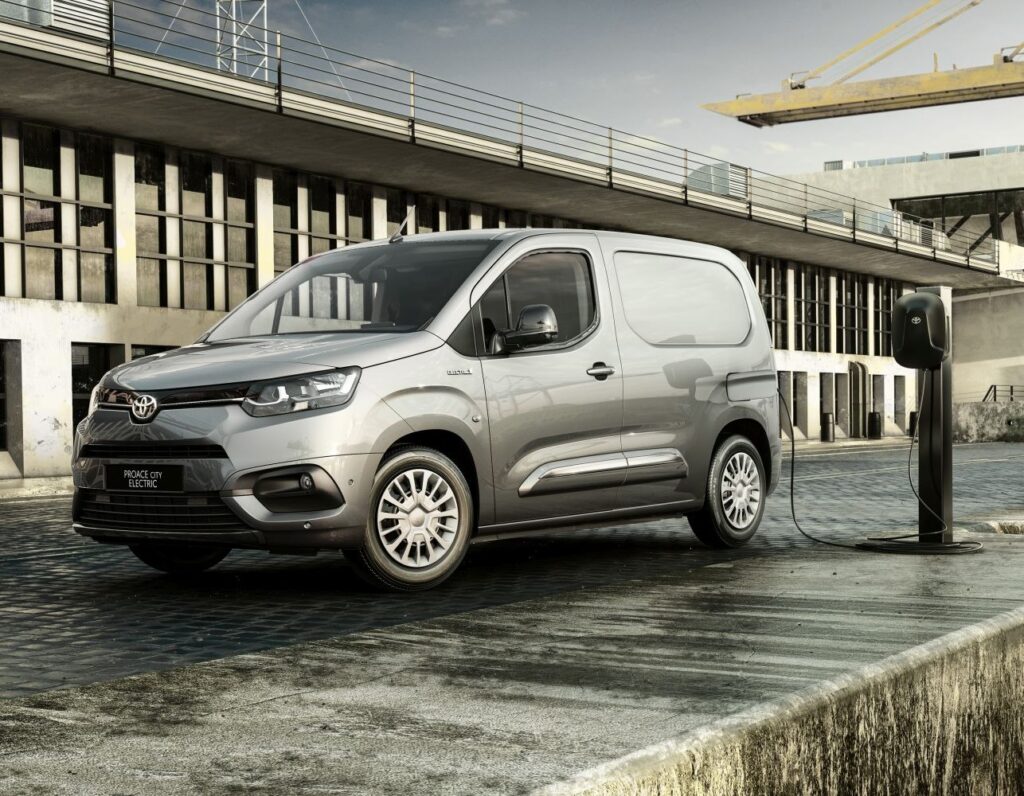
The Toyota Proace City SWB features a functional and robust design, characteristic of its segment. Classified as a minivan body type, it prioritizes utility and versatility. The short-wheelbase variant is particularly adept at maneuvering in tight urban spaces, making it an ideal choice for last-mile delivery services or tradespeople operating in congested city centers. With four doors and seating for 2 to 3 occupants, the interior is configured for practicality, allowing for ample cargo capacity while accommodating essential personnel.
Aesthetically, the Proace City Electric maintains a clean and purposeful exterior, reflecting its commercial roots. Toyota has subtly integrated its branding while retaining the core design language shared with its Stellantis counterparts. The dimensions are compact yet spacious, with a length of 173.35 inches (4403 mm), a width of 72.76 inches (1848 mm), and a height ranging from 70.71 to 73.23 inches (1796-1860 mm). The wheelbase measures 109.65 inches (2785 mm), contributing to its stable ride and generous interior volume.
Inside, the emphasis is on durability and ergonomics. While specific luxury features are typically omitted in favor of practicality, modern conveniences and essential safety systems are integrated. The cargo area is exceptionally versatile, offering a minimum trunk space of 116.54 cubic feet (3300 liters) and expanding to a maximum of 134.2 cubic feet (3800 liters). This cavernous space, combined with a maximum load capacity of 1929.04 lbs (875 kg), makes it highly capable of transporting a wide array of goods, tools, or equipment. The vehicle also supports a maximum roof load of 330.69 lbs (150 kg) and a permitted trailer load with brakes of 1653.47 lbs (750 kg), further enhancing its utility.
Suspension components are engineered for a comfortable ride even under load, featuring an independent McPherson type setup at the front and a robust torsion beam at the rear. Braking performance is handled by ventilated discs at the front and disc brakes at the rear, complemented by an Anti-lock Braking System (ABS) for enhanced safety. The electric power steering system, with its rack and pinion setup, provides light and responsive handling, crucial for urban driving and parking. The vehicle is fitted with either 195/65 R15 or 215/65 R16 tires on 6.5J x 15 or 6.5J x 16 wheel rims, respectively, offering a balance of grip, durability, and ride comfort. The minimum turning circle of 35.43 feet (10.8 meters) is particularly impressive for a vehicle of this size, aiding maneuverability in tight spots.
Technical Specifications
| Category | Specification |
|---|---|
| Brand | Toyota |
| Model | Proace City SWB |
| Generation | Proace City SWB |
| Type (Engine) | 50 kWh (136 Hp) Electric |
| Start of Production | April, 2022 |
| Powertrain Architecture | BEV (Electric Vehicle) |
| Body Type | Minivan |
| Seats | 2-3 |
| Doors | 4 |
| Fuel Type | Electricity |
| Maximum Speed | 83.89 mph (135 km/h) |
| Weight-to-Power Ratio | 11.1 kg/Hp (89.8 Hp/tonne) |
| Weight-to-Torque Ratio | 5.8 kg/Nm (171.6 Nm/tonne) |
| Gross Battery Capacity | 50 kWh |
| Battery Technology | Lithium-ion (Li-Ion) |
| Battery Location | Below the floor |
| All-Electric Range (WLTP) | 172.74 mi (278 km) |
| Average Energy Consumption (WLTP) | 32.03 – 32.83 kWh/100 mi (19.9-20.4 kWh/100 km) |
| MPGe | 105 – 103 MPGe |
| Electric Motor Power | 136 Hp |
| Electric Motor Torque | 191.77 lb.-ft. (260 Nm) |
| Electric Motor Model/Code | ZK01 |
| Electric Motor Location | Front axle, Transverse |
| Electric Motor Type | Synchronous |
| System Power | 136 Hp |
| System Torque | 191.77 lb.-ft. (260 Nm) |
| Kerb Weight | 3340 lbs (1515 kg) |
| Max. Weight | 5269.05 lbs (2390 kg) |
| Max Load | 1929.04 lbs (875 kg) |
| Trunk (boot) Space – Minimum | 116.54 cu. ft. (3300 l) |
| Trunk (boot) Space – Maximum | 134.2 cu. ft. (3800 l) |
| Max. Roof Load | 330.69 lbs (150 kg) |
| Permitted Trailer Load with Brakes (12%) | 1653.47 lbs (750 kg) |
| Permitted Towbar Download | 110.23 lbs (50 kg) |
| Length | 173.35 in (4403 mm) |
| Width | 72.76 in (1848 mm) |
| Width with Mirrors Folded | 75.63 in (1921 mm) |
| Width Including Mirrors | 82.95 in (2107 mm) |
| Height | 70.71 – 73.23 in (1796-1860 mm) |
| Wheelbase | 109.65 in (2785 mm) |
| Front Track | 60.94 – 61.54 in (1548-1563 mm) |
| Rear (Back) Track | 61.73 – 62.09 in (1568-1577 mm) |
| Front Overhang | 35.12 in (892 mm) |
| Rear Overhang | 28.58 in (726 mm) |
| Ride Height (Ground Clearance) | 5.71 – 7.17 in (145-182 mm) |
| Minimum Turning Circle (Turning Diameter) | 35.43 ft (10.8 m) |
| Drivetrain Architecture | One electric motor drives the front wheels. |
| Drive Wheel | Front wheel drive |
| Number of Gears and Type of Gearbox | 1 gear, automatic transmission |
| Front Suspension | Independent type McPherson |
| Rear Suspension | Torsion |
| Front Brakes | Ventilated discs |
| Rear Brakes | Disc |
| Assisting Systems | ABS (Anti-lock braking system) |
| Steering Type | Steering rack and pinion |
| Power Steering | Electric Steering |
| Tires Size | 195/65 R15 91H; 215/65 R16 98H |
| Wheel Rims Size | 6.5J x 15; 6.5J x 16 |
Legacy & Market Impact of the Toyota Proace City SWB 50 kWh (136 Hp) Electric
The Toyota Proace City SWB 50 kWh (136 Hp) Electric enters the market as a significant player in the evolving landscape of light commercial vehicles, particularly within Europe, where stringent emission regulations and incentives for electric vehicles are driving rapid adoption. While not sold in the United States, its presence in Europe and other global markets underscores a strategic move by Toyota to diversify its LCV offerings and cater to the growing demand for sustainable urban mobility solutions.
Its legacy is intrinsically linked to the highly successful Stellantis K9 platform, which has proven its mettle across various brands. The Proace City benefits from this established engineering, offering reliability and practicality that Toyota customers expect, combined with the zero-emission advantages of an electric powertrain. This collaboration allows Toyota to rapidly deploy a competitive electric LCV without extensive independent development, leveraging economies of scale.
In its primary markets, the Proace City Electric is renowned for its operational efficiency, low running costs, and silent operation, making it ideal for urban deliveries, small businesses, and tradespeople. Its compact dimensions and impressive maneuverability are particular assets in crowded city environments, allowing for easier navigation and parking. The vehicle’s generous cargo volume and robust payload capacity ensure that the transition to electric doesn’t compromise its utility as a commercial workhorse.
Competitors in the European market primarily include its platform siblings: the Citroën e-Berlingo, Peugeot e-Partner, and Opel/Vauxhall Combo-e. Beyond these, other key rivals in the compact electric van segment include the Renault Kangoo E-Tech Electric and, to a lesser extent, smaller commercial variants of electric passenger cars. The Proace City Electric differentiates itself through Toyota’s reputation for quality, reliability, and strong dealer network, offering a compelling alternative to its peers.
The historical significance of the Proace City Electric lies in its contribution to the broader electrification of commercial transport. As cities increasingly implement low-emission zones and businesses prioritize sustainable operations, vehicles like the Proace City Electric are crucial in facilitating this transition. It represents a practical, no-compromise solution for businesses looking to reduce their carbon footprint and operational expenses. Its adoption helps to accelerate the shift away from internal combustion engine vehicles in commercial fleets, contributing to cleaner air and quieter urban environments. The vehicle’s continued success is a testament to the viability and growing acceptance of electric vans as essential tools for modern commerce.