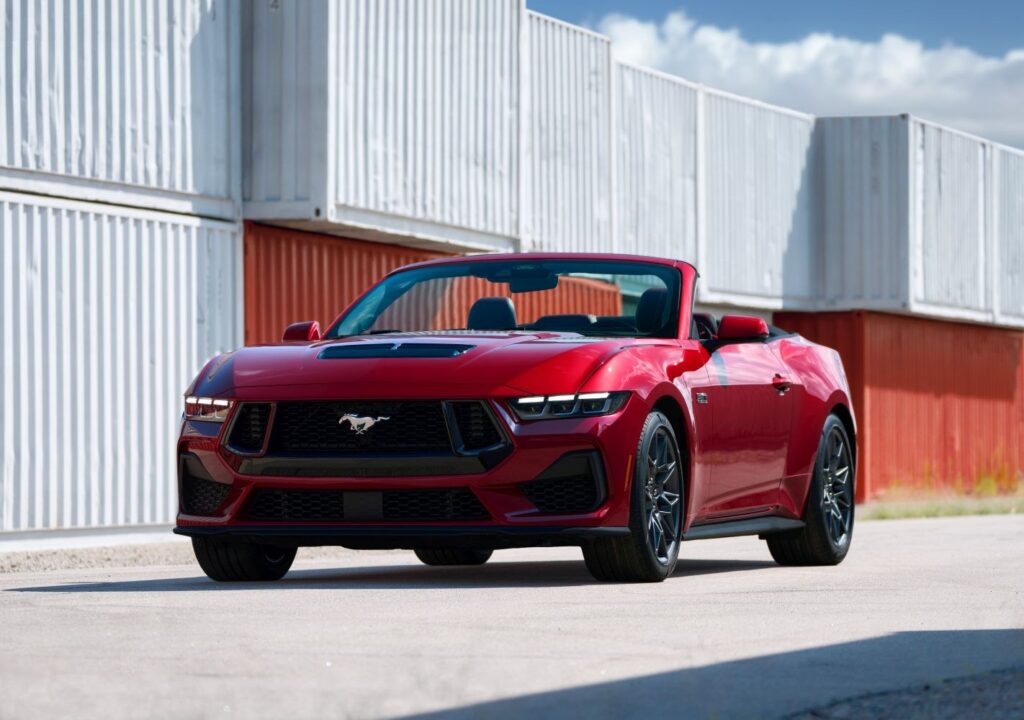
Ford Mustang Convertible VII GT 5.0 V8 (486 Hp)
The Ford Mustang, an enduring icon of American automotive prowess, entered its seventh generation in 2023, designated internally as the S650. This iteration continues the legacy of the original “pony car,” blending classic design cues with modern technology and performance. The focus of this detailed analysis is the Ford Mustang Convertible VII GT 5.0 V8 (486 Hp), a variant that encapsulates the quintessential Mustang experience: open-air driving combined with the raw power of a naturally aspirated V8 engine. Positioned as a high-performance grand tourer within the convertible segment, it caters to enthusiasts seeking a visceral driving experience and the unmistakable rumble of a large displacement engine.
The seventh-generation Mustang convertible maintains its two-door, four-seat configuration, offering a blend of sportiness and practicality for a performance car. Its launch signifies Ford’s commitment to the internal combustion engine and the enthusiast market, even as the automotive industry shifts towards electrification. The GT trim, specifically, represents the heart of the Mustang lineup, providing a direct link to the model’s rich heritage of powerful V8 performance.
Engine & Performance: The Heart of the Ford Mustang Convertible VII GT 5.0 V8 (486 Hp)
At the core of the Ford Mustang Convertible VII GT 5.0 V8 (486 Hp) lies the latest iteration of Ford’s revered Coyote V8 engine. This 5.0-liter (5038 cm3 or 307.44 cu. in.) naturally aspirated powerplant is a testament to traditional American muscle, delivering a robust 486 horsepower at a spirited 7250 rpm. Torque output is equally impressive, peaking at 567 Nm (418.2 lb.-ft.) at 4900 rpm, ensuring potent acceleration across a wide rev range. The Coyote engine, identified by its “Coyote” model code, employs a sophisticated DOHC (Dual Overhead Camshaft) valvetrain with Ti-VCT (Twin Independent Variable Cam Timing), optimizing valve timing for both power and efficiency.
A distinctive feature of this engine is its advanced fuel injection system, which combines both direct injection and multi-port manifold injection. This dual-fuel strategy allows for precise fuel delivery, enhancing combustion efficiency, reducing emissions, and maximizing power output. With a high compression ratio of 12:1 and four valves per cylinder, the engine is designed for optimal breathing and thermodynamic efficiency. The naturally aspirated nature of the engine ensures a linear power delivery and an unfiltered auditory experience, a hallmark cherished by Mustang enthusiasts.
Power is channeled to the rear wheels via a standard 6-speed manual transmission, a choice that underscores the car’s driver-focused philosophy. This drivetrain architecture, combined with the significant power-to-weight ratio of 3.7 kg/Hp (268.5 Hp/tonne), promises exhilarating acceleration and engaging driving dynamics. Fuel economy, while not the primary focus of a V8 performance convertible, is rated at an estimated 17 US mpg combined (13.8 l/100 km), with 14 US mpg in urban settings and 23.1 US mpg on the highway, reflecting the potent nature of the powertrain.
Design & Features: Modern Aesthetics and Open-Air Freedom
The design of the seventh-generation Mustang Convertible is an evolution of its predecessors, successfully blending modern aggression with classic pony car proportions. The cabriolet body type allows for an open-air driving experience, enhancing the sensory connection to the road and the engine’s soundtrack. With two doors and four seats, it retains a sporty profile while offering seating for occasional rear passengers, albeit with typical convertible compromises in rear legroom.
Dimensionally, the Mustang Convertible measures 189.41 inches (4811 mm) in length, 75.39 inches (1915 mm) in width (81.89 inches or 2080 mm including mirrors), and 55 inches (1397 mm) in height. Its 107.01-inch (2718 mm) wheelbase contributes to a stable ride and athletic handling. The exterior is characterized by a muscular stance, with a wide front track of 62.01 inches (1575 mm) and a rear track of 64.69 inches (1643 mm), giving it a planted appearance.
Underneath its sculpted body, the Mustang Convertible VII GT features an independent front suspension with McPherson struts, coil springs, and an anti-roll bar, paired with an independent multi-link spring suspension and stabilizer bar at the rear. This setup is engineered to provide a balance of ride comfort and dynamic handling. Braking power is supplied by substantial ventilated discs at both the front (352×32 mm) and rear (350×26 mm), ensuring confident stopping capability. Assisting systems like ABS (Anti-lock braking system) are standard, enhancing safety and control. The vehicle also benefits from electric power steering, offering precise feedback and ease of maneuverability. The availability of various tire and wheel sizes, ranging from 18 to 20 inches, allows for customization and further enhances the car’s performance and aesthetic appeal.
Technical Specifications
| Category | Specification |
|---|---|
| General Information | |
| Brand | Ford |
| Model | Mustang |
| Generation | Mustang Convertible VII |
| Type (Engine) | GT 5.0 V8 (486 Hp) |
| Start of Production | 2023 year |
| Powertrain Architecture | Internal Combustion engine |
| Body Type | Cabriolet |
| Seats | 4 |
| Doors | 2 |
| Performance Specs | |
| Fuel Consumption (Urban) | 16.8 l/100 km (14 US mpg) |
| Fuel Consumption (Extra Urban) | 10.2 l/100 km (23.1 US mpg) |
| Fuel Consumption (Combined) | 13.8 l/100 km (17 US mpg) |
| Fuel Type | Petrol (Gasoline) |
| Weight-to-Power Ratio | 3.7 kg/Hp (268.5 Hp/tonne) |
| Weight-to-Torque Ratio | 3.2 kg/Nm (313.3 Nm/tonne) |
| Engine Specs | |
| Power | 486 Hp @ 7250 rpm |
| Power per Liter | 96.5 Hp/l |
| Torque | 567 Nm (418.2 lb.-ft.) @ 4900 rpm |
| Engine Layout | Front, Longitudinal |
| Engine Model/Code | Coyote |
| Engine Displacement | 5038 cm3 (307.44 cu. in.) |
| Number of Cylinders | 8 |
| Engine Configuration | V-engine |
| Cylinder Bore | 93 mm (3.66 in.) |
| Piston Stroke | 92.7 mm (3.65 in.) |
| Compression Ratio | 12:1 |
| Number of Valves per Cylinder | 4 |
| Fuel Injection System | Direct injection and Multi-port manifold injection |
| Engine Aspiration | Naturally aspirated engine |
| Valvetrain | DOHC, Ti-VCT |
| Engine Oil Capacity | 9.5 l (10.04 US qt) |
| Engine Oil Specification | Not provided |
| Coolant Capacity | 11.1 l (11.73 US qt) |
| Engine Systems | Start & Stop System |
| Space, Volume and Weights | |
| Kerb Weight | 1810 kg (3990.37 lbs) |
| Trunk (Boot) Space – Minimum | 323 l (11.41 cu. ft.) |
| Fuel Tank Capacity | 61 l (16.11 US gal) |
| Dimensions | |
| Length | 4811 mm (189.41 in.) |
| Width | 1915 mm (75.39 in.) |
| Width with Mirrors Folded | 1933 mm (76.1 in.) |
| Width Including Mirrors | 2080 mm (81.89 in.) |
| Height | 1397 mm (55 in.) |
| Wheelbase | 2718 mm (107.01 in.) |
| Front Track | 1575 mm (62.01 in.) |
| Rear (Back) Track | 1643 mm (64.69 in.) |
| Drivetrain, Brakes and Suspension Specs | |
| Drivetrain Architecture | The Internal combustion engine (ICE) drives the rear wheels of the vehicle. |
| Drive Wheel | Rear wheel drive |
| Number of Gears and Type of Gearbox | 6 gears, manual transmission |
| Front Suspension | Independent, type McPherson with coil spring and anti-roll bar |
| Rear Suspension | Independent multi-link spring suspension with stabilizer |
| Front Brakes | Ventilated discs, 352×32 mm |
| Rear Brakes | Ventilated discs, 350×26 mm |
| Assisting Systems | ABS (Anti-lock braking system) |
| Steering Type | Steering rack and pinion |
| Power Steering | Electric Steering |
| Tires Size | Front: 255/45 R18; 255/40 R19; 265/35 R20 Rear: 255/45 R18; 255/40 R19; 275/40 R19; 265/35 R20 |
| Wheel Rims Size | Front: 8.5J x 18; 8.5J x 19; 9J x 19; 9J x 20 Rear: 8.5J x 18; 8.5J x 19; 9.5J x 19; 9J x 20 |
Legacy & Market Impact of the Ford Mustang Convertible VII GT 5.0 V8 (486 Hp)
The Ford Mustang, particularly in its GT V8 convertible guise, occupies a unique and revered position in the automotive landscape. Since its inception in 1964, the Mustang has been more than just a car; it’s been a cultural phenomenon, symbolizing American freedom, performance, and accessibility. The seventh-generation Ford Mustang Convertible VII GT 5.0 V8 (486 Hp) continues this proud legacy, cementing its role as the quintessential American pony car.
In its primary market, the United States, the Mustang has long faced direct competition from fellow domestic muscle cars like the Chevrolet Camaro and Dodge Challenger. However, with the discontinuation of its two main rivals in their current forms, the Mustang stands as the last remaining traditional American pony car offering a V8 engine and, crucially, a manual transmission in a world rapidly embracing electrification and automatic gearboxes. This unique market position enhances its appeal to purists and enthusiasts who value the tactile and auditory experience of a powerful, naturally aspirated engine paired with a stick shift.
The Mustang’s reputation extends far beyond the U.S. borders, having established a significant global presence. While the convertible might be more popular in sunnier climates, the GT 5.0 V8 represents a universally understood language of performance and excitement. Its historical significance lies in its ability to adapt and evolve over decades while remaining true to its core identity. The move to an independent rear suspension in previous generations, and continuous refinement of the Coyote V8, demonstrate Ford’s commitment to modernizing the Mustang without sacrificing its soul.
The market impact of the Mustang Convertible VII GT 5.0 V8 (486 Hp) is profound. It serves as a halo product for Ford, showcasing engineering prowess and an unwavering dedication to performance motoring. By offering a high-horsepower, naturally aspirated V8 with a manual transmission, Ford provides a compelling argument for the enduring appeal of traditional sports cars. It caters to a demographic that seeks not just speed, but also engagement, heritage, and the distinctive roar of a Coyote V8. In an increasingly homogenized automotive world, the Mustang Convertible GT stands out as a vibrant, unapologetically American machine, ensuring its place as a beloved icon for generations to come.