Toyota Proace City Verso LWB 1.2 Turbo (110 Hp): A Practical People Mover for Global Markets
The Toyota Proace City Verso LWB 1.2 Turbo (110 Hp) represents Toyota’s strategic entry into the compact minivan segment, primarily targeting European and other international markets where versatile, family-oriented vehicles with substantial cargo capacity are highly valued. Launched in April 2020, this iteration of the Proace City Verso, specifically the Long Wheelbase (LWB) variant, is a testament to the growing trend of automotive manufacturers leveraging platform sharing and badge engineering to offer a diverse product portfolio. Born from a collaboration with Stellantis (formerly PSA Group), the Proace City Verso shares its underpinnings with popular European models like the Citroën Berlingo, Peugeot Rifter, and Opel/Vauxhall Combo Life, allowing Toyota to provide a competitive offering without extensive independent development.
This particular model, equipped with a 1.2-liter turbocharged gasoline engine delivering 110 horsepower, is designed to balance everyday usability with impressive fuel efficiency. It caters to a wide audience, from large families needing flexible seating and ample storage to small businesses requiring a compact yet capable cargo solution. The “Verso” designation signifies its passenger-carrying capabilities, offering configurations for 5 to 7 occupants, making it a practical alternative to larger, less fuel-efficient SUVs in its class.
Engine and Performance: The Heart of the Toyota Proace City Verso LWB 1.2 Turbo (110 Hp)
Under the hood of the Toyota Proace City Verso LWB lies a modern, efficient powertrain designed for real-world driving conditions. The vehicle is propelled by a 1.2-liter (1199 cm³, or 73.17 cu. in.) inline three-cylinder gasoline engine, designated with the code HN05. This compact engine is a marvel of contemporary engineering, featuring a turbocharger and intercooler, which significantly boost its performance despite its small displacement. With direct fuel injection and four valves per cylinder, the engine is optimized for both power delivery and fuel economy.
The engine produces a respectable 110 horsepower at 5500 rpm, providing adequate motivation for daily commutes and family trips. More importantly for a utility-focused vehicle, it generates a robust 205 Nm (151.2 lb-ft) of torque at a low 1750 rpm. This low-end torque is crucial for effortless acceleration, especially when the vehicle is fully loaded with passengers or cargo, and contributes to its capability for towing. The powertrain architecture is front, transverse, driving the front wheels through a precise 6-speed manual transmission, offering the driver direct control and contributing to the overall efficiency.
Efficiency is a key highlight, with combined NEDC fuel consumption figures ranging from 5.3-5.5 liters per 100 km, which translates to an impressive 44.4 – 42.8 US mpg. Urban consumption is rated at 6.3-6.4 l/100 km (37.3 – 36.8 US mpg), while extra-urban driving yields 4.8-4.9 l/100 km (49 – 48 US mpg). These figures underscore the vehicle’s economical nature, a significant factor for buyers in its target markets. Furthermore, the engine complies with the stringent Euro 6d-ISC-FCM emission standard, featuring a Start & Stop System and a particulate filter to minimize its environmental footprint, with CO2 emissions ranging from 121-125 g/km.
Design and Features: Practicality Meets Modern Utility
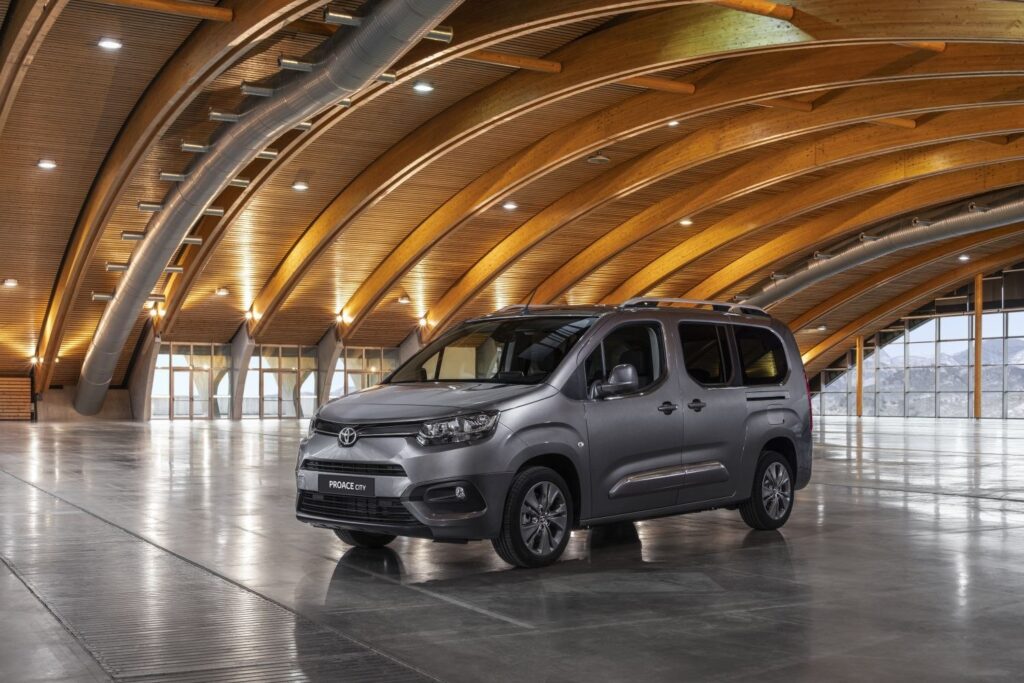
The design philosophy behind the Toyota Proace City Verso LWB is rooted in maximizing interior space and versatility within a compact footprint. As a minivan with five doors and seating for 5 to 7 occupants, its body type prioritizes functionality. The Long Wheelbase (LWB) variant, measuring 187.13 inches (4753 mm) in length, 72.76 inches (1848 mm) in width, and 71.26 inches (1810 mm) in height, provides generous interior dimensions, particularly for rear passengers and cargo.
The exterior styling is clean and functional, reflecting its utilitarian purpose while incorporating Toyota’s design cues to distinguish it from its Stellantis siblings. Large windows ensure excellent visibility, a boon for both drivers and passengers. Inside, the Proace City Verso LWB truly shines with its adaptable interior. Minimum trunk space starts at a substantial 806-850 liters (28.46 – 30.02 cu. ft.), which can expand to an cavernous 2693 liters (95.1 cu. ft.) with the rear seats folded down, making it exceptionally capable for hauling luggage, sports equipment, or even small furniture. This modularity is a core strength, allowing owners to easily switch between passenger transport and cargo duties.
In terms of features, the vehicle comes equipped with essential modern conveniences and safety systems. The electric power steering ensures light and responsive handling, crucial for navigating urban environments and parking. Safety is bolstered by an Anti-lock Braking System (ABS), and the vehicle features ventilated discs at the front and disc brakes at the rear for confident stopping power. The suspension system, with independent McPherson struts at the front and a torsion beam at the rear, is tuned to provide a comfortable ride, absorbing road imperfections effectively. Standard tire size is 205/60 R16, mounted on 16-inch wheel rims, providing a good balance of comfort and stability.
Technical Specifications: Toyota Proace City Verso LWB 1.2 Turbo (110 Hp)
| Category | Specification | Value |
|---|---|---|
| Brand | Toyota | |
| Model | Proace City | |
| Generation | Proace City Verso LWB | |
| Type (Engine) | 1.2 Turbo (110 Hp) | |
| Start of Production | April, 2020 | |
| Powertrain Architecture | Internal Combustion engine | |
| Body Type | Minivan | |
| Seats | 5-7 | |
| Doors | 5 | |
| Performance Specifications | ||
| Fuel Consumption (Urban, NEDC) | 6.3-6.4 l/100 km (37.3 – 36.8 US mpg) | |
| Fuel Consumption (Extra Urban, NEDC) | 4.8-4.9 l/100 km (49 – 48 US mpg) | |
| Fuel Consumption (Combined, NEDC) | 5.3-5.5 l/100 km (44.4 – 42.8 US mpg) | |
| CO2 Emissions (NEDC) | 121-125 g/km | |
| Fuel Type | Petrol (Gasoline) | |
| Emission Standard | Euro 6d-ISC-FCM | |
| Weight-to-Power Ratio | 12.9 kg/Hp, 77.5 Hp/tonne | |
| Weight-to-Torque Ratio | 6.9 kg/Nm, 144.4 Nm/tonne | |
| Engine Specifications | ||
| Power | 110 Hp @ 5500 rpm | |
| Power per Liter | 91.7 Hp/l | |
| Torque | 205 Nm @ 1750 rpm (151.2 lb.-ft. @ 1750 rpm) | |
| Engine Layout | Front, Transverse | |
| Engine Model/Code | HN05 | |
| Engine Displacement | 1199 cm³ (73.17 cu. in.) | |
| Number of Cylinders | 3 | |
| Engine Configuration | Inline | |
| Number of Valves per Cylinder | 4 | |
| Fuel Injection System | Direct injection | |
| Engine Aspiration | Turbocharger, Intercooler | |
| Valvetrain | OHC | |
| Engine Oil Capacity | 3.5 l (3.7 US qt) | |
| Engine Oil Specification | Not specified | |
| Engine Systems | Start & Stop System, Particulate filter | |
| Space, Volume and Weights | ||
| Kerb Weight | 1420 kg (3130.56 lbs) | |
| Max. Weight | 2240 kg (4938.35 lbs) | |
| Max Load | 820 kg (1807.79 lbs) | |
| Trunk (Boot) Space – Minimum | 806-850 l (28.46 – 30.02 cu. ft.) | |
| Trunk (Boot) Space – Maximum | 2693 l (95.1 cu. ft.) | |
| Fuel Tank Capacity | 61 l (16.11 US gal) | |
| Max. Roof Load | 150 kg (330.69 lbs) | |
| Permitted Trailer Load with Brakes (12%) | 1100 kg (2425.08 lbs) | |
| Permitted Trailer Load without Brakes | 750 kg (1653.47 lbs) | |
| Permitted Towbar Download | 74 kg (163.14 lbs) | |
| Dimensions | ||
| Length | 4753 mm (187.13 in.) | |
| Width | 1848 mm (72.76 in.) | |
| Height | 1810 mm (71.26 in.) | |
| Wheelbase | 2975 mm (117.13 in.) | |
| Front Track | 1553 mm (61.14 in.) | |
| Rear (Back) Track | 1567 mm (61.69 in.) | |
| Drivetrain, Brakes and Suspension Specifications | ||
| Drivetrain Architecture | The Internal combustion engine (ICE) drives the front wheels of the vehicle. | |
| Drive Wheel | Front wheel drive | |
| Number of Gears and Type of Gearbox | 6 gears, manual transmission | |
| Front Suspension | Independent type McPherson | |
| Rear Suspension | Torsion | |
| Front Brakes | Ventilated discs | |
| Rear Brakes | Disc | |
| Assisting Systems | ABS (Anti-lock braking system) | |
| Steering Type | Steering rack and pinion | |
| Power Steering | Electric Steering | |
| Tires Size | 205/60 R16 92H | |
| Wheel Rims Size | 16 | |
Legacy and Market Impact of the Toyota Proace City Verso LWB
The Toyota Proace City Verso LWB, particularly with its 1.2 Turbo (110 Hp) engine, holds a significant place in Toyota’s global strategy and the broader automotive landscape. Its existence is a direct result of a strategic partnership between Toyota and what is now Stellantis, a collaboration that allows Toyota to efficiently compete in segments where it traditionally had less presence, particularly in European light commercial vehicles (LCVs) and their passenger variants. This badge-engineered approach enables Toyota to offer a well-regarded, modern platform with its own branding and sales network, appealing to customers who value Toyota’s reputation for reliability and customer service.
In its primary markets, the Proace City Verso LWB competes in a fiercely contested segment against rivals such as the Renault Kangoo, Ford Tourneo Connect, Volkswagen Caddy, and its Stellantis siblings like the Citroën Berlingo and Peugeot Rifter. What sets the Toyota apart, beyond its badge, is its ability to blend the practicality of a van with the comfort and features expected of a modern passenger car. It’s often chosen by families and small businesses that prioritize interior space, fuel economy, and a robust build over purely stylistic considerations.
The vehicle’s impact is largely defined by its role as a highly practical and efficient people mover and cargo hauler. Its long wheelbase variant offers exceptional flexibility for seating configurations (5 to 7 seats) and a cavernous cargo area, making it ideal for large families, taxi services, or tradespeople. The efficient 1.2-liter turbocharged engine, coupled with a manual transmission, provides a cost-effective ownership experience through lower fuel consumption and reduced emissions, aligning with contemporary environmental standards.
While not a groundbreaking model in terms of revolutionary design or technology, the Proace City Verso LWB represents a smart, pragmatic solution for Toyota to expand its reach. Its legacy will likely be seen as a successful example of strategic collaboration, delivering a dependable, versatile, and economical vehicle that efficiently meets the diverse needs of its target demographic. It reinforces Toyota’s commitment to offering a comprehensive range of vehicles, even if it means sourcing proven platforms from other manufacturers to fill specific market niches. For many buyers outside the North American market, where large minivans are less common, the Proace City Verso LWB provides a compelling blend of utility, efficiency, and Toyota-backed peace of mind.