<!DOCTYPE html>
<html lang="en">
<head>
<meta charset="UTF-8">
<meta name="viewport" content="width=device-width, initial-scale=1.0">
<title>Opel Rekord E (facelift 1982) 1.8 S (90 Hp) – Expert Review</title>
</head>
<body>
<h2>The Opel Rekord E (facelift 1982) 1.8 S (90 Hp): A European Mainstay of the 1980s</h2>
<p>
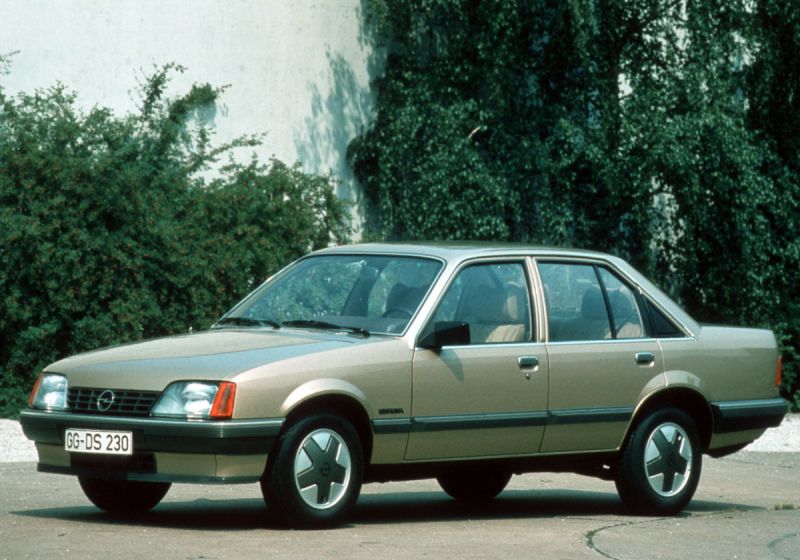
The <strong>Opel Rekord E (facelift 1982)</strong> 1.8 S (90 Hp) represents a significant chapter in the history of European mid-size to large family sedans. Produced by the German automaker Opel, a subsidiary of General Motors, the Rekord line had been a staple across the continent for decades, known for its robust construction, practicality, and reliable performance. The E-generation, initially launched in 1977, received a crucial facelift in September 1982, bringing subtle but effective updates that sustained its competitiveness in the fiercely contested European market until its discontinuation in August 1986. This particular variant, the 1.8 S, was a popular choice, striking a balance between adequate power and commendable fuel economy, making it a workhorse for families and business fleets alike. While never officially sold in the United States, the Rekord E played a vital role in defining the automotive landscape in Europe during the early to mid-1980s, embodying the pragmatic approach to motoring that characterized the era.
</p>
<h3>Powertrain and Performance of the Opel Rekord E (facelift 1982)</h3>
<p>
Under the hood, the <strong>Opel Rekord E (facelift 1982)</strong> 1.8 S featured a naturally aspirated, inline four-cylinder gasoline engine, designated by the code 18S. This unit boasted a displacement of 1,796 cubic centimeters (approximately 1.8 liters or 109.6 cu. in.). Adhering to the common engineering practices of its time, the engine utilized a Carburetor fuel injection system and a Single Overhead Camshaft (SOHC) valvetrain with two valves per cylinder, a configuration renowned for its simplicity and durability.
</p>
<p>
The 1.8 S engine delivered a respectable 90 horsepower at 5,400 rpm, which, for a family sedan of the early 1980s, provided sufficient motivation for daily driving and highway cruising. Torque output stood at 105.47 lb.-ft., available across a useful band from 3,000 to 3,400 rpm. This broad torque curve ensured decent tractability and reduced the need for frequent gear changes, contributing to a relaxed driving experience. Power was transmitted to the rear wheels via a five-speed manual transmission, a relatively advanced feature for a mainstream car of this period, offering improved fuel efficiency and quieter highway operation compared to older four-speed units.
</p>
<p>
In terms of raw performance, the Rekord 1.8 S could accelerate from 0 to 60 mph in a calculated 13.3 seconds, with a maximum speed of 107.5 mph. While these figures might seem modest by today’s standards, they were competitive for its segment and purpose. More importantly for its target audience, the vehicle achieved a combined fuel economy rating of approximately 29 US mpg (8.1 liters per 100 km), which was a strong selling point in an era increasingly conscious of fuel costs. The weight-to-power ratio of 12.4 kg/Hp (80.7 Hp/tonne) further underscores its balanced performance for its class.
</p>
<h3>Design and Features: Practicality Meets Subtle Evolution</h3>
<p>
The <strong>Opel Rekord E (facelift 1982)</strong> maintained the robust and somewhat conservative styling that characterized its predecessor, while incorporating subtle refinements. As a traditional four-door sedan with seating for five, its design prioritized interior space and practicality. The facelift brought minor cosmetic changes, primarily to the grille, headlights, and taillights, aimed at modernizing its appearance and improving aerodynamic efficiency. With a drag coefficient (Cd) of 0.36, the Rekord E was quite aerodynamically efficient for its time, contributing to both fuel economy and reduced wind noise at speed.
</p>
<p>
Dimensions were generous for its segment, measuring 183.15 inches in length, 67.95 inches in width, and 55.91 inches in height, with a wheelbase of 105.04 inches. These proportions translated into a spacious cabin capable of comfortably accommodating five adults and a substantial trunk space of 17.3 cubic feet (490 liters), making it an ideal vehicle for family vacations or business use. The Rekord E was built with durability in mind, featuring a solid chassis and conventional suspension setup: ventilated disc brakes at the front and drum brakes at the rear, a standard configuration for many European cars of the period, offering reliable stopping power for its performance envelope. Its minimum turning circle of 35.43 feet (10.8 meters) provided decent maneuverability in urban environments. The vehicle’s kerb weight of 2,458.15 lbs (1,115 kg) highlighted its solid, if not overly heavy, construction.
</p>
<h3>Technical Specifications</h3>
<table border="1" style="width:100%; border-collapse: collapse;">
<tr><td style="padding: 8px;" colspan="2"><strong>General Information</strong></td></tr>
<tr><td style="padding: 8px;">Brand</td><td style="padding: 8px;">Opel</td></tr>
<tr><td style="padding: 8px;">Model</td><td style="padding: 8px;">Rekord</td></tr>
<tr><td style="padding: 8px;">Generation</td><td style="padding: 8px;">Rekord E (facelift 1982)</td></tr>
<tr><td style="padding: 8px;">Type (Engine)</td><td style="padding: 8px;">1.8 S (90 Hp)</td></tr>
<tr><td style="padding: 8px;">Start of Production</td><td style="padding: 8px;">September, 1982</td></tr>
<tr><td style="padding: 8px;">End of Production</td><td style="padding: 8px;">August, 1986</td></tr>
<tr><td style="padding: 8px;">Powertrain Architecture</td><td style="padding: 8px;">Internal Combustion engine</td></tr>
<tr><td style="padding: 8px;">Body Type</td><td style="padding: 8px;">Sedan</td></tr>
<tr><td style="padding: 8px;">Seats</td><td style="padding: 8px;">5</td></tr>
<tr><td style="padding: 8px;">Doors</td><td style="padding: 8px;">4</td></tr>
<tr><td style="padding: 8px;" colspan="2"><strong>Performance Specifications</strong></td></tr>
<tr><td style="padding: 8px;">Fuel Consumption (combined)</td><td style="padding: 8px;">8.1 l/100 km (29 US mpg)</td></tr>
<tr><td style="padding: 8px;">Fuel Type</td><td style="padding: 8px;">Petrol (Gasoline)</td></tr>
<tr><td style="padding: 8px;">Acceleration 0 – 60 mph</td><td style="padding: 8px;">13.3 sec</td></tr>
<tr><td style="padding: 8px;">Maximum Speed</td><td style="padding: 8px;">173 km/h (107.5 mph)</td></tr>
<tr><td style="padding: 8px;">Weight-to-Power Ratio</td><td style="padding: 8px;">12.4 kg/Hp (80.7 Hp/tonne)</td></tr>
<tr><td style="padding: 8px;">Weight-to-Torque Ratio</td><td style="padding: 8px;">7.8 kg/Nm (128.3 Nm/tonne)</td></tr>
<tr><td style="padding: 8px;" colspan="2"><strong>Engine Specifications</strong></td></tr>
<tr><td style="padding: 8px;">Power</td><td style="padding: 8px;">90 Hp @ 5400 rpm</td></tr>
<tr><td style="padding: 8px;">Power per Liter</td><td style="padding: 8px;">50.1 Hp/l</td></tr>
<tr><td style="padding: 8px;">Torque</td><td style="padding: 8px;">143 Nm (105.47 lb.-ft.) @ 3000-3400 rpm</td></tr>
<tr><td style="padding: 8px;">Engine Model/Code</td><td style="padding: 8px;">18S</td></tr>
<tr><td style="padding: 8px;">Engine Displacement</td><td style="padding: 8px;">1796 cm<sup>3</sup> (1.8 Liters / 109.6 cu. in.)</td></tr>
<tr><td style="padding: 8px;">Number of Cylinders</td><td style="padding: 8px;">4</td></tr>
<tr><td style="padding: 8px;">Engine Configuration</td><td style="padding: 8px;">Inline</td></tr>
<tr><td style="padding: 8px;">Cylinder Bore</td><td style="padding: 8px;">84.8 mm (3.34 in.)</td></tr>
<tr><td style="padding: 8px;">Piston Stroke</td><td style="padding: 8px;">79.5 mm (3.13 in.)</td></tr>
<tr><td style="padding: 8px;">Compression Ratio</td><td style="padding: 8px;">9.2:1</td></tr>
<tr><td style="padding: 8px;">Number of Valves per Cylinder</td><td style="padding: 8px;">2</td></tr>
<tr><td style="padding: 8px;">Fuel Injection System</td><td style="padding: 8px;">Carburetor</td></tr>
<tr><td style="padding: 8px;">Engine Aspiration</td><td style="padding: 8px;">Naturally aspirated engine</td></tr>
<tr><td style="padding: 8px;">Valvetrain</td><td style="padding: 8px;">SOHC</td></tr>
<tr><td style="padding: 8px;">Engine Oil Capacity</td><td style="padding: 8px;">3.75 l (3.96 US qt)</td></tr>
<tr><td style="padding: 8px;">Coolant Capacity</td><td style="padding: 8px;">6 l (6.34 US qt)</td></tr>
<tr><td style="padding: 8px;" colspan="2"><strong>Space, Volume and Weights</strong></td></tr>
<tr><td style="padding: 8px;">Kerb Weight</td><td style="padding: 8px;">1115 kg (2458.15 lbs)</td></tr>
<tr><td style="padding: 8px;">Max. Weight</td><td style="padding: 8px;">1655 kg (3648.65 lbs)</td></tr>
<tr><td style="padding: 8px;">Max Load</td><td style="padding: 8px;">540 kg (1190.5 lbs)</td></tr>
<tr><td style="padding: 8px;">Trunk (boot) Space – minimum</td><td style="padding: 8px;">490 l (17.3 cu. ft.)</td></tr>
<tr><td style="padding: 8px;">Fuel Tank Capacity</td><td style="padding: 8px;">65 l (17.17 US gal)</td></tr>
<tr><td style="padding: 8px;">Permitted Trailer Load with Brakes (12%)</td><td style="padding: 8px;">1000 kg (2204.62 lbs)</td></tr>
<tr><td style="padding: 8px;" colspan="2"><strong>Dimensions</strong></td></tr>
<tr><td