
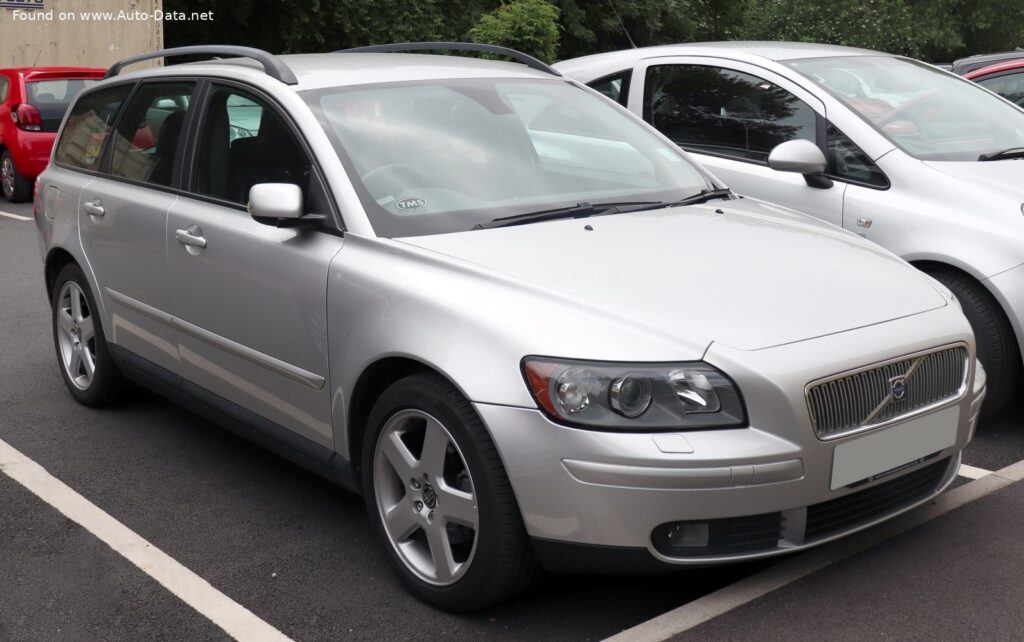
The Volvo V50 2.4 i 20V (170 Hp): A Blend of Practicality and Scandinavian Style
The Volvo V50, introduced in 2004, represented a significant evolution in Volvo’s compact executive lineup, succeeding the popular V40. Positioned as a premium compact station wagon (often referred to as an “estate” in European markets), the V50 shared its platform with the S40 sedan and the Ford C1 global platform, which also underpinned the Ford Focus and Mazda3. This strategic platform sharing allowed Volvo to imbue the V50 with a more dynamic driving experience while retaining the brand’s core values of safety, practicality, and sophisticated Scandinavian design. The specific variant under review, the Volvo V50 2.4 i 20V (170 Hp), was a popular choice in its primary European markets, offering a robust naturally aspirated five-cylinder engine that delivered a harmonious blend of power and refinement. Produced from 2004 to 2007, this model catered to buyers seeking a versatile vehicle with an upscale feel, without the larger footprint of Volvo’s traditional full-size wagons.
Engine and Performance of the Volvo V50 2.4 i 20V (170 Hp)
At the heart of the Volvo V50 2.4 i 20V (170 Hp) lies a distinctive 2.4-liter (2435 cm3 or 148.59 cu. in.) naturally aspirated inline five-cylinder engine, designated by Volvo as the B5244S4. This powerplant was a hallmark of Volvo engineering, renowned for its smooth power delivery, characteristic exhaust note, and inherent balance. With a DOHC (Double Overhead Camshaft) valvetrain and four valves per cylinder, this engine was designed for efficient breathing and responsiveness. It produced a respectable 170 horsepower at 5900 rpm, translating to a power-per-liter output of 69.8 horsepower per liter.
Torque figures were equally impressive for a naturally aspirated unit of its era, peaking at 230 Nm (169.64 lb.-ft.) at 4500 rpm. This robust torque output contributed significantly to the V50’s everyday drivability, providing ample pulling power for highway cruising and city commutes. The engine’s front, transverse layout, coupled with a front-wheel-drive architecture, ensured predictable handling and efficient packaging.
Power was transmitted through a five-speed manual transmission, offering direct engagement and control for the driver. This combination allowed the V50 2.4 i 20V (170 Hp) to accelerate from 0 to 60 mph in a brisk 8.6 seconds (0-100 km/h in 9 seconds), with a top speed of 124.27 mph (200 km/h). These performance metrics placed it competitively within its segment, offering a sporty yet comfortable driving experience. The car’s weight-to-power ratio stood at 8.5 kg/Hp (117.1 Hp/tonne), while the weight-to-torque ratio was 6.3 kg/Nm (158.4 Nm/tonne), indicating a well-balanced power-to-weight characteristic for its class. Fuel economy for the combined cycle was rated at 27.4 US mpg (8.6 l/100 km), with CO2 emissions of 204 g/km, reflecting a balance between performance and efficiency for a mid-2000s gasoline engine.
Design and Features
The Volvo V50 embodied Volvo’s contemporary design language of the mid-2000s, characterized by clean lines, a strong shoulder, and a distinctive rear tailgate. As a five-door station wagon (estate), it seamlessly blended the practicality of a cargo-friendly vehicle with the sleek aesthetics of a premium sedan. Its dimensions—177.72 inches (4514 mm) in length, 69.69 inches (1770 mm) in width, and 57.17 inches (1452 mm) in height—made it a compact and maneuverable vehicle suitable for urban environments, yet spacious enough for family duties. The wheelbase measured 103.94 inches (2640 mm), contributing to a stable ride and generous interior room.
Inside, the V50 showcased Volvo’s commitment to ergonomic design and high-quality materials. The cabin featured Volvo’s signature “floating” center console, a design innovation that provided a sense of lightness and allowed for clever storage behind the panel. Seating for five occupants was standard, with Volvo’s well-regarded seats offering excellent long-distance comfort and support. The trunk (boot) space was practical, ranging from 14.73 cu. ft. (417 liters) with the rear seats up to a capacious 46.16 cu. ft. (1307 liters) when folded down, highlighting its versatility as a utility vehicle.
Safety, as always with Volvo, was a paramount consideration. The V50 came equipped with a comprehensive suite of safety features for its time, including ABS (Anti-lock Braking System), a robust passenger safety cell, and multiple airbags. The braking system featured ventilated discs at the front and solid discs at the rear, providing strong and consistent stopping power. The suspension system, with transverse stabilizers at both the front and rear, was tuned to offer a comfortable ride while maintaining composed handling. The steering was a rack and pinion type, offering precise control and feedback to the driver.
Technical Specifications: Volvo V50 2.4 i 20V (170 Hp)
| Category | Specification | US Equivalent |
|---|---|---|
General Information |
||
| Brand | Volvo | |
| Model | V50 | |
| Generation | V50 | |
| Type (Engine) | 2.4 i 20V (170 Hp) | |
| Start of Production | 2004 year | |
| End of Production | 2007 year | |
| Powertrain Architecture | Internal Combustion engine | |
| Body type | Station wagon (estate) | |
| Seats | 5 | |
| Doors | 5 | |
Performance Specs |
||
| Fuel Consumption (combined) | 8.6 l/100 km | 27.4 US mpg |
| CO2 Emissions | 204 g/km | |
| Fuel Type | Petrol (Gasoline) | |
| Acceleration 0 – 60 mph | 8.6 sec | |
| Acceleration 0 – 100 km/h | 9 sec | |
| Maximum Speed | 200 km/h | 124.27 mph |
| Weight-to-power ratio | 8.5 kg/Hp | 117.1 Hp/tonne |
| Weight-to-torque ratio | 6.3 kg/Nm | 158.4 Nm/tonne |
Engine Specs |
||
| Power | 170 Hp @ 5900 rpm | |
| Power per liter | 69.8 Hp/l | |
| Torque | 230 Nm @ 4500 rpm | 169.64 lb.-ft. @ 4500 rpm |
| Engine Layout | Front, Transverse | |
| Engine Model/Code | B5244S4 | |
| Engine Displacement | 2435 cm3 | 2.4 liters / 148.59 cu. in. |
| Number of Cylinders | 5 | |
| Engine Configuration | Inline | |
| Cylinder Bore | 83 mm | 3.27 in. |
| Piston Stroke | 90 mm | 3.54 in. |
| Compression Ratio | 10.3:1 | |
| Valves per Cylinder | 4 | |
| Fuel Injection System | Multi-port manifold injection | |
| Engine Aspiration | Naturally aspirated engine | |
| Valvetrain | DOHC | |
| Engine Oil Capacity | 5.8 l | 6.13 US qt |
| Engine Oil Specification | (Details in owner’s manual) | |
| Coolant Capacity | 8 l | 8.45 US qt |
Space, Volume and Weights |
||
| Kerb Weight | 1452 kg | 3201.11 lbs. |
| Trunk (boot) Space – minimum | 417 l | 14.73 cu. ft. |
| Trunk (boot) Space – maximum | 1307 l | 46.16 cu. ft. |
| Fuel Tank Capacity | 62 l | 16.38 US gal |
Dimensions |
||
| Length | 4514 mm | 177.72 in. |
| Width | 1770 mm | 69.69 in. |
| Height | 1452 mm | 57.17 in. |
| Wheelbase | 2640 mm | 103.94 in. |
| Front Track | 1535 mm | 60.43 in. |
| Rear (Back) Track | 1531 mm | 60.28 in. |
Drivetrain, Brakes and Suspension Specs |
||
| Drivetrain Architecture | Internal combustion engine (ICE) drives front wheels | |
| Drive Wheel | Front wheel drive | |
| Number of Gears and Type | 5 gears, manual transmission | |
| Front Suspension | Transverse stabilizer | |
| Rear Suspension | Transverse stabilizer | |
| Front Brakes | Ventilated discs | |
| Rear Brakes | Ventilated discs | |
| Assisting Systems | ABS (Anti-lock braking system) | |
| Steering Type | Steering rack and pinion | |
Legacy and Market Impact
The Volvo V50, particularly the 2.4 i 20V (170 Hp) variant, played a crucial role in Volvo’s strategy to broaden its appeal beyond its traditional, somewhat staid, image. It aimed to capture a younger, more design-conscious demographic that still valued safety and practicality. While Volvo is a well-established brand in the United States, the V50, like its S40 sedan counterpart, found a particularly strong foothold in European markets, where compact premium wagons are a highly competitive and popular segment.
In its competitive landscape, the V50 squared off against formidable rivals such as the BMW 3 Series Touring, Audi A4 Avant, and Mercedes-Benz C-Class Estate. What set the V50 apart was its distinctive Scandinavian aesthetic, its unwavering commitment to safety, and the unique character of its five-cylinder engine. While the German competitors often emphasized sportiness and driving dynamics, the V50 offered a more understated, comfort-oriented, and practical alternative, without sacrificing a refined driving experience. Its front-wheel-drive architecture (though AWD options were available on other V50 variants) and compact dimensions made it an agile and efficient choice for navigating European cities and highways.
The V50’s reputation was built on its solid build quality, comfortable interior, and high safety ratings, continuing Volvo’s long-standing tradition. Its practical cargo space, combined with a relatively compact exterior, made it an ideal family car for those who didn’t need the bulk of a larger SUV or full-size wagon. The 2.4-liter five-cylinder engine, in particular, was praised for its durability and smooth power delivery, contributing to a premium feel that belied its compact size.
Although the V50 was eventually replaced by the V60 in 2011, its legacy is significant. It demonstrated Volvo’s ability to innovate within the compact segment, blending design, safety, and performance in a compelling package. The Volvo V50 2.4 i 20V (170 Hp) remains a testament to Volvo’s engineering prowess, offering a timeless blend of utility, comfort, and distinctive Swedish character that continues to be appreciated by enthusiasts and practical-minded drivers alike. It solidified Volvo’s position as a serious contender in the premium compact market, paving the way for future generations of stylish and capable Volvo models.
