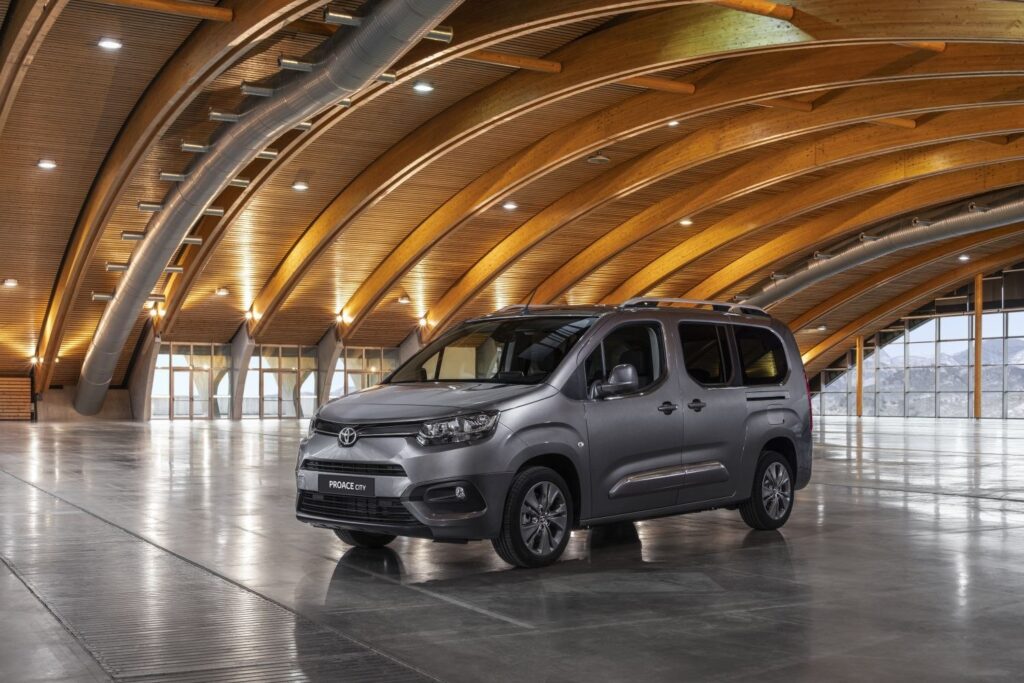
Toyota Proace City Verso LWB 1.5 D-4D (130 Hp): A Comprehensive Overview
The Toyota Proace City Verso LWB 1.5 D-4D (130 Hp) represents a compelling entry into the European compact minivan segment, offering a versatile and efficient solution for families and businesses alike. Launched in April 2020, this specific variant, with its long wheelbase (LWB) and robust 1.5-liter D-4D diesel engine, is a testament to Toyota’s strategic expansion in the light commercial vehicle (LCV) and passenger van markets outside of North America. While not available in the United States, the Proace City Verso plays a crucial role in Toyota’s European lineup, providing a practical and cost-effective alternative to traditional SUVs and larger minivans. It is a product of a collaborative effort, sharing its platform and core components with models from Stellantis (formerly PSA Group), such as the Citroën Berlingo, Peugeot Rifter, and Opel Combo Life, allowing Toyota to leverage established engineering prowess for rapid market entry.
Designed for maximum utility and passenger comfort, the Proace City Verso LWB distinguishes itself with its adaptable interior, generous cargo capacity, and a focus on fuel efficiency—attributes highly valued in its primary markets. Its development reflects a growing demand for multi-purpose vehicles that can effortlessly transition between family transporter and light-duty workhorse. This article delves into the technical specifications, design philosophies, and market positioning of the Toyota Proace City Verso LWB 1.5 D-4D (130 Hp), providing an international automotive expert’s perspective on its significance.
Engine and Performance Characteristics of the Toyota Proace City Verso LWB
Underpinning the Toyota Proace City Verso LWB 1.5 D-4D (130 Hp) is a highly optimized 1.5-liter D-4D inline-four diesel engine, designated with the internal code YH01. This powerplant is engineered for a balance of robust performance and exceptional fuel economy, making it particularly well-suited for the demands of European driving cycles. It delivers a respectable 130 horsepower at 3750 rpm, providing ample power for both urban commuting and highway cruising, even when fully loaded. Torque output is a significant highlight, peaking at 221.27 lb.-ft. (300 Nm) at a low 1750 rpm, which ensures strong acceleration from a standstill and effortless overtaking maneuvers without needing to frequently downshift.
The engine’s advanced architecture includes a common rail direct fuel injection system, a turbocharger with an intercooler, and a four-valve-per-cylinder OHC valvetrain, all contributing to its efficient operation. Furthermore, the inclusion of a Start & Stop System and a particulate filter helps the vehicle meet stringent Euro 6d-ISC-FCM emission standards, demonstrating Toyota’s commitment to environmental responsibility. The powertrain architecture is a straightforward front-wheel-drive setup, with the engine mounted transversely at the front. Power is routed through a precise 6-speed manual transmission, offering drivers direct control and further aiding in maximizing fuel efficiency.
In terms of fuel consumption, the 1.5 D-4D engine excels. According to NEDC figures, the combined fuel economy ranges from 54.7 to 56 US mpg (4.2-4.3 l/100 km). Urban driving yields 49 to 50 US mpg (4.7-4.8 l/100 km), while extra-urban conditions can see figures as high as 58.8 to 60.3 US mpg (3.9-4 l/100 km). These figures underscore the diesel engine’s inherent efficiency, making the Proace City Verso an economical choice for high-mileage users. The CO2 emissions are equally impressive, ranging from 111-113 g/km, reflecting its clean diesel technology. The vehicle’s weight-to-power ratio stands at 12.6 kg/Hp (79.6 Hp/tonne), indicating a responsive feel for its class, while the weight-to-torque ratio of 5.4 kg/Nm (183.7 Nm/tonne) highlights its strong pulling capabilities.
Design and Features: Practicality Meets Modernity
The Toyota Proace City Verso LWB adopts a functional and contemporary minivan body type, characterized by its five-door configuration and capacity for 5 to 7 passengers. The “Long Wheelbase” designation is key here, stretching the vehicle to 187.13 inches (4753 mm) in length and providing a generous wheelbase of 117.13 inches (2975 mm). This extended platform not only enhances ride comfort and stability but also significantly boosts interior space, particularly for rear passengers and cargo.
From a design perspective, the Proace City Verso features a clean, utilitarian aesthetic, typical of modern European vans, albeit with Toyota’s signature design cues integrated into the front fascia. Its dimensions—72.76 inches (1848 mm) wide and 71.26 inches (1810 mm) tall—contribute to a spacious cabin while maintaining a manageable footprint for urban environments. The large windows and sliding rear doors (common in this segment) facilitate easy entry and exit, especially in tight parking spots, and provide excellent visibility.
Inside, the emphasis is on versatility and practicality. The seating arrangement, offering either five or seven seats, can be configured to prioritize passenger capacity or cargo volume. With all seats in place, the minimum trunk space is a substantial 28.46 to 30.02 cubic feet (806-850 liters). When the rear seats are folded or removed, the cargo capacity expands dramatically to a cavernous 95.1 cubic feet (2693 liters), rivaling that of much larger SUVs and making it ideal for hauling bulky items or equipment. This adaptability is a cornerstone of the Proace City Verso’s appeal.
The vehicle’s chassis is designed for comfort and predictable handling. It features an independent McPherson strut suspension at the front, known for its ability to provide a good balance between ride quality and steering responsiveness. The rear employs a torsion beam suspension, a robust and space-efficient design common in utility vehicles that allows for a low load floor and high carrying capacity. Braking is handled by ventilated discs at the front and solid discs at the rear, complemented by an Anti-lock Braking System (ABS) for enhanced safety. Electric power steering ensures light and precise control, particularly beneficial in city driving and parking maneuvers. The 205/60 R16 tires on 16-inch wheels provide a comfortable ride and adequate grip.
Technical Specifications: Toyota Proace City Verso LWB 1.5 D-4D (130 Hp)
| Category | Specification | US Equivalent |
|---|---|---|
| General Information | ||
| Brand | Toyota | |
| Model | Proace City Verso LWB | |
| Engine Type | 1.5 D-4D (130 Hp) | |
| Production Start | April, 2020 | |
| Body Type | Minivan | |
| Doors | 5 | |
| Seats | 5-7 | |
| Performance Specs | ||
| Fuel Consumption (Urban, NEDC) | 4.7-4.8 l/100 km | 50 – 49 US mpg |
| Fuel Consumption (Extra Urban, NEDC) | 3.9-4 l/100 km | 60.3 – 58.8 US mpg |
| Fuel Consumption (Combined, NEDC) | 4.2-4.3 l/100 km | 56 – 54.7 US mpg |
| CO2 Emissions (NEDC) | 111-113 g/km | |
| Fuel Type | Diesel | |
| Emission Standard | Euro 6d-ISC-FCM | |
| Weight-to-Power Ratio | 12.6 kg/Hp | |
| Weight-to-Torque Ratio | 5.4 kg/Nm | |
| Engine Specs | ||
| Power | 130 Hp @ 3750 rpm | 130 Hp @ 3750 rpm |
| Power per liter | 86.7 Hp/l | |
| Torque | 300 Nm @ 1750 rpm | 221.27 lb.-ft. @ 1750 rpm |
| Engine Layout | Front, Transverse | |
| Engine Model/Code | YH01 | |
| Engine Displacement | 1499 cm3 | 91.47 cu. in. |
| Number of Cylinders | 4 | |
| Engine Configuration | Inline | |
| Valves per Cylinder | 4 | |
| Fuel Injection System | Diesel Commonrail | |
| Engine Aspiration | Turbocharger, Intercooler | |
| Valvetrain | OHC | |
| Engine Oil Capacity | 4 l | 4.23 US qt |
| Engine Oil Specification | Not specified | |
| Engine Systems | Start & Stop System, Particulate Filter | |
| Space, Volume and Weights | ||
| Kerb Weight | 1633 kg | 3600.15 lbs. |
| Max. Weight (Gross) | 2310 kg | 5092.68 lbs. |
| Max Load | 677 kg | 1492.53 lbs. |
| Trunk Space (Minimum) | 806-850 l | 28.46 – 30.02 cu. ft. |
| Trunk Space (Maximum) | 2693 l | 95.1 cu. ft. |
| Fuel Tank Capacity | 50 l | 13.21 US gal |
| AdBlue Tank | 17 l | 4.49 US gal |
| Max. Roof Load | 150 kg | 330.69 lbs. |
| Permitted Trailer Load (with brakes) | 1450 kg | 3196.7 lbs. |
| Permitted Trailer Load (without brakes) | 750 kg | 1653.47 lbs. |
| Permitted Towbar Download | 74 kg | 163.14 lbs. |
| Dimensions | ||
| Length | 4753 mm | 187.13 in. |
| Width | 1848 mm | 72.76 in. |
| Height | 1810 mm | 71.26 in. |
| Wheelbase | 2975 mm | 117.13 in. |
| Front Track | 1553 mm | 61.14 in. |
| Rear Track | 1567 mm | 61.69 in. |
| Drivetrain, Brakes and Suspension | ||
| Drivetrain Architecture | Front-wheel drive, Internal Combustion Engine | |
| Drive Wheel | Front-wheel drive | |
| Gearbox | 6 gears, manual transmission | |
| Front Suspension | Independent type McPherson | |
| Rear Suspension | Torsion | |
| Front Brakes | Ventilated discs | |
| Rear Brakes | Disc | |
| Assisting Systems | ABS (Anti-lock braking system) | |
| Steering Type | Steering rack and pinion | |
| Power Steering | Electric Steering | |
| Tire Size | 205/60 R16 92H | |
| Wheel Rims Size | 16 inch |
Legacy and Market Impact in the European Segment
The Toyota Proace City Verso LWB, particularly with its efficient 1.5 D-4D (130 Hp) engine, has carved out a significant niche in the highly competitive European compact minivan and leisure activity vehicle (LAV) segment since its introduction in 2020. Its existence is a direct result of a strategic alliance between Toyota and Stellantis (formerly PSA Group), where Toyota rebadges and sells versions of the Citroën Berlingo, Peugeot Rifter, and Opel Combo Life. This collaboration allows Toyota to offer a comprehensive range of LCVs and passenger-focused variants without the substantial investment in developing a bespoke platform for a segment where they historically had a limited presence.
In Europe, the Proace City Verso competes against a strong field of rivals, including the Volkswagen Caddy, Ford Tourneo Connect, and the Renault Kangoo, as well as its platform siblings. What sets the Toyota apart, beyond its shared engineering, is the brand’s reputation for reliability and durability. Toyota’s strong image for quality and customer satisfaction often translates into consumer confidence, even for a model that isn’t entirely an in-house design. This “badge engineering” strategy has proven effective, allowing Toyota to capture market share in a segment that prioritizes practicality, low running costs, and versatility.
The long-wheelbase variant, specifically, appeals to a diverse customer base, from large families needing flexible seating and ample luggage space for vacations, to small businesses requiring a vehicle that can double as a passenger shuttle and a cargo carrier. The high maximum load capacity of 1492.53 lbs. (677 kg) and impressive towing capabilities (3196.7 lbs. with brakes) further enhance its utility, making it a truly multi-purpose vehicle. The efficient diesel engine, with its excellent fuel economy and low emissions, aligns perfectly with European market preferences and regulatory demands, making it an attractive proposition for both private and fleet buyers concerned with operational costs and environmental impact.
The legacy of the Toyota Proace City Verso LWB is rooted in its ability to effectively bridge the gap between a traditional passenger car and a light commercial van. It represents a modern take on the minivan concept, emphasizing smart packaging, advanced diesel technology, and a strong value proposition. By offering a vehicle that is robust, economical, and incredibly adaptable, Toyota has solidified its position in a crucial European segment, proving that strategic partnerships can yield highly successful and relevant products for specific regional markets, even if those products do not grace the showrooms of North America.