The Suzuki Grand Vitara II (facelift 2008) 3 Door 1.6 (106 Hp) AWD: A Compact Off-Roader for the Global Market
The Suzuki Grand Vitara II (facelift 2008) 3 Door 1.6 (106 Hp) AWD represents a distinct chapter in the lineage of Suzuki’s compact SUV offerings, particularly catering to markets outside of the United States where smaller displacement engines and three-door configurations held significant appeal. Produced from May 2010 to September 2011, this specific variant of the second-generation Grand Vitara, which itself debuted in 2005, showcased Suzuki’s commitment to combining a rugged, capable off-road chassis with a more refined on-road demeanor. While the larger, five-door Grand Vitara with more powerful engines was available in North America, this 1.6-liter, three-door model was a common sight across Europe, Asia, and other international markets, prized for its maneuverability, compact dimensions, and genuine all-wheel-drive capability in a segment increasingly dominated by car-based crossovers.
Positioned as a versatile compact SUV, the Suzuki Grand Vitara II (facelift 2008) 3 Door 1.6 (106 Hp) AWD bridged the gap between smaller urban utility vehicles and more substantial full-size SUVs. Its facelift in 2008 brought subtle styling enhancements and technical refinements, ensuring its competitiveness in a rapidly evolving market. This particular iteration, with its modest yet efficient 1.6-liter engine, emphasized practicality, fuel economy, and accessibility, making it an attractive option for buyers seeking a reliable and adventurous vehicle without the bulk or running costs of larger alternatives.
Engine and Performance
At the heart of the Suzuki Grand Vitara II (facelift 2008) 3 Door 1.6 (106 Hp) AWD lies the M16A engine, a naturally aspirated 1.6-liter (1586 cm3 or 96.78 cu. in.) inline four-cylinder gasoline unit. This powerplant delivers a respectable 106 horsepower at 5900 rpm and 107 lb-ft of torque at 4100 rpm. While these figures might seem modest by American standards, they are well-suited for the vehicle’s compact size and intended markets, providing adequate propulsion for daily driving and light off-road excursions.
The engine features a multi-port manifold injection system and a VVT (Variable Valve Timing) valvetrain, contributing to its efficiency and responsiveness across the rev range. With a compression ratio of 10.5:1, it was designed to run on readily available gasoline. Power is channeled through a precise 5-speed manual transmission, offering drivers direct control and engagement, particularly beneficial in varied terrain. The permanent all-wheel-drive (AWD) architecture ensures power is delivered to all four wheels, enhancing traction and stability in challenging conditions, a hallmark of Suzuki’s SUV philosophy.
Performance figures for the Suzuki Grand Vitara II (facelift 2008) 3 Door 1.6 (106 Hp) AWD reflect its practical orientation rather than outright speed. It accelerates from 0 to 60 mph in a calculated 13.7 seconds, reaching a maximum speed of 99.42 mph (160 km/h). Fuel economy, measured under the NEDC standard, is a combined 28.7 US mpg (8.2 l/100 km), with urban consumption at 23.1 US mpg (10.2 l/100 km) and extra-urban at 33.1 US mpg (7.1 l/100 km). These figures, combined with CO2 emissions of 195 g/km, placed it in line with Euro 5 emission standards, highlighting its relative efficiency for an AWD vehicle of its time.
Design and Features of the Grand Vitara II
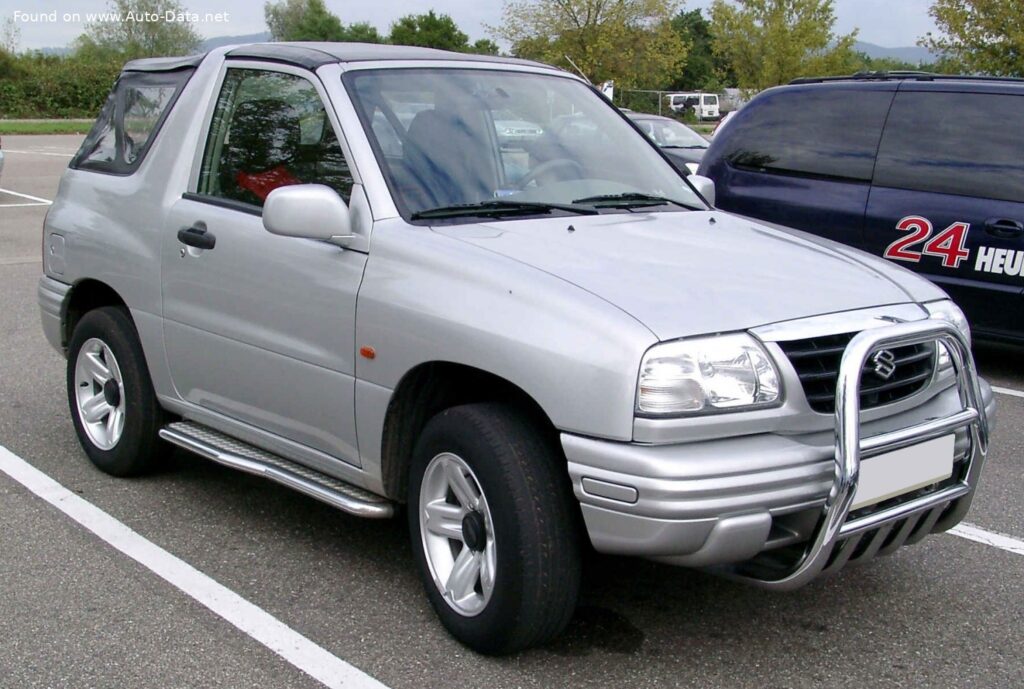
The Suzuki Grand Vitara II (facelift 2008) 3 Door maintains the rugged yet refined aesthetic that characterized the second-generation model. Its three-door body type, measuring 163.39 inches in length, 73.62 inches in width, and 66.73 inches in height, gives it a notably compact footprint. This design choice not only contributes to its maneuverability in urban environments but also enhances its agility on narrow trails, making it a favorite for those who value off-road capability in a smaller package.
The exterior design features a prominent grille, robust fender flares, and a relatively high ground clearance of 8.07 inches, all signaling its adventurous spirit. The rear-mounted spare tire, a classic SUV styling cue, further reinforces its utility and readiness for the outdoors. Inside, the Grand Vitara II 3 Door offers seating for four passengers, providing a functional and durable cabin. The trunk space is surprisingly versatile for its size, offering a minimum of 18.22 cu. ft. (516 liters) and expanding to a maximum of 34.04 cu. ft. (964 liters) with the rear seats folded, catering to various cargo needs.
In terms of chassis and safety, the Grand Vitara II employs an independent McPherson strut front suspension and an independent multi-link rear suspension, a setup that provides a good balance between on-road comfort and off-road articulation. Braking is handled by ventilated discs at the front and drum brakes at the rear, complemented by an Anti-lock Braking System (ABS) for enhanced stopping control. The steering system is a rack and pinion type with electric power steering, offering ease of maneuverability, particularly in tight parking spaces or during off-road navigation. Standard tire sizes ranged from 215/70 R16 to 225/65 R17, mounted on 16-inch or 17-inch wheel rims, providing ample grip and a comfortable ride.
Technical Specifications
| Category | Specification | US Equivalent |
|---|---|---|
| General Information | ||
| Brand | Suzuki | |
| Model | Grand Vitara | |
| Generation | Grand Vitara II (facelift 2008) 3 Door | |
| Engine Type | 1.6 (106 Hp) AWD | |
| Production Start | May, 2010 | |
| Production End | September, 2011 | |
| Powertrain Architecture | Internal Combustion Engine | |
| Body Type | SUV | |
| Seats | 4 | |
| Doors | 3 | |
| Performance Specs | ||
| Fuel Consumption (Urban NEDC) | 10.2 l/100 km | 23.1 US mpg |
| Fuel Consumption (Extra Urban NEDC) | 7.1 l/100 km | 33.1 US mpg |
| Fuel Consumption (Combined NEDC) | 8.2 l/100 km | 28.7 US mpg |
| CO2 Emissions (NEDC) | 195 g/km | |
| Fuel Type | Petrol (Gasoline) | |
| Acceleration 0 – 60 mph | 13.7 sec | |
| Maximum Speed | 160 km/h | 99.42 mph |
| Emission Standard | Euro 5 | |
| Weight-to-power ratio | 13.3 kg/Hp | 75.3 Hp/tonne |
| Weight-to-torque ratio | 9.7 kg/Nm | 103.1 Nm/tonne |
| Engine Specs | ||
| Power | 106 Hp @ 5900 rpm | |
| Power per liter | 66.8 Hp/l | |
| Torque | 145 Nm @ 4100 rpm | 106.95 lb.-ft. @ 4100 rpm |
| Engine Layout | Front, Longitudinal | |
| Engine Model/Code | M16A | |
| Engine Displacement | 1586 cm3 | 96.78 cu. in. |
| Number of Cylinders | 4 | |
| Engine Configuration | Inline | |
| Cylinder Bore | 78 mm | 3.07 in. |
| Piston Stroke | 83 mm | 3.27 in. |
| Compression Ratio | 10.5:1 | |
| Valves per Cylinder | 4 | |
| Fuel Injection System | Multi-port manifold injection | |
| Engine Aspiration | Naturally aspirated engine | |
| Valvetrain | VVT | |
| Engine Oil Capacity | 4.6 l | 4.86 US qt |
| Coolant Capacity | 6.9 l | 7.29 US qt |
| Space, Volume and Weights | ||
| Kerb Weight | 1407-1470 kg | 3101.9 – 3240.8 lbs. |
| Max. Weight | 1830 kg | 4034.46 lbs. |
| Max Load | 360-423 kg | 793.66 – 932.56 lbs. |
| Trunk (boot) space – minimum | 516 l | 18.22 cu. ft. |
| Trunk (boot) space – maximum | 964 l | 34.04 cu. ft. |
| Fuel Tank Capacity | 55 l | 14.53 US gal |
| Permitted Trailer Load with brakes (12%) | 1600 kg | 3527.4 lbs. |
| Permitted Trailer Load without brakes | 550 kg | 1212.54 lbs. |
| Permitted Towbar Download | 85 kg | 187.39 lbs. |
| Dimensions | ||
| Length | 4150 mm | 163.39 in. |
| Width | 1870 mm | 73.62 in. |
| Height | 1695 mm | 66.73 in. |
| Wheelbase | 2440 mm | 96.06 in. |
| Front Track | 1540 mm | 60.63 in. |
| Rear (Back) Track | 1570 mm | 61.81 in. |
| Ride Height (Ground Clearance) | 205 mm | 8.07 in. |
| Minimum Turning Circle | 10.2 m | 33.46 ft. |
| Drivetrain, Brakes and Suspension Specs | ||
| Drivetrain Architecture | Permanent All-Wheel Drive (4×4) | |
| Drive Wheel | All-wheel drive (4×4) | |
| Number of Gears | 5 | |
| Gearbox Type | Manual transmission | |
| Front Suspension | Independent type McPherson | |
| Rear Suspension | Independent multi-link suspension | |
| Front Brakes | Ventilated discs | |
| Rear Brakes | Drum | |
| Assisting Systems | ABS (Anti-lock braking system) | |
| Steering Type | Steering rack and pinion | |
| Power Steering | Electric Steering | |
| Tires Size | 215/70 R16 99H; 225/70 R16 102S; 225/65 R17 101H | |
| Wheel Rims Size | 6.5J x 16; 6.5J x 17 |
Legacy and Market Impact
The Suzuki Grand Vitara II, and particularly its Suzuki Grand Vitara II (facelift 2008) 3 Door 1.6 (106 Hp) AWD variant, holds a significant place in the global automotive landscape, especially in markets where Suzuki has a strong heritage in compact, capable off-roaders. Unlike many competitors that transitioned to purely car-based crossover platforms, the Grand Vitara II maintained a more traditional SUV approach, featuring a rugged body-on-frame construction (though it was an integrated ladder frame with a unibody for the second generation, offering a compromise between rigidity and comfort) and a robust all-wheel-drive system with selectable modes (though this 1.6L variant likely had a simpler permanent AWD). This commitment to genuine off-road prowess, combined with its compact size, made it a unique proposition.
In its primary markets, the 3-door Grand Vitara competed against a diverse range of vehicles. While larger SUVs like the Toyota RAV4 and Honda CR-V offered more space and often more powerful engines, the Grand Vitara carved out its niche by offering a more nimble, robust, and often more affordable alternative. It also faced competition from other compact SUVs and crossovers such as the Nissan Qashqai (Dualis in some markets), Hyundai Tucson, and Kia Sportage. However, the Suzuki often stood apart due to its more serious off-road credentials compared to these mostly front-wheel-drive biased rivals.
Suzuki’s reputation for building durable and reliable vehicles was further solidified by the Grand Vitara. Owners often praised its go-anywhere capability for its size, its straightforward mechanics, and its overall value. The 1.6-liter engine, while not a powerhouse, contributed to lower running costs and reduced tax burdens in many European and Asian countries, making it an economically sensible choice for many buyers. Its compact dimensions made it ideal for navigating crowded city streets as well as tackling unpaved roads or snowy conditions.
The legacy of the Grand Vitara II 3 Door 1.6 (106 Hp) AWD is one of a practical, no-nonsense SUV that stayed true to Suzuki’s roots. It demonstrated that a vehicle could be compact, relatively fuel-efficient, and still possess genuine all-terrain capabilities. While Suzuki eventually phased out the Grand Vitara nameplate in many markets, its influence can still be seen in the brand’s continued focus on versatile and capable compact SUVs globally. For enthusiasts and practical buyers alike, this specific Grand Vitara variant remains a testament to Suzuki’s enduring commitment to the adventurous spirit.