The Skoda Octavia III Combi: A European Practicality Champion
The Skoda Octavia III Combi, specifically the 1.6 TDI (110 Hp) variant, represents a pivotal model in the Czech automaker’s modern history. Launched in May 2013 and produced until 2017, this third generation of the Octavia station wagon (known as “estate” in many European markets) solidified Skoda’s reputation for delivering exceptional value, practicality, and robust engineering, all underpinned by Volkswagen Group technology. While Skoda vehicles are not officially sold in the United States, the Octavia has long been a cornerstone of the brand’s success across Europe and other international markets, celebrated for its spacious interior, efficient powertrains, and sensible design. The Combi, or station wagon, body style, in particular, has been a perennial favorite, offering a compelling blend of family-friendly utility and car-like driving dynamics.
The Octavia III was built on the Volkswagen Group’s highly versatile MQB platform, sharing foundational components with popular models like the VW Golf and Audi A3. This common architecture allowed Skoda to leverage advanced engineering and manufacturing efficiencies, translating into a competitive product offering. The 1.6 TDI engine, a common rail direct injection turbodiesel, was a popular choice for its impressive fuel economy and adequate performance, making it an ideal option for both private owners seeking low running costs and fleet operators requiring dependable, efficient vehicles. Its role in its primary European market was that of a sensible, no-nonsense family car or a reliable company vehicle, consistently ranking among the best-selling models in its segment.
Engine and Performance of the Skoda Octavia III Combi 1.6 TDI
At the heart of this particular Skoda Octavia III Combi variant is the 1.6-liter (1598 cm³ or 97.52 cu. in.) EA288 / CRKB, CXXB, DBKA turbodiesel engine. This inline four-cylinder unit, featuring a DOHC valvetrain and a common rail fuel injection system, was engineered for a blend of efficiency and usable torque. It generates a respectable 110 horsepower, delivered between 3200 and 4000 rpm, which translates to a power-per-liter figure of 68.8 Hp/l. More importantly for everyday driving, the engine produces a strong 250 Nm (184.39 lb.-ft.) of torque, available across a broad rev range from 1500 to 3000 rpm. This wide torque band ensures responsive acceleration and effortless cruising, even when carrying a full load.
Power is sent to the front wheels via a 5-speed manual transmission, a choice that underscores the vehicle’s focus on cost-effectiveness and driver engagement. Despite its modest horsepower, the Octavia III Combi 1.6 TDI is capable of accelerating from 0 to 60 mph in a calculated 10.3 seconds (0-100 km/h in 10.8 seconds), reaching a maximum speed of 120.55 mph (194 km/h). These figures are more than adequate for typical European road conditions, including highway cruising.
Where this powertrain truly shines is in its fuel efficiency. According to NEDC (New European Driving Cycle) figures, the 1.6 TDI achieves an impressive combined fuel consumption of 3.8 liters per 100 kilometers, which translates to an outstanding 61.9 US mpg. Urban consumption is rated at 4.4 l/100 km (53.5 US mpg), while extra-urban driving yields an exceptional 3.5 l/100 km (67.2 US mpg). These figures, combined with CO2 emissions of just 99 g/km, highlight the vehicle’s eco-friendly credentials and its compliance with the stringent Euro 6 emission standard. Further enhancing its efficiency are features like a Start & Stop System and a particulate filter, which were standard for modern diesel engines of its time.
Design and Features
Exterior and Dimensions
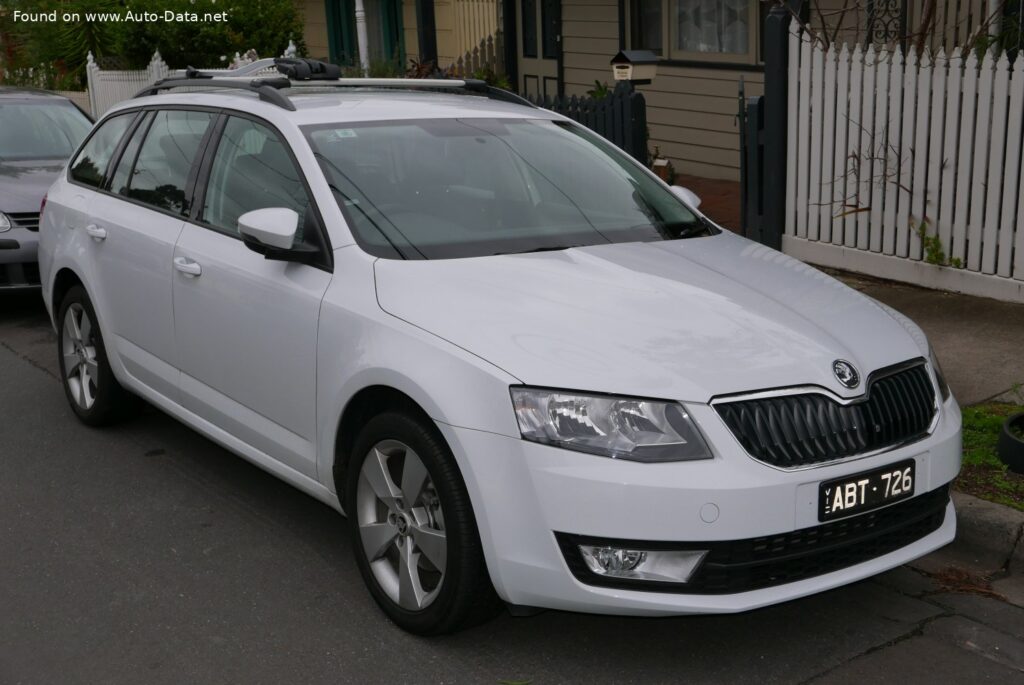
The Skoda Octavia III Combi maintains Skoda’s design philosophy of understated elegance and functional practicality. Its station wagon body type, with five doors and seating for five, is a testament to its utility-first approach. Measuring 183.43 inches (4659 mm) in length, 71.42 inches (1814 mm) in width (79.41 inches or 2017 mm including mirrors), and 57.68 inches (1465 mm) in height, the Octavia Combi strikes a balanced profile. The generous 105.75-inch (2686 mm) wheelbase contributes to a stable ride and a spacious cabin. Its aerodynamic design, evident in a drag coefficient (Cd) of 0.288, also contributes to its excellent fuel efficiency and reduced wind noise at speed.
Interior and Practicality
The interior of the Octavia III Combi is designed with practicality and comfort in mind. Skoda is renowned for its “Simply Clever” features, and the Octavia embodies this ethos with thoughtful touches throughout the cabin. The most compelling aspect of the Combi variant is its outstanding cargo capacity. With the rear seats in place, it offers a cavernous 21.54 cu. ft. (610 liters) of trunk space. Folding the rear seats expands this to an immense 61.45 cu. ft. (1740 liters), making it one of the most capacious vehicles in its class and capable of swallowing bulky items with ease. The maximum load capacity is 1421.98 lbs (645 kg), further highlighting its utility.
Chassis, Safety, and Driver Aids
Underneath, the Octavia III Combi features an independent McPherson strut front suspension with coil springs and an anti-roll bar, paired with a coil spring torsion beam rear suspension. This setup, while cost-effective, provides a comfortable ride and predictable handling characteristics. Braking is handled by ventilated discs at the front and solid discs at the rear, supported by an Anti-lock Braking System (ABS) for enhanced safety. The electric power steering system, with a rack and pinion setup, offers precise control and variable assistance, contributing to ease of maneuvering, especially in urban environments, as evidenced by its minimum turning circle of 36.25 ft (11.05 m). The vehicle’s kerb weight of 2760.19 lbs (1252 kg) ensures a nimble feel without sacrificing stability.
Technical Specifications
| Skoda Octavia III Combi 1.6 TDI (110 Hp) – Full Specifications | |
|---|---|
| General Information | |
| Brand | Skoda |
| Model | Octavia |
| Generation | Octavia III Combi |
| Type (Engine) | 1.6 TDI (110 Hp) |
| Start of Production | May, 2013 year |
| End of Production | 2017 year |
| Powertrain Architecture | Internal Combustion engine |
| Body Type | Station wagon (estate) |
| Seats | 5 |
| Doors | 5 |
| Performance Specs | |
| Fuel Consumption (Urban, NEDC) | 4.4 l/100 km (53.5 US mpg) |
| Fuel Consumption (Extra Urban, NEDC) | 3.5 l/100 km (67.2 US mpg) |
| Fuel Consumption (Combined, NEDC) | 3.8 l/100 km (61.9 US mpg) |
| CO2 Emissions (NEDC) | 99 g/km |
| Fuel Type | Diesel |
| Acceleration 0 – 60 mph | 10.3 sec |
| Maximum Speed | 120.55 mph (194 km/h) |
| Emission Standard | Euro 6 |
| Weight-to-Power Ratio | 11.4 kg/Hp (87.9 Hp/tonne) |
| Weight-to-Torque Ratio | 5 kg/Nm (199.7 Nm/tonne) |
| Engine Specs | |
| Power | 110 Hp @ 3200-4000 rpm |
| Power per Liter | 68.8 Hp/l |
| Torque | 250 Nm (184.39 lb.-ft.) @ 1500-3000 rpm |
| Engine Layout | Front, Transverse |
| Engine Model/Code | EA288 / CRKB, CXXB, DBKA |
| Engine Displacement | 1598 cm³ (97.52 cu. in.) |
| Number of Cylinders | 4 |
| Engine Configuration | Inline |
| Cylinder Bore | 79.5 mm (3.13 in.) |
| Piston Stroke | 80.5 mm (3.17 in.) |
| Compression Ratio | 16.2:1 |
| Number of Valves per Cylinder | 4 |
| Fuel Injection System | Diesel Commonrail |
| Engine Aspiration | Turbocharger, Intercooler |
| Valvetrain | DOHC |
| Engine Oil Capacity | 4.6 l (4.86 US qt) |
| Coolant Capacity | 8.4 l (8.88 US qt) |
| Engine Systems | Start & Stop System, Particulate filter |
| Space, Volume and Weights | |
| Kerb Weight | 1252 kg (2760.19 lbs) |
| Max. Weight | 1897 kg (4182.17 lbs) |
| Max Load | 645 kg (1421.98 lbs) |
| Trunk (Boot) Space – Minimum | 610 l (21.54 cu. ft.) |
| Trunk (Boot) Space – Maximum | 1740 l (61.45 cu. ft.) |
| Fuel Tank Capacity | 50 l (13.21 US gal) |
| Max. Roof Load | 75 kg (165.35 lbs) |
| Permitted Trailer Load with Brakes (12%) | 1500 kg (3306.93 lbs) |
| Permitted Trailer Load without Brakes | 660 kg (1455.05 lbs) |
| Permitted Towbar Download | 75 kg (165.35 lbs) |
| Dimensions | |
| Length | 4659 mm (183.43 in.) |
| Width | 1814 mm (71.42 in.) |
| Width Including Mirrors | 2017 mm (79.41 in.) |
| Height | 1465 mm (57.68 in.) |
| Wheelbase | 2686 mm (105.75 in.) |
| Front Track | 1549 mm (60.98 in.) |
| Rear (Back) Track | 1520 mm (59.84 in.) |
| Front Overhang | 886 mm (34.88 in.) |
| Rear Overhang | 1087 mm (42.8 in.) |
| Ride Height (Ground Clearance) | 140 mm (5.51 in.) |
| Drag Coefficient (Cd) | 0.288 |
| Minimum Turning Circle (Turning Diameter) | 11.05 m (36.25 ft) |
| Approach Angle | 13.9° |
| Departure Angle | 12.2° |
| Drivetrain, Brakes and Suspension Specs | |
| Drivetrain Architecture | Front-wheel drive, Internal Combustion engine |
| Drive Wheel | Front-wheel drive |
| Number of Gears and Type of Gearbox | 5 gears, manual transmission |
| Front Suspension | Independent, type McPherson with coil spring and anti-roll bar |
| Rear Suspension | Coil spring, Torsion |
| Front Brakes | Ventilated discs |
| Rear Brakes | Disc |
| Assisting Systems | ABS (Anti-lock braking system) |
| Steering Type | Steering rack and pinion |
| Power Steering | Electric Steering |
| Tire Sizes | 195/65 R15; 205/55 R16 |
| Wheel Rim Sizes | 6J x 15; 6.5J x 16 |
Legacy and Market Impact
The Skoda Octavia, and particularly its Combi variant, holds a significant place in the European automotive landscape. The third generation, from 2013 to 2017, further cemented its reputation as a highly competitive and desirable option in the compact family car segment. Operating under the Volkswagen Group umbrella, Skoda benefited from shared platforms and powertrains, allowing it to offer well-engineered vehicles at a more accessible price point than its German siblings. This strategy made the Octavia an incredibly popular choice for budget-conscious families and businesses alike.
In its primary markets, the Skoda Octavia III Combi competed fiercely with established players such as the Volkswagen Golf Variant, Ford Focus Estate, Opel Astra Sports Tourer, and Peugeot 308 SW. What set the Octavia apart was its unmatched combination of interior space, especially in the rear seats and cargo area, robust build quality, and exceptional fuel efficiency from engines like the 1.6 TDI. It often offered more practicality than its direct competitors while maintaining comparable driving dynamics and a strong sense of reliability.
The 1.6 TDI (110 Hp) variant, in particular, was a workhorse for fleet sales and a smart choice for private buyers covering significant mileage. Its Euro 6 compliance and low CO2 emissions were attractive in markets with emission-based taxation. The Octavia’s legacy is one of consistent quality, intelligent design, and a commitment to meeting the practical needs of its customers. It demonstrated that a car could be affordable, incredibly spacious, efficient, and well-built without needing a premium badge. This generation of Octavia helped to further elevate Skoda’s brand image, moving it from a perceived budget brand to a respected mainstream automaker known for its smart engineering and compelling value proposition. The Octavia III Combi remains a testament to Skoda’s success in understanding and serving the pragmatic demands of the European car buyer.