The Rover 400 (RT) 416 Si: A Detailed Overview
The Rover 400 (RT) 416 Si, produced between 1995 and 2000, represents a significant chapter in the history of the British automotive manufacturer, Rover. Positioned as a compact family car, or a small executive sedan in its home European market, the RT generation of the Rover 400 was the second iteration of the model line, following the R8 generation. This particular variant, the 416 Si, was a popular choice, offering a balanced blend of performance, fuel efficiency, and a touch of traditional British refinement, albeit with a strong underlying Japanese engineering influence due to Rover’s long-standing collaboration with Honda. While the Rover brand was not widely sold in the United States, the 400 (RT) played a crucial role in Europe and other international markets, competing in a highly contested segment with rivals from across the continent. Its design, engineering, and market positioning offer valuable insights into the European automotive landscape of the late 20th century.
Engine and Performance of the Rover 400 (RT) 416 Si
At the heart of the Rover 400 (RT) 416 Si lies a robust and efficient 1.6-liter (1589 cm3, or 96.97 cu. in.) naturally aspirated inline four-cylinder engine, designated as the K16 model. This powerplant was a key component of Rover’s engine lineup, known for its compact design and relatively smooth operation. The engine featured a Double Overhead Camshaft (DOHC) valvetrain with four valves per cylinder, a configuration that was becoming standard for achieving a good balance of power and efficiency in the mid-1990s.
The 416 Si delivered a respectable 111 horsepower (Hp) at 6000 rpm, providing adequate motivation for a vehicle in its class. Torque output stood at 145 Nm (106.95 lb.-ft.) at a relatively low 3000 rpm, which contributed to its flexible driving characteristics in urban environments and made it feel responsive in everyday traffic. Power was routed to the front wheels via a 5-speed manual transmission, a common and reliable setup for compact family sedans of the era. The front-transverse engine layout and front-wheel drive architecture were typical for optimizing interior space and manufacturing efficiency.
In terms of acceleration, the Rover 400 (RT) 416 Si could sprint from 0 to 60 mph in an estimated 10.3 seconds (0-100 km/h in 10.8 seconds), which was competitive for its segment. Its top speed was rated at 190 km/h (118.06 mph). Fuel economy was a strong suit for the 416 Si, reflecting its design as a practical family car. The combined fuel consumption was an impressive 6.5 liters per 100 kilometers, translating to approximately 36.2 US miles per gallon. For city driving, it achieved around 9.4 l/100 km (25 US mpg), while on the highway, it could manage an economical 5.1 l/100 km (46.1 US mpg). This efficiency was crucial for its target market, where running costs were a significant consideration for buyers. The engine utilized a multi-port manifold injection system and had a compression ratio of 10.5:1, running on standard petrol (gasoline).
Design and Features of the Rover 400 (RT)
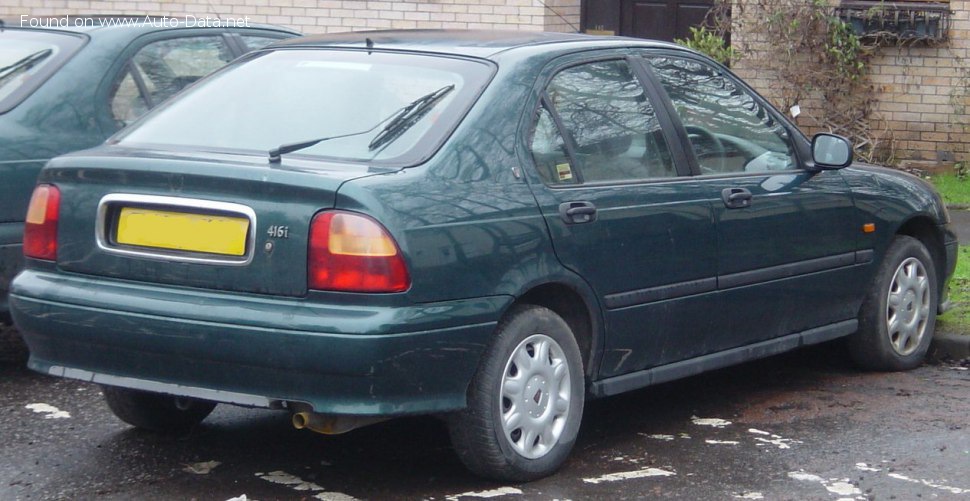
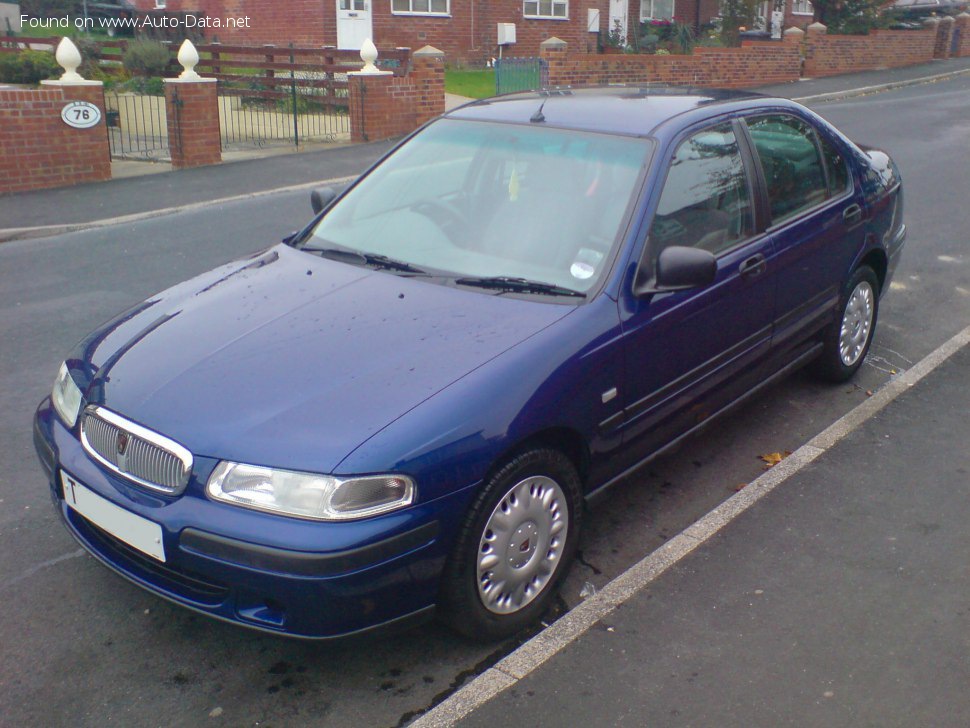
The Rover 400 (RT) generation, specifically the 416 Si sedan, showcased a design language that was a blend of European conservatism and subtle British styling cues, heavily influenced by its Honda Concerto/Civic platform sibling. The sedan body type, with its four doors and seating for five occupants, emphasized practicality and family-friendliness. Measuring 176.77 inches (4490 mm) in length, 66.73 inches (1695 mm) in width, and 54.72 inches (1390 mm) in height, the 400 (RT) was a well-proportioned compact sedan. Its 103.23-inch (2622 mm) wheelbase contributed to a comfortable ride and stable handling characteristics.
Aesthetically, the 400 (RT) featured clean lines and a generally understated appearance, aiming for broad appeal rather than bold statements. The front fascia typically included a modest grille with the distinctive Rover badge, flanked by conventional headlamps. Inside, the cabin prioritized functionality and comfort. While specific features could vary by trim level and market, the 416 Si generally offered a well-appointed interior for its class. Common features for the era included power windows, central locking, and a decent audio system. Materials were typically durable cloth for the seats and hard plastics for the dashboard and door panels, often with faux wood trim accents in higher specifications to evoke a sense of luxury, a traditional Rover hallmark.
Safety features for the 1990s were also integrated into the 400 (RT). The inclusion of an Anti-lock Braking System (ABS) was a significant advancement, offering improved control during emergency braking situations. The car utilized disc brakes on both the front and rear wheels, providing effective stopping power. The suspension system consisted of spring struts at both the front and rear, a common and cost-effective setup that provided a comfortable and predictable ride. Steering was handled by a hydraulic power-assisted rack and pinion system, offering ease of maneuverability at low speeds and good feedback on the highway. The vehicle was fitted with 185/60 R14 H tires on 14-inch wheel rims, providing a good balance between ride comfort and handling. With a minimum trunk space of 16.6 cubic feet (470 liters), expandable to 28.6 cubic feet (810 liters) with the rear seats folded, the 400 (RT) offered ample cargo capacity for family trips or daily errands.
Technical Specifications: Rover 400 (RT) 416 Si (111 Hp)
| Category | Specification |
|---|---|
| General Information | |
| Brand | Rover |
| Model | 400 |
| Generation | 400 (RT) |
| Type (Engine) | 416 Si (111 Hp) |
| Start of Production | 1995 year |
| End of Production | 2000 year |
| Powertrain Architecture | Internal Combustion engine |
| Body Type | Sedan |
| Seats | 5 |
| Doors | 4 |
| Performance Specs | |
| Fuel Consumption (Urban) | 9.4 l/100 km (25 US mpg) |
| Fuel Consumption (Extra Urban) | 5.1 l/100 km (46.1 US mpg) |
| Fuel Consumption (Combined) | 6.5 l/100 km (36.2 US mpg) |
| Fuel Type | Petrol (Gasoline) |
| Acceleration 0-60 mph | 10.3 sec |
| Acceleration 0-100 km/h | 10.8 sec |
| Maximum Speed | 190 km/h (118.06 mph) |
| Weight-to-Power Ratio | 10.6 kg/Hp (94.5 Hp/tonne) |
| Weight-to-Torque Ratio | 8.1 kg/Nm (123.4 Nm/tonne) |
| Engine Specs | |
| Power | 111 Hp @ 6000 rpm |
| Power per Liter | 69.9 Hp/l |
| Torque | 145 Nm @ 3000 rpm (106.95 lb.-ft. @ 3000 rpm) |
| Engine Layout | Front, Transverse |
| Engine Model/Code | K16 |
| Engine Displacement | 1589 cm3 (96.97 cu. in.) |
| Number of Cylinders | 4 |
| Engine Configuration | Inline |
| Cylinder Bore | 80 mm (3.15 in.) |
| Piston Stroke | 79 mm (3.11 in.) |
| Compression Ratio | 10.5:1 |
| Number of Valves per Cylinder | 4 |
| Fuel Injection System | Multi-port manifold injection |
| Engine Aspiration | Naturally aspirated engine |
| Valvetrain | DOHC |
| Engine Oil Capacity | 3.5 l (3.7 US qt) |
| Coolant Capacity | 5.5 l (5.81 US qt) |
| Space, Volume and Weights | |
| Kerb Weight | 1175 kg (2590.43 lbs) |
| Max. Weight | 1640 kg (3615.58 lbs) |
| Max Load | 465 kg (1025.15 lbs) |
| Trunk (Boot) Space – Minimum | 470 l (16.6 cu. ft.) |
| Trunk (Boot) Space – Maximum | 810 l (28.6 cu. ft.) |
| Fuel Tank Capacity | 55 l (14.53 US gal) |
| Dimensions | |
| Length | 4490 mm (176.77 in.) |
| Width | 1695 mm (66.73 in.) |
| Height | 1390 mm (54.72 in.) |
| Wheelbase | 2622 mm (103.23 in.) |
| Front Track | 1477 mm (58.15 in.) |
| Rear (Back) Track | 1465 mm (57.68 in.) |
| Drivetrain, Brakes and Suspension Specs | |
| Drivetrain Architecture | The Internal combustion engine (ICE) drives the front wheels of the vehicle. |
| Drive Wheel | Front wheel drive |
| Number of Gears and Type of Gearbox | 5 gears, manual transmission |
| Front Suspension | Spring Strut |
| Rear Suspension | Spring Strut |
| Front Brakes | Disc |
| Rear Brakes | Disc |
| Assisting Systems | ABS (Anti-lock braking system) |
| Steering Type | Steering rack and pinion |
| Power Steering | Hydraulic Steering |
| Tires Size | 185/60 R14 H |
| Wheel Rims Size | 14 |
Legacy and Market Impact
The Rover 400 (RT) 416 Si, along with its siblings in the 400 range, represented Rover’s continued effort to offer a competitive product in the crucial compact family car segment in Europe. Its reputation was largely built on a foundation of reasonable reliability, thanks in part to its Honda-derived platform and engineering, coupled with a distinctly British interior ambiance that appealed to a certain demographic. While it might not have been a trendsetter in design or groundbreaking in technology, it offered a comfortable, well-equipped, and efficient package for families and fleet buyers.
In its primary markets, the Rover 400 (RT) faced stiff competition from a host of established European rivals. Key competitors included the Ford Mondeo, Vauxhall Cavalier (later Vectra), Volkswagen Passat, Peugeot 406, and Renault Laguna. These vehicles often offered similar levels of performance, space, and features, making the market highly competitive on price, brand loyalty, and perceived quality. The Rover 400 tried to differentiate itself with a slightly more upscale feel and its “Britishness,” even as its mechanical underpinnings were increasingly international.
Historically, the 400 (RT) played a role in Rover’s challenging final decades. It was one of the last models developed under the Rover-Honda alliance, before BMW’s acquisition of Rover Group in 1994, which occurred around the time the RT generation was launched. The car’s production from 1995 to 2000 coincided with a period of significant change and uncertainty for the brand. While the 400 (RT) was a competent vehicle for its time, it struggled to truly stand out against its more modern and aggressively marketed European rivals as the decade progressed. Its legacy is thus intertwined with the broader narrative of the British automotive industry’s struggles and the eventual demise of the Rover brand itself. Despite this, the 416 Si remains a testament to Rover’s ability to produce a solid, practical, and reasonably refined family sedan, embodying the brand’s efforts to maintain relevance in a rapidly evolving automotive landscape.