Toyota Proace City Verso LWB 50 kWh (136 Hp) Electric
The Toyota Proace City Verso LWB 50 kWh (136 Hp) Electric represents a significant entry into the European electric minivan segment, launching in April 2022. As part of Toyota’s expanding electrified vehicle lineup, this model is a long-wheelbase (LWB) variant of the Proace City Verso, which is itself a rebadged and re-engineered product stemming from a collaboration with Stellantis (formerly PSA Group). This partnership allows Toyota to offer a competitive and versatile electric family and light commercial vehicle solution in markets where such models are highly valued, particularly across Europe and other international regions where it is sold. It is not offered in the United States market.
Designed primarily for urban families and small businesses requiring substantial cargo and passenger flexibility combined with zero-emission mobility, the Proace City Verso Electric offers a practical blend of space, efficiency, and modern technology. Its BEV (Battery Electric Vehicle) powertrain underscores Toyota’s commitment to electrification, providing an environmentally conscious alternative to traditional internal combustion engine minivans. With its extended wheelbase, the Verso LWB variant maximizes interior volume, catering to demands for more passenger seating or increased cargo capacity.
The Electrified Toyota Proace City Verso LWB
Engine & Performance
Powering the Toyota Proace City Verso LWB 50 kWh (136 Hp) Electric is a robust and efficient all-electric powertrain architecture. The vehicle features a single synchronous electric motor, designated model ZK01, strategically positioned on the front axle in a transverse orientation. This motor delivers a peak output of 136 horsepower (Hp) and a substantial 191.77 pound-feet (lb.-ft.) of instant torque. The characteristic of electric motors to provide maximum torque from a standstill translates into brisk acceleration and strong pulling power, which is particularly beneficial for a utility-focused vehicle like a minivan, especially when fully loaded.
Power is channeled exclusively to the front wheels through a single-speed automatic transmission, a common and efficient setup for electric vehicles that simplifies the driving experience. This drivetrain architecture, combined with the electric motor’s characteristics, ensures smooth, quiet, and responsive performance. The Proace City Verso Electric achieves an electronically limited top speed of 83.89 miles per hour (135 km/h), which is more than adequate for its intended use in urban and suburban environments, as well as highway cruising.
The vehicle’s energy storage comes from a 50 kilowatt-hour (kWh) gross capacity lithium-ion (Li-Ion) battery pack, intelligently integrated below the floor. This placement not only optimizes interior space but also contributes to a lower center of gravity, enhancing stability and handling. According to the WLTP (Worldwide Harmonized Light Vehicles Test Procedure) standard, the Proace City Verso Electric offers an all-electric range of approximately 176.47 miles (284 km). Energy consumption is rated between 31.22 and 33.96 kWh per 100 miles (19.4-21.1 kWh/100 km), translating to an impressive efficiency equivalent of 99-108 MPGe (Miles Per Gallon equivalent). These figures highlight the vehicle’s capability for daily commuting and regional travel with the benefit of zero tailpipe emissions.
Design & Features
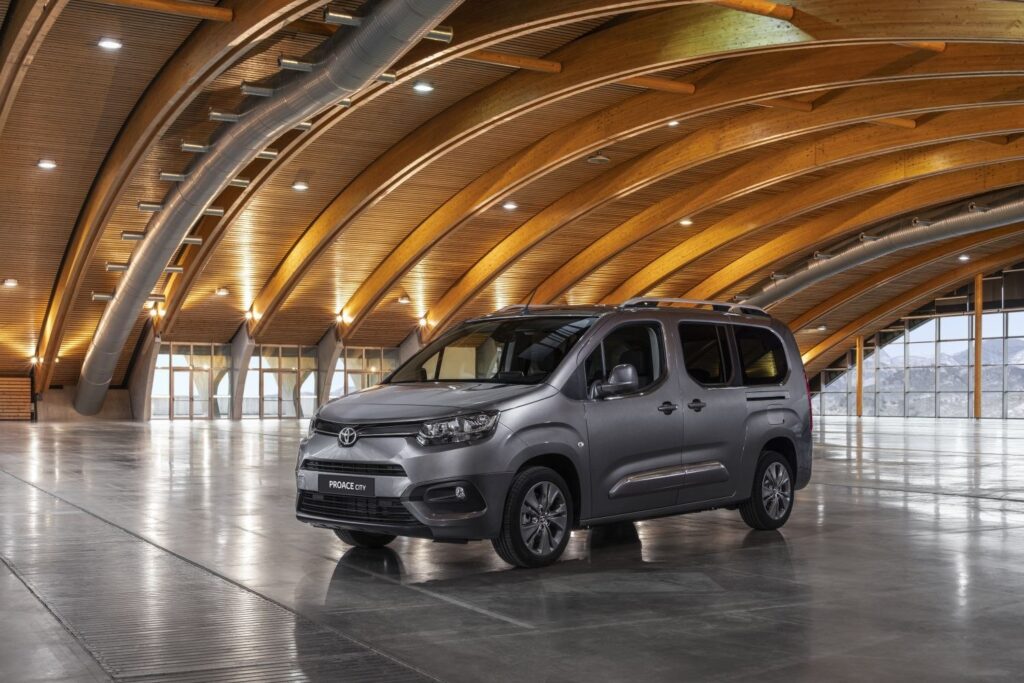
The Toyota Proace City Verso LWB 50 kWh (136 Hp) Electric adopts the practical and versatile body type of a minivan, specifically designed for maximum utility and passenger comfort. Its long-wheelbase configuration significantly enhances interior volume, allowing for flexible seating arrangements for 5 to 7 occupants. This adaptability makes it an ideal choice for larger families or for those who frequently transport groups. The vehicle features five doors, including large sliding rear doors, which are a hallmark of minivans and greatly facilitate access to the rear seats and loading cargo in confined spaces.
Dimensionally, the LWB model measures 187.13 inches (4753 mm) in length, 72.76 inches (1848 mm) in width, and 71.26 inches (1810 mm) in height, with a substantial wheelbase of 117.13 inches (2975 mm). These dimensions contribute to a spacious cabin and a generous cargo capacity. The trunk (boot) space is particularly impressive, ranging from a minimum of 28.46 cubic feet (806 liters) with all seats in place, expanding to a cavernous 95.1 cubic feet (2693 liters) with the rear seats folded down. This makes the Proace City Verso Electric highly capable of accommodating everything from luggage for a family vacation to bulky sports equipment or business goods. The vehicle also boasts a maximum roof load of 330.69 lbs (150 kg), further extending its utility.
From a chassis and suspension perspective, the Proace City Verso LWB is equipped with an independent McPherson-type front suspension and a robust torsion beam rear suspension. This setup provides a good balance of ride comfort and handling stability, crucial for a vehicle that often carries varying loads. Braking is handled by ventilated discs at the front and solid discs at the rear, complemented by an Anti-lock Braking System (ABS) for enhanced safety. The electric power steering system, with a rack and pinion setup, offers light and precise control, making urban maneuvers and parking effortless. The vehicle rides on 205/60 R16 tires mounted on 16-inch wheel rims, providing a comfortable ride and adequate grip.
Technical Specifications
| Category | Specification |
|---|---|
| Brand | Toyota |
| Model | Proace City |
| Generation | Proace City Verso LWB |
| Type (Engine) | 50 kWh (136 Hp) Electric |
| Start of Production | April, 2022 |
| Powertrain Architecture | BEV (Electric Vehicle) |
| Body Type | Minivan |
| Seats | 5-7 |
| Doors | 5 |
| Performance Specs | |
| Fuel Type | Electricity |
| Maximum Speed | 83.89 mph (135 km/h) |
| Weight-to-Power Ratio | 13.4 kg/Hp, 74.7 Hp/tonne |
| Weight-to-Torque Ratio | 7 kg/Nm, 142.9 Nm/tonne |
| Electric Cars and Hybrids Specs | |
| Gross Battery Capacity | 50 kWh |
| Battery Technology | Lithium-ion (Li-Ion) |
| Battery Location | Below the floor |
| All-electric range (WLTP) | 176.47 miles (284 km) |
| Average Energy Consumption (WLTP) | 31.22 – 33.96 kWh/100 mi (19.4-21.1 kWh/100 km) / 108 – 99 MPGe |
| Electric Motor Power | 136 Hp |
| Electric Motor Torque | 191.77 lb.-ft. (260 Nm) |
| Electric Motor Model/Code | ZK01 |
| Electric Motor Location | Front axle, Transverse |
| Electric Motor Type | Synchronous |
| System Power | 136 Hp |
| System Torque | 191.77 lb.-ft. (260 Nm) |
| Space, Volume and Weights | |
| Kerb Weight | 4012.41 lbs. (1820 kg) |
| Max. Weight | 5379.28 lbs. (2440 kg) |
| Max Load | 1366.87 lbs. (620 kg) |
| Trunk (boot) Space – Minimum | 28.46 cu. ft. (806 l) |
| Trunk (boot) Space – Maximum | 95.1 cu. ft. (2693 l) |
| Max. Roof Load | 330.69 lbs. (150 kg) |
| Dimensions | |
| Length | 187.13 in. (4753 mm) |
| Width | 72.76 in. (1848 mm) |
| Height | 71.26 in. (1810 mm) |
| Wheelbase | 117.13 in. (2975 mm) |
| Front Track | 61.14 in. (1553 mm) |
| Rear (Back) Track | 61.69 in. (1567 mm) |
| Drivetrain, Brakes and Suspension Specs | |
| Drivetrain Architecture | One electric motor drives the front wheels. |
| Drive Wheel | Front wheel drive |
| Number of Gears and Type of Gearbox | 1 gear, automatic transmission |
| Front Suspension | Independent type McPherson |
| Rear Suspension | Torsion |
| Front Brakes | Ventilated discs |
| Rear Brakes | Disc |
| Assisting Systems | ABS (Anti-lock braking system) |
| Steering Type | Steering rack and pinion |
| Power Steering | Electric Steering |
| Tires Size | 205/60 R16 92H |
| Wheel Rims Size | 16 |
Legacy & Market Impact
The Toyota Proace City Verso LWB 50 kWh (136 Hp) Electric plays a crucial role in Toyota’s broader electrification strategy, particularly in European markets where emissions regulations are stringent and the demand for practical, eco-friendly family and commercial vehicles is growing. Its existence is a direct result of the strategic collaboration between Toyota and Stellantis, leveraging a shared platform that underpins several other electric minivans and light commercial vehicles, including the Peugeot e-Rifter, Citroën e-Berlingo, and Opel/Vauxhall Combo-e Life. This partnership allows Toyota to efficiently enter and compete in a segment that might otherwise require substantial individual investment, while also contributing to economies of scale for the shared electric vehicle components.
In its primary European market, the Proace City Verso Electric competes against these platform siblings, as well as other electric vans and minivans from brands like Renault (Kangoo E-Tech Electric) and Mercedes-Benz (EQT). Its reputation benefits from Toyota’s strong brand image for reliability and quality, even though its underlying architecture is shared. For consumers, it offers a compelling package: the versatility of a traditional minivan with the environmental and running cost benefits of an electric vehicle. Its generous cargo capacity and flexible seating make it particularly attractive to large families, taxi services, and small businesses that need a multi-purpose vehicle capable of urban deliveries or passenger transport without contributing to local air pollution.
The Proace City Verso Electric contributes to the ongoing shift towards electrification in the automotive industry, demonstrating that even highly practical and utilitarian vehicle segments can successfully transition to electric powertrains. Its market impact is observed in its ability to provide a zero-emission option for buyers who might otherwise opt for diesel or gasoline-powered minivans, thereby aiding in the reduction of overall carbon footprint in urban areas. As charging infrastructure continues to expand and battery technology evolves, the appeal and market penetration of vehicles like the Toyota Proace City Verso LWB 50 kWh (136 Hp) Electric are expected to grow, solidifying its place as a practical and forward-thinking mobility solution for the future.